

5 CPRA Contract Terms for Data Sharing



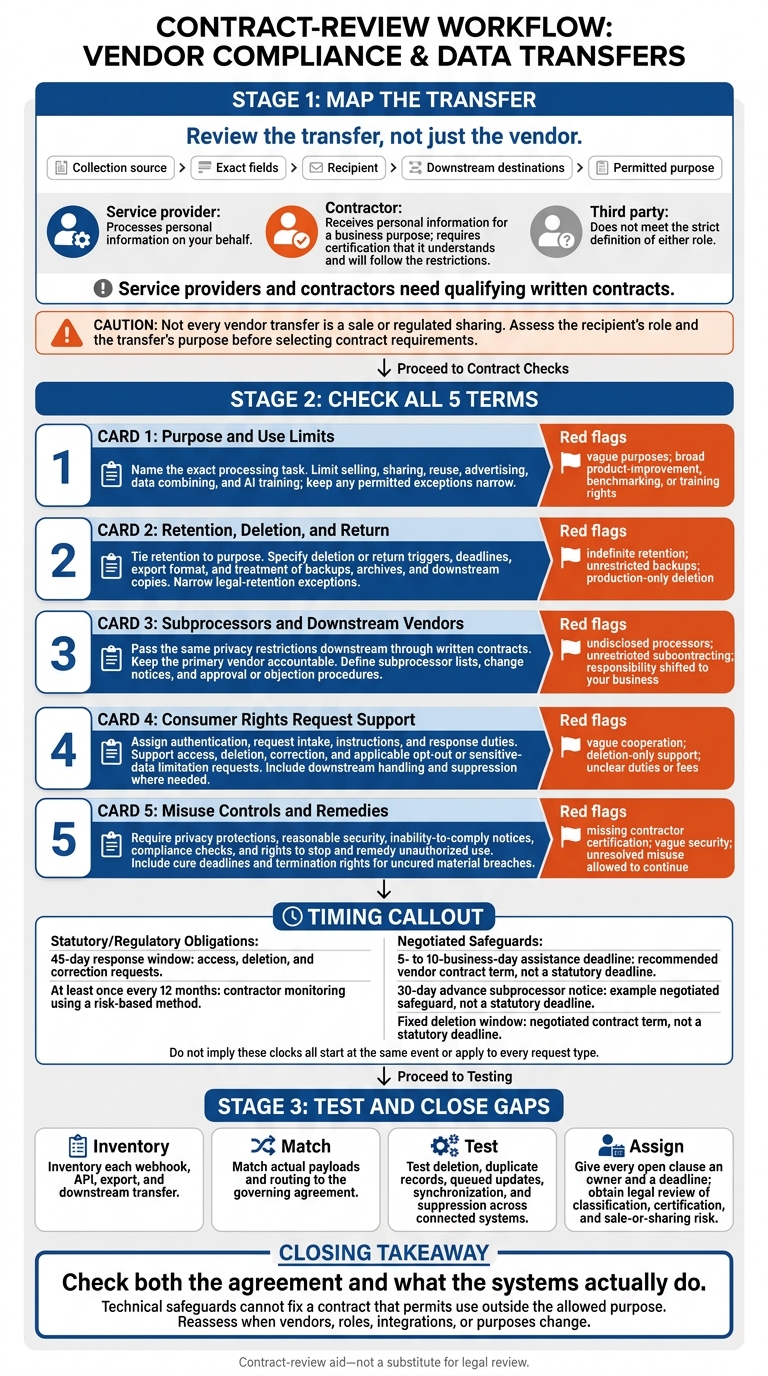
Before I send lead data to a vendor, I check 5 contract terms - not just a “CCPA compliant” claim:
- Purpose and use: Define the task and limit reuse, advertising, data combining, and AI training.
- Retention, deletion, and return: Set deadlines and cover backups, archives, and legal-retention exceptions.
- Subprocessors: Pass the same privacy limits downstream and keep the primary vendor accountable.
- Consumer rights support: Assign duties for access, deletion, correction, and applicable opt-out or limitation requests.
- Misuse controls and remedies: Require compliance checks, notices, and rights to stop improper use or end the contract.
Not every vendor transfer is a sale or regulated sharing. I first map where the data goes and check the recipient’s role. Then I match the contract to each live connection, test request handling, and give every gap an owner and deadline.
My rule: <u>check both the agreement and what the systems actually do.</u>
CPRA Vendor Contract Review: 5 Terms to Check
Vendors and the CCPA - CIPM Certification Masterclass
sbb-itb-5f36581
Map Vendor Roles and Data Flows
A service provider processes personal information on your behalf. A contractor receives it for a business purpose. Both need qualifying written contracts, and a contractor must certify that it understands and will follow the restrictions. An entity that does not meet the strict definition of either role is a third party.
Once you identify the vendor’s role, check whether the contract limits data use to your contracted purpose - or lets the vendor use it for its own purposes. Broad “product improvement” rights are a red flag.
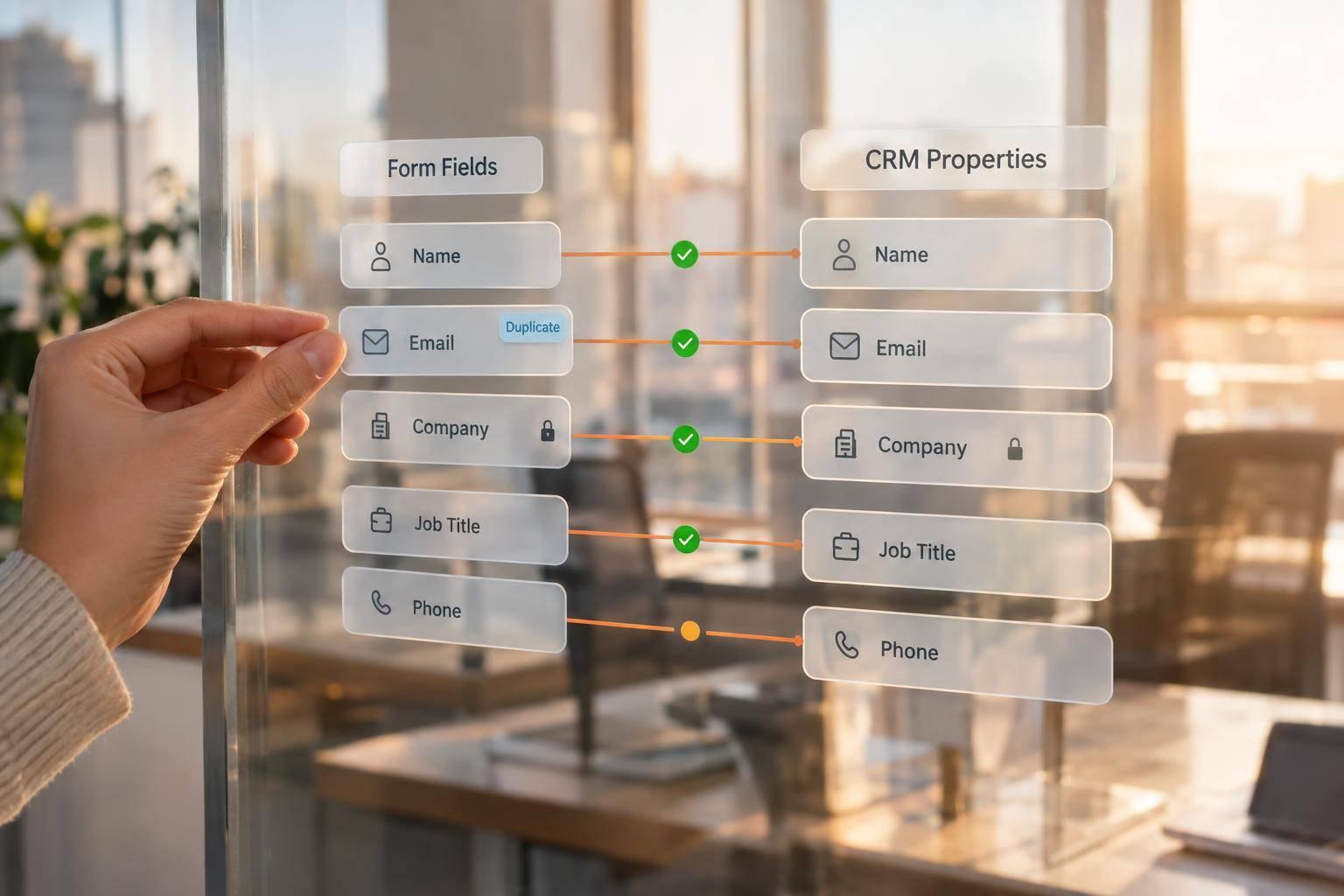
Create a data-flow record that shows the collection source, exact fields, recipient, downstream destinations, and permitted purpose. Note whether the flow supports advertising or other CPRA-sharing activity, and assess other third-party transfers for potential sale treatment. Use this record to check whether each agreement matches how the data actually moves.
Read the DPA, MSA, order form, policies, and subprocessor terms together. Match the ordered services to the DPA’s permitted purpose, and verify that the contract limits use to that mapped purpose. Flag any right to reuse, combine, or retain data, including rights over “de-identified” data. Seek a precedence clause that makes the DPA control privacy-related conflicts, and confirm that downstream terms preserve the required protections.
Put contract requirements in the compliance column and technical controls in the safeguards column. Safeguards cannot fix a contract that allows data use outside the permitted purpose.
1. Purpose and Use Limits
Contract scope
After mapping each vendor, start with purpose and use limits.
Name the exact processing task - not just the product category.
Specify lead verification for form submissions, CRM record syncing of enriched lead fields, and usage reporting tied to analytics IDs.
Reject vague language that leaves these tasks undefined.
Why it matters under the CPRA
Service providers and contractors may use personal information only for the contracted service, and only as reasonably necessary for the original collection purpose.
Language to check
Require clear bans on selling or sharing lead data; using, disclosing, or retaining it outside the contracted purpose; and combining it with other clients’ data or the vendor’s own consumer data.
Keep exceptions narrow, limited to purposes such as security, integrity, or debugging.
Red flags
Flag any reuse rights that extend beyond the contracted purpose. Advertising, benchmarking, product improvement, and AI training rights need precise limits. Address training and fine-tuning directly, covering the vendor’s use of lead data in both inputs and outputs. Any allowed service improvement must stay within regulatory limits - a general service-improvement clause isn’t enough.
Use these warnings to narrow the clause before reviewing retention terms.
2. Retention, Deletion, and Return
Once you’ve limited data use, set clear rules for how long the vendor can keep it.
Contract scope
For each mapped data flow, tie retention to its specific purpose. State what triggers deletion or return - task completion or contract end - and cover every copy, including backups and archives.
Why it matters under the CPRA
Require deletion or return at contract end, along with the agreed business-purpose limits. A fixed deletion window is a negotiated contract term, not a statutory deadline.
Language to check
Spell out who initiates return, the export format, when access ends, and the deletion date. Also set a backup deletion schedule, restrict backup use, and define how you’ll verify that downstream subprocessors comply. A deletion certificate and firm completion deadlines can help document compliance.
Keep legal-retention exceptions narrow. Identify the legal duty, limit retained records and their use to what that duty requires, and require deletion when it ends. The vendor must also notify you if it determines it can no longer meet the contract’s privacy terms.
Red flags
Reject indefinite retention, unrestricted backups, and deletion rules that apply only to production systems.
Next, check whether the vendor can use subprocessors that must follow these same limits.
3. Subprocessors and Downstream Vendors
Contract scope
If the vendor uses subprocessors, the same lead-data restrictions must apply downstream. Require a written contract with every subcontractor that processes lead data. Each contract must carry the same CPRA limits: no selling or sharing, use only for the stated purpose, no combining beyond permitted exceptions, and the same privacy protections.
Why it matters under the CPRA
Permission to subcontract doesn't reduce downstream obligations. Keep the primary vendor responsible for compliance. Your contract should also let your business take reasonable and appropriate steps to check compliance and stop or correct uses that aren't allowed.
Language to check
Require prompt notice if a downstream vendor can no longer comply. That notice should reach your business through the primary vendor. The primary vendor should enforce the restrictions, rather than leave you to chase each subcontractor.
Spell out the notice process: a current subprocessor list, advance notice of changes, and approval or objection procedures. State how your business can object and whether an unresolved objection allows you to terminate the contract.
For example, you might negotiate 30-day advance notice - a contractual safeguard, not a statutory deadline.
Red flags
Watch for unrestricted subcontracting without notice, undisclosed processors, and clauses that shift downstream oversight to your business. Challenge terms that leave out the same privacy protections or disclaim the primary vendor's responsibility for subcontractor breaches.
Next, check how the vendor supports consumer rights requests.
4. Consumer Rights Request Support
Contract scope
After reviewing downstream vendor controls, check that each system can handle consumer requests from start to finish.
Require support for access, deletion, correction, sensitive-data limitation, and sale or sharing opt-outs. Put responsibilities in writing: who authenticates the consumer, receives the request, issues instructions, and sends the response.
Why it matters under the CPRA
Vendor delays can use up the 45-day response window for access, deletion, and correction requests. Require coordinated updates across every form, CRM, analytics system, and enrichment system the request touches.
For analytics and enrichment systems, deletion alone may not be enough. Suppression rules may also be needed to stop future processing after an opt-out or limitation request.
Language to check
Spell out search procedures, export formats, correction procedures, and how deletion requests reach subprocessors.
Set a 5- to 10-business-day assistance deadline. Require portable export formats, a dedicated privacy escalation contact, and clear fee terms.
Red flags
Push back on vague reasonable-cooperation language that lacks procedures or deadlines. Also flag deletion-only clauses that leave out correction, sensitive-data limitation, or opt-out support.
Watch for unclear authentication duties, requests routed only through general support, and unspecified assistance fees.
Next, check how the contract prevents misuse and spells out remedies.
5. Misuse Controls and Remedies
Contract scope
After checking rights-request handling, review how the contract prevents improper use and enforces consequences.
Require privacy protections under California law and reasonable security for the information. Specify when and how the vendor must notify you if it determines it can no longer meet its California privacy obligations.
Why it matters under the CPRA
Use limits need enforcement behind them. Reserve rights to review, assess, and test compliance. For contractors, require monitoring at least once every 12 months using a risk-based method.
Language to check
For a contractor, require written certification that it complies with restrictions on selling, sharing, retention, use, and data combination. This records its acceptance of the limits you will enforce.
Reserve the right, upon notice, to stop and remedy unauthorized use. Set enforceable cure deadlines and allow termination if a material breach remains uncured by the deadline. Apply the same remedy standard and security obligations to every downstream processor.
Red flags
Watch for missing contractor certification, vague security promises, or remedies that allow processing to continue while a breach remains unresolved. Reject contracts that omit inability-to-comply notices or leave downstream enforcement terms unclear.
Check Each Data Flow
Review the transfer, not just the vendor. Use this table to set priorities, but check all five terms for every transfer.
| Data flow | Terms to prioritize | Review focus |
|---|---|---|
| Form to CRM | Purpose, retention, rights requests | Collection fields, routing, deletion, and synchronization |
| Form to analytics | Purpose, misuse controls | Analytics uses, identifiers, access, and retention |
| CRM to enrichment | Purpose, subprocessors, rights requests | Matching, source data, opt-outs, and suppression |
| Downstream vendor transfers | Subprocessors, misuse controls | Flow-down terms, notice, monitoring, and remedies |
Audit each live connection against the contract - not just the vendor label. Add every webhook, API, export, and downstream transfer to your inventory. For each connection, record the sender, recipient, data fields, purpose, retention, access, rights-request process, owner, and governing agreement. Check that actual payloads and routing rules match the contract’s stated purpose.
“business operations” is too vague.
Test what happens after a request. Follow a deletion through connected systems, including duplicate records and queued updates. Does synchronization recreate deleted data? Does enrichment respect suppression flags?
For analytics, check whether submitted answers, IP addresses, or session identifiers are sent. Then verify their permitted uses and deletion schedule. Teams using Reform for forms, routing, lead enrichment, analytics, or CRM integrations should audit every native integration and custom automation against the governing agreement.
Conclusion: Assign Owners and Close Contract Gaps
After reviewing each term, assign owners and set deadlines for unresolved issues. Before approval, check purpose limits, retention, downstream controls, rights-request support, and remedies.
Give every open clause an owner and a deadline. Track exceptions in one privacy-procurement log and review it periodically.
Have legal review vendor classification, contractor certifications, and sale-or-sharing risk before signing. Reopen the agreement immediately when vendors, roles, integrations, or processing purposes change. If a vendor reports noncompliance, assign one owner to put restrictions and remediation in place.
FAQs
Can one vendor have multiple CPRA roles?
Yes. A vendor’s CPRA role - service provider, contractor, or third party - depends on how it processes data. Record each role separately in your vendor inventory to support accurate risk management.
The same vendor may act as a processor when following your instructions and as a controller when its privacy policy permits data reuse for service improvement or analytics. Audit these activities because they may trigger additional compliance obligations.
What if a vendor refuses CPRA contract changes?
A vendor’s refusal to include required CPRA contract terms is a major red flag. Without those terms, transferring personal information to the vendor may count as a sale or sharing. That can trigger opt-out and notice obligations, closer regulatory scrutiny, and possible financial penalties.
If the vendor won’t sign a compliant agreement, reassess the risks of continuing the partnership.
How can I verify a vendor actually deleted my data?
Your contract should define secure deletion, such as overwriting or physical destruction. It should also require written certification that every copy - including backups - has been deleted.
During audits, ask for evidence of deletion practices, access logs, and security certifications. For high-risk vendors, use on-site inspections or security questionnaires to check that their systems can delete data within your required timeframes.
Related Blog Posts
Get new content delivered straight to your inbox

The Response
Updates on the Reform platform, insights on optimizing conversion rates, and tips to craft forms that convert.

Drive real results with form optimizations
Tested across hundreds of experiments, our strategies deliver a 215% lift in qualified leads for B2B and SaaS companies.
