
.webp)
5 CCPA Contract Clauses for Data Sharing



If your vendor contract misses the right CCPA terms, a simple data transfer can be treated as a sale or share. That can trigger opt-out duties, notice duties, and more risk. One 2025 California settlement hit $1.35 million, which shows how much contract language matters.
If I had to boil this article down, I’d say this: your contract should clearly limit why a vendor gets data, what it can do with it, what it cannot do, when it must alert you, and how it must help with consumer requests.
Here’s the full checklist in plain English:
- Purpose limitation: the vendor can use the data only for the named job
- No resale or secondary commercial use: the vendor cannot sell it or use it for its own money-making side uses
- No use outside contract scope: the vendor cannot use the data outside your direct relationship or mix it with other client data
- Notice and contract update duties: the vendor must tell you fast if it can no longer meet CCPA/CPRA terms
- Consumer request cooperation: the vendor must help with access, deletion, correction, and opt-out requests within your timelines
Sell, Share, or Beware | Privacy PowerUp #13
Quick Comparison
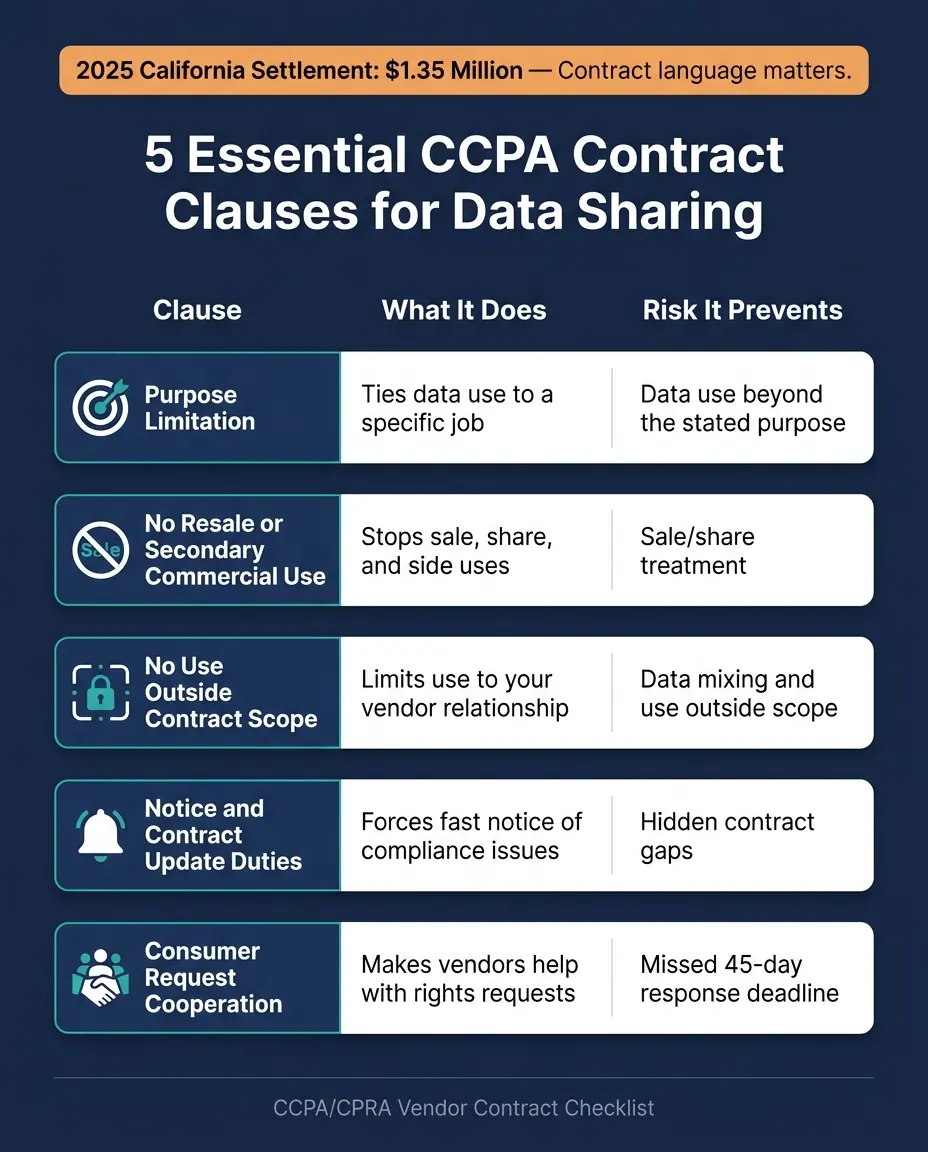
5 Essential CCPA Contract Clauses for Data Sharing
| Clause | What it does | Main risk it helps avoid |
|---|---|---|
| Purpose limitation | Ties data use to a specific job | Data use beyond the stated purpose |
| No resale or secondary commercial use | Stops sale, share, and side uses | Sale/share treatment |
| No use outside contract scope | Limits use to your vendor relationship | Data mixing and use outside scope |
| Notice and contract update duties | Forces fast notice of compliance issues | Hidden contract gaps |
| Consumer request cooperation | Makes vendors help with rights requests | Missed 45-day response deadline |
Put simply: I’d treat these five clauses as the minimum contract guardrails for lead forms, CRMs, enrichment tools, analytics platforms, and marketing vendors.
Why Data Sharing Contracts Need Clear Use Restrictions
A general confidentiality clause can keep data private. But that does not automatically limit how the data can be used.
Under the CCPA, those are two separate issues. Confidentiality deals with disclosure. The CCPA deals with use. That gap is where many contracts fall short, and it’s why the wording needs to be precise.
If a contract does not spell out use restrictions, the transfer may be treated as a "sale" or "share" under the CCPA, even when the business meant it as a service transfer. That can lead to opt-out duties, downstream liability, and the loss of the statutory defense tied to contract terms that meet the law’s rules.
That’s why the five clauses below belong in vendor contracts. The first safeguard is purpose limitation.
1. Purpose Limitation Clause
A purpose limitation clause tells a vendor exactly what it may do with the personal information you share - and nothing beyond that. Under 11 CCR § 7051, contracts must name the specific business purposes for processing. That means spelling out the actual tasks, not waving at a broad services agreement. This narrow limit sets the base for the downstream-use limits that follow.
CCPA/CPRA Requirement Addressed
This clause speaks to the rule that a vendor may use the data only for the authorized purpose. As Danny Riley of Seyfarth Shaw LLP puts it:
"This is the basic 'stay in your lane' rule: the vendor uses the data only for what the contract authorizes."
If the contract is vague, the transfer may be treated as a sale or share, which can trigger opt-out and notice duties.
Downstream Use Restriction
The clause should bar:
- combining your data with other clients' data
- resale
- any use outside the stated business purpose
Lead-Generation Vendor Example
In lead-generation workflows, each lead should stay tied to the named campaign only. For lead-gen vendors, the clause should block use of leads for the vendor's own marketing, enrichment, or other clients.
Drafting point
Use narrow language, not “vendor will process data to provide the services.” A better line looks like this: “Vendor will process lead contact information solely to qualify prospects for [Campaign Name].” It also helps to add audit rights and flow-down duties for subcontractors.
2. No Resale or Secondary Commercial Use Clause
A no resale clause stops the vendor from making money off your data. Put simply, it closes the gap that purpose limits can leave behind.
CCPA/CPRA Requirement Addressed
Under 11 CCR § 7051, service provider and contractor contracts must ban the sale or sharing of personal information and limit use to the purpose stated in the contract. That rule matters after the first handoff too. Even if resale is off the table, the contract still needs to block unrelated internal use.
Downstream Use Restriction
The clause shouldn't stop at an outright sale ban. It should also block secondary uses, like building consumer profiles for other clients or mixing your data with other sources. The CPRA also bars vendors from combining your data with other sources.
Chiara Portner and Kenny E. Gutierrez, Authors, Lathrop GPM:
"Service providers are permitted to use personal information for their own limited internal purposes... provided that the use does not include building or modifying household or consumer profiles to use in providing services to another business."
Lead-Generation Vendor Example
In lead-gen workflows, this clause needs to stop the vendor from reselling leads to competitors or reusing them in unrelated campaigns. If the vendor uses lead data outside the contract, it can become a third party. That's where this language does its job: it keeps the vendor inside the deal you actually made.
Drafting Point for U.S. Contracts
The contract must spell out the business purposes with some detail. A vague cross-reference to a master services agreement isn't enough under California rules. For contractors, the contract must also include a certification that the recipient understands and agrees to follow all use limits.
Use direct language:
"Vendor will not sell, share, or otherwise use the personal information for any purpose other than the services described in this agreement."
3. No Use Outside Contract Scope Clause
This clause limits more than the task itself. It also limits the context - what data the vendor can use, and within which business relationship. Put simply, it's a scope-control rule. For lead capture workflows, that matters a lot because it keeps form data tied to the specific campaign and the vendor's stated role.
CCPA/CPRA Requirement Addressed
Under 11 CCR § 7051, the contract must prohibit the service provider or contractor from retaining, using, or disclosing personal information outside your company's direct vendor relationship.
If that clause is missing, the transfer can be treated as a "sale" or "share." That can trigger opt-out and notice duties.
As Danny Riley of Seyfarth Shaw LLP puts it:
"If the paper isn't right, the transfer becomes a sale or share. That reclassification cascades into opt-out obligations, notice obligations, and downstream liability."
Downstream Use Restriction
The clause should also include a no-commingling rule. In plain English, the vendor can't mix your data with personal information from other clients or from its own separate dealings with consumers.
Lead-Generation Vendor Example
A CRM or lead-gen provider may handle data from many clients and want to use it for market analysis or trend forecasting. That's where things can go off the rails. If the vendor uses your data for other clients' services or folds it into other datasets, that would likely violate this clause.
To stay within service provider status under CCPA, the contract should block that use in clear terms. It may still allow narrow internal purposes, such as service quality work, as long as the vendor does not build or modify consumer profiles to provide services to another business.
Drafting Point for U.S. Contracts
Loose wording like "as needed to perform the services" is not enough. The contract should spell out the exact tasks the vendor may perform. It should also add:
- subcontractor flow-down language
- a written certification of compliance
Once scope is locked down, the contract should also require notice and update duties when vendor practices change.
sbb-itb-5f36581
4. Notice and Contract Update Duties Clause
Once the scope is locked in, the contract also needs a prompt notice requirement for any change in the vendor's compliance status.
CCPA/CPRA Requirement Addressed
Under 11 CCR § 7051, contracts must require service providers, contractors, or third parties to notify your business if they determine they can no longer meet their CCPA/CPRA obligations.
That clause should also give your business the right to act right away after receiving notice. For example, you may need to pause the transfer, require remediation, or stop the data flow altogether.
For lead-generation workflows, timing matters. That notice needs to reach you before the data is passed downstream again.
Lead-Generation Vendor Example
Say a vendor can no longer honor a "Do Not Sell" request. Your contract should let you stop that lead flow at once, before the data moves to the next party.
Drafting Point for U.S. Contracts
Your U.S. contract should require:
- Prompt notice of compliance changes
- Advance notice of new subprocessors before use begins
- Written flow-down terms
"A service provider must notify a business if it engages another person or company to assist it in processing personal information." - Henry M. Greenberg, Shareholder, Greenberg Traurig, LLP
It also helps to set a fixed notice window, such as 24 or 48 hours.
5. Consumer Request Cooperation and Downstream Assistance Clause
Once your notice rules are set, the next step is simple: make sure the contract spells out how the vendor must help with consumer requests.
This clause should tell the vendor what to do when a consumer asks to access, delete, or correct their data, or opts out of sale or sharing. If that process isn't clear, things can get messy fast.
CCPA/CPRA Requirement Addressed
Under 11 CCR § 7051(a), every service provider and contractor contract must require the vendor to help your business handle consumer requests or provide the data needed for your business to do that work.
The contract should also require the vendor to notify you if it gets a request straight from a consumer and to help with access, deletion, and correction requests. In plain English, the vendor can't sit on the request or treat it like someone else's problem.
Your contract should also set the ground rules for:
- response time
- response format
- escalation steps
That matters because you still have to meet the CCPA's 45-day deadline.
This duty shouldn't stop with the main vendor. It should apply to every vendor and subprocessor that handles the same lead data.
Downstream Use Restriction
Make this duty flow down to subprocessors so no one in the chain turns into a dead end for consumer requests. If a subcontractor gets lead data and a consumer sends a deletion request, that subcontractor must honor the request too.
Think of it like a relay race. If one runner drops the baton, the whole team loses. The same idea applies here: one weak link can stall your response and put your compliance work at risk.
Drafting Point for U.S. Contracts
For lead-generation vendors, add direct flow-down language that requires each subprocessor to fulfill consumer requests within the same timelines your contract sets for the main vendor.
Where These Clauses Apply in Lead Capture and Vendor Workflows
These clauses line up with the main handoffs in a lead workflow. And every handoff creates risk when the contract language is loose.
Web forms are the first handoff. That means you should collect only the data the campaign needs and send submissions only to approved vendors. Reform supports this with conditional routing and controlled integrations, so lead data goes only to authorized vendors. When you limit collection at the source, each downstream handoff becomes easier to control.
After that, the data moves through lead routing, validation, spam filtering, and enrichment. Lead routing should trigger notice before any new subprocessor touches the data. Validation and spam filtering can fit the stated purpose, but nothing beyond that. Enrichment vendors need a no-commingling rule.
CRM sync and analytics are where the No Secondary Commercial Use and No Use Outside Contract Scope clauses matter most. A CRM provider should not use lead data for cross-client analysis. An analytics vendor that uses lead data for its own purposes may turn the disclosure into a sale or share and trigger opt-out duties.
Marketing automation is where the consumer-request cooperation clause does the heavy lifting. Contracts should require vendors to pass opt-out, deletion, and correction requests downstream and stop any use outside the agreed workflow. They should also send consumer requests to your team and help complete them. The table below maps each stage to the clause it supports.
Clause-to-Obligation Reference Table
Use the table below as a quick contract checklist.
| Clause | Issue | Restriction | Sample Business Use Case |
|---|---|---|---|
| Purpose Limitation | Unauthorized secondary use | Use data only for the specific tasks defined in the contract | A CRM host may store leads but may not use them for its own research |
| No Resale or Secondary Commercial Use | Data sale/share liability | Bars selling data or sharing it for cross-context behavioral advertising | A lead generation agency is contractually barred from selling a client's prospect list to third-party marketing brokers |
| No Use Outside Contract Scope | Unauthorized consumer profiling | Bars combining data received from the business with data from other clients or the vendor's own interactions | A lead vendor may not mix one client's leads with another client's data to improve its own analytics |
| Notice and Contract Update Duties | Compliance monitoring and gap detection | Vendor must notify the business if it can no longer meet CCPA/CPRA standards | A vendor notifies a business after a change that prevents it from meeting CCPA contract terms |
| Consumer Request Cooperation | Consumer rights fulfillment | Vendor must assist with deletion, access, correction, or opt-out requests | When a consumer submits a deletion request to a business, the vendor must also purge that consumer's data from its servers |
Conclusion
Privacy policies explain how data is used. Contract clauses are what make vendors follow those rules. That’s why the five clauses above work best as a single system, not as random boilerplate.
When they work together, these clauses set clear limits on purpose, resale, scope, notice, and support for consumer requests. Without those guardrails, a data transfer can move from a controlled disclosure to a sale or share. And once that happens, opt-out and notice duties can kick in automatically.
The message from enforcement is pretty plain: regulators treat vendor contracts as proof of whether a privacy program can hold up in day-to-day use. Every form submission, CRM sync, and enrichment handoff relies on those limits being spelled out in the contract. For lead capture and vendor transfers, these clauses mark the line between a controlled disclosure and a CCPA problem.
FAQs
What happens if a vendor contract misses these CCPA clauses?
Without these CCPA clauses, a transfer of personal information may be treated as a sale or sharing of data.
That matters more than it might seem at first glance. Once a transfer falls into that bucket, you may need to add opt-out link requirements and take on more risk for what a vendor does with the data.
Missing terms can also make your privacy program look out of step with CCPA rules. And that can increase the chance of regulatory scrutiny and financial penalties.
Put simply, the right contract language helps protect vendor status and limit liability.
Does a confidentiality clause alone satisfy CCPA data-sharing rules?
No. A confidentiality clause by itself does not meet CCPA data-sharing rules.
If you want to help keep a transfer from being treated as a sale or share, the contract needs more than a simple promise to keep data secret.
It also needs specific required terms. For example, the agreement should include:
- Limits on selling or sharing the data
- Limits on using the data only for the contract’s business purposes
- A requirement to provide the same level of privacy protection required by the CCPA
That’s the key point: confidentiality matters, but on its own, it’s not enough under the CCPA.
Which vendors need these CCPA contract terms?
Any vendor that receives, accesses, or processes personal information on your business’s behalf should have these terms in place. That includes service providers, contractors, and third parties.
Common examples include cloud storage providers, website hosting services, and CRM platforms. Put simply, if a vendor touches personal information for your business, these terms matter. They help make sure the data transfer doesn't count as a sale or sharing of personal information.
Related Blog Posts
Get new content delivered straight to your inbox

The Response
Updates on the Reform platform, insights on optimizing conversion rates, and tips to craft forms that convert.


Drive real results with form optimizations
Tested across hundreds of experiments, our strategies deliver a 215% lift in qualified leads for B2B and SaaS companies.
