
.webp)
AI in Lead Enrichment: Industry Insights


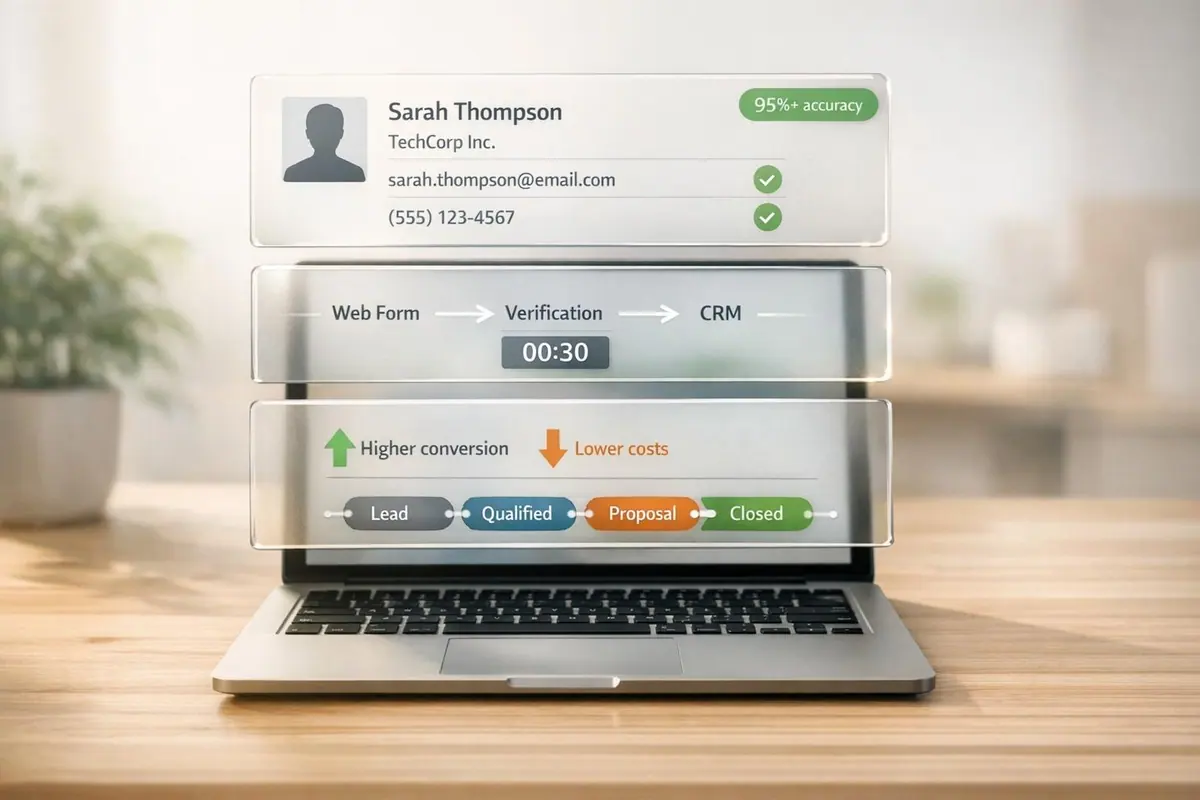
AI is reshaping lead enrichment in 2026, turning outdated, manual processes into real-time, automated systems that deliver faster and more accurate results. Here’s what you need to know:
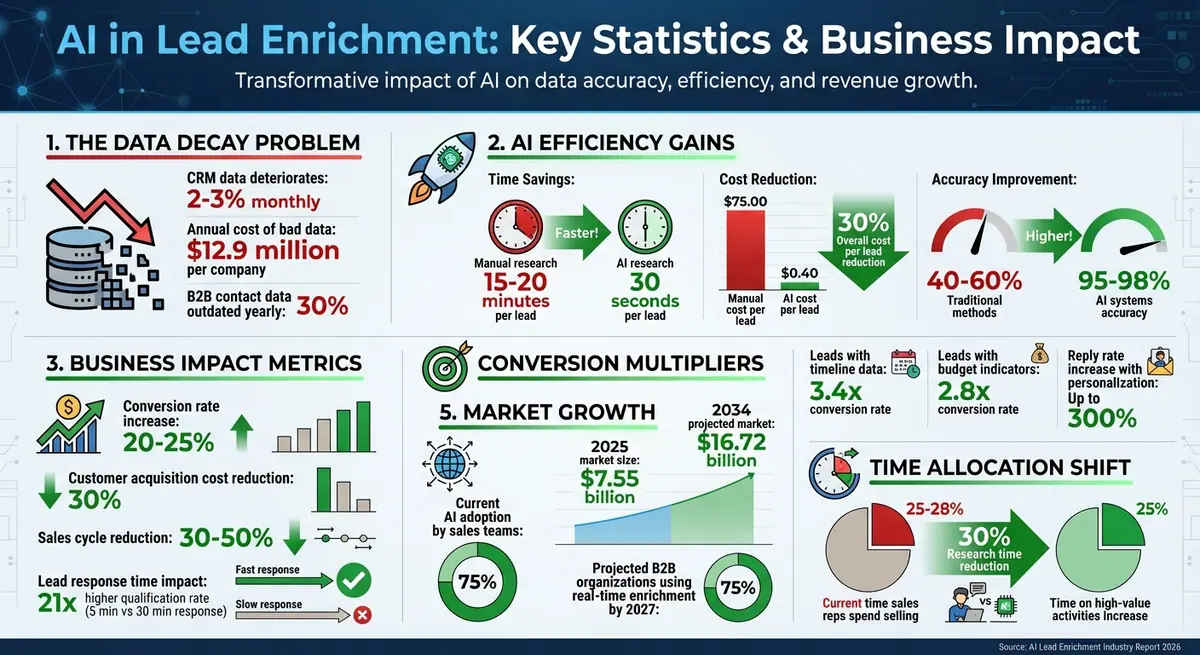
- Data Decay Problem: CRM data deteriorates by 2–3% monthly, costing companies an average of $12.9 million per year.
- AI Efficiency: AI reduces lead research time from 15–20 minutes to 30 seconds, cutting costs from $75 to $0.40 per lead.
- Business Impact: Companies using AI report 20–25% higher conversion rates, 30% lower customer acquisition costs, and up to 50% shorter sales cycles.
- Real-Time Updates: AI ensures 95–98% data accuracy by continuously verifying information from live sources.
- Market Growth: The lead enrichment market is projected to grow from $7.55 billion in 2025 to $16.72 billion by 2034.
AI-driven lead enrichment improves speed, accuracy, and data relevance, helping businesses prioritize high-value leads and optimize sales outcomes. By automating repetitive tasks, sales teams focus more on closing deals rather than manual data entry, driving measurable revenue growth.
AI Lead Enrichment ROI: Key Statistics and Business Impact 2026
Best AI Tools for Lead Enrichment in 2026 (Zapier + Google Sheets)
sbb-itb-5f36581
The Move to AI-Powered Lead Enrichment
AI has completely changed the way lead enrichment is done. With 75% of sales teams now using AI in some form, it's clear that manual methods can no longer keep up. As Ibby Syed, Founder of Cotera, explains:
"Lead enrichment at 50 leads a week is a research task. At 500 leads a week, it's an infrastructure problem."
Why the shift? Manual research is slow and expensive. It can take 15–20 minutes per lead, costing $75.00 each. AI, however, can do the same work in just 30 seconds for $0.40. Speed is critical - responding to a lead within five minutes increases the chances of qualifying them by 21 times compared to waiting 30 minutes.
The traditional approach of using static lookup tables is also outdated. These tables quickly lose relevance, while AI agents use a "waterfall enrichment" process. By pulling data from live sources like LinkedIn, company websites, and news feeds, AI ensures the information is current and accurate. This difference isn't just theoretical - it delivers real results. For example, TechNova started using AI enrichment in 2025 and saw:
- A 25% increase in qualified leads
- A 15% boost in conversion rates
- $1.2 million in additional quarterly revenue
These kinds of improvements highlight the advantages AI offers in speed, accuracy, and overall business performance.
Main Benefits of AI in Lead Enrichment
AI redefines lead enrichment by improving speed, accuracy, and data freshness. Right now, sales reps spend only 25% of their time selling, with the rest consumed by research and admin work. Automating these tasks frees up time for actual prospect engagement.
Accuracy is another game-changer. While traditional methods achieve 40–60% accuracy, AI systems hit 95–98% by verifying data in real time against live sources. This matters because bad data costs companies an average of $12.9 million annually. Plus, about 30% of B2B contact data becomes outdated each year due to job changes or company updates. Unlike static databases, AI continuously refreshes data, ensuring it's always up to date.
AI also excels at analyzing unstructured data. It can scan CRM notes, emails, and meeting transcripts to uncover signals like budgets, timelines, and competitive insights - details that static databases often miss. A sales analyst at Cotera described how this shift has transformed their role:
"I used to be a data entry clerk who happened to sit in the sales org. Now I'm an analyst. I review the AI's enrichment, flag the leads with the most interesting patterns, and brief the AEs on what the data is telling us."
The impact of AI is especially clear when it comes to behavioral data. For instance, leads with a stated timeline convert at 3.4 times the baseline rate, and those with budget indications see conversion rates increase by 2.8 times. AI identifies and prioritizes these high-value signals, directly contributing to better revenue outcomes.
Business Impact: Metrics and Results
The combination of faster processes, better accuracy, and fresher data drives real business results. Companies using AI for lead qualification have cut their cost per lead by 30%. Conversion rates typically improve by 20–25%, and sales cycles are shortened by as much as 30%. In some cases, AI has cut sales cycle times by 40–50%.
Examples from real-world applications underline these benefits. Demandbase, for instance, integrated G2 intent signals into their prioritization workflows, generating $3.5 million in influenced pipeline by targeting in-market accounts rather than increasing outbound efforts. Company X saw similar success after adopting AI in 2025, achieving:
- A 20% increase in conversion rates
- $200,000 in additional sales-qualified opportunities per quarter
- A first-year ROI of 1,042%
Another example comes from Cotiss, a procurement software company. Switching to AI for signal prioritization improved their contact accuracy to 85–90% and more than doubled their call connect rates. Sales teams using AI also report spending 30% less time on research and 25% more time on high-value activities, with manual research time cut by over 50%.
The lead enrichment market reflects this momentum. It is expected to grow from $7.55 billion in 2025 to $16.72 billion by 2034. By 2027, 75% of B2B organizations are projected to adopt real-time enrichment, making AI-powered systems the new standard in lead management.
Core AI Functions in Lead Enrichment
AI-powered lead enrichment turns simple contact details into comprehensive profiles. By using a waterfall enrichment process, which sequentially gathers verified data, AI improves both match rates and accuracy. It pulls firmographic, technographic, and intent data from multiple sources simultaneously.
What sets AI apart is its ability to work with unstructured internal data. AI tools can analyze CRM notes, emails, and call transcripts to uncover insights like budget signals or decision-making timelines. For instance, AI-identified leads with a clear timeline are 3.4 times more likely to convert than average.
Real-Time Intent Detection and Lead Scoring
AI can evaluate behavioral data - such as website visits, content downloads, and search activity - to pinpoint which prospects are actively researching solutions. This allows teams to prioritize leads that are more likely to convert. Machine learning models, trained on historical data, can predict conversion likelihood with much greater precision than traditional static scoring methods.
This dynamic prioritization significantly enhances sales outcomes. For example, a 2025 study found that machine learning models using enriched CRM data achieved 98.39% accuracy in predicting B2B lead conversions. Businesses that adopt AI for lead scoring experience a 38% higher conversion rate and a 28% shorter sales cycle. Additionally, AI monitors intent signals - like funding announcements, leadership changes, and research activity - to identify the ideal "buying window", ensuring sales teams engage prospects at the right time.
Real-time enrichment also enables highly personalized outreach. When sales reps know details like a prospect's current tech stack or recent company developments, they can craft messages that resonate. This level of tailored communication can boost reply rates by up to 300%.
Firmographics and Technographics Enrichment
AI takes firmographic and technographic data to the next level. Using Natural Language Processing (NLP), it can analyze company websites and mission statements to classify businesses more precisely. For example, instead of simply labeling a company as "Healthcare", AI can identify specific niches like "Healthcare IT" or "Decentralized Identity". It also tracks news, press releases, and SEC filings to uncover funding rounds, growth plans, and leadership changes, offering insights into a company's trajectory and budget capacity.
When it comes to technographics, AI digs deep into a prospect's technology stack. By analyzing website code, tracking pixels, and job postings, AI can determine which platforms a company uses, such as Salesforce or HubSpot, and even predict future tech investments.
The results speak for themselves. In 2025, Amanda Newman, SDR Manager at UserEvidence, reported a 98% match rate for contact data after switching to AI-powered enrichment, up from 72%. This change increased her team's call connect rate from 14% to 22%. Similarly, John Pennypacker, VP of Sales and Marketing at Deep Cognition, noted a 25% quarter-over-quarter increase in call connect rates after using verified phone numbers from AI enrichment in early 2026.
Beyond initial enrichment, AI ensures data remains accurate over time through automated verification.
Automated Data Verification and Updates
AI continuously checks email syntax, domain validity, and phone connectivity, significantly reducing "wrong number" issues. This is crucial because around 30% of B2B data becomes outdated each year due to job changes and company restructuring.
While traditional data providers often deliver only 40–60% accuracy, AI achieves 95–98% accuracy by pulling information directly from live sources like LinkedIn, company websites, and news feeds. For example, Edward White, Head of Growth at beehiiv, used AI in 2025 to integrate OpenAI with LinkedIn data. This automated enrichment process saved his team 8–10 hours of manual research weekly.
Since data decays quickly, automated refresh cycles are critical. AI systems can re-verify opportunities on a weekly or monthly basis, ensuring sales teams always have up-to-date information. This proactive approach helps prevent data quality issues, which cost U.S. businesses an average of $12.9 million annually.
AI-Powered Workflow Automation in Lead Management
AI is revolutionizing lead management by automating workflows that were once handled manually. Unlike older "if-then" automation tools that can falter when data isn’t perfectly aligned, modern AI agents rely on reasoning to manage the entire lead lifecycle. This includes everything from capturing and enriching leads to validating, scoring, and routing them - all without human intervention. Instead of building intricate 20-step workflows, teams can now simply describe their needs in plain language, and the AI takes care of the rest.
On average, sales teams spend 23% of their day on tasks like manual research and data entry. AI-powered workflows drastically cut down this time, reducing research per lead from 15–20 minutes to just 30 seconds. For instance, Cotera enabled a sales team to scale from handling 50 leads per week to over 300, all without hiring additional staff. Their AI agent extracted key details like budget signals and timelines from CRM call notes, which resulted in a 28% boost in lead-to-opportunity conversion and a 19% increase in win rates.
"Lead enrichment is not a 'project.' It's an operational layer that needs to run continuously - like demand capture itself."
– Ameya Deshmukh, VP of Marketing, EverWorker
This example highlights how AI agents are reshaping every aspect of lead management.
AI Agents for Lead Management Tasks
AI agents excel at handling repetitive tasks that used to require hours of manual effort. They autonomously manage processes like ingesting leads, normalizing data, verifying accuracy, removing duplicates, scoring, and routing. Even when faced with inconsistent data - for example, conflicting job titles on LinkedIn versus a company website - they can make informed decisions.
These agents also tap into unstructured internal data that traditional tools often miss. By analyzing CRM call notes, email threads, and meeting transcripts, they can identify critical details such as budget constraints, decision timelines, and competitive insights. A great example of this is Remote.com, which in 2024 implemented an automated enrichment workflow. This system processed over 100,000 accounts every 45 days, achieved a 98.9% data accuracy rate, and reduced SDR research time by 40%.
Integration with Marketing and CRM Platforms
The real power of AI in lead management comes when it integrates seamlessly with marketing and CRM platforms. AI-enriched data becomes even more impactful when it’s automatically updated in tools like Salesforce, HubSpot, Attio, and Pipedrive. Modern AI agents don’t just append data; they actively update CRM fields, log enrichment notes, and trigger downstream actions like Slack notifications or email sequences. This ensures sales reps have access to complete, actionable profiles without needing to sift through multiple systems.
Integration also speeds up the sales pipeline by automating tasks like lead-to-account matching and intelligent routing based on factors like territory, expertise, or rep capacity. To maintain data consistency, it’s essential to establish a clear hierarchy: for instance, internal data from the past 30 days should override external records, while external data should take precedence over internal notes older than 90 days. This approach ensures sales teams always work with the most up-to-date and relevant information, as the AI continuously verifies data against live sources to counteract the 30% annual decay rate common in B2B contact data.
Platforms like Reform take this integration further by turning form submissions into the starting point for automated enrichment workflows. This means every lead enters the CRM with a fully enriched profile, ready for immediate follow-up and action.
What's Next for AI in Lead Enrichment
AI is moving beyond simply assisting with lead enrichment - it’s stepping into a role where it can act autonomously. By 2027, it’s predicted that 75% of companies will integrate autonomous AI into their sales strategies. This means AI won't just suggest next steps; it will independently execute entire workflows. Imagine a system that doesn’t just update a lead record but analyzes scenarios, makes decisions, and updates your CRM - all without waiting for human intervention.
These advancements are set to redefine not only how data enrichment works but also how sales and marketing professionals approach their daily tasks.
Expected AI Developments
One of the most notable changes is the shift from basic automation to self-learning systems. These platforms use continuous feedback loops to refine their models, learning from which leads convert without needing manual adjustments. This approach has been shown to improve lead scoring accuracy by 37% compared to static models.
AI is also tapping into unstructured CRM data - like call transcripts, email threads, and meeting notes - to uncover insights such as budget limitations or decision-making timelines, going beyond what external databases can provide.
On the technical front, companies are leveraging specialized AI hardware like TPUs and Inferentia to handle the demands of real-time enrichment. Coupled with edge computing, these systems can qualify and enrich leads in under six minutes.
Another emerging standard is waterfall enrichment. Instead of relying on a single data source, AI systems now verify information across multiple providers sequentially. This method boosts contact accuracy to an impressive 95–98%, addressing the persistent issue of data decay in B2B environments.
"The era of the 'pipeline' is over. The era of the 'prompt' has begun."
– Ibby Syed, Founder, Cotera
How AI Will Change Sales and Marketing Roles
With these advancements, AI is shifting the focus of sales and marketing professionals from repetitive tasks to more strategic, insight-driven roles. Right now, sales reps spend only 25% to 28% of their time actively selling, with much of their week consumed by manual research and administrative work. AI is eliminating this inefficiency, giving teams the freedom to concentrate on relationship-building and deal strategy.
Sales analyst Rashid captures this shift perfectly:
"I used to be a data entry clerk who happened to sit in the sales org. Now I'm an analyst."
Instead of manually gathering data from sources like LinkedIn, sales teams are now analyzing AI-generated insights. They can identify patterns across hundreds of leads and focus their efforts on high-value opportunities. This is made possible by the improved accuracy of self-learning models, which ensure reps spend their time on genuinely qualified prospects.
By 2026, 65% of organizations are expected to adopt integrated AI-CRM solutions. These systems will blur the line between enrichment tools and CRMs, creating unified intelligence hubs where data flows seamlessly. AI will manage everything from capturing leads to routing them, dramatically reducing costs. For example, AI-powered outbound systems can lower costs by 60–80% compared to human SDRs, cutting the cost of a qualified lead from $262 to just $39.
However, this transformation also comes with new responsibilities. As AI systems evolve, 70% of enterprises have established data governance teams to ensure ethical practices and compliance. With 85% of countries expected to enforce stricter data protection laws by 2027, maintaining trust and adhering to regulations will be more important than ever.
Conclusion
AI is reshaping how businesses handle lead enrichment. By moving from static database searches to smart, real-time analysis, companies can now achieve 95–98% contact accuracy while slashing research time from 15–20 minutes per lead to just 30 seconds. The results? Tangible business benefits: businesses leveraging AI-powered enrichment report 20% to 25% higher conversion rates and 30% lower customer acquisition costs.
This leap in performance highlights the importance of making lead enrichment an ongoing process rather than a one-time task. To get started, focus on enriching key decision-making data points - like timelines, budget indicators, and competitive context pulled from your CRM. Leads with these enriched insights convert at 3.4x the rate of those without them. Establish clear data governance rules, decide how to resolve conflicts between internal and external data, and use time-decay logic to ensure your team always has up-to-date, actionable information.
Begin with a pilot program of 50–100 leads to validate accuracy. Instead of trying to enrich your entire database, focus on active opportunities and high-intent inbound leads first. Additionally, enable automatic meeting transcription to give AI tools access to raw data from internal conversations, helping them generate insights that matter. These early steps pave the way for scalable and impactful lead management.
And the cost savings? They’re hard to ignore. Manual enrichment costs around $75 per lead, while AI processing brings that down to just $0.40 per lead. Beyond saving money, AI frees up your sales team to focus on strategic, revenue-generating activities instead of repetitive data entry.
With 65% of organizations planning to adopt unified AI-CRM systems by 2026, the real question isn’t whether to implement AI-driven enrichment but how quickly you can make it happen. Companies that act now will gain a major edge in lead quality, conversion rates, and overall sales performance.
FAQs
How do I start AI lead enrichment without redoing my whole CRM?
To get started with AI lead enrichment, you can integrate automation tools directly into your current CRM. By using AI-driven workflows, you can automatically validate and complete lead information, filling in gaps such as firmographic or contact details. This approach boosts the quality of your leads without needing to completely revamp your CRM system. Taking an incremental approach allows you to steadily improve your data quality while maintaining your existing setup.
What data should AI enrich first to improve conversions fastest?
AI should prioritize enhancing key firmographic data like company size, industry, revenue, and organizational hierarchy. These details play a crucial role in refining targeting and personalization efforts, which can lead to quicker improvements in conversion rates.
How can I ensure AI-enriched data stays compliant and governed?
To ensure compliance and proper governance when working with AI-enriched data, it's crucial to stick to certain best practices. Start by using first-party data that comes with clear and informed consent. If you're working with third-party providers, make sure to thoroughly vet them to confirm they meet legal and ethical standards. Additionally, follow data minimization and retention policies as outlined by regulations like GDPR and CCPA.
Be transparent about how you handle privacy by clearly communicating your practices to users. It's also important to manage data subject access requests (DSARs) efficiently, ensuring individuals can exercise their rights over their data. Automating compliance workflows can help streamline processes, but don’t forget to maintain detailed audit trails to demonstrate ongoing compliance. These steps will help you stay aligned with legal requirements while building trust with users.
Related Blog Posts
Get new content delivered straight to your inbox

The Response
Updates on the Reform platform, insights on optimizing conversion rates, and tips to craft forms that convert.



Drive real results with form optimizations
Tested across hundreds of experiments, our strategies deliver a 215% lift in qualified leads for B2B and SaaS companies.
