
.webp)
5 Benefits of AI for Email Form Segmentation



AI is transforming email marketing. It helps marketers send the right message to the right person at the right time by analyzing vast amounts of data. Here's how AI-driven segmentation improves email campaigns:
- Better Targeting: AI analyzes user behavior, like browsing habits and purchase intent, to create precise audience segments.
- Real-Time Updates: Segments adjust automatically based on user actions, ensuring timely and relevant messaging.
- Higher Engagement: AI-powered campaigns see up to 760% more revenue, 6x higher transaction rates, and up to 120% better click-through rates.
- Time Savings: Automation eliminates manual segmentation, letting teams focus on strategy.
- More Revenue: Personalized emails generate 3.2x more revenue per recipient compared to generic messages.
AI-powered tools, combined with high-converting lead forms, streamline data collection and segmentation, making email marketing more effective and efficient.
How To Define Segments with AI: Advanced Tips for Marketers
sbb-itb-5f36581
1. Better Audience Targeting Through Behavioral Analysis
AI goes beyond just looking at basic demographics - it pays attention to what your audience does. Instead of only focusing on static details like age or job title, AI tracks real-time behaviors such as visits to pricing pages, email clicks, how users interact with features, and even how far they scroll on a page. These insights help paint a clearer picture of user intent.
"AI doesn't replace segmentation strategy - it strengthens it. Instead of relying solely on static rules, AI analyzes patterns across behavior, timing, and engagement to continuously refine who should receive which message." - monday campaigns
And the results speak for themselves: AI-segmented emails boast a 13.44% click rate, with 51% of marketers reporting stronger performance. Campaigns using AI-driven segmentation see 30% more opens and 50% higher click-through rates.
Using structured web forms with fields like dropdowns and checkboxes ensures clean data for AI to work with. Tools such as Reform simplify this process through features like conditional routing and lead enrichment. These tools can automatically sort leads based on factors like urgency, budget, or buying stage right after a form is submitted.
The real magic happens with dynamic targeting. Segments update automatically in response to user behavior. For instance, if a subscriber visits your pricing page multiple times in a week, AI can instantly move them into a high-intent segment - no manual updates required. This approach eliminates guesswork, allowing you to pinpoint where buyers are in their journey. The result? Campaigns that drive higher conversions and revenue, as we’ll explore further in upcoming sections.
2. Real-Time Updates and Dynamic Personalization
Impact on Audience Targeting Accuracy
Static audience segments have a major flaw - they don’t keep up with changes in behavior. For example, someone who filled out a form last month might now be showing high purchase intent by visiting your pricing page multiple times this week. But static lists won’t reflect this shift. AI solves this problem with automated segmentation, continuously updating lists based on changes in contact properties, website activity, or engagement data. This means your campaigns are always aligned with current customer intent rather than outdated assumptions.
Here’s how it works: AI analyzes behavioral patterns to spot high-intent signals, like repeated visits to key pages, and then triggers timely, relevant messaging. If a subscriber’s actions suggest they’re ready to buy, AI moves them into the right segment instantly. This dynamic approach not only improves targeting accuracy but also accelerates campaign readiness.
Efficiency Improvements for Marketing Teams
AI transforms segmentation from a time-consuming process into something that takes just minutes, thanks to natural language prompts. By eliminating IT bottlenecks, marketing teams can launch campaigns much faster. When paired with high-quality data from well-designed forms, these improvements become even more impactful.
Beyond segmentation, AI takes personalization to the next level. It autonomously creates variations in visuals, copy, and layouts, tailoring them to individual subscribers. As Anika Gupta from Typeface explains:
"The real game-changer isn't AI writing your emails. It's agentic AI that can make decisions, run experiments, and optimize your email marketing campaigns without you having to micromanage every detail".
Effect on Email Engagement Metrics
The difference between AI-optimized campaigns and traditional ones is striking. AI-powered campaigns achieve an average 13.44% click-through rate, compared to just 3% for non-AI campaigns. Send-Time Optimization (STO) uses machine learning to pinpoint the best delivery times based on real-time click and conversion signals, bypassing unreliable open-rate data. This method boosts email engagement metrics by 15-25%.
AI also adapts email content in real time, adjusting value propositions, proof points, and calls to action based on factors like a recipient’s lifecycle stage or industry type. This level of personalization pays off: 93.2% of marketers report that personalized or segmented experiences lead to more leads and purchases.
Contribution to Conversion Rates and Revenue
The more AI features you use, the greater the impact on revenue. A single feature like STO can increase revenue by 8-14%. Add a second feature, and that number jumps to 18-28%. Companies using a full AI stack see 41% higher revenue than those relying solely on manual campaigns. AI-personalized emails generate 3.2x more revenue per recipient compared to traditional batch-and-blast emails.
Personalization drives measurable results. Revenue increases by 5-15%, and marketing ROI improves by 10-30% when personalization is done effectively. According to Alex Sventeckis from HubSpot:
"Personalization works at scale when content, data, and delivery logic share the same source of truth".
Scalability and Adaptability for Dynamic Segmentation
AI excels where manual processes fall short: managing massive datasets and adapting to constant changes in real time. Machine learning models analyze hundreds of variables - like browsing behavior, purchase timing, and channel preferences - all at once. Segments update dynamically as new data flows in. This adaptability is what drives the significant gains in engagement and revenue.
AI also identifies subscribers at risk of churn 30-60 days before they become inactive, enabling proactive re-engagement efforts. Tools like Reform enhance this process by capturing clean, structured data through features like conditional routing and lead enrichment. This ensures AI has the high-quality inputs it needs to make accurate predictions and update segments effectively. These insights are key to maximizing email conversions and keeping your campaigns ahead of the curve.
3. Higher Email Open Rates and Click-Through Rates
Impact on Audience Targeting Accuracy
Building on the benefits of real-time personalization, AI's ability to precisely target audiences significantly enhances email open rates and click-through performance.
Unlike traditional segmentation methods that rely on 8–12 data points (like demographics or past purchases), AI processes over 200 signals at once. These include factors such as scroll depth, time spent on specific pages, device type, and overall engagement time. This comprehensive analysis enables predictive engagement scoring, which continuously updates to reflect the likelihood of a user engaging with specific content. For instance, AI can predict whether an individual is more inclined to open an email about a webinar or a product update.
AI also uncovers "Behavioral Clusters" - patterns that would be impossible for marketers to identify manually. For example, it might detect users who browse on their mobile devices during commutes but only make purchases on desktop computers on particular days. Drew Madore, Founder & CEO of Synergist Digital Media, explains:
"Machine learning doesn't care about your carefully labeled folders. It finds patterns you'd never see - and it updates them constantly".
Another powerful feature is content affinity prediction, which goes beyond identifying preferred topics to pinpoint the exact formats that drive engagement. This could mean recognizing that a user prefers short videos under three minutes instead of lengthy articles.
Effect on Email Engagement Metrics
AI-based segmentation delivers impressive improvements in email engagement. Open rates can increase by 40–85%, while click-through rates may rise by 60–120%, compared to traditional methods. In B2B testing, AI-generated segments achieved 2.3 times the open rate and 4.1 times the click rate of manually created segments. Segmented campaigns, in general, outperform non-segmented ones, with open rates improving by 30–46% and click rates soaring by 100.95%.
Timing also plays a critical role. Since 21% of email opens happen within the first hour after delivery, AI-powered send-time optimization ensures emails are delivered at the precise moment a subscriber is most likely to engage. This approach beats relying on broad industry benchmarks.
These enhancements are further amplified by AI's dynamic segmentation capabilities, which keep campaigns adaptable and relevant.
Scalability and Adaptability for Dynamic Segmentation
AI thrives in managing complex, ever-changing segmentation needs. Its dynamic nature not only boosts engagement but also helps detect anomalies, such as sudden increases in unsubscribe rates or shifts in average open times. When these issues arise, AI alerts teams instantly, allowing for quick adjustments and improved campaign performance.
However, before diving into AI-driven segmentation, it's crucial to ensure your data is clean. Broken or incomplete data will lead to poor results. Make sure website tracking is functional and your CRM and ESP are synced properly. Once your data is in good shape, use a 7–14 day onboarding sequence with diverse content - like case studies, how-to guides, and news articles - to help the AI gather enough behavioral data for accurate predictions. Tools like Reform can assist by ensuring clean, structured data through features like email validation and lead enrichment, giving AI the inputs it needs to optimize your campaigns effectively.
4. Less Time Spent on Manual Segmentation
Efficiency Improvements for Marketing Teams
Manual segmentation can eat up a huge chunk of a marketing team's day. Sales reps often start their mornings sifting through form submissions, trying to figure out which prospects are worth pursuing. This process involves gathering data from various sources, cleaning it up, and then creating filters - a tedious, time-consuming task.
AI completely changes the game by automating the entire segmentation process. Instead of spending time building filters and sorting through data, teams can simply describe their ideal audience in plain terms. For instance, they might input something like, "customers within 100 miles of New York who haven't purchased in 30 days", and AI instantly generates the segment. Jessica Schanzer, Product Marketing Lead at Klaviyo, sums it up perfectly:
"AI can analyze huge volumes of data and identify patterns and correlations much more quickly than humans can".
This automation not only saves valuable time but also allows teams to focus on bigger-picture strategies that drive growth. It’s a win-win: less time wasted on repetitive tasks and more time for meaningful, scalable work.
Scalability and Adaptability for Dynamic Segmentation
AI takes raw form submissions and turns them into neatly organized, actionable groups on the spot. The moment a lead fills out a form, conditional logic kicks in, assigning them to specific segments based on details like company size, budget, or intent. For example, if someone selects "Enterprise" and "High Budget", the system can instantly notify senior sales via Slack while routing smaller prospects to automated nurture campaigns.
And here’s the kicker: companies that reach out to leads within five minutes are 100 times more likely to qualify leads compared to those who wait 30 minutes. For teams managing large volumes of leads, manual processes just can’t keep up. AI-driven tools handle this effortlessly, making sure high-value leads get the attention they deserve almost immediately. Platforms like Reform make this even easier by collecting structured data through features like dropdown menus and conditional routing, ensuring AI has exactly what it needs to segment leads quickly and accurately.
5. More Conversions and Revenue Per Email
Contribution to Conversion Rates and Revenue
AI-driven segmentation has a direct impact on how much revenue your email campaigns can bring in. Segmented campaigns can produce up to 760% more revenue compared to generic, one-size-fits-all emails. On top of that, AI-personalized emails generate 3.2x more revenue per recipient by delivering the right message to the right person at just the right moment. These results stem from AI's ability to dynamically adjust segments based on real-time actions and behaviors.
For instance, brands leveraging AI-driven predictive segments report revenue per recipient (RPR) increases ranging from 18% to 45%, significantly outperforming traditional demographic-based segmentation. A case study from early 2026 by CustomersAI and Larry Kim highlights this perfectly: an AI-identified "Highly Engaged Segment" of just 8,865 emails generated the same revenue ($2,660) as a much larger "Business-As-Usual" segment of 30,095 emails. This meant a 70.5% reduction in send volume, while click rates jumped from 2.06% to 5.06%. Marketing expert Irfan Khan summed it up well:
"When you stop treating your audience as a list and start treating them as humans with specific readiness to act, everything compounds. Fewer touchpoints. Deeper trust. Same revenue."
Automated and triggered emails, which rely on precise behavioral segmentation, are another standout. Despite making up only 2% of total email volume, these emails account for a whopping 41% of total email revenue. This shows how sending fewer, highly-targeted emails can drive better financial results. Tools like Reform play a key role here, offering features like dropdown menus, conditional routing, and lead enrichment to ensure your AI gets clean, actionable data right from the start.
Effect on Email Engagement Metrics
AI-driven segmentation doesn’t just boost revenue - it also significantly improves how subscribers engage with your emails. Campaigns optimized with AI achieve an average 13.44% click-through rate, compared to only 3% for non-AI campaigns. When people receive messages that align with their interests and needs, they’re more likely to click, read, and take action.
This enhanced engagement builds momentum over time. Customers who have positive experiences are shown to spend 140% more than those with negative ones. Additionally, 89% of marketers report that AI-powered content or product recommendations lead to more repeat purchases. By continuously updating segments based on real-time behaviors - like recent purchases, browsing habits, or email interactions - AI ensures your messaging stays relevant. This keeps your audience engaged, boosts their lifetime value, and drives consistent revenue growth.
Performance Comparison: Unsegmented vs. AI-Segmented Email Campaigns
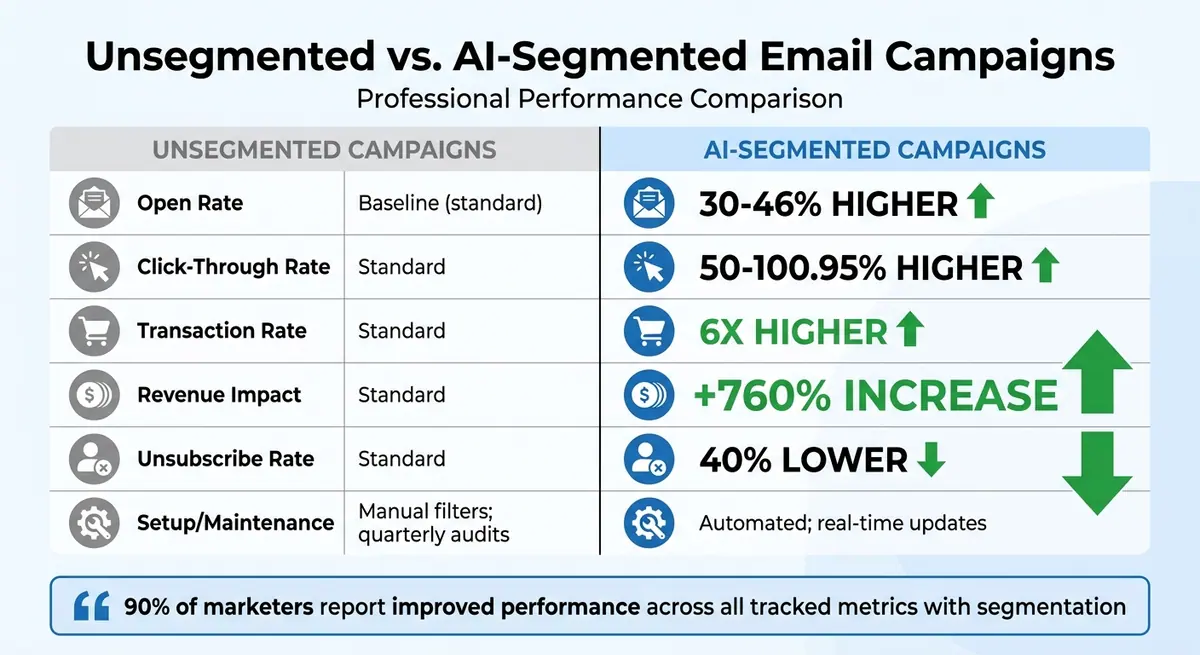
AI-Segmented vs Unsegmented Email Campaigns Performance Comparison
When it comes to email marketing, unsegmented campaigns fall short in every measurable way compared to AI-segmented campaigns. Here's a side-by-side look at how the two approaches compare:
| Metric | Unsegmented Campaigns | AI-Segmented Campaigns |
|---|---|---|
| Open Rate | Baseline | 30–46% higher |
| Click-Through Rate | Standard | 50–100.95% higher |
| Transaction Rate | Standard | 6x higher |
| Revenue Impact | Standard | +760% increase |
| Unsubscribe Rate | Standard | 40% lower |
| Setup/Maintenance | Manual filters; quarterly audits | Automated; real-time updates |
These numbers clearly illustrate the advantages of using AI for email segmentation. AI-segmented campaigns consistently outperform unsegmented ones, with standout results like a 760% increase in revenue impact and unsubscribe rates dropping by 40%. It's no wonder that 90% of marketers report improved performance across all tracked metrics thanks to segmentation.
Dynamic content driven by AI is a game-changer. For instance, AI-powered emails can generate 18x more revenue than generic ones, while automated triggered emails deliver 320% more revenue compared to non-automated alternatives.
Time efficiency is another key factor. While unsegmented campaigns are quick to send, they lack strategic depth. Manual segmentation, on the other hand, is time-intensive, requiring hours of data extraction and regular audits. AI streamlines this process. After an initial setup phase (approximately 40 hours), ongoing optimization typically takes just 3–4 hours per week.
Drew Madore, Founder & CEO of Synergist Digital Media, captures this balance perfectly:
"AI email segmentation isn't about replacing human strategy - it's about identifying patterns at a scale humans can't match, then applying human judgment to those insights."
The success of AI segmentation relies heavily on clean, actionable data. This is where high-quality forms come into play. Tools like Reform offer features such as conditional routing, lead enrichment, and email validation, ensuring your AI segmentation system starts with the best data possible.
Conclusion
AI has taken email segmentation to a whole new level, delivering results that are impossible to ignore: 760% more revenue, 100.95% higher click-through rates, and six times higher transaction rates compared to unsegmented campaigns. These aren’t just small gains - they’re transformative outcomes that can significantly boost your bottom line.
What’s driving these results? A shift from relying on traditional demographics to leveraging behavioral and intent data. AI dives deep into thousands of data points - like opens, clicks, conversions, and form submissions - to uncover patterns that would otherwise go unnoticed. As ROI.com.au aptly puts it:
"AI-powered segmentation turns email from spray-and-pray into precision targeting".
But it’s not just about accuracy - speed matters just as much. Reaching leads quickly can dramatically increase qualification rates. AI tools, like conditional routing and real-time validation in forms, ensure the data you collect is clean and ready to act on from the moment it’s submitted.
The benefits don’t stop at performance metrics. Companies using segmentation are 60% more likely to understand customer challenges and 130% more likely to anticipate their intentions. This not only drives revenue but also strengthens customer relationships by improving relevance, reducing unsubscribe rates, and creating a deeper connection with your audience.
With 67% of marketers already using AI for email by 2026, the real question is: how soon can you start leveraging AI-powered segmentation? Tools like Reform make it simple to collect actionable data, turning every form submission into an opportunity to grow your revenue.
FAQs
What data do I need for AI segmentation to work well?
To make AI segmentation work effectively, gather and study data such as customer behavior, interests, demographics, and other relevant factors. This data allows AI to form more precise audience groups, which can lead to better targeting and higher engagement.
How quickly do AI segments update after someone takes an action?
AI-driven segments usually update almost instantly or within just a few minutes after an action is taken. This quick adjustment allows for audience segmentation and email send times to adapt based on subscriber behavior, making email campaigns more impactful.
How do I collect cleaner form data for better AI targeting?
To get more accurate form data for AI targeting, it's essential to use data validation and enrichment techniques. AI can tidy up messy information by validating email addresses and standardizing inputs. For example, features like email verification - which includes syntax checks, DNS lookups, and SMTP handshakes - help ensure email addresses are legitimate. Tools like Reform also offer conditional routing, which can block invalid entries, leading to better-quality data for AI targeting.
Related Blog Posts
Get new content delivered straight to your inbox

The Response
Updates on the Reform platform, insights on optimizing conversion rates, and tips to craft forms that convert.



Drive real results with form optimizations
Tested across hundreds of experiments, our strategies deliver a 215% lift in qualified leads for B2B and SaaS companies.
