
.webp)
What Is AI Income Estimation?



AI income estimation uses machine learning to predict income by analyzing financial data in real time. Instead of relying on documents like pay stubs or tax returns, it identifies valid income sources - such as salaries, gig payments, or pensions - by categorizing and filtering transactions. This approach is faster, more accurate, and less costly than manual methods, making it a valuable tool for lead generation, credit decisions, and personalized marketing.
Key points:
- Efficiency: Cuts verification time by 17% and reduces lead qualification costs from $150-$200 to $40-$60.
- Accuracy: Achieves 70%-85% qualification accuracy compared to 30%-40% with traditional methods.
- Real-time insights: Provides up-to-date financial snapshots, improving decision-making speed.
Despite its benefits, challenges include data privacy concerns, potential bias in algorithms, and the need for frequent model updates to maintain accuracy.
AI income estimation is transforming how businesses evaluate financial data, prioritize leads, and tailor marketing strategies.
How AI Income Estimation Works
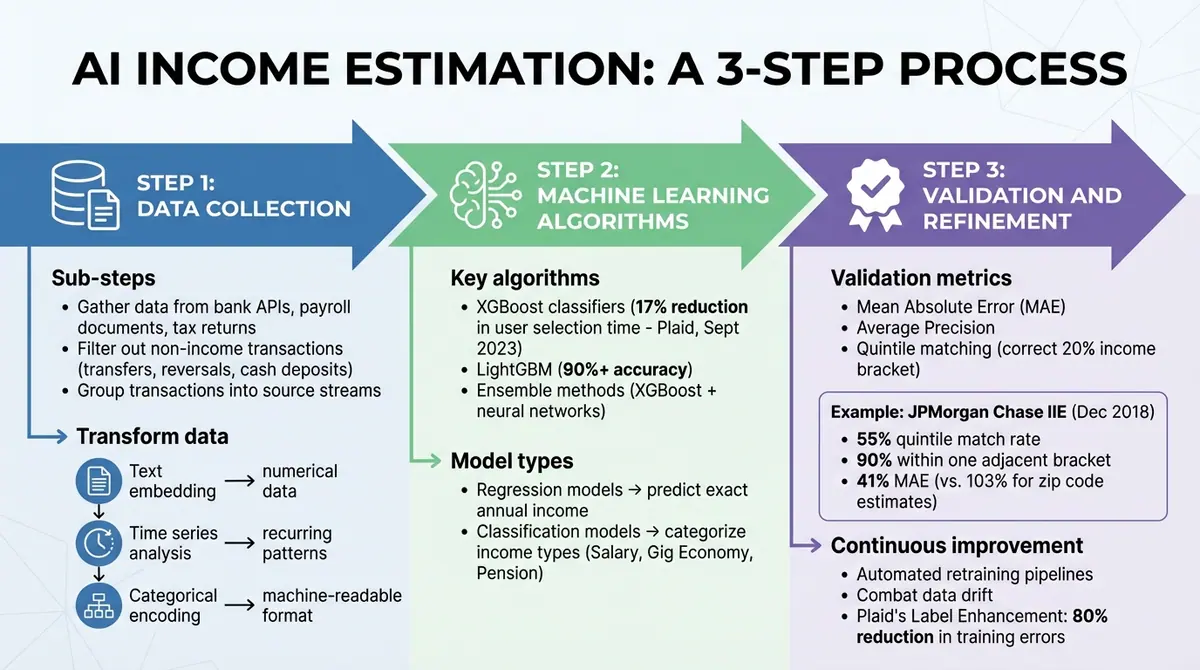
How AI Income Estimation Works: 3-Step Process from Data Collection to Validation
Step 1: Data Collection
The process kicks off with gathering data from various sources, often using multi-step forms to improve completion rates. AI systems pull information from real-time bank transaction streams via APIs, payroll documents like pay stubs and tax returns, and verified datasets from mortgage or credit card applications.
Once this data is collected, it’s cleaned up. This involves filtering out non-income transactions - such as internal transfers, reversed charges, and cash deposits - and grouping similar transactions into distinct "source streams." This step helps separate regular salary payments from more sporadic income, like gig economy earnings.
Next, the system transforms the data into predictive features. Text embedding turns transaction details into numerical data, time series analysis identifies recurring patterns in transaction dates and amounts, and categorical encoding makes details like financial institution IDs machine-readable. AI models also correct mislabeled transactions during this stage.
The cleaned and feature-rich data is then ready to be analyzed by machine learning models.
Step 2: Machine Learning Algorithms
Once the data is prepped, machine learning models get to work identifying income patterns. Most systems rely on supervised learning, where models are trained on verified data from individuals with known income levels to estimate income for others.
Popular algorithms include gradient boosting methods like XGBoost and LightGBM, which excel at handling complex datasets. For example, in September 2023, Plaid used XGBoost classifiers in its Bank Income product. These models cluster transactions and classify whether a stream represents valid income. A/B testing showed this automated system reduced user selection time by 17% compared to manual processes.
Different models serve different purposes. Regression models predict exact annual household income, while classification models determine whether a transaction qualifies as income or categorize it into types such as "Salary", "Gig Economy", or "Pension". Ensemble methods, which combine algorithms like XGBoost and neural networks, deliver more reliable predictions than standalone models. LightGBM, for instance, has achieved over 90% accuracy when predicting annual income based on personal attributes.
Step 3: Validation and Refinement
After predictions are made, rigorous validation ensures their accuracy. Results are compared against verified data using metrics like Mean Absolute Error (MAE), Average Precision, and quintile matching, which checks if predicted income falls into the correct 20% income bracket.
In December 2018, the JPMorgan Chase Institute launched its Institute Income Estimate (JPMC IIE). Using supervised learning trained on mortgage application data, the model predicted income for a broader checking account base. It achieved a quintile match rate of 55%, a 90% rate within one adjacent bracket, and a mean absolute error of 41% - a significant improvement over the 103% error rate of zip code-based estimates.
"Our prediction was only going to be as strong as our truth set. And we needed to make sure that the truth set was representative of the larger universe of customers for whom we were trying to predict income."
- JPMorgan Chase Institute
Continuous improvement is key. Automated retraining pipelines update models with fresh data to counter "data drift", where older patterns lose relevance due to changing economic conditions. For instance, by expanding their truth set to include more lower-income applicants, JPMorgan Chase improved prediction accuracy for the lowest-income quintile by 28 percentage points. Similarly, Plaid's Label Enhancement model reduced training data errors by 80% by identifying and fixing mislabeled transactions.
sbb-itb-5f36581
Using AI Income Estimation in Lead Generation
Personalized Marketing Campaigns
Income data takes marketing strategies from one-size-fits-all to precisely targeted efforts. By tailoring messages, offers, and product recommendations to a lead's estimated income bracket, businesses can significantly improve engagement. For instance, a Fortune 100 financial services company worked with Salesforce Marketing Cloud and IBM Consulting to implement this approach. The result? A 3%–5% boost in target conversion rates through better segmentation and personalized marketing.
Instead of relying on mass email blasts, AI systems can now craft messages that adapt tone, content, and offers based on a lead's financial profile.
"The 2026 evolution of AI lead generation is not about doing more, but about orchestrating better." - Enginy
This level of personalization paves the way for advanced data enrichment, which we'll dive into next.
Lead Enrichment with Reform
Reform's lead enrichment feature, available on its Pro Plan, automates the process of gathering demographic data - like estimated income - by integrating with ExactBuyer. As soon as a user inputs their email address, the system populates this data, eliminating the need for invasive financial questions.
The platform also shortens forms dynamically by hiding fields that AI can fill in automatically. This reduces user fatigue and increases form completion rates. Behind the scenes, hidden fields capture data like income scores for routing and lead scoring purposes, all without being visible to the user.
To ensure seamless implementation, connect your team-level data source, map enriched fields to form blocks, and test entries for accuracy.
But the benefits don’t stop with individual leads. AI insights can also help prioritize which prospects deserve attention first.
Prioritizing High-Value Leads
With real-time income insights, AI-powered lead scoring achieves a qualification accuracy of 70%–85%, a huge leap from the 30%–40% accuracy of manual methods. By analyzing historical data - such as the patterns from your last 500 closed deals - machine learning models can identify factors, including income, that predict a lead's likelihood to convert.
High-value leads are routed directly to sales teams, while lower-priority prospects are placed in automated nurture sequences. Setting clear score thresholds in your CRM ensures the right actions are triggered for each lead. For example, a prospect with a household income above $150,000 might get an immediate phone call, while others might be directed to an email sequence. Speed is critical - companies that contact a lead within an hour of inquiry are nearly seven times more likely to qualify them than those that delay. AI makes this speed possible, scaling operations to handle 10 times the volume without needing extra staff.
Plus, AI-personalized emails have proven to increase open rates by up to 41% and click-through rates by 14%. This shows how AI can transform not just lead generation, but also how effectively businesses engage with their audience.
Benefits and Limitations of AI Income Estimation
Benefits: Speed, Accuracy, and Scalability
AI has completely reshaped how income estimation supports lead generation, offering incredible efficiency and precision.
Instead of relying on slow, manual income verification, AI automates the process, evaluating thousands of prospects in just minutes. To put this into perspective, while a human researcher might handle around 20 leads per day, AI can process the same workload in mere seconds. This speed doesn’t just save time - it drives results. Companies using AI for lead generation have seen up to a 50% boost in leads and appointments.
AI also uses predictive analytics to uncover subtle revenue indicators like recent funding rounds or executive changes - factors that might slip past human analysis. By automating repetitive tasks, sales teams can save 10 to 15 hours per week per representative. Plus, improved data cleaning can raise lead prediction accuracy from 63% to 88%, while close rates climb by 32%.
Scalability is another standout advantage. AI enables businesses to handle enormous datasets without needing to expand their teams, making it possible to grow lead pipelines efficiently.
Limitations: Data Privacy and Bias
Despite its benefits, AI income estimation comes with challenges, particularly around data privacy and bias.
Data privacy is a major concern, as organizations must adhere to strict regulations like GDPR, CCPA, and the EU AI Act, all of which demand transparent and secure data management. Security vulnerabilities also remain a common hurdle for many businesses.
Algorithmic bias is another issue. AI models often rely on historical data, which can reinforce outdated sales patterns and fail to recognize high-value prospects that fall outside traditional trends. For example, research shows that up to 50% of healthcare AI models carry significant bias, often due to missing demographic data or poorly designed algorithms.
Then there’s the "black box" problem. Many AI systems lack transparency, making it tough for users to understand how estimates are generated or to challenge inaccuracies. Over time, model performance can also decline due to evolving market conditions - a phenomenon called concept drift - which requires retraining every few months. Without complete firmographic data, AI accuracy can drop by as much as 27%.
Comparison Table: Benefits vs. Limitations
Here’s a quick look at how the benefits of AI income estimation stack up against its challenges:
| Aspect | Benefits | Limitations |
|---|---|---|
| Speed | Processes thousands of leads in minutes | Relies heavily on high-quality data |
| Accuracy | Uses predictive analytics for better lead qualification | Can be inconsistent when traditional methods are used |
| Scalability | Handles large datasets without extra staff | Needs frequent retraining due to concept drift |
| Personalization | Creates tailored content using real-time signals | May reflect bias from historical data |
| Transparency | Provides data-driven insights | Often operates as a "black box", limiting explainability |
| Compliance | Automates data management within legal frameworks | Must stay ahead of changing data privacy laws |
Key Takeaways
Summary of AI Income Estimation
AI income estimation uses data patterns to predict a prospect's income, helping businesses prioritize leads more efficiently. This process involves three main steps: gathering data from public records and digital activity, using machine learning to identify income-related patterns, and continuously refining predictions to improve accuracy.
This approach not only speeds up lead qualification but also improves targeting, often leading to better results. For example, businesses have reported a 30–40% boost in conversion rates on inbound leads, thanks to quicker response times and more precise targeting.
However, challenges like data privacy concerns and algorithmic bias can’t be ignored. Compliance with regulations like GDPR and CCPA is essential, and businesses must actively address biases that may stem from historical data. To keep predictions accurate as market dynamics evolve, AI models need frequent updates. Striking the right balance between automation and transparency is key - this means understanding how the predictions are made and regularly comparing them to actual outcomes.
These strategies integrate effectively with tools like Reform, enhancing lead generation efforts.
Using Reform for Better Lead Generation
To make the most of AI-driven insights, capturing high-quality data is critical. Reform’s no-code form builder simplifies this process. Features like multi-step forms with conditional routing help minimize form abandonment while ensuring complete data collection. Automatic lead enrichment adds essential details, and tools like email validation and spam prevention keep your data accurate and clean.
Reform also integrates directly with CRM platforms and marketing tools like Mailchimp. This allows AI-estimated income data to seamlessly enter your workflows, enabling you to segment prospects by income level, tailor outreach to match their purchasing power, and assign high-value leads to senior sales reps - all without manual effort. By fine-tuning your form fields and using JavaScript triggers to track user behavior, you can gather the signals AI needs to make sharper income predictions and focus on leads with the highest conversion potential.
FAQs
What data does AI use to estimate income?
AI determines income by examining data such as bank transactions, payroll records, and pay stubs. Using machine learning models, it processes this information to quickly pinpoint and classify income sources, delivering precise results in real time.
How accurate is AI income estimation in real-world use?
AI-powered income estimation can deliver impressive accuracy, particularly when leveraging machine learning models designed to handle extensive datasets. These models excel at analyzing vast amounts of information quickly, often in real time, to produce dependable results. This capability is evident in advanced income verification systems, where precision is key.
How can I use AI-estimated income for lead scoring without violating privacy laws?
To ethically incorporate AI-estimated income for lead scoring, prioritize compliance with privacy laws. Start by obtaining explicit consent from individuals and being upfront about how their data will be used. Protect personal information by implementing privacy-preserving methods like anonymization to safeguard identities.
Additionally, keep your privacy policies up to date to align with current regulations and industry standards. This not only minimizes potential misuse but also ensures you're handling income estimates responsibly while maintaining trust with your audience.
Related Blog Posts
Get new content delivered straight to your inbox

The Response
Updates on the Reform platform, insights on optimizing conversion rates, and tips to craft forms that convert.




Drive real results with form optimizations
Tested across hundreds of experiments, our strategies deliver a 215% lift in qualified leads for B2B and SaaS companies.
