
.webp)
5 Alternatives to Third-Party Cookies for Identity Resolution



Third-party cookies are disappearing, and marketers need new ways to track and understand audiences. Here are five effective alternatives to adapt to this privacy-first era:
- First-Party & Zero-Party Data: Collect data directly from your users, such as purchase history (first-party) or preferences they willingly share (zero-party). This ensures compliance and builds trust.
- Universal IDs: Use hashed, consented identifiers like email addresses to link user activity across platforms while respecting privacy.
- Identity Graphs & Data Clean Rooms: Combine internal and external data securely to create unified customer profiles without exposing raw data.
- Contextual & Cohort-Based Targeting: Focus on user interests or group behaviors instead of personal identifiers to deliver relevant ads.
- Authentication & Progressive Profiling: Encourage logins and gradually collect user information over time to enhance personalization and user experience.
Quick Comparison:
| Alternative | Data Type | Privacy Compliance | Key Use | Complexity |
|---|---|---|---|---|
| First/Zero-Party Data | Direct user data | High | Personalization | Low to Moderate |
| Universal IDs | Hashed identifiers | Moderate | Cross-platform tracking | Moderate |
| Identity Graphs & Data Clean Rooms | Aggregated, anonymized data | High | Measurement & attribution | High |
| Contextual & Cohort Targeting | Non-personal data | Very High | Broad audience reach | Low to Moderate |
| Authentication & Progressive Profiling | Verified user profiles | High | Personalization & UX | Moderate |
Each method addresses specific challenges. Combining these strategies can help you maintain accurate identity resolution while staying privacy-compliant.
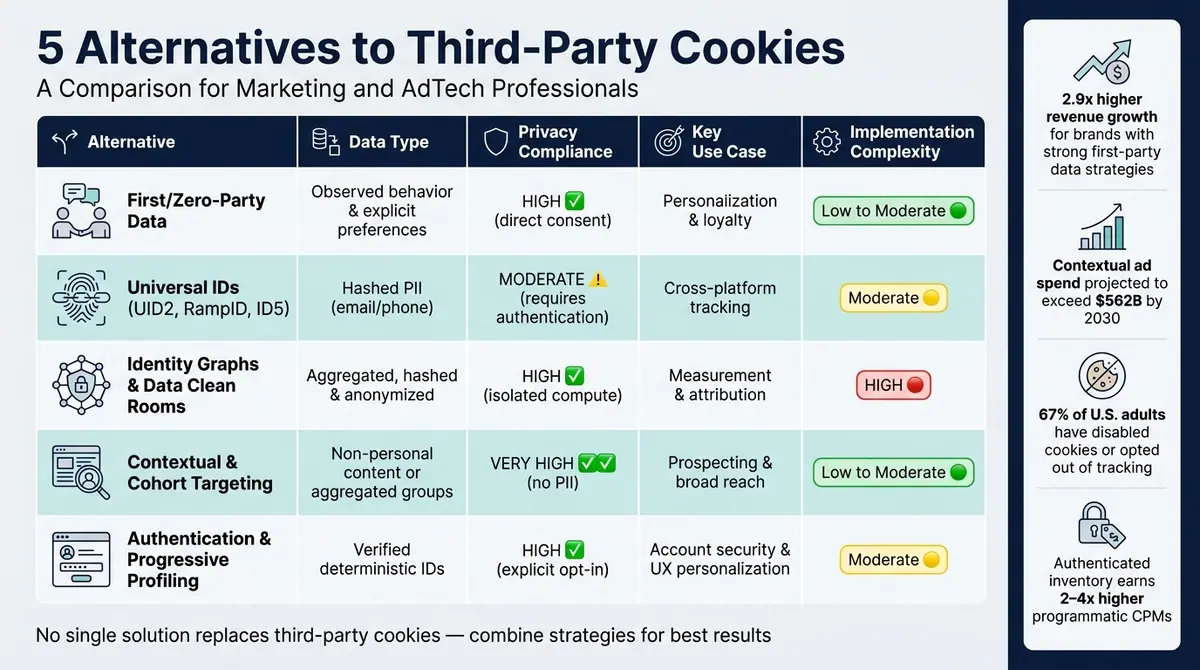
5 Third-Party Cookie Alternatives: Privacy, Complexity & Use Cases Compared
6 Alternatives to Third Party Cookies and Mobile IDs in AdTech
sbb-itb-5f36581
1. First-Party and Zero-Party Data Strategies
The strongest starting point for identity resolution lies in the data you directly control. First-party data (1P) comes from what you observe firsthand - things like purchase history, website activity, app usage, or customer service interactions. On the other hand, zero-party data (0P) is information that users voluntarily share with you - such as their style preferences, quiz responses, or communication settings. Both types of data are collected through your own platforms, with explicit consent, and don't rely on third-party tracking. While first-party data tells you what a customer did, zero-party data explains why they did it.
"Zero-party data is gold... it means that the brand doesn't have to go off and infer what the customer wants." - Fatemeh Khatibloo, VP Principal Analyst, Forrester Research
The numbers back this up. Businesses with well-established first-party data strategies report up to 2.9x higher revenue growth and 1.5x greater cost efficiency compared to those still relying on cross-site tracking. Take Shopify brand Billy Footwear as an example: in May 2026, they saw a 36% year-over-year revenue boost while increasing ad spend by just 7%. Their secret? A first-party identity-resolved attribution system that clarified which channels - Meta, Google, or email - were driving genuine new customer acquisitions.
This success hinges on deterministic matching, which uses verified identifiers like hashed emails or phone numbers to link records. This method is not only more accurate but also aligns better with legal requirements, especially as 19 U.S. states now enforce comprehensive privacy laws. Combine this with progressive profiling - starting with simple questions during signup and gradually collecting more preferences after purchases - and you can build detailed customer profiles without overwhelming or alienating users.
Another key piece of the puzzle is server-side tracking. By shifting critical conversion events from browser-based pixels to server-to-server APIs, such as Meta's Conversion API, businesses can recover 15–30% of conversions typically lost to ad blockers and browser restrictions. Considering that about 30% of desktop users now use ad blockers, this is a significant gap to address. First-party infrastructure provides a seamless way to close that gap. Up next, we’ll explore how universal IDs can take identity resolution to the next level.
2. Universal IDs (e.g., UID2, ID5, RampID)
Expanding on first-party data strategies, universal IDs help extend your reach across the open internet. Instead of relying on browser cookies, these systems create deterministic identifiers from information users have willingly shared, like email addresses or phone numbers. This approach enables a secure and measurable way to resolve identities across multiple channels.
Here’s how it works: a user’s email address is first normalized (converted to lowercase and stripped of unnecessary spaces) and then encrypted using SHA-256 hashing. This process generates a universal identifier - such as a UID2 token, RampID, or ID5 ID - that can be recognized by publishers, DSPs, and ad platforms. Importantly, the raw email itself is never sent through the bidstream; only the encrypted token is shared. This design makes it much harder to track users across sites persistently.
Different universal ID solutions take unique approaches. For example, UID2, developed by The Trade Desk and now open-source, is tailored for programmatic advertising. It uses rotating "salt buckets", which change approximately 1/365 of the buckets daily. This means a user's Raw UID2 typically updates about once a year. On the other hand, LiveRamp's RampID employs its proprietary AbiliTec technology to connect offline data points - like names and postal addresses - with online devices, creating a unified, pseudonymized profile. Both systems are designed to operate in environments where cookies are absent, such as Connected TV (CTV), mobile apps, and the broader web.
Privacy is a core feature of these systems. UID2, for instance, includes a centralized Transparency and Control Portal where users can opt out entirely. Daily API checks ensure that opt-out requests are honored. Additionally, UID2 explicitly bans the processing of HIPAA-regulated health data, even with user consent. RampID takes a different route, assigning unique ID values for each client domain, which prevents data sharing between companies without authorization.
Implementing these solutions requires some technical groundwork. Businesses need to normalize input data (e.g., formatting phone numbers to the E.164 standard), manage refresh timestamps on servers, and automate checks for ID rotations and opt-out signals. Tools like SDKs in Python, Java, or JavaScript simplify tasks like token generation, encryption, and refresh processes. These practices ensure privacy-preserving identity resolution, a critical need in today’s digital ecosystem.
3. Identity Graphs and Data Clean Rooms
With privacy regulations becoming stricter, tools like identity graphs and data clean rooms have become vital for achieving precise, consent-driven identity resolution. While universal IDs aim to track identities across the open web, identity graphs focus on a more specific goal: connecting a single user across all the touchpoints they interact with - whether it's your app, website, email, or even an in-store visit. Essentially, an identity graph is a database that links identifiers like hashed emails, device IDs, IP addresses, and customer IDs back to a single individual or household.
How Identity Graphs Work
Identity graphs use two main methods for matching:
- Deterministic matching: This method relies on exact, verified data - such as a confirmed login or hashed email - to create highly accurate links between records.
- Probabilistic matching: This approach uses statistical patterns, like shared IP addresses or browsing behaviors, to infer connections between devices that likely belong to the same person.
Most advanced identity graphs combine these methods. Deterministic logic serves as the backbone, while probabilistic signals help expand coverage. The challenge is not small - on average, households interact with brands through 21 connected devices. This makes cross-device linking both essential and complicated.
What Data Clean Rooms Bring to the Table
While identity graphs focus on unifying internal data, data clean rooms allow companies to collaborate on data securely without exposing raw records. The concept revolves around compute-to-data, meaning raw data stays protected behind each company's firewall. Only aggregated insights or anonymized tokens are shared across the boundary. Technologies like PSI (Private Set Intersection), SMPC (Secure Multi-Party Computation), and TEEs (Trusted Execution Environments) make this secure collaboration possible.
Real-World Impact
The benefits of these tools are clear in practice. For example:
- Whirlpool: In 2026, the company used identity resolution to create a complete view of its customers, distinguishing between those interacting with retail partners and its direct-to-consumer site. This led to 5x greater reach to target audiences and eliminated 200,000 duplicate audience records, significantly reducing wasted media spend.
- Tailored Brands: By resolving all digital data to a single identifier (RampID), Men's Wearhouse achieved a 26% higher ROAS (Return on Ad Spend) on the web, while Jos. A. Bank saw a 42% increase in incremental revenue.
Challenges in Implementation
Building and maintaining these systems is no small feat. Developing a proprietary identity graph requires direct data partnerships and constant validation, which can double match rates compared to relying on third-party data. Clean rooms come with their own technical hurdles: data must be meticulously prepared before entry. For example, improperly formatted emails or phone numbers (e.g., whitespace errors or missing country codes) can disrupt SHA-256 hashing, voiding matches entirely.
Compliance is another critical factor. Clean rooms often enforce k-anonymity thresholds, suppressing results from groups smaller than 50 users to protect privacy. Some systems also implement a privacy budget, which limits the number of queries allowed on a dataset to prevent identity triangulation through repeated attempts.
"Clean rooms are infrastructure, not intelligence. Without strong measurement frameworks, clean rooms risk becoming expensive query layers that surface correlations without context." - Emily Sullivan, Content Marketing Strategist, fusepoint
These tools offer immense potential, but their success depends on precise execution and a strong foundation in both technical and measurement strategies.
4. Contextual and Cohort-Based Targeting
Contextual and cohort-based targeting takes a different path compared to identity graphs and clean rooms. Instead of focusing on who the user is, this method zeroes in on where the user is and what they’re interested in at the moment - without relying on personal identifiers. It’s all about tapping into the relevance of current content rather than past behavior.
"If behavioral targeting is about who the user is based on where they've been, contextual targeting is about what the user is interested in right at this moment." - Philip Mahler, Eskimi
Contextual Targeting
This approach places ads based on the content a user is actively engaging with, rather than their browsing history. Advanced systems use tools like Natural Language Processing (NLP), sentiment analysis, and computer vision to evaluate the content and determine the best ad placement. For example, these systems can assess not just the topic of an article but also its tone, helping advertisers avoid placing ads next to emotionally charged or negative content.
Cohort-Based Models
Cohort-based targeting focuses on groups rather than individuals. For instance, Google's Topics API categorizes users into broad interest groups based on locally processed browsing data. This method ensures privacy by avoiding individual tracking while still reaching relevant audience segments. Considering that only about 10% of internet traffic is from logged-in users, cohort-based strategies are crucial for connecting with the other 90% of unauthenticated users.
Privacy and Market Trends
Both contextual and cohort-based targeting align well with privacy regulations like GDPR and CCPA because they don’t rely on persistent individual identifiers. This is particularly important as 67% of U.S. adults have disabled cookies or opted out of website tracking. Additionally, the demand for contextual advertising is projected to grow significantly, with spending expected to surpass $562 billion annually by 2030.
Challenges and Solutions
While these methods improve targeting accuracy, they bring new hurdles for measurement. Without persistent IDs, managing ad frequency across publishers becomes tricky, and attribution often defaults to last-click models, which can skew budget decisions. To navigate these challenges, you can:
- Combine contextual signals with first-party data.
- Use tools like Google’s Consent Mode V2 to model conversions when users decline tracking consent.
- Start small by allocating 10–15% of your budget to test contextual segments before scaling up.
5. Authentication and Progressive Profiling
Authentication, much like the earlier strategies, revolves around obtaining user consent and maintaining clear data collection practices. While contextual and cohort-based methods don’t require identifying individual users, authentication takes a more direct route. It links anonymous browsing activity to a real user profile through logins, even when cookies are deleted.
The magic ingredient here is progressive profiling. Instead of overwhelming users with lengthy forms, this method gathers data bit by bit, reducing the chances of users abandoning the process. For example, each additional field in a signup form can decrease completion rates by 5–15%. A simple email-only signup form often sees 30–60% higher completion rates compared to a seven-field form.
"The 2026 default is one-step signup - email or social, nothing else. Everything else is collected contextually as the user takes actions that justify the specific data." - Deepak Gupta, Technical Co-founder & CEO, GrackerAI
Once a user logs in, data collection becomes more contextual. For instance, you might request a shipping address during checkout, a job title after a few logins, or a phone number when enabling two-factor authentication. This approach not only aligns with GDPR’s Article 5(c) on data minimization but also meets CCPA standards by using regional compliance zones to display "Do Not Sell" options automatically. The table below illustrates how data is collected in stages throughout the customer journey:
| Data Tier | Collection Stage | Data Examples |
|---|---|---|
| Core | Initial signup | Email, social ID, first name |
| Enrichment | Post-signup/onboarding | Job role, team size, industry |
| Intent | Feature engagement | Budget, integrations, timeline |
| Transactional | First checkout or action | Shipping address, phone (for MFA) |
From a revenue perspective, authenticated users are immensely valuable. Authenticated inventory can earn 2–4× higher programmatic CPMs compared to unauthenticated impressions. Publishers with over 30% of their monthly active users registered report an average revenue per user that is 2.3 times higher than publishers with less than 10% registration. Once users are authenticated, their hashed email or phone number can be used with frameworks like UID2 or ConnectID, enabling addressable audiences across the open web.
"Third party cookie deprecation is not a tactical SEO problem you patch with a header bidding tweak. It is a structural shift that makes the publisher's authentication system the single most important piece of revenue infrastructure on the open web." - Gopal Gehlot, Product & Identity Evangelist
Comparison Table
The table below lays out a side-by-side comparison of five alternatives to third-party cookies. None of these methods can fully replace third-party cookies on their own. Instead, each tackles specific challenges, and the best approach depends on your technical capabilities, audience engagement, and compliance needs. Here's how they compare:
| Alternative | Data Type | Privacy Compliance | Key Application | Implementation Complexity |
|---|---|---|---|---|
| 1. First/Zero-Party Data | Observed behavior & explicit preferences | High (direct consent) | Personalization & loyalty | Low to moderate |
| 2. Universal IDs | Hashed PII (email/phone) | Moderate (requires authentication) | Cross-site targeting | Moderate (API integration) |
| 3. Identity Graphs & Clean Rooms | Aggregated, hashed & anonymized | High (isolated compute) | Measurement & attribution | High (infrastructure-heavy) |
| 4. Contextual & Cohort Targeting | Non-personal content or aggregated groups | Very high (no PII) | Prospecting & reach | Low to moderate |
| 5. Authentication & Progressive Profiling | Verified deterministic IDs | High (explicit opt-in) | Account security & UX | Moderate (login flows) |
The table highlights some key trends. Contextual and cohort-based targeting is the simplest to implement and has the least compliance hurdles since it avoids using personally identifiable information (PII). This makes it an excellent starting point for teams with limited technical resources. On the other hand, identity graphs and clean rooms demand substantial data engineering investment but provide robust governance and auditability, making them a strong choice for enterprises focused on detailed measurement.
A balanced approach, such as leveraging first-party data, combines ease of use with strong regulatory compliance. Tools like Reform simplify the process by auto-identifying visitors through email submissions, ensuring that the data collected is owned by the brand and obtained with clear consent.
"When identity is resolved within first-party boundaries and managed directly at the data layer level, compliance with regulations such as GDPR and CCPA is no longer an after-the-fact constraint, but a structural characteristic." - Bytek
Conclusion
No single solution can entirely replicate the role third-party cookies once played. The five approaches discussed - first/zero-party data, universal IDs, identity graphs and clean rooms, contextual and cohort targeting, and authentication with progressive profiling - each tackle different aspects of identity resolution. The real power lies in combining these methods.
Think of it like a backbone: deterministic identifiers (such as verified logins and hashed emails) form the sturdy core, while probabilistic signals bridge the gaps, creating a seamless identity framework.
This approach isn’t just about performance - it’s also about compliance. Daniel Mercer, Senior Identity & Access Management Editor, highlights this perfectly:
"The winners in the post-cookie era will not be the teams with the most data; they will be the teams with the cleanest consent model, the strongest deterministic identifiers, and the most disciplined data lifecycle controls."
To lay a strong, privacy-first foundation, start by auditing the first-party data you already collect - like form submissions, login events, and CRM records - and map them to a clear activation path. Tools such as Reform simplify the process of gathering consented, high-quality first-party data through conversion-friendly forms. Once you’ve established this base, incorporate progressive profiling to enrich user profiles over time. Set clear rules for how long signals remain valid before they expire.
Success in the post-cookie world depends on viewing identity as a long-term investment, not a quick fix. Start today to create a resilient, compliant data strategy that will stand the test of time.
FAQs
Which cookie alternative should I start with first?
The best alternative to cookies largely depends on your specific requirements and where your audience is located. A great starting point is focusing on first-party data strategies. This involves leveraging data collected directly from your website, app, CRM, or loyalty programs - resources you control and can rely on.
For businesses operating in the U.S., UID2 is a dependable choice. On the other hand, if your organization caters to a significant European audience, NetID is better suited, as it aligns with EU privacy regulations.
Do universal IDs still count as PII tracking?
Universal IDs are typically not considered PII tracking when they utilize hashed or encrypted data rather than storing raw personal details. By relying on privacy-compliant, pseudonymous identifiers, these IDs protect user privacy while avoiding the exposure of sensitive personal information.
How can I measure conversions without third-party cookies?
You can track conversions without relying on third-party cookies by using privacy-focused attribution techniques. For instance, server-side tracking shifts data collection to your server, allowing you to capture most conversion data while maintaining privacy. Another option is incrementality testing, which evaluates the difference in outcomes between groups exposed to your ads and those that aren't. You might also consider marketing mix modeling (MMM), which uses aggregated data to assess performance. Finally, leveraging zero-party data - information users willingly share - can offer meaningful insights while respecting their privacy.
Related Blog Posts
Get new content delivered straight to your inbox

The Response
Updates on the Reform platform, insights on optimizing conversion rates, and tips to craft forms that convert.




Drive real results with form optimizations
Tested across hundreds of experiments, our strategies deliver a 215% lift in qualified leads for B2B and SaaS companies.
