
.webp)
5 Alternatives to Third-Party Cookies for Tracking



The end of third-party cookies has reshaped how marketers track users online. With Chrome joining Safari and Firefox in limiting cookie-based tracking, businesses must now rely on privacy-friendly methods to gather insights. Here are five effective alternatives:
- First-Party Data: Collected directly from your customers, this data is accurate, consent-driven, and aligns with privacy laws like GDPR and CCPA.
- Google’s Privacy Sandbox: A set of on-device APIs that prioritize user privacy while enabling ad relevance and measurement.
- Universal IDs: Consent-based identifiers that work across devices and platforms, offering reliable tracking without cookies.
- Zero-Party Data: Information users willingly share, such as preferences or purchase intentions, typically gathered through quizzes or surveys.
- Contextual Targeting: Focuses on the content of a webpage rather than user behavior, ensuring privacy compliance while delivering relevant ads.
Quick Comparison
| Method | Privacy Compliance | Data Accuracy | Ease of Use | Scalability |
|---|---|---|---|---|
| First-Party Data | High | High | Requires upfront investment | Limited to existing customers |
| Privacy Sandbox | High | Moderate | Requires technical setup | Broad browser coverage |
| Universal IDs | High | High | Relies on user logins | Depends on industry adoption |
| Zero-Party Data | High | High (self-reported) | Simple tools like surveys | Requires user participation |
| Contextual Targeting | High | Moderate | Easy to implement | Works across all browsers |
To stay competitive, combine these strategies. Use first-party and zero-party data for known users, contextual targeting for anonymous audiences, and explore Privacy Sandbox or Universal IDs for broader reach. Start testing now to prepare for a cookieless future.
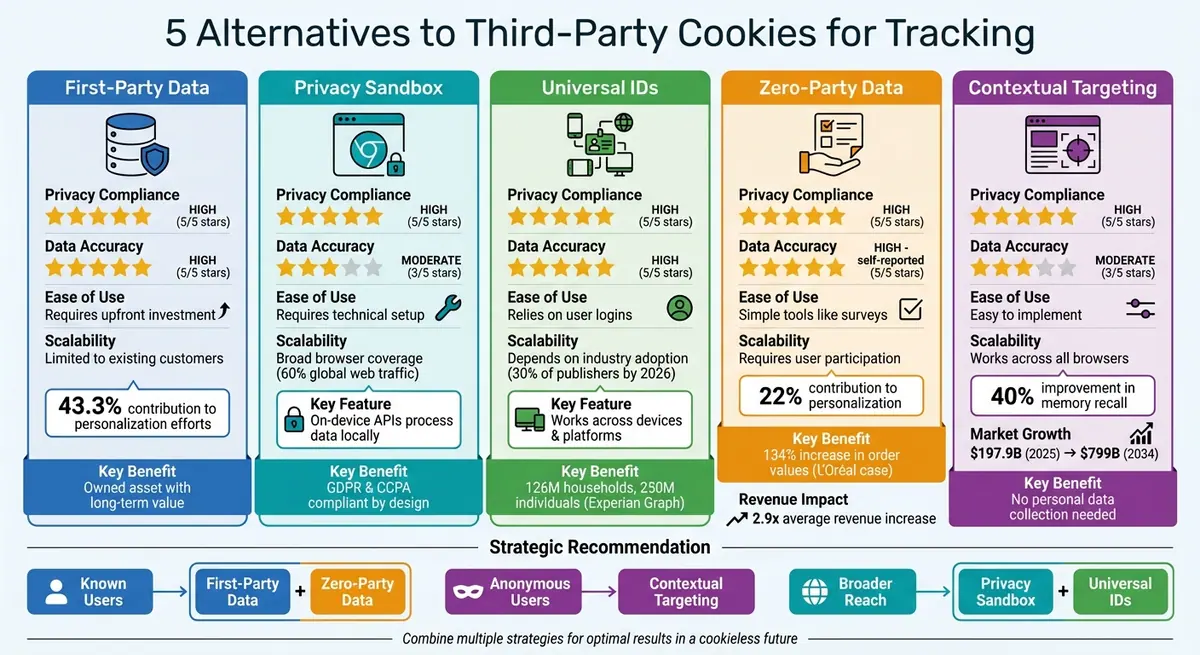
Comparison of 5 Cookie-Free Tracking Alternatives for Digital Marketing
Cookieless Tracking: What does that mean for businesses?
sbb-itb-5f36581
1. First-Party Data
First-party data refers to the information you gather directly from your customers through interactions on your website, app, email campaigns, or CRM systems. Unlike third-party cookies, which track users across different sites, this data comes from customers who knowingly share their information with your brand.
This shift toward first-party data is becoming increasingly important. By January 2026, 19 U.S. states, including Indiana, Kentucky, and Rhode Island, will have implemented comprehensive privacy laws. Additionally, about 34.9% of U.S. browser traffic blocks third-party cookies by default, thanks to browsers like Safari and Firefox. As Andrew Frank of Gartner explains, "First-party data has become the strategic asset that powers competitive advantage in an AI-driven marketing landscape".
Privacy Compliance
First-party data naturally aligns with privacy laws because it’s collected directly from customers with their consent. When someone fills out a lead capture form or creates an account, they understand who is collecting their information and for what purpose, making compliance with regulations like GDPR and CCPA much simpler. Since this data remains within your ecosystem, the risks associated with external data brokers - often criticized for their opaque sourcing practices - are avoided.
Data Accuracy
First-party data provides more reliable insights compared to third-party alternatives because it captures real-time customer actions. Server-side tracking can recover 15–30% of lost conversion signals caused by blockers, using deterministic identifiers like hashed emails or login IDs for consistent cross-device tracking. This precision boosts B2B lead generation and personalization, with first-party data contributing to 43.3% of personalization efforts, compared to 33.9% for third-party data. Additionally, server-set first-party cookies can last up to 400 days, while browser-restricted cookies may expire in as little as 24 hours. This level of accuracy simplifies implementation and enhances outcomes.
Ease of Implementation
While adopting first-party data requires an upfront investment, server-side tagging has made the process more straightforward. By shifting tracking from browsers to your servers, you can bypass client-side blockers and ensure critical events, like purchases or signups, are accurately captured. Encouraging customers to share their data willingly is key - loyalty programs with clear rewards often result in 3–5 times higher account creation rates than access-only programs. Well-designed consent experiences can achieve opt-in rates of 60–75%, even in regions with strict privacy laws like the EU. Integrating consent logic into event triggers further streamlines compliance.
Scalability
First-party data is not only accurate and privacy-compliant but also adaptable as businesses grow. That said, its scope is limited to users who already interact with your brand. For smaller businesses, engineering challenges can arise, but Customer Data Platforms (CDPs) help by consolidating data from websites, apps, and CRMs into a unified identity graph. To expand your reach, you can use first-party data to create lookalike audiences on platforms like Google and Meta. Focus on tracking high-value actions - like checkout steps or lead submissions - that directly impact revenue, rather than collecting data that doesn’t inform decision-making.
| Feature | First-Party Data | Third-Party Data |
|---|---|---|
| Source | Direct interaction with your brand | Aggregated from external brokers |
| Accuracy | High; based on actual behavior | Low; often inferred or outdated |
| Privacy Risk | Low; clear consent and transparency | High; opaque sourcing |
| Cost | Upfront infrastructure investment | Pay-per-use rental fees |
| Ownership | Owned asset with long-term value | Rented access |
2. Google's Privacy Sandbox
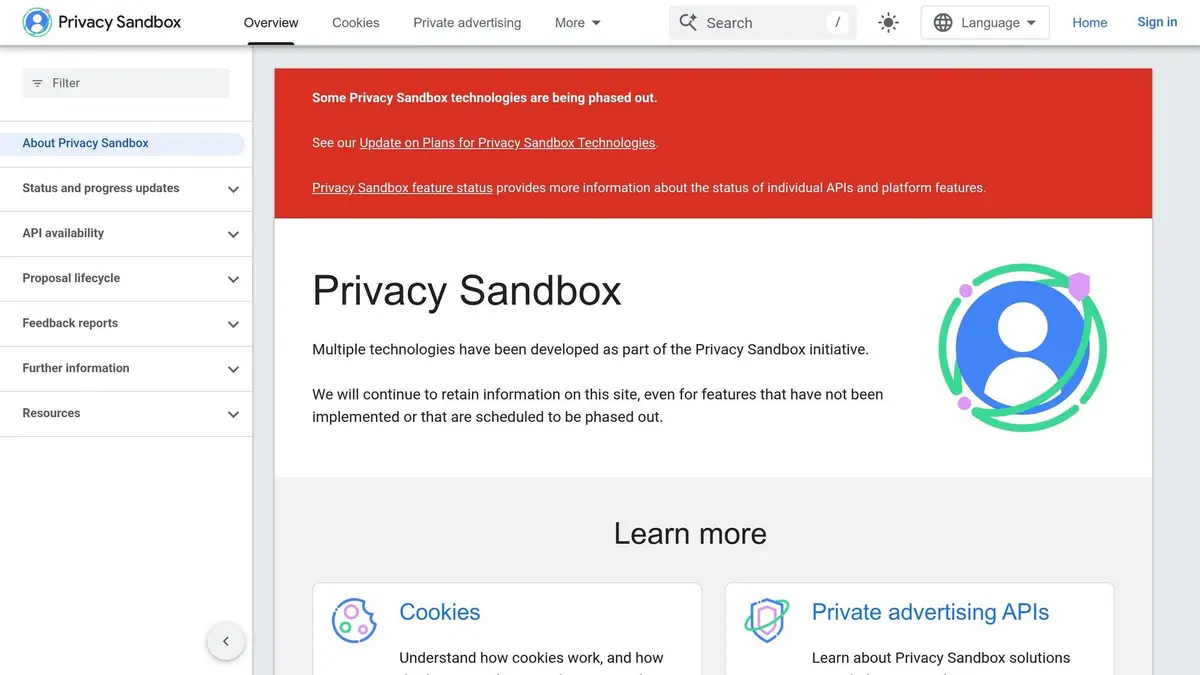
Google's Privacy Sandbox is designed to replace third-party cookies with on-device APIs, ensuring ad relevance and measurement while prioritizing user privacy. Instead of relying on cross-site tracking, these APIs process data directly on users' devices. Considering that Chrome accounts for about 60% of global web traffic, this shift is a major development for marketers. This browser-based solution works alongside first-party data and other privacy-conscious alternatives.
The Privacy Sandbox includes several APIs with specific purposes. For example, the Topics API identifies user interests locally without exposing detailed browsing histories. The Protected Audience API enables remarketing through on-device auctions, and the Attribution Reporting API measures conversions using aggregated data with added noise to protect anonymity. In collaboration with ecosystem partners, Chrome has proposed over 30 initiatives to establish new web standards.
Privacy Compliance
The Privacy Sandbox complies with major privacy regulations like GDPR and CCPA by ensuring users' raw browsing data stays on their devices, avoiding transmission to external servers. For instance, the Topics API holds interest categories for up to three weeks before deleting them. Meanwhile, the Attribution Reporting API uses differential privacy techniques, working with aggregated and anonymized data to prevent user re-identification.
Additionally, Google collaborates with organizations like the UK's Competition and Markets Authority and the Information Commissioner's Office to ensure these tools meet privacy standards without unfairly benefiting its own ad operations. These efforts align with other privacy-focused solutions, emphasizing the balance between actionable insights and user consent.
Data Accuracy
A trade-off for enhanced privacy is reduced precision in targeting and measurement. Unlike the deterministic tracking offered by third-party cookies, the Privacy Sandbox relies on modeled data and aggregated signals. This means advertisers must shift to probabilistic matching and summary-based reporting. To address these challenges, marketers often combine Privacy Sandbox data with Media Mix Modeling, adapting their strategies for this new approach. These changes pave the way for tools that integrate effectively with first-party data strategies.
Ease of Implementation
While privacy and measurement are central, the practical implementation of the Privacy Sandbox is equally crucial for marketers moving away from cookie-based tracking. Transitioning requires technical integration, including a shift from client-side tracking pixels to server-side tagging and the adoption of multiple APIs. To simplify this process, Google's Tag Gateway helps streamline server-side implementation, reducing infrastructure demands while improving data quality.
As a starting point, marketers should audit their current reliance on third-party cookies and establish a Consent Management Platform. This setup is essential for building high-converting forms that respect user privacy while capturing necessary data. This ensures user opt-outs are respected and consent states align with the appropriate Sandbox APIs.
3. Universal IDs
Universal IDs, introduced by independent ad-tech companies, aim to replace cookie-based tracking with a more reliable, consent-driven system. These IDs rely on hashed, deterministic identifiers that work across various devices - like smartphones, tablets, and desktops - and platforms. Unlike cookies, which are often limited to a single domain, Universal IDs offer a broader, more consistent tracking method. Prominent examples include Unified ID 2.0 (The Trade Desk), RampID (LiveRamp), ID5, and Publisher Common ID. Some providers even boast nearly perfect matching accuracy, helping marketers avoid the inefficiencies of cookie syncing.
Privacy Compliance
Universal IDs are designed with privacy in mind. Personal data is encrypted or hashed before sharing, creating a pseudonymous identifier that’s hard to trace back to an individual. This system ensures that data sharing happens only with approved partners, and users have the ability to opt out. As James Phang explains:
"None of this should be used to sneak around consent. The ethics and legality hinge on transparency, scope, and governance".
By early 2026, around 30% of global publishers had adopted a first-party ID solution. To make Universal IDs work effectively, publishers can encourage users to sign in by offering perks like newsletters, gated content, or loyalty programs. It’s also important that Consent Management Platforms (CMPs) properly communicate user preferences - such as "reject all" options - to ID vendors downstream.
Data Accuracy
Universal IDs provide better user recognition and higher match rates compared to traditional, cookie-based tracking. For instance, the Experian Graph, which supports IDs like UID2 and ID5, connects to 126 million households and 250 million individuals. This allows marketers to maintain a cohesive view of users across devices and platforms, even without cookies. However, no single Universal ID currently has the reach to completely replace third-party cookies. As Experian notes:
"Universal identifiers are valuable for tracking users across different devices and websites. However, no single universal identifier has enough reach to fully replace third-party cookies".
One of the main hurdles is the "login wall." Since Universal IDs rely on authenticated users, they struggle to account for the large portion of anonymous web traffic.
Ease of Implementation
To implement Universal IDs, marketers need to create a compelling "value exchange" through impressive multi-step form design that encourages users to log in, as these IDs depend on authenticated data like email addresses. Fortunately, established tools like Prebid's User ID Modules make integration relatively straightforward, without requiring extensive manual coding. Testing Universal ID integrations - allocating roughly 5–10% of your budget - can help prepare for the eventual end of third-party cookies. A strong first-party data strategy, paired with clear incentives, can expand the pool of authenticated users. Additionally, it’s critical to ensure your demand-side (DSP) and supply-side (SSP) partners support the chosen Universal ID framework for smooth operation. Evaluating whether Universal IDs improve site performance - such as reducing pixel sync requests - can also highlight added benefits. However, like first-party solutions, Universal IDs remain limited by their reliance on logged-in users, leaving anonymous traffic unaddressed.
Scalability
Scalability is key to the success of Universal IDs. Their effectiveness depends on widespread adoption by publishers and ad-tech platforms. Since no single solution offers complete coverage, the industry is moving toward using multiple interoperable IDs to maximize reach. Companies like Disney, VideoAmp, and Magnite are adopting a "graph-of-graph" strategy - combining their first-party data with licensed identity graphs to maintain user addressability. By leveraging multiple identifiers, such as UID2, ID5, and LiveRamp ATS, businesses can improve overall reach and performance. However, the success of Universal IDs ultimately hinges on achieving a critical mass of adoption among publishers and advertisers. They work best as part of a broader strategy that includes contextual targeting and first-party data solutions.
4. Zero-Party Data
Zero-party data refers to the information customers willingly provide - like their preferences, product sizes, purchase intentions, or personal interests. This data is typically collected through quizzes, surveys, or conversational forms.
Privacy Compliance
With zero-party data, customer consent is explicit right from the beginning. There’s no hidden tracking or sneaky scripts. Customers are fully aware of what they’re sharing and why. As Shreya from CookieYes puts it:
"Zero-party data is the foundation of privacy-first personalisation. By inviting users to share meaningful preferences and rewarding them fairly, you build trust, improve targeting accuracy, and remain compliant."
The importance of transparency is clear. Studies show 71% of consumers will stop supporting brands that misuse data or fail to explain their intentions, and 67% have actively disabled cookies or tracking when given the option. This transparency not only builds trust but also ensures the data collected is highly accurate.
Data Accuracy
Zero-party data avoids the pitfalls of inferred behavior, offering precise insights into factual details like sizes or communication preferences. However, there’s a small caveat: aspirations shared by customers may not always align with their actual behavior.
For instance, while 81% of brands believe they understand their customers well, only 46% of consumers feel the same. Yet, the value of zero-party data is undeniable. In March 2026, L'Oréal's Routine Finder quiz helped brands collect specific customer preferences, leading to a 134% increase in order values. Moreover, while first-party data contributes 43.3% to personalization efforts, zero-party data adds another 22.0%.
Ease of Implementation
Gathering zero-party data doesn’t require advanced technical skills - it’s more about creativity. Interactive tools like quizzes, micro-surveys, and preference centers can engage users effectively while providing value in exchange for their data. Keeping these tools simple is key: quizzes with 5–8 questions tend to have higher completion rates. Using conversational language also helps - phrases like "friend or family" feel more approachable than "referral" in forms.
Platforms like Reform make the process easier with features like multi-step forms, conditional routing, and real-time analytics. For example, in 2026, Modulo, an EdTech app developer, achieved a 15.2% conversion rate - three times the industry average - on their 12-minute feedback form. Not only did 56.7% of respondents opt into their mailing list, but the data collected was both accurate and actionable. However, scaling zero-party data collection requires thoughtful planning and strategy.
Scalability
Because zero-party data depends on active user participation, offering attractive incentives - like discounts, exclusive content, or early access - can encourage customers to share more information.
To scale effectively, integrate data collection naturally into various points of the customer journey, such as onboarding, post-purchase, or account settings. Progressive profiling - gathering information over time rather than all at once - can prevent users from feeling overwhelmed. Additionally, make preference centers easily accessible, such as through email footers, so customers can update their interests whenever they choose. Brands that actively combine first-party and zero-party data strategies have reported an average revenue increase of 2.9x.
5. Contextual Targeting
Contextual targeting shifts the focus from who the user is to where the ad appears. By analyzing page content - such as keywords, themes, sentiment, and tone - it delivers relevant ads in real time. Since it doesn’t depend on personal identifiers or cross-site tracking, this approach is naturally privacy-friendly and works across all browsers, including Safari and Firefox, which block third-party cookies. This method complements other cookie-free solutions by focusing on the content rather than individual behavior.
Privacy Compliance
Because contextual targeting doesn’t collect or store personal data, it aligns with privacy regulations like GDPR, CCPA, and the ePrivacy Directive. It eliminates the need for complex consent management systems, as it targets the content environment rather than the individual user. As Next Millennium states:
"Contextual ads are brand-safe by design as they only appear in relevant environments."
This privacy-first approach is becoming increasingly important, especially as about 44% of users now actively review cookie settings instead of blindly accepting them.
Data Accuracy
Modern contextual platforms have taken a big leap forward thanks to AI and natural language processing. These tools allow for a much deeper understanding of content, capturing nuances like sentiment and intent - not just matching keywords. For instance, they can differentiate between "Apple" the fruit and "Apple" the tech company, avoiding irrelevant placements.
Performance-wise, contextual ads hold their own against behavioral targeting, achieving 5–8% comparability in click-through rates and 10–12% in conversion quality. They also enhance memory recall by roughly 40% compared to non-contextual placements.
Ease of Implementation
One of the biggest advantages of contextual targeting is how straightforward it is to implement. Unlike identity-based solutions, it doesn’t require data syncing, identity resolution, or the use of data clean rooms. Marketers simply need to define relevant keywords, topics, and negative keywords to ensure brand safety. The technology then scans and categorizes between 45,000 and 50,000 new web pages daily. It works particularly well on niche websites - like those dedicated to automotive or gaming - where content themes are clearly defined.
Scalability
Contextual targeting scales effortlessly across multiple channels, including display, in-app, audio, connected TV (CTV), and digital out-of-home platforms. Its growth potential is enormous, with the contextual advertising market projected to expand from $197.9 billion in 2025 to $799 billion by 2034.
A great example of this scalability comes from Gourmet Ads. In November 2025, they expanded a niche contextual segment from 64,000 URLs to 749,000 URLs - a 12× increase. This allowed an Agency Trading Desk to scale effectively across Amazon DSP, reaching high volumes of relevant audiences. For programmatic campaigns, contextual segments typically need over 50,000 URLs to generate enough bid requests. When paired with first-party data, contextual targeting becomes a powerful tool in building a cookieless advertising strategy capable of reaching both broad and niche audiences effectively.
Conclusion
The shift away from third-party cookies doesn’t spell the end of effective marketing - it simply requires a new approach rooted in transparent and responsible data practices. First-party data remains a cornerstone, contributing 43.3% to personalization efforts while ensuring compliance with regulations like GDPR and CCPA. Meanwhile, zero-party data goes a step further by allowing users to directly share their preferences through multi-step forms, fostering even greater trust.
Google's Privacy Sandbox is poised to set a new standard for Chrome users, but its technical complexity means it’s wise to start experimenting with it now. Similarly, Universal IDs can help preserve cross-platform reach, provided your partners are aligned and users give clear consent. For a privacy-first alternative, contextual targeting - powered by AI-driven semantic analysis - delivers impressive results, improving memory recall by 40% compared to behavioral targeting.
The key is to adopt a layered strategy. Relying on a single method is risky, so combine first-party data for existing customers with contextual targeting for anonymous audiences. Integrate tools like Privacy Sandbox APIs or server-side tracking to ensure broader coverage. This diversified approach reduces dependency on any one solution and strengthens your overall framework.
Privacy compliance isn’t just about avoiding penalties - it’s about earning trust. With 44% of users now actively reviewing cookie settings rather than automatically accepting them, transparent practices directly influence engagement. Choose solutions that align with your capabilities and legal requirements, and start testing now. Early adopters will be better positioned to navigate tightening browser restrictions and gain a competitive advantage.
FAQs
Which cookie-free tracking option should I start with?
To begin navigating cookie-free tracking, focus on first-party data and server-side tracking. First-party data comes directly from your website through tools like logins, forms, or surveys, offering dependable insights while prioritizing user privacy. On the other hand, server-side tracking helps overcome browser limitations and ad blockers, giving you a clearer picture of user behavior. These approaches are practical and reliable options for marketers moving beyond third-party cookies.
How do I measure conversions without third-party cookies?
You can track conversions without relying on third-party cookies by turning to cookieless tracking methods. These include gathering first-party data directly from users through forms, surveys, or account sign-ups. Another option is server-side tracking, which processes data directly on your servers instead of depending on browser-based cookies.
Additionally, techniques like aggregated modeling and consent-based identity graphs (using tools like email hashes or data from logged-in users) allow you to monitor campaigns while adhering to privacy-focused practices. These methods not only align with modern privacy standards but often deliver more dependable insights compared to traditional cookie-based tracking.
How can I collect more consented data without hurting sign-ups?
To gather more consented data without discouraging sign-ups, prioritize trust and transparency. Use straightforward, easy-to-understand consent forms that clearly explain how the data will be used. Offer users something in return for their data, such as personalized recommendations or access to exclusive content.
Focus on first-party data collection methods, like API integrations or webhooks, to stay compliant with privacy regulations. Additionally, simplify the process by incorporating features like conditional routing, which tailors forms based on user input, and real-time analytics to monitor and optimize performance. These steps can help build trust and encourage higher consent rates.
Related Blog Posts
Get new content delivered straight to your inbox

The Response
Updates on the Reform platform, insights on optimizing conversion rates, and tips to craft forms that convert.




Drive real results with form optimizations
Tested across hundreds of experiments, our strategies deliver a 215% lift in qualified leads for B2B and SaaS companies.
