
.webp)
AI Lead Scoring Data: What to Collect



AI lead scoring uses machine learning to rank leads based on their likelihood to convert. To make this process effective, you need clean, reliable, and well-structured data. Here's what to focus on:
- Demographic & Firmographic Data: Collect details like job title, company size, industry, and location to build accurate customer profiles.
- Behavioral Data: Track actions like website visits, email opens, content downloads, and demo requests to measure engagement.
- Transactional Data: Include purchase history, deal stages, and reasons for lost deals to provide feedback for refining predictions.
Centralizing data from your CRM, marketing tools, and analytics platforms ensures the AI system has a complete view. Regular data audits, enrichment tools, and real-time syncing improve accuracy and keep your scoring system effective over time. Poor data costs businesses millions annually, but AI lead scoring can increase conversions, shorten sales cycles, and deliver measurable ROI.
So What? How To Get Started With Generative AI Lead Scoring
sbb-itb-5f36581
Core Data Categories for AI Lead Scoring
AI lead scoring models rely on three primary data categories to determine which leads are most likely to convert. These categories help define who the leads are, what actions they take, and how they perform. Together, they provide the foundation for AI to uncover patterns that often go unnoticed by human analysis.
Demographic and Firmographic Data
This category answers the "who" behind your leads. It includes details like job title, seniority, location, company size, industry, annual revenue, and even the technology stack a company uses. By leveraging this data, AI can create an Ideal Customer Profile (ICP) and filter out irrelevant prospects early, allowing sales teams to focus on high-potential leads.
For example, sales teams using AI lead scoring can spend up to 80% of their time with qualified leads, compared to just 30% when using manual methods. A case in point: Workforce Software achieved a 121% increase in in-market account engagement within six months by adopting AI-driven account intelligence.
Unlike traditional scoring systems that rely on simple rules, AI evaluates complex relationships between attributes. For instance, a specific job title within a high-revenue industry might indicate faster deal closures - something a basic point system would likely overlook. To ensure accuracy, standardize data formats for job titles, company names, and industry classifications. Additionally, negative scoring can help flag low-quality leads, such as assigning -10 points for personal email addresses or -20 points for students and researchers.
Behavioral and Engagement Data
Behavioral data focuses on what leads actually do - actions like website visits, email opens, content downloads, webinar attendance, or product trials. These activities provide implicit intent signals, helping AI gauge interest and buying readiness. By comparing a lead’s behavior to historical conversion patterns, AI can dynamically adjust scores to reflect real-time engagement.
Certain actions carry more weight than others. For example, visiting pricing pages, requesting demos, or viewing case studies - key bottom-of-funnel activities - should rank higher than browsing blog posts. The speed of engagement, such as how quickly a lead interacts with multiple pieces of content, is another crucial signal AI can measure effectively. Conversely, negative behaviors, like repeatedly visiting the "Careers" page or unsubscribing from newsletters, should lower a lead's score.
To maintain relevance, implement score decay so older activities lose weight over time. A whitepaper download from six months ago won’t matter as much as one from yesterday. Consolidating data from email, social media, and your website into a single view ensures the AI has a complete picture of each lead’s journey.
Transactional and Outcome Data
This data tracks the results of engagement - purchase history, deal stages, conversion rates, churn data, and reasons for closed-lost deals. It serves as a feedback loop, enabling AI to understand which patterns lead to success and which don’t.
Analyzing failed opportunities is just as important as studying wins. By identifying what went wrong in stalled or lost deals, AI can refine its predictions and improve over time. The model continuously updates its weighting factors based on actual outcomes, becoming more precise with each new data point. Without this feedback, the AI would lack the context to distinguish successful patterns from unsuccessful ones, leaving its predictions incomplete.
Integrating and Consolidating Data Sources
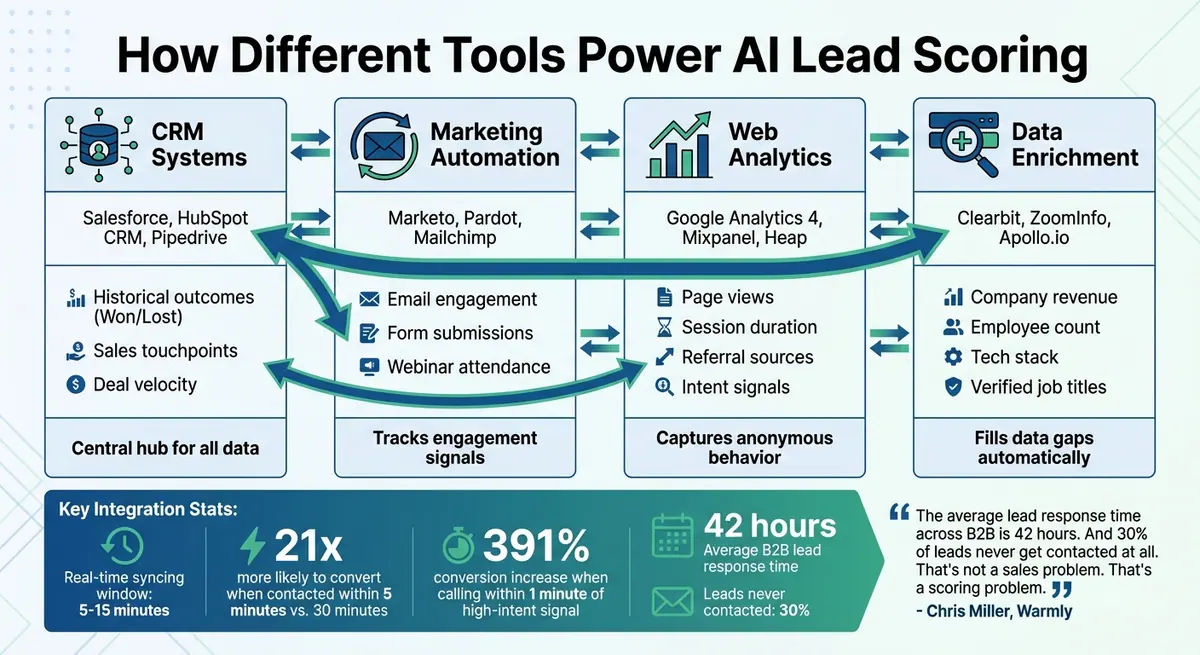
AI Lead Scoring Data Categories and Sources Comparison
For AI lead scoring to work effectively, all your data needs to be centralized. When tools operate in isolation, they create gaps that prevent AI from building complete lead profiles. The solution? Combine everything - your CRM, marketing automation, web analytics, and enrichment tools - into a single source of truth. Below, we’ll explore how to connect these systems and enhance your data for comprehensive AI analysis.
Connecting CRM, Marketing Automation, and Analytics Tools
Your CRM should act as the main hub where all data converges. This means pulling in website activity, email engagement, social interactions, and third-party data. With bidirectional syncing, sales teams get visibility into lead behavior, while marketing teams receive feedback on customer conversions.
Timing is everything. Real-time syncing (within 5–15 minutes) ensures sales teams can act while leads are still engaged. Quick responses make a huge difference: reaching out within 5 minutes makes a lead 21 times more likely to convert compared to waiting 30 minutes. And if you call within 1 minute of a high-intent signal, you can see a 391% increase in conversions.
"The average lead response time across B2B is 42 hours. And 30% of leads never get contacted at all. That's not a sales problem. That's a scoring problem." - Chris Miller, Head of Demand Generation, Warmly
To avoid data confusion, standardize fields across systems. For example, ensure the "Industry" dropdown in your CRM matches the same field in your marketing automation tool. Mismatched formats can confuse AI and create duplicate records. Use native integrations, like those between Salesforce and HubSpot, whenever possible - they’re faster and more reliable than custom APIs or middleware.
Integrating web analytics tools like Google Analytics 4 or Mixpanel adds another layer of insight. These platforms track anonymous intent signals - like repeated visits to your pricing page - before a lead even submits their information. This data should feed directly into your CRM so the AI can immediately factor it into lead scoring.
Here’s how different tools contribute to the AI scoring process:
| Tool Category | Primary Data Contribution | Examples |
|---|---|---|
| CRM | Historical outcomes (Won/Lost), sales touchpoints, deal velocity | Salesforce, HubSpot CRM, Pipedrive |
| Marketing Automation | Email engagement, form submissions, webinar attendance | Marketo, Pardot, Mailchimp |
| Web Analytics | Page views, session duration, referral sources, intent signals | Google Analytics 4, Mixpanel, Heap |
| Data Enrichment | Company revenue, employee count, tech stack, verified job titles | Clearbit, ZoomInfo, Apollo.io |
Using Third-Party Enrichment Tools
Even with solid integrations, your data might still have gaps. For instance, a lead might submit their email and company name, but you’ll need more details - like company size, revenue, or industry classification - to score them accurately. That’s where third-party enrichment tools come in.
Set these tools to trigger as soon as a lead enters your system. They’ll automatically fill in missing firmographic details, ensuring the AI works with complete profiles. This approach also supports negative scoring by identifying disqualifying attributes. For example, enrichment tools can flag if a lead’s email domain is from a non-business source or if their job title doesn’t align with your target audience. These signals should flow into your central data hub alongside positive ones.
High-quality data is critical for precise AI scoring. Poor data quality can cost organizations an average of $12.9 million annually. Regularly audit your integration points to ensure no information gets lost or duplicated during syncing. Don’t overlook negative signals like newsletter unsubscribes or visits to your "Careers" page - these may indicate someone is job hunting rather than showing buying intent.
Data Quality and Preparation Best Practices
When it comes to AI lead scoring, data quality is everything. If your data isn’t accurate, clean, and well-maintained, your AI won’t deliver reliable results. In fact, nearly 73% of marketers say their lead data isn’t dependable, and poor data quality can cost businesses 12% to 25% of potential revenue. To get the most out of your AI, you need to start with clean, standardized, and well-prepared data. Here’s how to make that happen.
Cleaning and Standardizing Data
The first step to accurate AI scoring is ensuring your data is in top shape. Start by eliminating duplicate records during CRM synchronization. This prevents inflated lead counts and messy conversion metrics. Use matching logic to ensure each lead appears only once.
Next, standardize your data fields. Use predefined dropdown options and validate entries in real time to catch errors like suspicious names or unusually short company names. Real-time email verification is another must - this process checks mail servers before forms are submitted, flagging invalid or disposable addresses. For high-value assets, block personal email domains like Gmail or Yahoo to focus on capturing business-related leads. Also, tidy up inconsistent entries by standardizing variations (e.g., "VP", "V.P.", and "Vice President" into one format).
Transform raw data into meaningful insights with feature engineering. For example, turn "time spent on website" into a "lead engagement score" to help the AI better assess interest. Regularly audit your datasets - quarterly is a good rule of thumb - to remove fields that don’t contribute to scoring, personalization, or sales qualification.
Once your data is clean and standardized, make sure it’s complete and enriched to give your AI the context it needs.
Ensuring Complete and Relevant Data
AI scoring works best when key fields are populated. Use data enrichment tools to fill in gaps, especially for important predictors like job titles or company details. For example, third-party tools can use an email domain to automatically pull firmographic data like company size, revenue, or tech stack. This allows you to keep forms short while still gathering comprehensive information.
"You only get out what you put in." - Breadcrumbs.io
To improve form completion rates, break long forms into sections (e.g., contact details, company info, and qualifications). Include custom qualifying questions to capture critical data early, particularly on social media forms, where you want to balance ease of use with gathering valuable insights.
Set up decay rules to ensure your AI prioritizes recent lead activity over older interactions. For instance, a lead who engaged last week should rank higher than one who last interacted six months ago. This keeps your scoring aligned with current intent.
Maintaining Data Hygiene Over Time
Even the cleanest data won’t stay that way forever. Customer churn and market changes mean your data needs regular upkeep. Companies that consistently refresh and retrain their AI models see a 17% improvement in lead conversion rates.
Schedule monthly or quarterly audits to compare AI predictions with actual conversion outcomes. This helps identify when your model might be relying on outdated patterns. Retrain your AI whenever you update engagement metrics or intent keywords to keep its scoring logic sharp.
Create feedback loops with your sales team. If reps notice leads are scored inaccurately - too high or too low - they can flag these issues, giving your data team the chance to adjust the model. Additionally, implement automatic data retention policies to delete outdated information, reducing compliance risks and keeping your system efficient. Anonymize sensitive data to meet regulations like GDPR and CCPA during the preparation phase.
Finally, ensure all your tools - CRM, marketing automation, and analytics - are synced in real time using APIs. This seamless data flow eliminates silos that could compromise your AI’s performance. It’s worth noting that 98% of sales teams using AI say it helps them prioritize leads effectively, but this only works when the data driving those decisions is accurate and up to date. By following these practices, you’ll set your AI - and your sales team - up for success.
Building a Data Collection Strategy
Creating a structured data collection strategy is key to ensuring your AI accurately scores leads from the start. This approach builds on earlier efforts in data cleaning and integration, enabling your AI to fully utilize its predictive capabilities.
Begin by evaluating your data sources. Pull data from the last 12 months of closed deals in your CRM and analyze patterns in website analytics, email engagement, product usage, and support tickets. Dive deeper into your most recent 50–100 converted customers to find trends in factors like company size, industry, and job titles. This analysis helps distinguish between data points that predict conversions and those that add unnecessary noise.
Next, map out all the data collection points in your customer journey. This includes everything from landing page visits and email clicks to demo requests, pricing page interactions, and third-party data enrichment. Classify this information into two categories: explicit details (like firmographics and demographics provided by leads) and implicit signals (such as behavioral actions like content downloads or documentation views). Make sure every scoring criterion in your AI model is backed by a dependable, automated data source.
Use progressive profiling to gather lead information incrementally. Start with basic details during initial interactions and collect more data over time. This method keeps form completion rates high while gradually building a detailed lead profile. Also, set negative scoring criteria to filter out unqualified leads before they reach your sales team.
Integrate your CRM, marketing tools, website tracking, and form builders through APIs to ensure lead scores update in real time. For example, when a lead takes a high-intent action - like visiting your pricing page or signing up for a trial - your AI can respond instantly. Quick responses matter: companies that engage leads within an hour are seven times more likely to have meaningful conversations with key decision-makers.
This strategy ensures you capture data across the entire funnel, leaving no critical interaction unnoticed.
Capturing Full-Funnel Data
For AI to effectively score leads, it needs a complete view of the customer journey - not just isolated interactions. Full-funnel data collection tracks every step, from a visitor’s first website interaction to post-sale activities. This includes initial page views, time spent on site, email engagement, CRM data (like deal stages and communication logs), social signals (e.g., LinkedIn mentions), and product usage metrics. These comprehensive insights provide the behavioral context your AI needs to make accurate predictions.
Context matters at every stage. For instance, a lead who repeatedly visits your pricing page within a week signals a stronger intent than one who downloaded a whitepaper months ago. Track actions like technical documentation views, security page visits, API guide downloads, and feature adoption patterns - these behavioral indicators often predict conversions better than basic demographics.
Multi-step forms can help you gather this context without overwhelming users. Design forms to capture details like the content offer that prompted the submission, the page the lead came from, and their actions before and after completing the form.
Additionally, set up tracking mechanisms to flag unqualified leads, ensuring your sales team focuses on the most promising opportunities. With AI lead scoring, sales teams report spending up to 80% of their time on qualified leads, compared to just 30% with manual methods.
This approach feeds rich, actionable data into tools like Reform, streamlining the conversion process.
Using Conversion-Focused Form Builders Like Reform
Forms are often your first - and sometimes only - opportunity to collect essential lead data. But there’s a tradeoff: adding more fields provides better context for your sales team but can hurt conversion rates. This is where tools like Reform excel.
Reform tackles the balance between context and conversion with multi-step forms and automatic lead enrichment. Rather than overwhelming users with a single long form, Reform breaks it into smaller, manageable steps. Its lead enrichment feature fills in gaps - like company size, revenue, or industry - using just an email address. This lets you collect comprehensive data without overloading your forms.
Reform also includes real-time email validation to block invalid or disposable addresses before submission, ensuring your AI works with legitimate data. You can even restrict personal email domains to focus on business leads. Conditional routing lets you ask tailored qualifying questions based on previous answers, helping you gather critical information early without making forms repetitive.
Because Reform integrates seamlessly with CRMs and marketing tools, lead scores update instantly as new data flows in. This real-time synchronization is vital: 65% of businesses cite lead generation and qualification as their biggest sales challenges. Companies using AI in sales have seen lead volume and appointments increase by over 50%. Reform’s real-time analytics also allow you to monitor form performance and identify drop-off points, making it easier to refine your data collection strategy.
Conclusion
AI lead scoring thrives on three key elements: high-quality data, smooth integration, and strong data hygiene practices. Poor data quality is no small issue - it costs organizations an average of $12.9 million annually.
But the rewards? They’re just as impressive. While manual lead scoring methods typically achieve 15-25% accuracy, AI lead scoring takes it up a notch, delivering 40-60% accuracy. This translates into tangible outcomes like a 50%+ increase in leads and appointments, a 38% rise in Sales Qualified Leads, and a 22x ROI - all in just two months.
"AI lead scoring is the use of machine learning to automatically evaluate and rank prospects based on their likelihood to convert and their readiness for action." - Chris Miller, Head of Demand Generation, Warmly
Streamlining data collection is another critical piece of the puzzle. Tools like Reform make it easier to strike a balance between collecting detailed information and maintaining high conversion rates. Features such as multi-step forms, automatic lead enrichment, and real-time email validation ensure you’re gathering the right data without overwhelming potential leads.
And don’t forget - data collection isn’t a one-and-done process. Regular updates are essential. Consider implementing quarterly recalibrations to adapt to market changes, using 30/60/90 day decay curves to track engagement signals, and keeping a close eye on your data sources. With these strategies and tools in place, your AI lead scoring system will only get better over time - turning your data into a powerful driver of revenue growth.
FAQs
What’s the minimum data I need to start AI lead scoring?
To kick off AI lead scoring, you'll need to gather key data points like demographic and firmographic details, behavioral signals, engagement metrics, and contact information. You can pull this information from sources such as CRMs, marketing tools, website interactions, and social media activity. Prioritize collecting data that's both accurate and relevant - this is crucial for creating an effective scoring model.
How do I handle missing or messy lead data without hurting scores?
To keep lead scores accurate, prioritize data quality and consistency. Only score leads with complete and trustworthy information, leaving out any data that's incomplete or inconsistent. Tools like email validation and real-time analytics can help you catch and correct errors quickly. Standardizing your data collection process ensures uniformity, reducing the risk of inaccuracies. By focusing on clean, reliable data, you'll improve the accuracy of your lead scoring and streamline your lead prioritization efforts.
How often should I retrain my model and refresh scoring rules?
Regularly updating your model and scoring rules is essential to stay aligned with evolving customer behaviors and shifting data trends. Many experts suggest adopting a consistent schedule - whether weekly or monthly - to maintain both accuracy and relevance over time.
Related Blog Posts
Get new content delivered straight to your inbox

The Response
Updates on the Reform platform, insights on optimizing conversion rates, and tips to craft forms that convert.



Drive real results with form optimizations
Tested across hundreds of experiments, our strategies deliver a 215% lift in qualified leads for B2B and SaaS companies.
