
.webp)
AI Location Profiling vs. Traditional Geo-Targeting


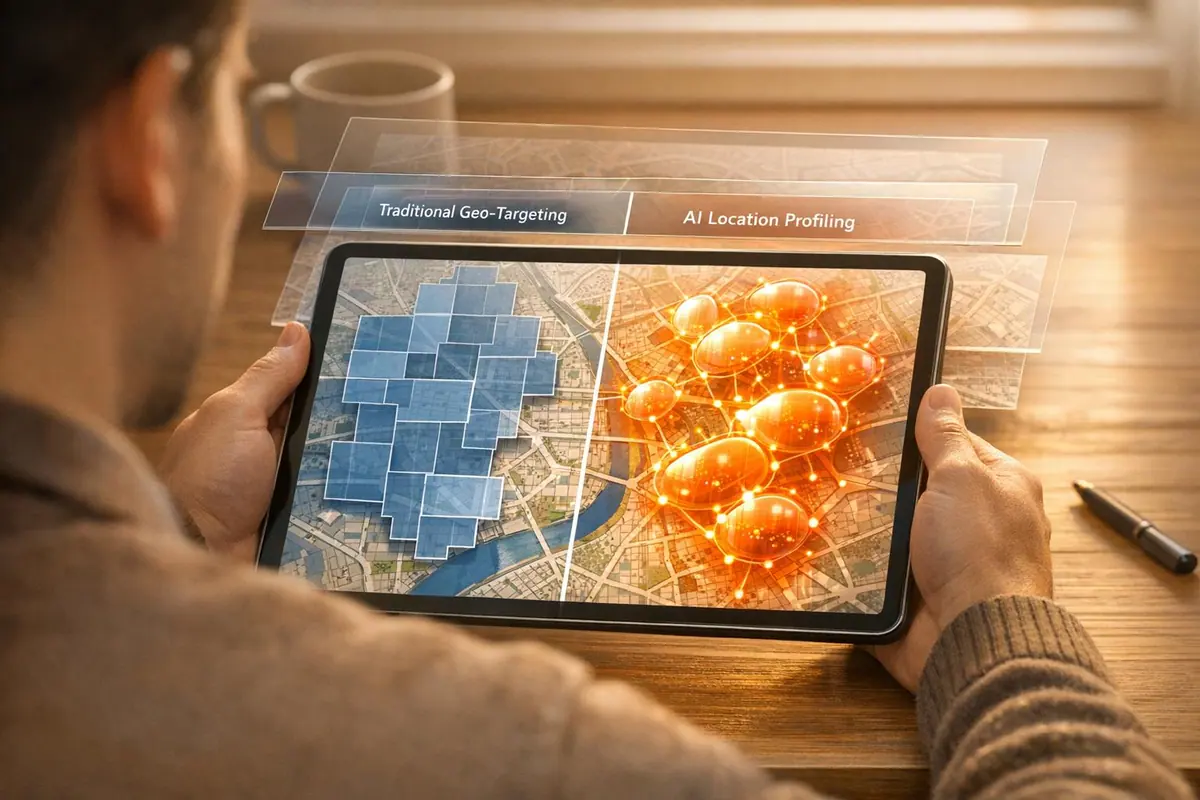
AI location profiling outperforms older geo-targeting methods by using machine learning to analyze real-time data, predict customer intent, and optimize campaigns automatically. While geo-targeting relies on static rules like ZIP codes or radii, AI digs deeper into behavioral patterns, movement history, and environmental factors through advanced data enrichment to deliver more precise and effective results.
Key Takeaways:
- Accuracy: AI achieves up to 89% accuracy in predicting customer movements and intent, compared to 15%-35% city-level accuracy for IP-based geo-targeting.
- Efficiency: AI processes billions of data points in under 500ms, eliminating manual adjustments and reducing ad spend.
- Engagement: Businesses using AI report 67% higher customer engagement and 43% better conversion rates.
- Privacy: AI systems use federated learning to stay compliant with privacy regulations, unlike traditional methods that rely heavily on third-party data.
Quick Comparison:
| Metric | Geo-Targeting | AI Location Profiling |
|---|---|---|
| Accuracy | 15%-35% (city-level, IP-based) | Up to 89% (predictive modeling) |
| Optimization | Manual bid adjustments | Real-time, automated optimization |
| Engagement Rate | Standard | 67% higher |
| Conversion Lift | Standard | 19% average increase |
| Data Processing | Limited signals (IP, GPS) | Billions of data points analyzed |
AI profiling is ideal for dynamic campaigns, competitive targeting, and real-time adjustments, while geo-targeting works well for small budgets and fixed service areas. Combining both methods can maximize results by leveraging the strengths of each.
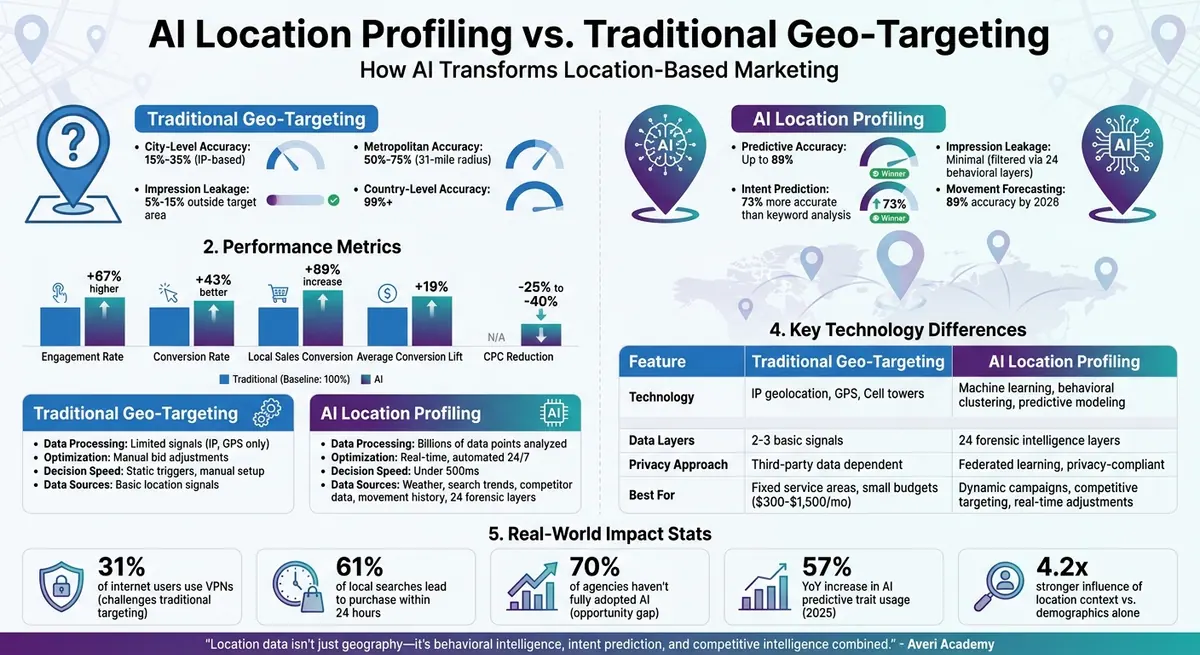
AI Location Profiling vs Traditional Geo-Targeting: Performance Comparison
How Traditional Geo-Targeting Works
Core Methods of Traditional Geo-Targeting
Traditional geo-targeting relies on well-established techniques to determine user locations. The most common approach is IP-based geolocation, which matches a visitor's IP address to a geographic database (like MaxMind or IP2Location). This method can quickly identify a user's country, state, or city without requiring permission. However, its accuracy can be affected by factors like VPN use or mobile carrier routing.
Another method involves GPS through the browser's Geolocation API, which uses satellite data to pinpoint a location with an accuracy of 3–5 meters. Unlike IP-based methods, GPS requires user consent and takes a bit longer to process. It’s particularly useful for outdoor environments, but when GPS signals are weak (like indoors or in crowded urban areas), Wi‑Fi and Bluetooth triangulation come into play. These signals can locate users within a 3–20 meter range by measuring nearby signal strengths.
Cell tower triangulation is another fallback option, estimating a device's position based on its proximity to cellular towers. While less precise - offering an accuracy range of 50–500 meters - it is often used when more accurate methods are unavailable. Lastly, postal code and radius-based filtering, often called geofencing, allows businesses to set virtual boundaries around specific areas, like stores or stadiums. When users enter or exit these zones, targeted ads or notifications can be triggered.
Each approach comes with its own trade-offs, balancing precision and usability.
Benefits and Drawbacks of Traditional Methods
One of the biggest strengths of traditional geo-targeting is its ease of use and low cost. For instance, IP-based targeting provides a seamless experience right from the first page load, offering a reliable way to localize content like currency and language. At the country level, accuracy is over 99%, making it a dependable option for broad applications. However, accuracy drops significantly for more detailed targeting, such as city-level (50–80% accuracy) or postal code-level targeting, which is often unreliable.
"IP geolocation tells you where the network is, not where the person is." – Sheharyar Malik, Senior Software Engineer
Challenges also arise from the widespread use of VPNs, with about 31% of internet users globally masking their locations, which can distort targeting efforts. Additionally, static databases require constant updates to remain accurate, and technologies like Carrier-Grade NAT (CGNAT) - where thousands of users share a single IP - further reduce precision. Even the best campaigns can experience a 5–15% error rate, with ads occasionally appearing outside the intended geographic area.
Summary of Traditional Geo-Targeting Methods
| Method | Accuracy | Permission Required | Best For |
|---|---|---|---|
| IP Geolocation | City/Region | No | General localization (e.g., currency, language) |
| GPS | 3–5 meters | Yes | Navigation and precise real-time tracking |
| Wi‑Fi / Bluetooth | 3–20 meters | Yes | Indoor positioning and mobile apps |
| Cell Tower | 50–500 meters | Yes | Emergency services and carrier-level tracking |
sbb-itb-5f36581
How AI Location Profiling Works
AI Technologies Behind Location Profiling
AI location profiling takes a fresh approach to understanding geography. Instead of simply pinpointing "where someone is", it dives deeper, asking, "What does this person's movement and location behavior reveal about their intent?" This method treats geography as dynamic and contextual, not just a fixed spot on a map.
At its core, machine learning algorithms process billions of data points - like store visits, local search trends, weather changes, and movement history - to make decisions faster and more precisely than manual campaigns ever could. These systems use up to 24 forensic intelligence layers to evaluate signal quality. For instance, they can tell whether a signal is fabricated, derived from an IP address, or behaviorally plausible. They even differentiate between someone driving past a location and someone walking into a store.
One standout feature is behavioral clustering. AI can spot patterns in location behavior, grouping users into micro-segments such as "convenience-driven shoppers" or "experience seekers." It builds these profiles by analyzing past movements rather than just current coordinates. For example, it might notice someone regularly visits coffee shops on weekday mornings, hits the gym three times a week, and shops at home improvement stores on Saturday mornings. This paints a detailed picture of intent that goes far beyond a simple ZIP code.
Predictive intent modeling takes this even further by analyzing factors like time of day, weather, and historical movement to predict purchase intent. This method is said to be 73% more accurate than relying solely on search keyword analysis for immediate purchase decisions. A great example is Starbucks' AI-driven hyper-local personalization campaign, which tailored offers based on time-of-day habits, local weather, and store-specific drink preferences. The result? A 34% increase in offer redemption rates.
AI systems combine data from GPS, Wi-Fi triangulation, Bluetooth beacons, device sensors, and IP addresses to create a detailed "intent map." Instead of drawing static circles around a store, AI dynamically adjusts boundaries by analyzing real-time conversion data and competitive density. It can even fine-tune bids down to the street level. And all of this happens in under 500 milliseconds, enabling real-time offer adjustments as a customer moves past a location.
"Location data isn't just geography - it's behavioral intelligence, intent prediction, and competitive intelligence combined into a single, real-time signal." – Averi Academy
These advancements aren't just theoretical - they deliver measurable improvements in marketing performance.
Key Benefits of AI Location Profiling
AI location profiling goes beyond traditional geo-targeting by offering real-time, behavior-driven insights that significantly enhance campaign outcomes. Businesses leveraging these advanced systems report 67% higher customer engagement and 43% better conversion rates compared to older methods. In fact, AI-powered location profiling has been shown to drive an 89% increase in local sales conversions.
One of the standout advantages is improved accuracy. By cross-referencing multiple data sources, AI significantly reduces errors like "IP volatility" and signal loss that often plague traditional methods. This multi-signal validation ensures a much more reliable understanding of user behavior.
Another game-changer is intent detection. AI doesn't just identify that you're near a store - it figures out whether you're a "comparison shopper" checking out competitors or a "convenience-driven shopper" looking for the closest option. Research shows that location context influences purchasing decisions 4.2 times more strongly than demographic data alone, and AI captures this nuance in real-time.
Privacy is also a priority. By using federated learning, AI systems keep user data local while still generating actionable insights. This approach helps businesses stay compliant with privacy regulations, especially as third-party cookies are phased out. AI can infer location-based insights from behavioral patterns and first-party data without compromising user privacy. By 2026, predictive location marketing is expected to reach 89% accuracy in forecasting customer movement and intent.
Finally, AI eliminates the need for manual adjustments. Instead of guessing which neighborhoods will perform best or tweaking bids by hand, the system continuously optimizes using real conversion data. Google has reported that campaigns using "Smart Bidding Exploration" experience an average 19% boost in conversions.
"Geotargeting is budget allocation discipline disguised as targeting." – Sarah Moss, AI Digital
This ensures that every dollar is spent on locations that truly drive results.
Accuracy and Efficiency Comparison
Geographic Targeting Accuracy
When it comes to precision, traditional IP-based geo-targeting falls short. It achieves only 50% to 75% accuracy at the metropolitan level (around 31 miles) and drops significantly to just 15%-35% at the city level. Factors like VPNs, proxies, and mobile carrier routing further complicate matters, causing 5% to 15% of impressions to fall outside the desired target area.
AI location profiling takes a completely different approach. By analyzing behavioral signals such as commute patterns, dwell time, and visit frequency, it identifies real users while filtering out fake or misleading data. According to Gartner, AI-driven predictive location marketing is expected to reach an impressive 89% accuracy in forecasting customer movements and intent by 2026. Compare this to traditional methods, which often misinterpret casual passersby as potential customers, and the gap becomes clear.
"A CTV-to-MAID linkage built on IP-derived coordinates or synthetic device IDs doesn't give a platform a cross-channel view. It gives them cross-channel fiction." – Unacast
AI also excels at eliminating spoofed signals, making its results far more reliable than older, static methods.
Lead Enrichment Efficiency
Traditional geo-targeting relies heavily on manual processes, such as setting radius-based rules and periodically adjusting bids. This approach is not only labor-intensive but also reactive, often lagging behind real-time market dynamics.
AI, on the other hand, uses its enhanced accuracy to optimize campaigns in real time. It processes billions of data points - including store visit trends, local search activity, weather conditions, and competitor behavior - in under 500 milliseconds. This allows for instant adjustments to budgets and bids, ensuring resources are allocated where they’ll have the most impact.
Campaigns powered by AI-driven smart bidding have reported an average 19% boost in conversions. Additionally, AI continuously adapts based on factors like time of day and traffic patterns, eliminating the need for manual intervention.
Unlike traditional methods that work with broad city-level or ZIP code data, AI dives deeper, offering neighborhood-level insights by analyzing real-time performance metrics.
Side-by-Side Comparison Table
The table below highlights the stark differences between traditional geo-targeting and AI-driven location profiling, emphasizing the performance advantages of AI.
| Metric | Traditional Geo-Targeting | AI Location Profiling |
|---|---|---|
| City-Level Accuracy | 15% – 35% (IP-based) | Up to 89% (Predictive modeling) |
| Impression Leakage | 5% – 15% outside target area | Minimal; filtered via behavioral layers |
| Decision Speed | Manual setup; static triggers | Under 500ms automated |
| Data Processing | Basic location signals (IP, GPS) | Billions of points (weather, search, competitors) |
| Optimization | Manual bid adjustments | Real-time, autonomous 24/7 |
| Engagement Rate | Standard | 67% higher than radius-based |
| CPC Reduction | N/A | 25% – 40% |
| Conversion Lift | Standard | 19% average increase |
This comparison underscores how AI transforms geographic profiling from a static, error-prone process into a dynamic, highly efficient system. By leveraging advanced data analysis and real-time decision-making, AI delivers results that traditional methods simply cannot match.
Integration with Lead Generation Systems
Marketing Tool Compatibility
Traditional geo-targeting often works as a rigid filter, relying on fixed radius-based rules or ZIP codes through platforms like Google Ads or Meta Ads. This approach simplifies location into a static marker, ignoring its potential as a dynamic performance indicator.
AI location profiling, on the other hand, takes a more advanced approach. It connects directly to advertising APIs, combining location signals with behavioral data to automate bid adjustments and budget distribution in real time. Tools such as Ryze AI, Opteo, and Revealbot already use this method, integrating seamlessly with Google Ads and Meta Ads to enhance local market coverage.
When paired with cloud data warehouses and CRMs, AI can tap into "Predictive Traits", analyzing massive datasets to enable more precise segmentation within marketing systems. This allows for Cross-Platform Local Attribution, linking online ad interactions, offline store visits, and CRM data into one cohesive system.
"Geotargeting is budget allocation discipline disguised as targeting." – AI Digital
Despite these advancements, a staggering 70% of agencies, brands, and publishers have yet to fully embrace AI within their media planning, activation, and analytics workflows. However, those who have adopted AI-driven segmentation report a 57% year-over-year increase in the use of Predictive Traits as of 2025.
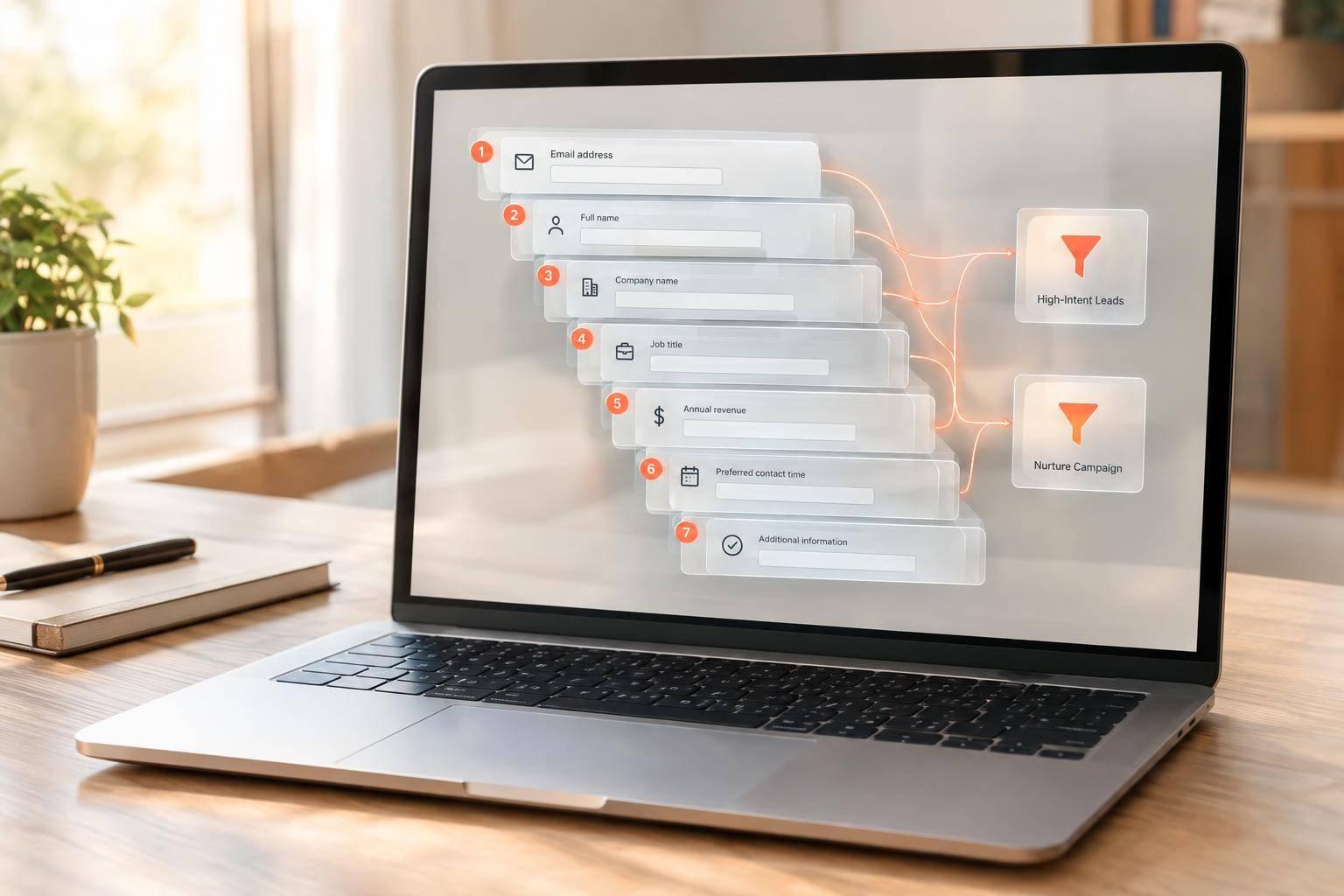
This level of integration also enhances form-based lead capture, turning basic location data into actionable insights through contextual intelligence.
Improving Form-Based Lead Capture
Traditional geo-targeting typically provides simple details like a prospect's city or ZIP code. AI location profiling goes several steps further, analyzing movement patterns, visit frequency, and dwell time to create detailed behavioral clusters. Instead of merely identifying where someone lives, it uncovers whether they are convenience-focused or prefer unique experiences.
This deeper behavioral understanding revolutionizes how forms collect and enrich data. AI can predict high-value neighborhoods and dynamically adjust form fields and offers. For example, an HVAC company might highlight emergency repair services in areas with older homes when weather conditions worsen.
AI processes multiple factors - location, weather, local events, and competitor activity - in under 500 milliseconds, enabling real-time, personalized forms. Businesses leveraging this capability have seen conversion rates improve by 43% compared to those sticking with traditional methods.
For companies using tools like Reform, integrating AI location profiling means leads arrive in the CRM with enriched behavioral insights and intent scores, not just basic geographic details. This allows sales teams to prioritize follow-ups based on actual purchase intent. Additionally, location-based intent prediction is 73% more accurate than keyword analysis for identifying immediate buying decisions.
When to Use Each Approach
Best Scenarios for Traditional Geo-Targeting
Traditional geo-targeting works best for smaller campaigns with budgets ranging from $300 to $1,500 per month and for service-based businesses operating within a 20-mile radius. For example, plumbers or electricians with clearly defined service areas can achieve their goals using basic radius targeting.
This method is also effective for industries with strict regulations. Insurance agencies and legal firms, which are often licensed to operate only within specific states, benefit from the precise geographic limits that traditional geo-targeting offers. Similarly, large-scale brand awareness campaigns targeting entire states or regions can use traditional geo-targeting effectively, especially when delivering content tailored to specific languages across different countries.
For local businesses, switching to "Presence Only" targeting (instead of the default "Presence or Interest") ensures ads are shown exclusively to users physically located in the area, avoiding wasted spend on users simply researching the location from afar.
However, when immediate action or more nuanced user behavior is involved, AI location profiling takes the lead.
Best Scenarios for AI Location Profiling
AI location profiling excels in dynamic situations where static targeting falls short. For example, businesses influenced by weather - like HVAC or roofing services - can scale their campaigns in real time as conditions change. Another strong use case is competitive conquesting. With AI, businesses can target users physically present at competitor locations and deliver real-time offers to sway their decisions.
A notable example from 2026 highlights this approach: an auto dealership used geofencing around competitor lots to offer a $500 trade-in bonus. The result? They secured 340 conquest sales in just six weeks. Additionally, with 61% of local searches leading to a purchase within 24 hours, AI's ability to predict user intent - 73% more accurately than keyword analysis - makes it a powerful tool for capturing these immediate buying decisions.
Combining Both Methods
Blending traditional and AI-driven strategies allows businesses to harness the advantages of both. For instance, you can start with a traditional 5-mile radius as your base and then use AI-driven bid adjustments - up to +900% - to target high-value micro-locations, such as affluent neighborhoods.
In 2026, a local service chain adopted this layered strategy, combining traditional radius targeting with AI-powered micro-market insights. Over just eight weeks, they saw a 65% increase in store visits by using optimized multi-step form designs and cut ad spend by 30% by reallocating budgets to high-performing zones. The campaign also made use of multiple platforms: Google Ads focused on tight-radius, high-intent search targeting, while Meta Ads handled AI-driven awareness and retargeting within the same areas.
"National brands can outspend you, but they can't out-local you. Geotargeting lets local businesses compete by owning their immediate geography." – AdBid
For franchises, this hybrid approach is especially effective. Using distinct radii managed by AI prevents internal competition between locations while ensuring consistent coverage. This combination offers the simplicity and budget management of traditional methods alongside the precision and adaptability of AI.
Conclusion
Choosing the right method boils down to finding the balance between control and adaptability. Traditional geo-targeting offers precise market-level control and disciplined budget management, making it a great fit for service businesses with defined territories, regulatory requirements, or broad brand campaigns. On the other hand, AI profiling shines when it comes to predicting intent and capturing immediate purchases through real-time insights.
For example, AI location profiling has been shown to boost local sales conversion by 89% and engagement by 67% compared to static, radius-based methods. The most effective campaigns heading into 2026 are blending these approaches - using traditional geo-targeting to define markets while incorporating AI to optimize micro-locations. This hybrid strategy combines the dependability of traditional methods with the precision and flexibility of AI.
The takeaway? Location data serves as a guide, not an absolute. Whether you aim to define your market or anticipate customer behavior, the right mix of these tools allows businesses to allocate resources wisely and meet customer demands more effectively.
FAQs
What data does AI location profiling use beyond GPS or IP?
AI location profiling takes a step further than just relying on GPS and IP addresses. It combines address-level data, identity resolution, and real-time location behavior to create a more refined understanding of users. On top of that, it factors in contextual elements like weather conditions, ongoing events, and even the time of day. This approach not only ensures precision but also respects privacy, offering a more accurate way to target users compared to older, less sophisticated methods.
How can I start using AI location profiling without replacing my current geo-targeting setup?
You can use AI-powered location signals to refine your geo-targeting strategies over time. By analyzing data from sources like mobile devices and connected TV (CTV), AI can provide detailed insights into audience behavior and intent. A great way to begin is by combining these AI insights with existing methods like geofencing or radius targeting. Focus on areas with high conversion potential to fine-tune your campaigns. This approach lets you gradually incorporate AI into your strategy while keeping your current setup intact for a smooth transition.
How does AI location profiling stay privacy-compliant while improving accuracy?
AI location profiling prioritizes privacy by relying on consent-based data collection and techniques that safeguard user information. It blends geographical data with behavioral insights to improve targeting precision, all while respecting privacy boundaries. Over time, as behavioral data becomes more detailed, the need for extensive location data diminishes. By fostering trust through transparent consent processes and offering clear value in return, businesses can encourage users to share their data while staying compliant with regulations in markets like the U.S.
Related Blog Posts
Get new content delivered straight to your inbox

The Response
Updates on the Reform platform, insights on optimizing conversion rates, and tips to craft forms that convert.



Drive real results with form optimizations
Tested across hundreds of experiments, our strategies deliver a 215% lift in qualified leads for B2B and SaaS companies.
