
.webp)
How to Scale Content Calendars for Lead Nurturing



Scaling a content calendar is essential for growing your lead nurturing efforts effectively. Without structure, teams risk inconsistent posting, missed opportunities, and a lack of alignment with business goals. Here’s the core takeaway: shift from random content creation to intent-driven planning that aligns with your buyer’s journey and measurable outcomes.
Key Insights:
- Set Clear Goals: Focus on outcomes like pipeline contribution and lead quality, not just content volume.
- Map Content to Buyer Intent: Address specific stages of the buyer’s journey with tailored content (e.g., awareness, consideration, decision).
- Centralize Your Workflow: Use a single platform to manage content strategy, production, and performance tracking.
- Automate Where Possible: Streamline scheduling, notifications, and lead routing to save time and improve efficiency.
- Track Metrics Regularly: Monitor KPIs like impressions, click-through rates, and conversions to identify gaps and improve performance.
- Repurpose Content: Refresh and reuse high-performing assets to maximize results without overloading your team.
By prioritizing intent-first planning, leveraging automation, and consistently refining your approach, you can create a scalable system that nurtures leads effectively and drives measurable business outcomes.
How to Automate Your Content Calendar (and Get More AI SEO Traffic)
sbb-itb-5f36581
Set Clear Goals for Your Content Calendar
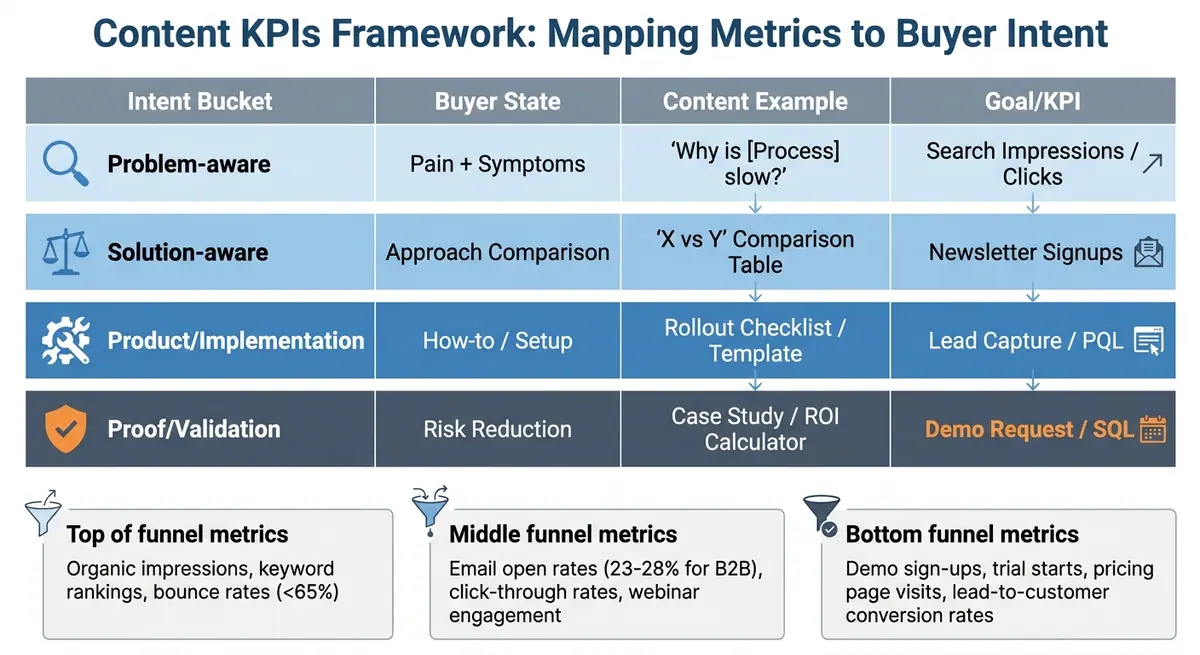
Content KPIs by Buyer Journey Stage and Intent
Before diving into your content calendar, define what success looks like. Many teams focus solely on output - like publishing a certain number of posts per week or meeting word count targets. But the real focus should be on outcomes, such as how well your content contributes to your pipeline and improves lead quality. Start with an intent-driven approach, setting measurable goals that directly impact revenue.
Create a one-page automation charter to outline these goals. Include revenue targets, your ideal customer segments, and key conversion events - whether it’s optimizing lead generation through demo requests, trial sign-ups, or moving MQLs (Marketing Qualified Leads) to SQLs (Sales Qualified Leads). For instance, AvidXchange used Marketo Engage to automate MQL routing based on clear conversion goals. This saved them over 30 hours weekly and more than doubled their sales opportunities. The takeaway? Tools help, but clear goals are what make automation effective.
Similarly, OneMetric revamped their automation workflows in HubSpot and Salesforce, aligning them with revenue-driven outcomes. The result? A 28% boost in meetings booked and a 19.5% increase in conversions. Once your goals are clear, identify specific KPIs to track progress across every stage of the buyer’s journey.
Identify KPIs for Lead Nurturing
Each stage of the buyer’s journey requires its own metrics. Early in the funnel, focus on building awareness and tracking metrics like organic impressions, keyword rankings, and bounce rates (aim for less than 65%). In the middle stages, monitor email open rates (23–28% is typical for B2B services in 2025), click-through rates, and engagement with content like webinars or case studies. At the bottom of the funnel, keep an eye on high-converting landing page forms for demo sign-ups, trial starts, pricing page visits, and lead-to-customer conversion rates.
Here’s a simple framework for organizing KPIs by buyer intent:
| Intent Bucket | Buyer State | Content Example | Goal/KPI |
|---|---|---|---|
| Problem-aware | Pain + Symptoms | "Why is [Process] slow?" | Search Impressions / Clicks |
| Solution-aware | Approach Comparison | "X vs Y" Comparison Table | Newsletter Signups |
| Product/Implementation | How-to / Setup | Rollout Checklist / Template | Lead Capture / PQL |
| Proof/Validation | Risk Reduction | Case Study / ROI Calculator | Demo Request / SQL |
Additionally, track operational metrics like the time it takes to move from content brief to launch, speed-to-lead, and MQL-to-SQL conversion rates. These metrics help you assess if your nurturing process is efficient or if you’re overwhelming leads with too much content. Considering that marketing automation can deliver an average ROI of $5.44 for every $1 spent, staying on top of these metrics is essential.
Match Goals to Buyer Personas and Journey Stages
To keep audiences engaged, map each piece of content to a specific buyer persona and their current stage in the journey. Research shows that 80% of leads not ready to purchase immediately will eventually buy if nurtured correctly. Aligning content to personas ensures they stay engaged over time.
Start by creating an intent coverage map. This is a grid where your product categories are rows, and intent buckets (Problem-aware, Solution-aware, Product/Implementation, Proof/Validation) are columns. This helps you spot gaps where buyer questions aren’t being addressed. For example, if you’re targeting CFOs in the consideration stage but only have awareness-level content, you’re missing a key opportunity to build trust.
The Royal Bank of Canada tackled this issue when scaling content across 22 divisions. By partnering with Contently, they implemented a decentralized model where each department tailored content to its audience while staying aligned with corporate goals. Streamlining processes like legal reviews and targeting specific personas helped them achieve an 81% engagement rate and a 15% higher content finish rate than the industry average.
To prioritize effectively, score content ideas using the formula: (Business Value + Ranking Feasibility) − Effort. This ensures your calendar is filled with content that drives results, not just easy-to-produce pieces. Balance your mix of content - educational for awareness, solution-based for consideration, and case studies or product comparisons for decision-making. If one area is overrepresented, adjust your focus to fill the gaps.
Finally, set SMART objectives for each persona and stage of the journey. These goals should be Specific, Measurable, Achievable, Relevant, and Time-bound. For example, instead of saying, “increase demo sign-ups,” aim for something like, “increase demo sign-ups from enterprise CFOs by 25% by Q4 2026”. This level of detail transforms your content calendar into a strategic tool, not just a publishing schedule.
Organize and Prioritize Content for Scaling
Once you’ve set your goals, the next hurdle is staying organized. B2B teams often juggle between 8–12 tools for their marketing and sales efforts. Yet, only 26% of B2B marketers feel they have the right technology to manage content effectively across their organization. The answer isn’t adding more tools - it’s about simplifying and creating a system that actually works. This streamlined setup lays the groundwork for systemized content management, as described below.
Create a Central Content Repository
A centralized hub is the backbone of the content lifecycle. It handles everything - strategy, briefs, production, approvals, distribution, and performance tracking. Aligning your tech stack with your strategic goals ensures that intent-first planning, as discussed earlier, stays on track. Without this alignment, teams can face delays, unclear responsibilities, and inconsistent messaging. A centralized system solves these issues by streamlining workflows, clarifying roles, and unifying performance tracking.
Start by choosing an all-in-one platform that covers planning, writing, and publishing. This eliminates the chaos of using multiple disconnected tools. Build a smart taxonomy to organize content by type (e.g., blog, social media), status (e.g., draft, review), topic or pillar (e.g., SEO, product), and campaign. This makes assets easy to search, manage, and repurpose.
Take this example: In 2025, a three-person B2B SaaS team managing a mid-market workflow product consolidated their keywords, briefs, and drafts into one workspace using Iriscale. By shifting from date-driven planning to an intent-first backlog and automating notifications for stage changes and performance reviews, they saw a 40% increase in organic traffic and a threefold improvement in keyword rankings within a single quarter.
"A centralized content hub is your team's single source of truth for everything content-related - strategy, briefs, production, approvals, distribution, and performance." - Esther Van den Eynde, StoryChief
Standardize your processes with reusable templates for content briefs (including audience, keywords, and CTAs), outlines, and review checklists (SEO, legal, tone). Templates reduce decision fatigue and speed up production. Assign clear roles - like Creator, Editor, Approver, and Publisher - to avoid bottlenecks. Define what "done" means at each stage; for example, a plan is complete when the brief, outline, and CTA are approved. This keeps everyone on the same page.
Apply a Prioritization Framework
Once you’ve centralized your assets, the next step is prioritizing content that delivers the most impact. Not every idea deserves equal attention. Strategic content calendars can help high-performing teams generate up to 67% more leads, but only if they focus on the right initiatives. Transition from rigid schedules to a prioritized, search-demand-driven backlog.
Use the (Value + Feasibility) − Effort model to rank content ideas. Score each idea from 1 to 5 based on Business Value (how well it aligns with your customer profile and revenue goals) and Ranking Feasibility (your likelihood of ranking for the keyword). Then subtract the Effort required, including input from subject matter experts, design work, and data collection. This approach ensures your calendar prioritizes content that drives results and supports lead nurturing efforts.
For smaller teams, assign content by week instead of specific days. This provides flexibility when unexpected product launches or urgent sales needs arise. Follow the 70-20-10 rule to balance your content mix: allocate 70% to planned cornerstone content, 20% to trending topics or industry changes, and 10% to experimental ideas. This method ensures consistency while allowing for agility.
Before creating new content, audit your existing assets. Look for high-performing pieces that can be refreshed or repurposed - this often requires less effort than starting from scratch. For instance, between 2025 and 2026, Tomorrow Sleep grew its organic traffic from 4,000 to 400,000 monthly visitors by identifying topic gaps, crafting in-depth content tailored to specific search intents, and securing multiple featured snippets in search results.
"Real content scaling isn't about producing 'more stuff.' It's about building systems that amplify your content's reach, impact, and efficiency without sacrificing the strategic thinking or quality." - Insight Engine
Lastly, organize your backlog by search-intent buckets: Problem-aware (symptoms), Solution-aware (comparisons), Product/Implementation (how-to guides), and Proof/Validation (ROI-focused case studies). This ensures you’re addressing different search intents at every stage of the buyer’s journey, rather than just churning out content to meet a publishing quota.
Use Automation Tools for Content Management
Scaling your content calendar to effectively nurture leads depends heavily on automation. It helps streamline both content distribution and lead capture, cutting out manual tasks that often slow things down. By automating repetitive processes - like scheduling publish dates, sharing content across platforms, or managing review assignments - you can focus on delivering results faster and more efficiently.
Automate Content Scheduling and Distribution
Tools like Zapier, Make, and Microsoft Power Automate act as workflow hubs, connecting your CMS, social media platforms, and analytics tools into a single, unified system. This eliminates manual tasks and ensures content flows smoothly from draft to publication. Advanced scheduling features even analyze past engagement data to recommend the best times to post on each platform.
Here’s an example: In 2025, a mid-size SaaS company switched from using spreadsheets to a smart scheduling tool. This shift not only eliminated missed deadlines (one of which previously cost them $12,000 in leads) but also boosted organic leads by 35% within 90 days. Similarly, a fintech startup used an API to import a 12-month editorial calendar into an automation platform. This reduced content production time from 4 days per post to under 12 hours, driving 48% growth in organic traffic over six months.
To maximize results, assign high-traffic keywords to premium publishing slots, like weekday mornings. Aim for at least two posts per week, but leave some flexibility for reactive content. However, don’t automate more than 80% of your content calendar without a human quality check to maintain consistency and accuracy.
"Never let a high-performing keyword sit idle for more than 24 hours. The longer you wait, the more you lose in potential traffic." - Distribb
Set aside a weekly "audit hour" to review performance from the past week and fine-tune your automated schedule as needed. Interestingly, scheduling employee-shared content can expand your reach by up to 70%.
Connect Reform for Better Lead Capture
Once your content is automated and live, the next challenge is capturing leads effectively. This is where Reform steps in, streamlining lead capture and enrichment. By integrating Reform’s form-building tools with your content management system, you can automate the process of moving leads into the right nurturing sequence without manual intervention.
For example, you can map specific Reform forms to different stages of your sales funnel. A "Top of Funnel" eBook download form might trigger a welcome email sequence, while a "Bottom of Funnel" demo request form could immediately notify your sales team. Reform’s lead enrichment and conditional routing features allow you to gather behavioral data during submission, enabling real-time segmentation based on where the lead is in their journey.
With triggers in place, a Reform submission can automatically schedule the next step - whether it’s sending a resource, following up with an email, or setting a sales call reminder.
"72% of tech buyers are more likely to consider a vendor who provides educational content throughout each stage of the decision process."
Automation ensures that your content reaches potential leads exactly when they need it most.
To prioritize leads effectively, assign numerical values to actions taken on Reform forms - like downloading a whitepaper or requesting a consultation. This helps you identify "hot" leads and move them up in your system. Use Reform’s real-time analytics to monitor form performance and conversion rates, then refine your content calendar based on what’s driving the best results.
Monitor and Update Content Performance
Automation helps deliver your content, but tracking its performance is what actually drives results. Without consistent monitoring, you won’t know which pieces are pushing leads forward and which are missing the mark. To get the full picture, track both engagement metrics - like click-through rates and video views - and revenue-focused indicators. For example, if a piece generates high engagement but low conversions, it might mean your content is interesting but not providing the information buyers need to take the next step [23, 24].
Track Metrics and Find Performance Gaps
With clear goals and streamlined automation in place, regular performance reviews are essential to ensure your content continues to nurture leads effectively. Sync your CRM with your marketing automation tools to access real-time lead data. Use tools like scroll maps and read time trackers to see where leads drop off while engaging with your content. If leads become unresponsive, analyze where the content journey may have lost their interest or consult a lead generation guide to refine your strategy.
A monthly content scorecard can help you compare your top-performing and weakest content pieces. This comparison reveals what’s working and what needs adjustment. You can also set automated alerts for sudden drops in traffic or rankings on key pages, allowing you to act quickly. Focus your updates on “striking distance” pages - those ranking between positions 4 and 20 but showing traffic declines over three months. These pages often have high commercial intent and are worth refining [27, 28].
"Closely tracking improvements/declines in keyword rankings gives a good indicator of whether you're on the right path, need to rewrite the content, or take another path like building backlinks."
– Ben Goodey, Founder, Spicy Margarita Content
Run A/B Tests for Better Results
Once you’ve identified performance gaps, test your updates to make sure they’re effective. A/B testing is a great way to validate changes. For instance, try different messaging styles - like a technical white paper versus a cost-benefit breakdown - to see which drives more conversions. You can also A/B test headlines on high-traffic pages to boost click-through rates. Use tools like Reform’s real-time analytics to track which variations perform better, then adjust your content calendar based on those insights.
Update and Repurpose Existing Content
Think of your content library as a collection of valuable assets. Regular updates can prevent pages from losing relevance and rankings. On average, untouched pages lose 8–12% of their ranking each quarter, but updates can recover 52% of lost positions within 45 days. Plus, updating content is much cheaper - typically $50–$150 per page compared to $200–$500 for creating new content. Audit your high-value pages (those with over 500 monthly visits) every 90 days. Replace outdated data, fix broken links, and optimize mobile load speeds. Be sure to keep the URL unchanged to retain any backlinks the page has earned [27, 28]. For efficiency, update 5–8 pages per week instead of tackling everything at once; this approach has shown a 31% improvement in ranking recovery.
Repurposing content can also keep your calendar full without overloading your team. For instance, a single webinar can be transformed into around 47 different content pieces, covering 3–4 weeks of calendar slots. This strategy can fill 70–80% of your schedule, which is especially helpful given that nearly 40% of marketing teams struggle with limited resources. Keeping your content fresh and repurposed ensures your strategy remains effective over time.
"A 50-page blog that skips content updates for one year loses the equivalent traffic of 25-30 net-new articles - making 'publish and forget' the most expensive content strategy possible."
– The Seo Engine
Wrapping It Up
Scaling your content calendar for lead nurturing isn't just about producing more content - it’s about creating smarter systems that cater directly to what buyers need. By shifting from a date-focused to an intent-driven approach, you ensure your content addresses genuine buyer questions at the right moments in their journey. Centralizing your operations into a single workspace helps cut down inefficiencies and keeps your strategy on track.
A structured workflow becomes key as your content production ramps up. Using modular content allows you to repurpose material into various formats, lightening the load on your team. Automation can take care of repetitive tasks, while performance tracking helps you identify what’s working to move leads forward and what needs adjustments.
Thinking of your calendar as a prioritized backlog of search demand, rather than a rigid schedule, gives small teams the flexibility to adapt and keep pushing forward. Each small improvement adds up, creating a strong lead nurturing system.
Focus on identifying inefficiencies, streamlining workflows, and embracing flexible scheduling. These steps, taken together, build a scalable operation that maintains the quality needed to nurture leads effectively.
FAQs
How do I pick the right KPIs for each stage of the buyer journey?
Picking the right KPIs is all about aligning them with your objectives at different points in the buyer journey. For the early stages, focus on metrics like website engagement or content views to gauge awareness. As prospects move further along, later-stage metrics like conversion rates or demo requests become more relevant.
Here’s how to approach it:
- Define Key Actions: Identify the specific actions you want your audience to take at each stage.
- Map Content to Stages: Ensure your content supports and guides buyers through their journey.
- Monitor Performance Regularly: Keep a close eye on how your KPIs are performing.
And don’t forget: Adjust your KPIs every month based on the data you collect. This helps you fine-tune your lead nurturing strategy and stay on track.
What’s the simplest way to turn a rigid content calendar into a prioritized backlog?
Begin by crafting a content strategy that aligns seamlessly with your business objectives. Consider your audience's buyer journey and set measurable KPIs to track success. This foundation ensures every piece of content serves a purpose.
Next, create a backlog of content ideas. Rank these ideas based on relevance, urgency, and potential impact. This approach helps you prioritize high-value topics and keeps your efforts focused. By doing so, you can turn a static content calendar into a flexible and actionable tool that drives lead nurturing effectively.
How can Reform forms trigger different lead-nurture workflows automatically?
Reform forms can automatically kickstart lead-nurture workflows by using behavior-based and conditional routing. These tools adapt actions based on what a lead inputs, allowing for personalized follow-ups without needing manual intervention. For example, if a lead demonstrates strong interest or highlights specific preferences, the form can direct them into customized workflows. This ensures timely, relevant interactions, improving the overall effectiveness of lead nurturing.
Related Blog Posts
Get new content delivered straight to your inbox

The Response
Updates on the Reform platform, insights on optimizing conversion rates, and tips to craft forms that convert.




Drive real results with form optimizations
Tested across hundreds of experiments, our strategies deliver a 215% lift in qualified leads for B2B and SaaS companies.
