
.webp)
AI Personalization in Email A/B Testing


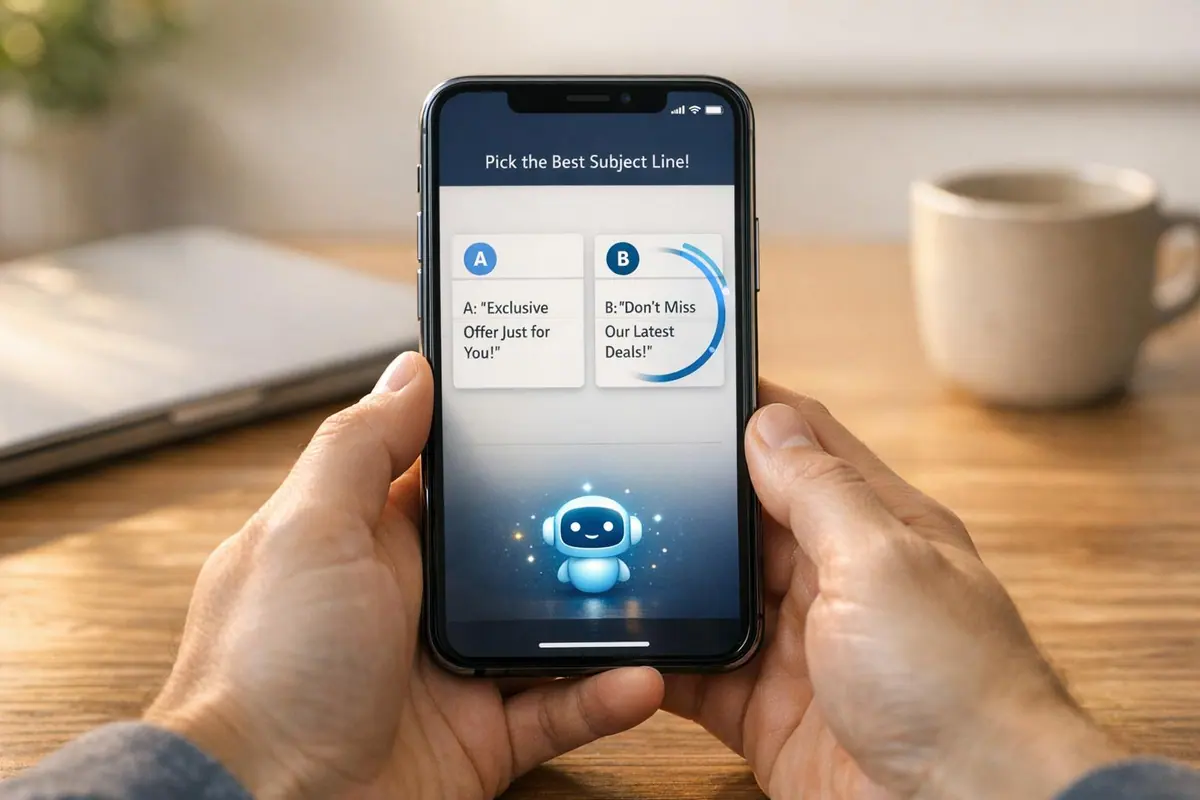
AI is transforming email A/B testing by replacing slow, outdated methods with real-time, data-driven personalization. Instead of testing one-size-fits-all content, AI delivers tailored messages to individuals based on their behavior, preferences, and engagement patterns. This dynamic approach not only improves open and click-through rates but also drives measurable business results, like increased revenue and high-converting lead forms.
Key Takeaways:
- Why It Matters: Personalized email campaigns outperform generic ones, with segmented emails achieving 30% more opens and 50% higher click-through rates.
- Traditional A/B Testing Issues: It's slow, requires large recipient lists, and often misses shifting customer preferences.
- How AI Helps: AI uses real-time data, predictive analytics, and multi-armed bandit testing to optimize email performance instantly.
- Proven Results: Companies using AI have seen up to 135% increases in purchases and 3.2x more revenue per recipient.
With AI, email marketing becomes smarter, faster, and more effective at reaching the right audience with the right message at the right time.
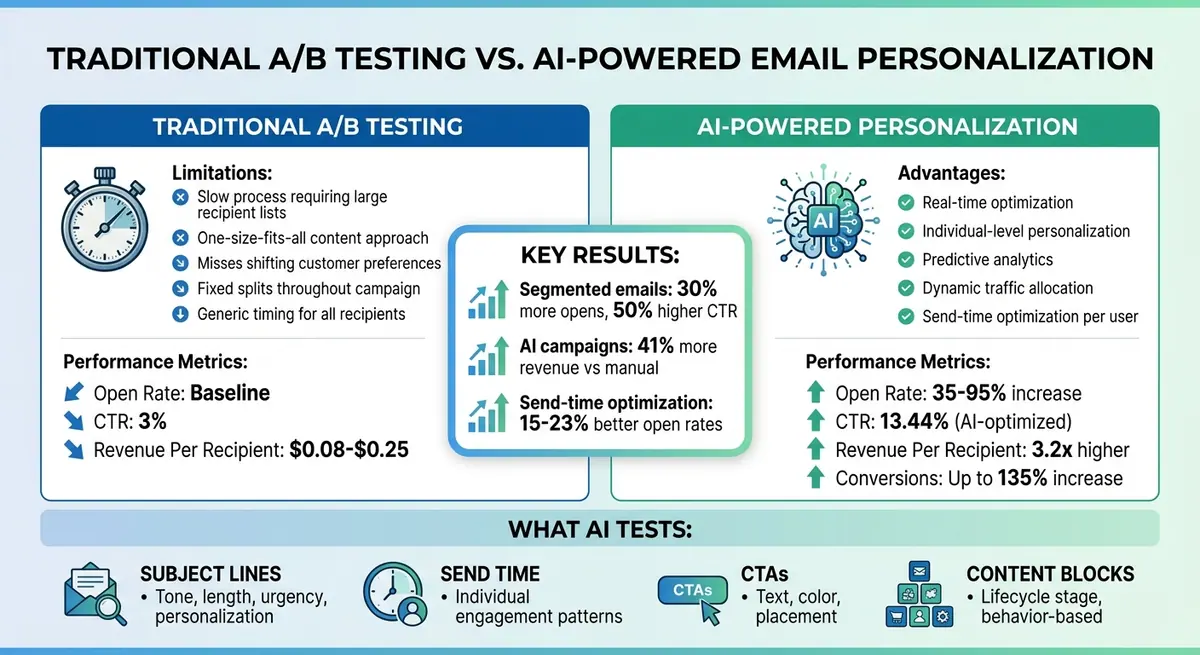
AI vs Traditional Email A/B Testing: Performance Metrics Comparison
AI Agent Personalizes and A/B Tests Stripe Transaction Emails
sbb-itb-5f36581
AI Technologies That Power Email Personalization Testing
Every personalized email that hits your inbox at just the right moment with just the right message is backed by a powerful combination of AI technologies. These tools are no longer futuristic - they’re actively reshaping how marketers approach email campaigns. Here’s a closer look at the three core technologies driving AI-powered email personalization.
Predictive Analytics for Smarter Decisions
Predictive analytics relies on historical and real-time data to anticipate how individual recipients will respond. By analyzing behaviors like past email opens, clicks, and conversions, AI predicts which subject lines or messages will resonate best with each person. This technology also enables Intelligent Timing, which identifies the exact moment a user is most likely to check their inbox and schedules emails accordingly.
The results are impressive. In April 2026, BUGECE, a music and events platform, used Braze’s Intelligent Timing feature to optimize email delivery. By tailoring send times based on user behavior, they saw a 63% increase in open rates and a 32% boost in signup conversions. This shows how precision timing can transform email performance - not for a broad audience, but for each individual.
AI also enhances testing methods like Multi-Armed Bandit testing. Instead of traditional A/B testing, this approach reallocates traffic to the best-performing email variations in real time, reducing the risk of lost conversions from underperforming emails.
With these insights, AI further refines campaigns through dynamic segmentation and adaptive traffic allocation.
Dynamic Segmentation and Real-Time Traffic Shifts
AI doesn’t stop at predictions - it continuously updates audience groups and adjusts delivery strategies based on live behaviors. Dynamic segmentation ensures your emails target the most relevant audience by automatically adjusting groups based on triggers like cart abandonment, pricing page visits, or lifecycle changes. This way, email variations reach the right people at the right time, not just whoever happened to be on a static list.
But AI takes it a step further by managing traffic allocation in real time. Instead of sticking to fixed splits, it monitors performance and shifts more traffic toward winning variations as confidence builds. For example, in April 2026, Panera Bread used AI to personalize offers during a menu update. By tailoring timing and offers to customer segments - like sandwich enthusiasts versus Sip Club members - they achieved a 5% retention increase among at-risk customers and doubled loyalty offer redemptions.
The standout benefit? Flexibility. If customer behavior shifts mid-campaign - due to a competitor’s promotion or an unexpected event - AI adapts instantly. Salesforce calls this the "force multiplier" effect, where AI doesn’t just speed up testing but makes it smarter.
Generative AI for Tailored Content
Generative AI has revolutionized email copywriting by creating highly personalized subject lines and body text. With signal-grounded generative AI, the system uses real-time data - like recent page views, engagement history, or lifecycle stage - to craft emails that feel thoughtfully written. This isn’t about dropping a first name into a generic email; it’s about producing messages that seem like they were tailored by an actual person.
Jimit Mehta from Abmatic describes the shift:
"AI-powered personalization in email marketing is no longer about generating a thousand subject lines. It is about feeding the model real signals (intent, engagement, account context, lifecycle stage) and letting it produce a single email that looks like a human spent 20 minutes on it."
Generative AI also leverages Natural Language Processing (NLP) to fine-tune tone and sentiment, ensuring the copy aligns with your brand voice and resonates with different audiences. For instance, it might create a casual, benefits-focused email for a small business owner while crafting a more data-driven, ROI-focused version for an enterprise client - all based on the same campaign.
This approach delivered big wins for Tonies, a children’s audio brand. In April 2026, they used AI to generate and test personalized onboarding and upsell emails tailored to user interests and activation patterns. The impact? A 117% year-over-year increase in free-to-paid conversions. That’s the difference between generic automation and AI that understands context.
One golden rule with generative AI: every piece of content must be grounded in real, verifiable data. If the AI lacks a specific signal - like a page view or CRM field - it should skip the personalization rather than risk making an inaccurate claim that could erode trust. The best teams pair AI with human oversight, reviewing drafts to ensure accuracy and maintain brand integrity before hitting send.
Email Elements to A/B Test with AI Personalization
AI takes email marketing to the next level by tailoring everything from subject lines to content blocks based on recipient behavior. The trick is identifying which elements have the most influence and how AI can optimize them effectively. By testing multiple components simultaneously, AI uncovers what works best for your audience.
Subject Lines and Preview Text
Subject lines are the gateway to your email. In fact, 47% of recipients decide whether to open an email based solely on the subject line. That’s why AI-powered subject line testing is such a game-changer, often delivering 35–95% increases in open rates.
AI generates 5–10 subject line variations, tweaking tone, length, word choice, and personalization. Unlike traditional A/B testing, which treats each subject line as a whole, AI zeroes in on specific elements - like urgency or brevity - that drive engagement. This method is 22% more accurate at identifying winning combinations.
"AI subject line testing identifies the winning combination 22% more accurately because it isolates which specific element drives opens rather than comparing complete subject lines as black boxes." – Digital Applied
AI also ensures subject lines stay within the ideal 28–50 character range, boosting open rates by 21% on mobile devices.
Preview text complements the subject line, offering additional context without duplicating it. For example, in 2026, Emerson tested two subject lines for a free trial email. The control read, "Free Trial & Installation: Capture Energy Savings with Automated Steam Trap Monitoring", while the alternative referenced "[White Paper] The Impact of Failed Steam Traps on Process Plants." The white paper version achieved a 23% higher open rate.
AI also leverages behavioral data to personalize subject lines. Referencing past purchases or browsing history can lift open rates by 26% compared to generic messaging. By pulling real-time data from your CRM, AI ensures every recipient sees a subject line tailored to their actions.
With subject lines optimized, the next step is refining when emails land in inboxes.
Send Time Optimization
After fine-tuning subject lines, send time becomes the next critical factor. AI-powered Send Time Optimization (STO) analyzes individual engagement habits to determine the best moment to deliver emails.
The results are impressive: STO improves open rates by 15–23% compared to sending emails at a fixed time. Instead of relying on generic schedules like "Tuesday at 10 AM", AI creates personalized delivery models. For instance, if one subscriber checks emails during their morning commute and another prefers evenings, AI adjusts accordingly.
"AI send-time optimization analyzes individual subscriber engagement patterns - when each person typically opens emails - and delivers at their personal optimal moment." – Digital Applied
AI also normalizes time zones, ensuring emails arrive during recipients' active hours rather than the middle of the night. For time-sensitive campaigns, you can set a delivery window - like 24 hours - to balance timing with urgency. However, STO is most effective for newsletters and promotions, while transactional emails (like cart abandonment) often prioritize speed.
Content Personalization and CTA Variations
AI doesn’t stop at subject lines and timing - it personalizes the entire email body. Using dynamic content modules, AI tailors value propositions, product recommendations, proof points, and images based on factors like lifecycle stage, company type, or behavior. This creates a truly personalized experience, where two recipients on the same list might see entirely different emails designed for their unique journey.
Call-to-action (CTA) buttons are another area where AI shines. It tests variations in text, color, placement, and design to maximize conversions. For example, in 2026, Indeed's product team tested different CTA button copy for job alert sign-ups. Comparing "subscribe" and "sign up" against "activate", they found that "activate" increased sign-ups by 12%.
AI-driven personalization also leads to better overall performance, with personalized emails generating 3.2x more revenue per recipient and achieving an average click-through rate (CTR) of 13.44%, compared to just 3% for non-personalized campaigns.
One essential rule: test one variable at a time. Changing multiple elements - like subject lines, preview text, and send time - simultaneously makes it impossible to determine which change drove the results.
Here’s a quick look at how AI testing impacts key email elements:
| Element | What AI Tests | Typical Impact |
|---|---|---|
| Subject Lines | Tone, length, word choice, urgency, personalization | 35–95% increase in open rates |
| Send Time | Individual engagement patterns, time zones | 15–23% improvement in open rates |
| CTAs | Button text, color, placement, design | Up to 12% increase in conversions |
| Content Blocks | Value propositions, images, proof points by lifecycle stage | 3.2x more revenue per recipient |
How to Implement AI-Powered Personalization in Email A/B Testing
Bringing AI-powered personalization into your email A/B testing strategy isn’t as simple as flipping a switch. It requires a clear plan to align your data, define success, and ensure AI-generated content stays true to your brand. With the right approach, you could start seeing measurable results in just 90 days.
Setting Clear Goals and Metrics
Start by defining your objectives on a single-page goal sheet. Outline a specific target, such as a 10% increase in open rates, the minimum acceptable improvement, and the evaluation period (14, 30, or 90 days). This keeps your focus on meaningful metrics rather than chasing stats that don’t contribute to your bottom line.
By 2026, Revenue Per Recipient (RPR) is expected to replace open rates as the primary metric. RPR is calculated by dividing total revenue by the number of email recipients, with benchmarks ranging from $0.08 to $0.25.
To ensure reliable results, aim for 95% statistical confidence (p < 0.05). This typically requires testing over 3–7 days with at least 1,000 recipients per variation.
Case studies show the power of systematic A/B testing. For instance:
- River Island, a fashion retailer, achieved a 30.9% boost in revenue per email and a 30.7% increase in orders per email, even with a 22.5% reduction in send volume.
- Whisker, a pet care brand, saw a 107% rise in conversion rates and a 112% increase in revenue per user, thanks to personalized messaging.
"A/B testing is a great choice when engagement is your primary goal. It gives you the data you need so you can step away from taking a shot in the dark and use real information to sharpen your campaigns." – Camila Espinal, Email Marketing Manager, Validity
For a more accurate measure of AI’s impact, try incremental holdout testing. Randomly exclude 10% of your list from AI personalization and compare performance after 90 days.
Once your metrics are set, establish strong content guidelines to ensure AI outputs align with your brand.
Establishing Content Guidelines for AI Tools
While AI can craft compelling email content, it needs clear boundaries to stay aligned with your brand and avoid inaccuracies. A great approach is signal-grounded personalization, where every claim the AI generates is backed by a verified data source - like a CRM field, intent signal, or public web data.
Start by auditing your CRM, ecommerce, and event data. Map key fields (e.g., last_purchase_date, product_view_history) to create a comprehensive feature set for the AI to work with. This ensures the AI has the right data to produce accurate and relevant content.
"The teams winning in 2026 wire their CRM, intent platform, and enrichment data into the AI layer and pin every personalized claim to a verifiable signal." – Jimit Mehta, Abmatic
Use modular email templates with dynamic blocks for subject lines, hero images, and product suggestions. Always include fallback options, like top-selling products, to ensure emails render properly even if AI outputs are incomplete. For critical campaigns, consider having AI drafts reviewed by a secondary verification model to check for brand voice, tone, and accuracy before sending.
If certain data signals are missing, instruct the AI to skip personalization rather than guessing. For example, if no browsing history exists for a recipient, default to a general message instead of making assumptions about their preferences.
To integrate AI effectively, follow a 90-day timeline: 30 days for data setup, 30 days for pilot testing, and another 30 days for full-scale implementation.
Using Reform for Lead Capture Integration
High-quality, first-party data is essential for effective AI personalization, and this is where Reform comes into play. Reform, a no-code form builder, helps capture the intent signals AI needs to create personalized email content.
Reform’s features like conditional routing and lead enrichment ensure you’re collecting accurate, actionable data. For example, if a prospect selects "interested in pricing" on a Reform form, that information flows directly into your CRM. The AI can then use this signal to craft follow-up emails tailored to their interest, such as referencing the pricing page they viewed.
Reform integrates seamlessly with platforms like HubSpot and Salesforce, creating a clean data pipeline for your AI workflows. Its tools, such as abandoned submission tracking and real-time analytics, help you identify where prospects drop off. For instance, if someone starts filling out a demo request form but doesn’t finish, AI can send a follow-up email addressing their hesitation, like "Still have questions about our enterprise plan?" to re-engage them.
Measuring Success and Scaling Winning Variations
After launching your AI-driven campaigns, it's critical to evaluate their performance, scale the successful strategies, and use the data to refine future efforts. This process ensures your campaigns remain effective and continually improve.
Key Metrics to Evaluate AI-Powered Campaigns
One of the most important metrics to track is Revenue Per Recipient (RPR). This is calculated by dividing total revenue by the number of email recipients, with benchmarks typically ranging from $0.08 to $0.25. Unlike open rates - which have been inflated by 18–30 percentage points due to Apple Mail Privacy Protection - RPR directly ties your email efforts to actual business outcomes.
"Revenue per recipient, click-through rate, and conversion rate per send are the metrics that actually correlate with business outcomes." – Digital Applied
Click-Through Rate (CTR) continues to be a solid measure of engagement, with AI-optimized campaigns achieving an average CTR of 13.44%, compared to just 3% for non-AI campaigns. Similarly, Click-to-Open Rate (CTOR) measures how well your email content delivers on the promise of its subject line. Another key metric is Conversion Rate Per Send, which is calculated by dividing conversions by the total number of emails delivered. Typical benchmarks for this metric range between 0.5% and 2%.
Monitoring the unsubscribe rate is equally important. A spike in this metric could indicate a mismatch between your AI-generated content and your audience's preferences. Before declaring a "winning" variation, ensure it has reached 95% statistical confidence to rule out random chance. For reliable results, aim for 20,000 recipients per variation.
| Metric | Formula | Why It Matters | 2026 Benchmark |
|---|---|---|---|
| Revenue Per Recipient (RPR) | Total revenue / Total recipients | Directly connects email efforts to revenue | $0.08–$0.25 |
| Click-Through Rate (CTR) | Unique clicks / Total delivered | Measures engagement and intent | 10–15% (AI-optimized) |
| Conversion Rate Per Send | Conversions / Total delivered | Indicates business impact | 0.5–2% |
| LTV by Email Cohort | Avg. 12-month revenue from cohort | Highlights the long-term value of strategies | 1.5–3x initial purchase |
These metrics are the foundation for identifying and scaling successful strategies effectively.
Refining and Scaling Winning Variations
Once a variation reaches 95% confidence, scale it cautiously using a canary rollout approach. Start by testing it with 5% of your list, then gradually expand to 20% and 50% as confidence in its performance grows. This step-by-step method reduces risks while validating results across different audience segments.
For example, BUGECE, a music platform, used AI-powered Intelligent Timing to test delivery windows, leading to a 63% increase in email open rates and a 32% boost in signup conversions.
Instead of applying a "one-size-fits-all" approach, use AI to personalize winning variations for each recipient. By analyzing purchase history and engagement patterns, AI can determine which content variations resonate best with specific audience segments. For instance, rather than universally applying a winning subject line, AI can tailor variations to match individual preferences.
To measure the true impact of personalization, maintain a 10% holdout group that receives non-personalized content. Comparing this group's performance to the AI-personalized group over a 90-day period helps isolate the incremental lift driven by your strategy.
For maximum results, consider implementing a full AI stack. This includes dynamic content, send-time optimization based on clicks, predictive segmentation, and generative content. These strategies have been shown to increase RPR by up to 3.2x. Before scaling, clean your email list to avoid skewed results - a 10% bounce rate can significantly distort your metrics.
Using Feedback Loops for Continuous Improvement
Once you've scaled successful variations, feedback loops are key to refining future campaigns. These loops turn your AI into a learning system, where each test result contributes to better performance over time.
"The beauty of A/B testing is its snowball effect... Those improved messages lead to better data, which lead to even more improved messaging." – Salesforce
Establish a consistent testing schedule. Test high-impact elements like subject lines and calls-to-action weekly, review patterns and segment behaviors monthly, and assess overall program effectiveness quarterly. Keep detailed records of each test, including hypotheses, variables, and outcomes, to build a knowledge base and avoid repeating experiments.
Integrate test results with CRM and sales data to focus on metrics like revenue and qualified leads, rather than superficial ones. Use advanced AI tools to analyze historical data and suggest new tests. Retrain your AI models monthly to adjust to shifting audience preferences and seasonal trends.
Finally, treat the winning variation from one test as the control for your next experiment. Brands like River Island have successfully applied this iterative approach, achieving a 30.9% increase in revenue per email while reducing send volumes by 22.5%.
Conclusion
AI has revolutionized email A/B testing, turning it from a time-consuming manual task into a fast, real-time optimization process. The results speak for themselves: AI-personalized email campaigns generate 41% more revenue compared to manual efforts, while comprehensive AI solutions boost revenue per recipient by 3.2x.
"AI changes the pace of experimentation - to the degree that A/B testing can be replaced by other real-time methods of experimentation and personalization, redirecting energy toward what's working while phasing out what's not." – Team Braze
This shift highlights the power of real-time, personalized email optimization.
To move beyond the outdated "winner takes all" approach, adopt AI-driven tools that tailor the copy for each subscriber based on their behavior. This method not only avoids stagnation but also ensures your campaigns are always improving. Start with impactful elements like subject lines and CTAs - these often yield the quickest results. For personalization to feel authentic, tie every customized element to verified CRM data rather than relying on generic placeholders. Tools like Reform can help you collect enriched, accurate data, giving your AI the signals it needs to deliver meaningful personalization throughout your funnel.
Focus on metrics that directly impact your business, such as revenue per recipient, click-through rates, and conversion rates. These remain reliable indicators even as privacy changes make open rates less dependable. Done right, AI-powered email testing isn't just an improvement - it's a must-have to stay competitive. Now is the time to embrace AI-driven email testing and take your marketing strategy to the next level.
FAQs
How is AI A/B testing different from traditional A/B testing?
AI A/B testing is a game-changer when it comes to speed and real-time insights. Traditional testing methods can drag on for weeks or even months before producing actionable results. In contrast, AI works continuously, analyzing key factors like user intent and engagement to make instant optimizations. It also allows for dynamic, ongoing experimentation, offering personalized variations tailored to individual users. This makes the process not only faster and more efficient but also more in tune with evolving customer preferences.
What data do I need to personalize emails with AI safely?
To personalize emails effectively and safely using AI, rely on relevant first-party data. This includes information like CRM records, website activity, engagement metrics, and intent data. To ensure privacy compliance, centralize your data, use clear and consistent schemas, and apply controlled segmentation strategies.
It’s also crucial to implement safeguards. These can include review processes, detailed segmentation, and regular compliance checks to ensure your AI-generated emails stay aligned with your brand's voice and values. Regular monitoring and testing are key to maintaining relevance and safeguarding user trust.
Which email metric should I focus on if open rates are unreliable?
If open rates aren’t dependable, shift your attention to click-through rate (CTR). CTR provides a clearer picture of user engagement by measuring the actions recipients take after opening your email. It’s a stronger signal of how effectively your content connects with your audience.
Related Blog Posts
Get new content delivered straight to your inbox

The Response
Updates on the Reform platform, insights on optimizing conversion rates, and tips to craft forms that convert.


Drive real results with form optimizations
Tested across hundreds of experiments, our strategies deliver a 215% lift in qualified leads for B2B and SaaS companies.
