
.webp)
Data Sharing Compliance: Audit Preparation Tips



Preparing for a data-sharing audit is no longer optional - it’s essential to protect your business, reputation, and finances. With data breaches costing an average of $4.88 million in 2025 and GDPR fines reaching €20 million or 4% of global revenue, compliance is a top priority. This guide breaks down six key steps to simplify the process and ensure your organization is ready for any audit:
- Define your audit scope and goals: Identify applicable regulations (e.g., GDPR, CCPA, HIPAA) based on customer locations and business activities.
- Build a complete data inventory: Map how data enters, flows, and exits your systems, and classify it by sensitivity.
- Review policies and contracts: Ensure internal policies and third-party agreements align with legal requirements.
- Identify risks and strengthen protections: Evaluate vendor security practices, update incident response plans, and implement safeguards like encryption and access controls.
- Organize documentation: Centralize evidence such as audit trails, risk assessments, and compliance records for easy access.
- Train your team and inform partners: Regularly educate staff on data handling rules and communicate audit expectations to vendors.
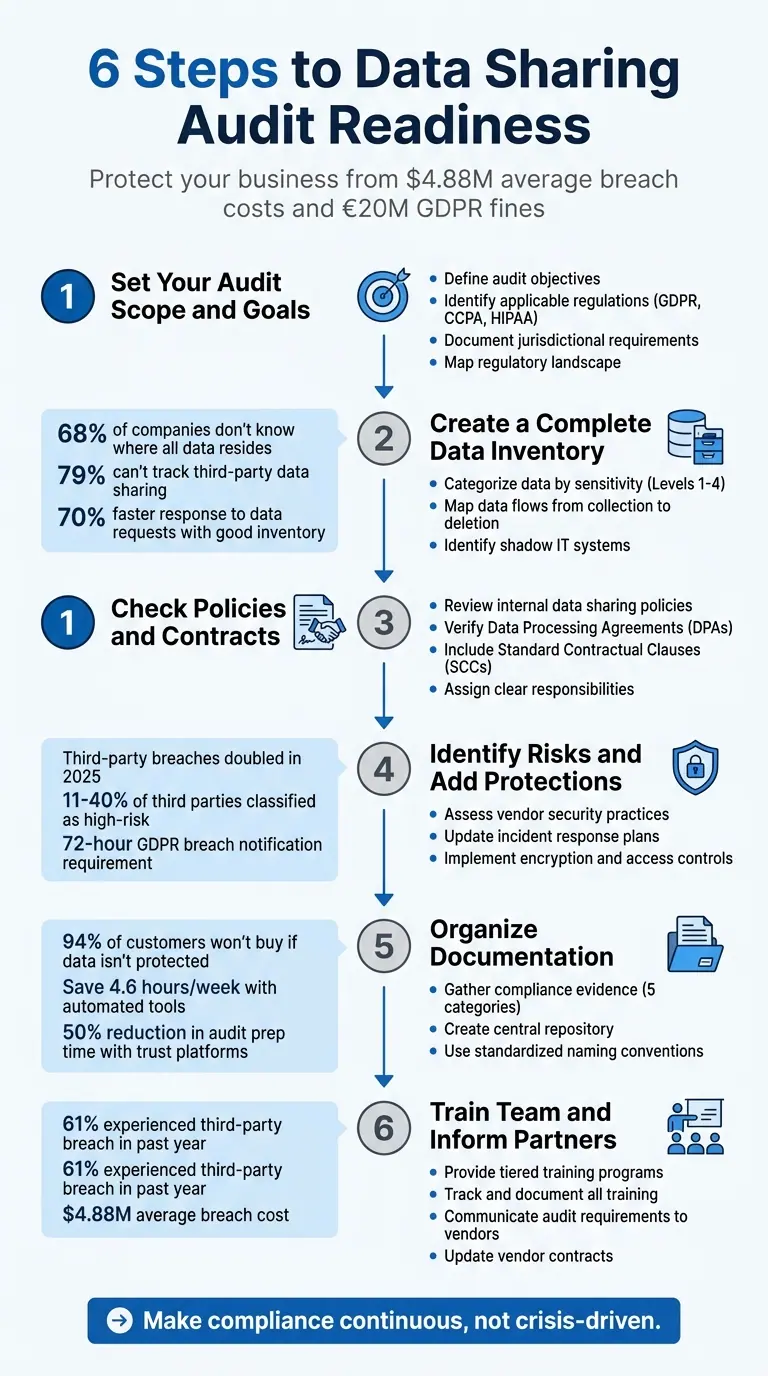
6-Step Data Sharing Audit Preparation Process
GDPR Compliance Audit - Evaluating Your Data Protection Practices
sbb-itb-5f36581
Step 1: Set Your Audit Scope and Goals
Start by defining the scope and purpose of your audit. Sebastien Ruosch, Executive Audit Director at Auditsuisse, offers a critical reminder:
Scope mistakes are expensive because they cascade into incorrect control design, wrong evidence requests, and missed dependencies during fieldwork.
Your objectives should be crystal clear. Are you focusing on compliance with specific state regulations? Pinpointing vulnerabilities in your data security practices? Or perhaps evaluating the overall maturity of your data protection program? These goals will determine which systems you assess and what evidence you need to collect. A well-defined scope is the foundation for identifying all relevant regulatory requirements.
Determine Which Regulations Apply
Understanding which regulations apply to your business is essential. This often depends on where your customers are located rather than where your business operates. For instance, if you're a U.S.-based company serving clients in the EU, the GDPR applies. Similarly, if you handle data from California residents, the CCPA comes into play.
California has particularly detailed requirements. Starting January 1, 2026, businesses earning over $26,625,000 in gross revenue and handling personal information of more than 250,000 consumers must conduct annual cybersecurity audits. The same applies to companies that derive 50% of their revenue from selling or sharing personal information or process sensitive personal data for over 50,000 consumers.
Industry-specific frameworks add complexity. Healthcare organizations, for example, must comply with HIPAA. Companies dealing with data from EU or UK residents need Transfer Impact Assessments (TIAs) and Standard Contractual Clauses (SCCs) for cross-border data transfers. Create a comprehensive list of applicable laws based on jurisdiction, revenue, and data activities. Be sure to document jurisdictional differences - Rhode Island, for instance, has unique transparency rules for third-party data sales that differ from California’s. This level of understanding is key to building a compliance framework that holds up under scrutiny.
Document Your Data Sharing Activities
After mapping out the regulatory landscape, catalog all your data-sharing activities. Record every instance where data leaves your control, specifying its purpose, legal basis, the categories of data subjects involved, retention periods, and any cross-border transfers. This documentation forms the backbone of your Records of Processing Activities (ROPA).
Define system boundaries clearly by naming the exact systems, integrations, SaaS tools, databases, and subprocessors involved. Assign compliance controls to specific roles to ensure continuity even when staff changes occur. If you collect customer data through forms, detail how that information flows - from collection to storage to third-party sharing. For example, businesses using platforms like Reform to gather leads should track how submissions move through CRM integrations and identify who has access at each stage.
High-risk activities, such as AI profiling, biometric data processing, or handling minors' information, require documented risk assessments under the 2026 mandates. Link these activities to their specific business purposes to demonstrate both necessity and proportionality. Accurate and thorough documentation - aligned with your audit scope - is critical for proving compliance and mitigating risks effectively.
Step 2: Create a Complete Data Inventory
Building a thorough data inventory is a cornerstone of compliance. However, a staggering 68% of surveyed companies admit they don't know where all their data resides, and 79% can't track how third parties share their data. On the other hand, businesses with well-maintained data inventories respond to customer data requests 70% faster and experience 45% fewer security issues compared to those that don’t. As Kapden.io aptly states:
You can't protect data you don't know about.
A detailed inventory works hand-in-hand with your audit scope by identifying data sources and tracking how data flows through your organization.
Categorize Data Types and Origins
Start by identifying all the ways data enters your system. This includes:
- Digital sources: Website forms, APIs, and chatbots.
- Offline sources: Paper forms and phone calls.
- Third-party sources: Business partners and public records.
For example, if you use tools like Reform to generate leads via web forms, document the type of information collected and where it goes next.
Next, classify your data by sensitivity. Here's a framework to guide you:
- Level 1: Public information (e.g., marketing materials).
- Level 2: Internal business data (e.g., project plans).
- Level 3: Personal data (e.g., names, emails, phone numbers).
- Level 4: Sensitive data (e.g., Social Security numbers, health records, biometric data).
For each data type, document critical details such as its source, storage location, access permissions, and retention period. To uncover hidden or untracked systems (often referred to as shadow IT), consider holding discovery workshops and reviewing software purchase records. Alarmingly, 85% of businesses have shadow IT systems that aren’t accounted for in their inventories.
Map How Data Moves
Once you’ve categorized your data, map out its entire lifecycle - from collection to deletion. Visual tools like Lucidchart, Draw.io, or Miro can help you create clear and effective data flow diagrams. As Kapden.io highlights:
A picture is worth a thousand words when explaining data flows to stakeholders.
When mapping, distinguish between data processors and data recipients. Processors are vendors who act on your behalf (e.g., AWS for hosting or payment processors like Razorpay), while recipients are partners who use the data independently (e.g., credit bureaus or marketing affiliates).
If your data crosses borders, document the destination country and the legal safeguards in place, such as Standard Contractual Clauses. Additionally, establish a deletion policy for each data category - like removing data three years after the last transaction - to avoid keeping it longer than necessary.
Finally, treat your data inventory as a living document. Review it monthly to capture new collection points, and conduct an annual deep-dive audit to ensure its accuracy. Regular updates will keep your organization compliant and prepared for audits.
Step 3: Check Policies and Contracts
Once you've built a detailed data inventory, the next step is to ensure your policies and contracts align with regulatory requirements. A strong data inventory is only effective if the policies and agreements that govern it are up to date and compliant. Modern compliance frameworks rely heavily on well-structured policies and agreements. This makes it essential to confirm that both internal policies and third-party contracts meet the latest standards.
Review Internal Data Sharing Policies
Start by reviewing your internal data sharing policies to ensure they comply with legal requirements. For example, the Information Commissioner's Office (ICO) offers an "Accountability Framework" designed to help organizations manage compliance related to contracts and data sharing. Even if regulatory guidance pages are outdated or unavailable, archived versions can provide helpful historical standards.
To maintain control over policies, assign clear responsibilities to specific roles. Many organizations have solid policies but fall short during audits because they can't produce "attributable" evidence - records showing who performed a control and when. This lack of evidence is a common reason for audit failures. Sebastien Ruosch, Executive Audit Director at Auditsuisse, explains:
The challenge is building repeatable execution: people know what should happen, but workflows, ownership, and evidence hygiene often lag behind growth.
To avoid these pitfalls, review workflows monthly with your engineering, security, and compliance teams to prevent "control drift" - when processes deviate from intended practices. Use a unified control register to avoid fragmented ownership, where different departments might operate under conflicting definitions.
Verify Third-Party Agreements
If you're working under GDPR, a Data Processing Agreement (DPA) is mandatory whenever you engage a vendor to handle personal data. These agreements must include Article 28 clauses that outline critical details like the subject matter, duration, nature, and purpose of data processing. They should also specify the types of data and categories of data subjects involved.
Your DPA should require processors to act only on your written instructions and secure your written approval for engaging sub-processors. For data transfers outside the EEA or UK to regions without "adequate" protection - such as the U.S. - you must incorporate Standard Contractual Clauses (SCCs) or the UK Addendum as legally binding appendices. The agreement should also grant you the right to verify compliance through evidence requests or audits, whether conducted remotely or in person.
To ensure accuracy, have a reviewer verify evidence for proper dates, scope, and alignment with approvals. Using standard evidence templates can help minimize interpretation errors. Keep in mind that as the controller, it's your responsibility to ensure the final signed agreement fully meets regulatory requirements, even if the vendor provides the initial draft.
Step 4: Identify Risks and Add Protections
Once your data sharing practices and policies are fully documented and verified, the next step is to pinpoint vulnerabilities in your processes. This is crucial, especially as breaches involving third parties have seen a sharp rise, doubling in 2025.
Check Third-Party Security Practices
Begin by categorizing your vendors based on the sensitivity of the data they handle. Research shows that 11% to 40% of third parties are classified as high-risk across organizations. For these high-risk partners, require thorough security checks, including independent audits, penetration testing conducted within the last year, and vulnerability scans from the previous quarter.
To assess vendor security, use standardized tools like the Standardized Information Gathering (SIG) Questionnaire or the Cloud Security Alliance's Consensus Assessments Initiative Questionnaire (CAIQ). During pre-engagement evaluations, focus on critical areas such as encryption standards, identity management, and access controls. For cloud services or payment processing, create a shared responsibility matrix to clearly define which party is accountable for specific security measures. This eliminates any potential gaps in your security strategy.
Continuous monitoring is also essential. Use security rating services to track external attack surfaces, review financial stability, and stay updated on any legal or regulatory changes in real time. For instance, the FTC Safeguards Rule, as of June 2023, mandates that financial institutions monitor their service providers and secure contractual commitments for protective controls. Ensure that your contracts include "flow-down" clauses, requiring primary vendors to hold their subcontractors to the same security standards.
Once your vendor security measures are in place, shift your attention to preparing for potential breaches.
Prepare for Data Breaches
After solidifying vendor security protocols, update your incident response plan to address data sharing security incidents effectively. GDPR's Article 33 specifies a 72-hour breach notification requirement, so ensure your plan can be activated quickly. Confirm that third-party incident response plans align with these timelines and include steps for identifying, mitigating, and reporting incidents within the necessary regulatory frameworks.
Develop a comprehensive crisis plan for reporting breaches to both regulatory bodies and affected individuals. Strengthen your defenses with measures like:
- Encryption for data both at rest and in transit
- Firewalls and data anonymization
- Role-based access controls and oversight of privileged accounts
- Immediate access revocation for employees who change roles or leave the organization
When ending a partnership with a vendor, require a data deletion certificate and proof of access revocation, following NIST SP 800-88 guidelines. These steps help ensure that sensitive data is no longer accessible and remains protected even after the relationship ends.
Step 5: Organize Documentation for the Audit
Once you've addressed risks and mapped your inventory, the next step is organizing documentation to prove your compliance. This isn't just about meeting regulatory demands - it's also about maintaining trust. A striking 94% of businesses believe customers won’t buy from them if their data isn’t properly protected. That makes thorough documentation a business necessity as much as a legal one.
Gather Compliance Evidence
To prepare for an audit, collect evidence across five key categories:
- Administrative records: This includes privacy policies, data protection notices, consent forms, and staff training records related to data handling.
- Technical evidence: Gather system audit trails, access logs that show who accessed data and when, encryption protocol verifications (e.g., AES-256), and results from technical control tests.
- Operational records: These cover data processing inventories, data flow maps, risk assessments (especially for high-risk activities like AI profiling), and incident response plans.
- Third-party oversight documentation: Include Data Processing Agreements (DPAs), Service Level Agreements (SLAs), and records of vendor security assessments.
- Governance records: These might include management or board review notes, evidence of remediation actions for previous gaps, and business continuity plans.
For businesses earning at least 50% of their revenue from selling or sharing personal information, the 2026 CCPA amendments require annual independent cybersecurity audits. That makes these records even more critical.
To streamline this process, use digital tools that track the "chain of custody" for all shared evidence. This ensures every interaction with the evidence is documented and legally admissible. As Nohad Ahsan, Product Marketing Executive at VIDIZMO, warns:
A simple slip in the chain of custody could lead to the disqualification of critical evidence.
Once you've gathered everything, centralize the documentation for easy auditor access.
Create a Central Document Repository
Store all your evidence in one secure, centralized repository. Automated evidence management tools can save organizations an average of 4.6 hours per week on collection tasks. Additionally, trust management platforms can cut total audit preparation time by up to 50%.
Organize your repository with folders based on compliance categories and time periods to align with auditor expectations. Use standardized naming conventions, such as "2026-05-03-Consent-Logs.pdf", to make files easy to find and sort. Add README files or short narratives in each folder to explain what the evidence proves, who collected it, and how frequently the control is reviewed.
For storage, cloud solutions with granular permissions work best. These allow only authorized personnel to modify files while providing auditors with read-only access. Set up calendar reminders to archive evidence promptly after control reviews, avoiding last-minute scrambles during audit windows. Uri Kedem from Kiteworks highlights the importance of a secure file-sharing system:
A 2026-ready secure file sharing program centralizes exchanges, enforces end-to-end encryption and zero-trust access, and produces immutable, scoped evidence for audits.
Step 6: Train Your Team and Inform Partners
With your documentation in place, it’s time to equip your team and ensure your partners are aligned with compliance responsibilities. This step goes beyond simply meeting requirements. As Integrate.io emphasizes:
Data compliance is everyone's responsibility.
When your employees and vendors understand their roles, they become the first line of defense. This is critical, especially considering that breaches are projected to cost an average of $4.88 million in 2025.
Train Staff on Data Sharing Rules
Regular training is essential to keep up with regulations like GDPR, CCPA, and HIPAA. A tiered approach works best: provide general awareness training for all employees and more specific sessions for key roles. For example, IT teams need to focus on encryption, while customer service teams should learn how to handle PII properly.
Interactive workshops and simulations are great tools to reinforce these rules. Follow up with one-on-one evaluations to ensure everyone fully understands their responsibilities. Keep detailed records of all training sessions, including attendance and signed acknowledgments. Using automated tracking systems can simplify this process by logging completions and keeping your organization audit-ready.
Inform Vendors of Audit Requirements
Your compliance depends on how well your vendors perform. Alarmingly, 61% of companies reported experiencing a third-party data breach or security incident in the 12 months leading up to May 2024. To mitigate this risk, you need to clearly communicate audit expectations to your partners.
Start by reviewing your Data Processing Agreements (DPAs) and Business Associate Agreements (BAAs). These documents should outline audit rights, evidence submission requirements, and incident response procedures. Make sure vendors understand the audit scope, timelines, and required documentation, such as access logs, encryption records, and security certifications.
Assign a Data Protection Officer or a compliance team to handle vendor communications. Update contracts to reflect new requirements, including audit rights, data recovery protocols, and breach reporting obligations under the evolving privacy laws for 2026. As Usercentrics highlights:
A data protection audit should review vendor management programs and third-party processors based on their data protection capabilities and security certifications.
Conclusion
Getting ready for a data sharing audit isn't just a one-time effort - it’s a practice that should weave seamlessly into your everyday operations. When compliance becomes second nature, you’ll be prepared whenever auditors come knocking. As Rewind aptly states:
With compliance embedded into your daily operations, all that remains is to present the evidence.
This mindset aligns perfectly with the structured processes we've discussed earlier.
Consider this: the average cost of a data breach hit $4.88 million in 2025. On top of that, failing a GDPR audit could lead to fines as high as €20 million or 4% of your annual global revenue, whichever is greater. These figures highlight one thing - continuous monitoring is not just a good idea; it’s a critical safeguard for your organization.
To stay ahead, use tools like real-time dashboards, automated systems, and internal mock audits to ensure your data inventories are always up to date. Keep a centralized repository where policies, training documentation, and evidence are easy to find. And don’t treat audit findings as mere paperwork - use them as opportunities to improve.
As Alation puts it:
Make audits a catalyst, not a crisis.
FAQs
How do I know which data privacy laws apply to my business?
To determine which data privacy laws apply to your business, start by examining three key factors: your location, your customer base, and the type of data you process.
For instance, if your business collects or processes data from EU residents, the General Data Protection Regulation (GDPR) will likely apply, regardless of where your company is physically located. In the United States, privacy regulations such as the California Consumer Privacy Act (CCPA) differ by state, so it's crucial to understand the specific requirements based on where your customers are.
Given the ever-changing nature of privacy laws, staying compliant requires ongoing effort. Regularly review and update your practices by conducting data audits to identify potential gaps. And don't hesitate to seek guidance from legal professionals who specialize in data privacy to navigate this complex and evolving landscape.
What’s the easiest way to build a reliable data inventory and data flow map?
To create a dependable data inventory and flow map, it’s essential to take a systematic approach. Begin by documenting all data collection points, the reasons for processing the data, where it’s stored, how it’s transferred, and its various lifecycle stages. This method offers a clear picture of how data moves within your organization, which is key for maintaining compliance and managing risks effectively.
Start by thoroughly detailing your data sources, activities, and transfer points. This groundwork is especially critical in industries with strict regulations, such as healthcare, where transparency is non-negotiable.
What evidence do auditors usually ask for in a data-sharing compliance audit?
Auditors often ask for evidence like recent independent audit reports that focus on data processing systems and personnel. These reports usually detail the controls that were tested and highlight any deficiencies found. To show compliance effectively, it's crucial to provide clear, current documentation that addresses these areas.
Related Blog Posts
Get new content delivered straight to your inbox

The Response
Updates on the Reform platform, insights on optimizing conversion rates, and tips to craft forms that convert.



Drive real results with form optimizations
Tested across hundreds of experiments, our strategies deliver a 215% lift in qualified leads for B2B and SaaS companies.
