
.webp)
AI-Powered Data Cleansing for Lead Generation


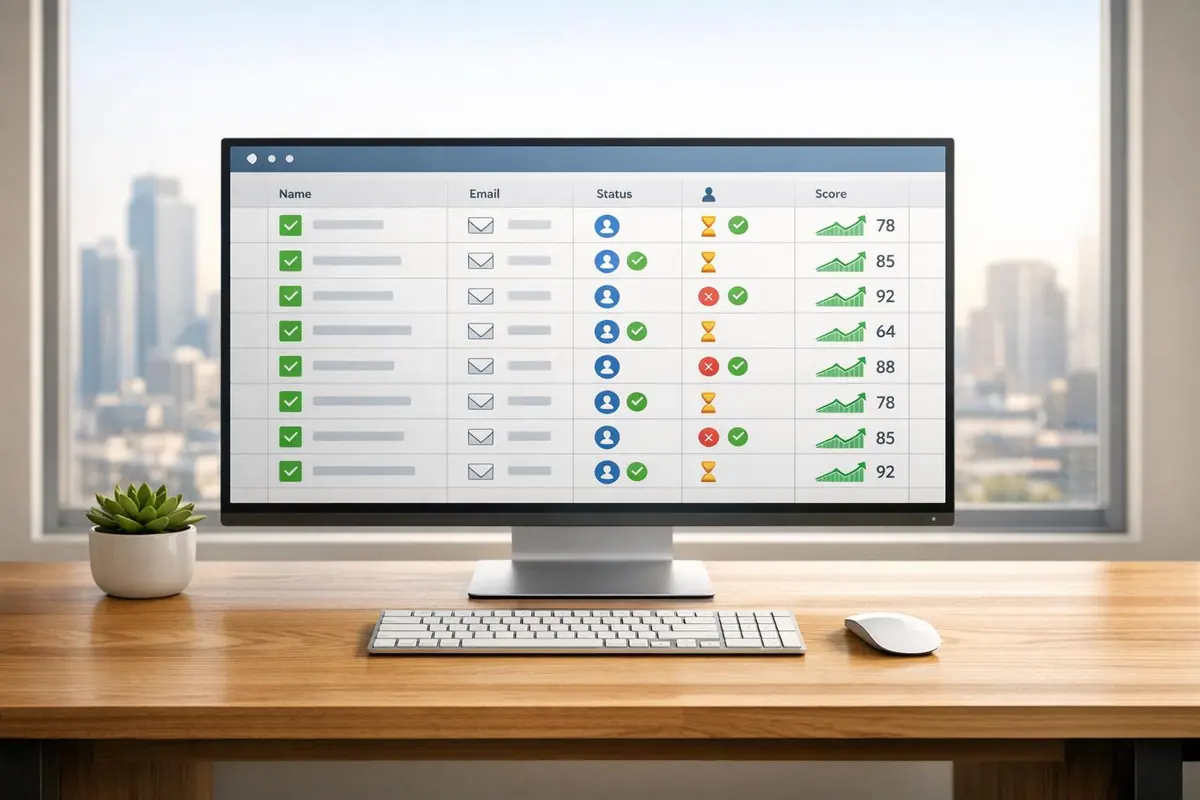
Your lead database might be hurting your revenue more than you think. Poor-quality data can cost sales teams up to 27% of their revenue, while B2B data decays at a staggering 30% annually - and even faster for tech startups. Manual data cleansing methods are slow, error-prone, and expensive, with reps spending 20% of their time on tasks like verifying and enriching contact details. That's where AI-powered data cleansing steps in.
AI tools process millions of records in minutes, achieve over 99% accuracy, and reduce email bounce rates by 75–85%. They also cut data management costs by 30–50% and improve lead-to-opportunity conversion rates from 8–12% to 18–28%. For businesses dealing with large datasets, AI offers a faster, more precise, and cost-effective alternative to manual methods.
Key Takeaways:
- Speed: AI cleans 10,000 records in under 15 minutes, vs. weeks manually.
- Accuracy: Achieves 98%+ accuracy, resolving duplicates and inconsistencies.
- Cost: Cuts expenses by 30–50%, with ROI often within two months.
- Scalability: Handles growing datasets without additional staff.
AI-powered data cleansing not only saves time but also drives higher conversions and revenue. If you're still relying on manual methods, it's time to rethink your approach.
Clean Salesforce lead data with AI in one simple workflow
sbb-itb-5f36581
1. AI-Powered Data Cleansing
AI-powered data cleansing takes the heavy lifting out of lead generation by automating tasks that would otherwise take days - or even weeks - to complete manually. Instead of sales teams spending nearly 20% of their workday verifying contact details, AI tools can process millions of records in minutes while maintaining over 99% accuracy in standardizing fields like phone numbers and email addresses.
Efficiency
The difference in speed is staggering. AI can process 10,000 records in under 15 minutes, whereas manual methods might take weeks to handle enterprise-scale datasets. In 2024, AI tools managed to process 57 multilingual survey datasets in under an hour - a task that would have required over 25 hours of manual effort. Beyond speed, AI learns patterns from massive datasets, correcting inconsistencies on its own. It also excels at complex tasks like entity resolution, using fuzzy logic to merge duplicate records where traditional systems fall short.
Real-world examples highlight the impact. In 2023, Cisco used Informatica's AI-powered tool to audit 90 million records, cutting sales cycle delays by 65% and saving $76 million annually. Similarly, in 2024, Atlassian adopted ZoomInfo's machine-learning enrichment, boosting pipeline generation by 37% and reducing email bounce rates from 17% to under 4%.
This speed advantage pairs seamlessly with AI's precision, which is explored in the next section.
Accuracy
AI doesn't just work faster - it works smarter. Traditional databases often hover between 40% and 60% accuracy, but AI-driven systems consistently achieve 98% accuracy. This is largely due to AI's ability to understand context, which prevents errors like misrouted leads or flawed segmentation. AI also uses multi-source verification, cross-referencing 5–7 independent sources - such as LinkedIn, company websites, news outlets, and job postings - to resolve conflicting data.
Additionally, AI employs semantic deduplication, recognizing that "John Smith" and "J. Smith" might refer to the same person, rather than relying on exact matches. It even flags catch-all email domains that might pass traditional checks but often lead to silent bounces. This level of precision can reduce email bounce rates by 75–85%.
These accuracy improvements directly contribute to saving time and money, as discussed in the next section.
Cost-Effectiveness
The financial benefits of AI are hard to ignore. Manual data cleaning costs around $2,400 per month, and traditional database subscriptions add $15,000–$30,000 annually. AI, on the other hand, slashes data management expenses by 30–50%. While manual cleaning can cost $3–$8 per record, AI validation operates at a fraction of that cost and completes the task in seconds. Poor data quality costs organizations an average of $12.9 million annually.
"AI, when fueled by quality data, has the power to elevate B2B marketing from a volume game to a precision-driven growth engine." - Canio Martino, CRO/MD, B2B Media Group
The return on investment (ROI) is quick, often within two months. Integrated AI platforms can reduce lead generation costs by up to 60% compared to manual methods. In 2024, Gong cleaned 5 million contact records using internal machine learning models and third-party APIs, resulting in 31% faster SDR onboarding and a 29% increase in personalized email click-through rates.
Scalability
AI grows with your business. As databases expand from thousands to millions of records, AI systems handle the increase without requiring additional staff or slowing down. This is especially important as B2B data decays at a rate of 22.5–30% annually due to job changes and relocations. AI combats this decay by continuously monitoring real-time events - such as promotions, job changes, and funding rounds - and updating records within 24–48 hours.
Modern AI tools also use waterfall enrichment, querying over 15 data providers simultaneously to fill in missing fields like direct dials or LinkedIn URLs. This ensures high data completeness without manual effort. Automated enrichment layers then add firmographics (like company size, revenue, and industry) and contact details (such as seniority and role) right after lead capture, giving sales teams the context they need immediately.
2. Manual Data Cleansing
Manual data cleansing is a time-consuming, reactive approach that often falls short of addressing the deeper issues behind data quality. Once the cleanup is done, data begins to degrade almost immediately, leaving teams stuck in a never-ending cycle of maintenance. On average, sales representatives spend about 20% of their time - nearly two full workdays per week - on tasks like data entry and validation. For a single rep earning $100,000 annually, this amounts to $20,000–$30,000 in lost productivity.
Efficiency
The speed gap between manual and AI-driven data cleansing is glaring. AI can process 10,000 records in under 15 minutes, while manual methods can take weeks to tackle datasets of similar size. For example, in November 2024, normalizing 57 multilingual survey datasets manually required over 25 hours of work. Manual processes scale linearly, meaning that as data volumes increase, companies must hire more staff to keep up - a costly and unsustainable approach.
Data quality issues further complicate matters, with sales teams losing up to 27% of their time addressing them instead of focusing on prospect intent or follow-ups. The larger the database grows, the more overwhelming the workload becomes without matching budget increases. This slow, labor-intensive process also compromises overall data accuracy.
Accuracy
While manual data cleansing can achieve around 90% accuracy, it is prone to human error. Small discrepancies - like "John Smith, 123 Main St." versus "J. Smith, 123 Main Street" - often go unnoticed. On average, 22% of a company’s contact data is inaccurate due to human mistakes or natural decay. Manual reviews catch obvious errors but struggle to identify subtle issues like semantic differences or nuanced inconsistencies, which can significantly impact data integrity.
Adding to the challenge, B2B data decays at a rate of 2.1% per month, or 22.5% annually, making quarterly cleanups insufficient to keep up. In November 2024, business email decay surged to 3.6% in a single month, driven by rapid job changes. These limitations in accuracy increase operational costs and reduce the effectiveness of lead generation efforts.
Cost-Effectiveness
The financial strain of manual data cleansing is hard to ignore. It can consume up to 20% of a company’s revenue. Across the U.S., bad data is estimated to cost the economy $3.1 trillion per year, with manual processes shouldering a disproportionate share of this burden. Data scientists, for instance, spend 60% to 80% of their time cleaning data rather than analyzing it. This misallocation of resources forces teams to focus on fixing problems instead of driving revenue, with labor costs ballooning as data volumes grow.
Scalability
As datasets expand, the inefficiencies of manual data entry become even more pronounced. To maintain the same level of quality with five times the data, a company would need a team five times larger. This is simply not feasible for most budgets. In fact, 60% of businesses identify manual data entry as a major bottleneck, leading to delays that slow sales cycles and erode competitive advantage.
"The team that cleaned your database in Q1 would need to be five times larger to maintain the same quality at five times the volume. Nobody's budget works that way." - William Flaiz, Data Strategy Lead
Without automation, the rising costs and growing labor demands make manual data cleansing an unsustainable option for long-term lead generation.
Pros and Cons
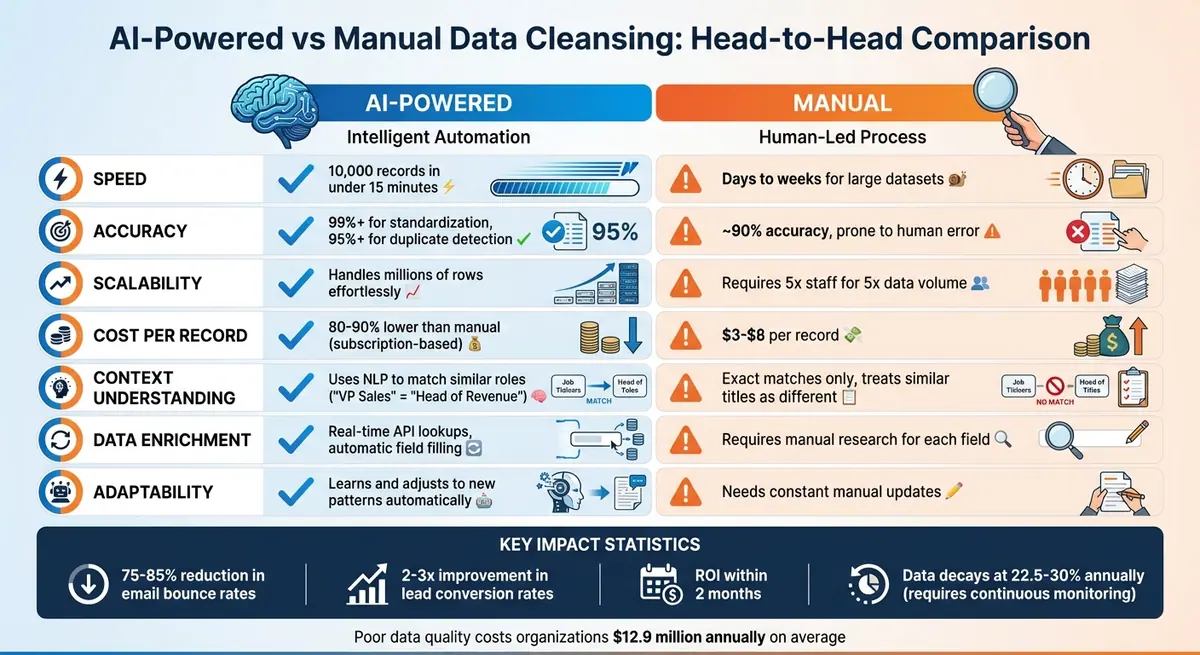
AI vs Manual Data Cleansing: Speed, Accuracy, and Cost Comparison
The table below highlights the main trade-offs between AI-powered and manual data cleansing, focusing on efficiency, accuracy, and scalability.
| Feature | AI-Powered Cleansing | Manual Data Cleansing |
|---|---|---|
| Speed | Processes 10,000 records in under 15 minutes | Takes days or even weeks for large datasets |
| Accuracy | Achieves over 99% for standardizing phone numbers and emails; over 95% for detecting duplicates | Prone to inconsistencies and errors due to human limitations |
| Scalability | Effortlessly handles millions of rows | Struggles with large volumes and requires more staff as data grows |
| Cost per Record | 80–90% lower than manual methods; typically subscription-based | Costs range from $3 to $8 per record when factoring in labor and research time |
| Context Understanding | Uses NLP to equate roles like "VP Sales" and "Head of Revenue" | Relies on exact matches, treating similar titles as distinct |
| Data Enrichment | Provides real-time API lookups to fill missing fields | Requires manual research for additional data |
| Adaptability | Learns and adjusts to new patterns over time | Needs constant manual updates and intervention |
| Catch-All Detection | Flags high-risk domains that seem valid but often bounce | Frequently marks catch-all domains as deliverable |
| Limitations | Can falter if the initial dataset lacks critical context | Limited by human speed and impractical for scaling |
AI-powered data cleansing excels in areas like speed, accuracy, and scalability, making it ideal for businesses dealing with large datasets. For example, AI's ability to recognize equivalent job titles (e.g., "VP Sales" and "Head of Revenue") showcases its semantic capabilities. However, it does have its challenges, such as potential latency during real-time processing and a reliance on high-quality initial data.
In contrast, manual data cleansing offers the advantage of nuanced human judgment but quickly becomes unsustainable as data volumes increase. It's also a resource-intensive process - data scientists reportedly spend 60% to 80% of their time cleaning data instead of analyzing it.
For businesses aiming to optimize speed, accuracy, and long-term cost savings, AI-powered cleansing delivers clear advantages and measurable ROI. Manual methods, while still useful for small or highly specialized tasks, are less practical for large-scale lead generation efforts. This comparison underscores why AI-powered solutions are becoming the go-to choice for most organizations.
Conclusion
AI-powered data cleansing offers a level of return on investment that manual methods simply can't match. Poor data quality costs organizations an average of $12.9 million annually, contributing to a staggering $3.1 trillion in losses for U.S. businesses alone. By leveraging AI, companies can tackle these challenges head-on, achieving results like a 75–85% reduction in email bounce rates, a 2–3x improvement in lead-to-opportunity conversion rates, and a 30–45% decrease in cost per qualified lead.
The operational benefits are just as impressive. Sales reps, who typically spend 20–30% of their day managing data, can cut that down to just 5–10% with AI tools. That means 70–80% more time for what matters most: closing deals. Companies that have already implemented AI solutions report shorter sales cycles and millions of dollars in annual savings.
To get started, look for AI platforms that integrate seamlessly with your existing CRM. Begin with a small pilot - around 10,000 records - to fine-tune field mapping and test automation workflows. Use AI-generated Ideal Customer Profile (ICP) scores to ensure high-quality leads are routed to your top sales reps.
Keep in mind, though, that data decays at a rate of 22.5% per year. A one-time cleanup isn't enough. Continuous AI monitoring is essential to keep your data accurate and actionable. As Kiara Robinson from Engaging.io aptly puts it:
"You can't have smart AI with messy data... your AI tools are only as powerful as the data you feed them".
Adopting AI-driven data cleansing isn't just about protecting your revenue pipeline - it’s about empowering your team to focus on what they do best. With ROI potential reaching up to 900% and payback periods as short as 1.2 months, the real question is: how soon can you implement it?
FAQs
How do I measure ROI from AI data cleansing in my lead gen funnel?
To figure out the ROI of AI-driven data cleansing, start by examining how better data quality impacts your sales and marketing performance. Poor data can lead to costly problems like missed opportunities or failed automations, so compare these losses against the advantages of cleaner data - think higher conversion rates, faster sales cycles, and fewer manual fixes. By calculating the savings and revenue improvements from more accurate and enriched data, you can clearly define the ROI for your lead generation strategies.
How often should my lead data be cleansed to prevent decay?
Lead data needs regular cleansing - ideally every month or at least once a quarter - to stay accurate and useful. Why? Because B2B contact data can degrade at an alarming rate, with studies showing an annual decay of 30-70%. Regular updates are crucial to keep your information reliable and actionable.
What data should I validate at capture to cut bounce rates fast?
Validating email addresses, phone numbers, and geographic details as they're entered ensures your data is accurate from the start. This process helps weed out fake or unreliable information, which can dramatically cut down bounce rates and boost the quality of your leads. By catching errors in real-time, you save time and resources while focusing on leads that matter.
Related Blog Posts
Get new content delivered straight to your inbox

The Response
Updates on the Reform platform, insights on optimizing conversion rates, and tips to craft forms that convert.




Drive real results with form optimizations
Tested across hundreds of experiments, our strategies deliver a 215% lift in qualified leads for B2B and SaaS companies.
