
.webp)
Ultimate Guide To Nurture Campaign Analytics



Nurture campaigns are automated email sequences designed to build trust and guide potential customers through the buying process. Unlike one-off promotional emails, these campaigns use user behavior - like visiting a pricing page or downloading a resource - to deliver personalized content. The result? Companies using nurture strategies see 50% more sales-ready leads at 33% lower costs.
But here's the catch: without analytics, you're flying blind. Tracking metrics like click-through rates, conversion rates, and time-to-conversion is what turns a good campaign into a revenue-generating machine. Analytics show you what’s working, where leads drop off, and how to optimize every step of the buyer’s journey.
This guide covers:
- Setting clear goals and KPIs for your campaigns.
- The most important metrics to track at every stage of the sales funnel.
- Tools and strategies, like A/B testing and lead scoring, to refine your approach.
- Using closed-loop analytics to connect campaigns directly to revenue.
If you want to get the most out of your nurture campaigns, understanding and acting on the right data is non-negotiable.
The Lead Nurture Email Playbook: What Works and What Doesn’t
sbb-itb-5f36581
Setting Goals and KPIs for Nurture Campaign Analytics
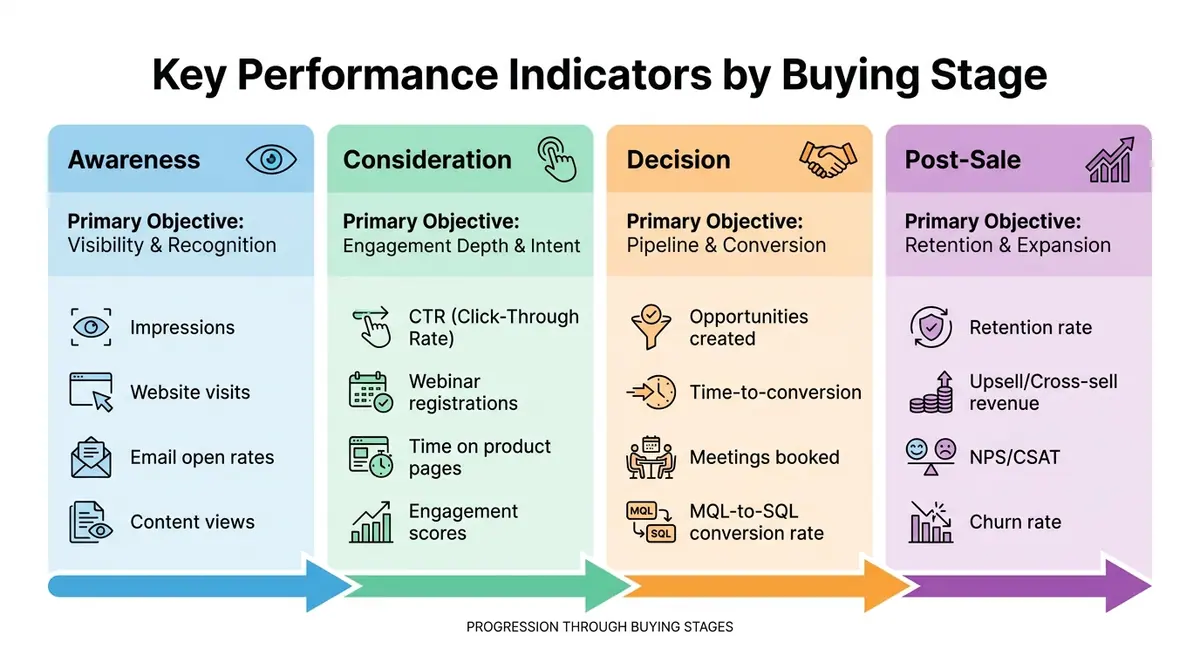
Key Performance Indicators by Buying Stage for Nurture Campaigns
Defining Campaign Objectives
Clear goals and well-defined KPIs are the bridge between collecting data and using it to make decisions. Did you know that 67% of marketers track metrics that don’t align with their business priorities?. The issue? Many focus on what’s easy to measure instead of what truly matters to the business.
To avoid this pitfall, work closely with your marketing and sales teams to establish objectives that align with your business strategy. A great way to do this is by using the SMART framework (Specific, Measurable, Attainable, Realistic, and Time-bound). For instance, instead of saying, “We want better engagement,” set a specific target: “Increase MQL-to-SQL conversion by 10% in Q3”.
"Leadership doesn't fund email CTRs - they fund pipeline growth." - Madison Logic
Your goals should adapt to where prospects are in their journey. For example:
- Awareness stage: Focus on visibility (e.g., impressions or website visits).
- Consideration stage: Measure engagement depth (e.g., webinar signups or time spent on key pages).
- Decision stage: Track pipeline creation and conversion rates.
Keep in mind that 50% of new leads aren’t ready to buy right away. This means your objectives need to balance immediate engagement with long-term conversion strategies.
Identifying Key Performance Indicators (KPIs)
Understanding the difference between KPIs and metrics is key. As Qlik explains: "KPIs represent how you're performing against strategic goals... Metrics support KPIs by representing the tactical processes or actions necessary to achieve the KPIs". For example, if your KPI is quarterly revenue, a supporting metric might be the number of whitepaper downloads each month.
The landscape for tracking KPIs has changed, especially with Apple’s iOS 15 privacy updates. These updates have inflated email open rates by 15-30%, making them less reliable. Instead, focus on click-through rates (CTR) and click-to-open rates (CTOR), which reflect deliberate actions taken by your audience.
Here’s a breakdown of what to track at each stage of the buying process:
| Buying Stage | Primary Objective | Key Performance Indicators (KPIs) |
|---|---|---|
| Awareness | Visibility & Recognition | Impressions, Website visits, Email open rates, Content views |
| Consideration | Engagement Depth & Intent | CTR, Webinar registrations, Time on product pages, Engagement scores |
| Decision | Pipeline & Conversion | Opportunities created, Time-to-conversion, Meetings booked, MQL-to-SQL conversion rate |
| Post-Sale | Retention & Expansion | Retention rate, Upsell/Cross-sell revenue, NPS/CSAT, Churn rate |
To protect your sender reputation, aim to keep your unsubscribe rate below 1% and spam complaints under 0.1%.
Another effective strategy is lead scoring, which helps quantify how ready a lead is for sales. Assign points for specific actions - like 5 points for clicking a link, 15 for downloading a whitepaper, and 50 for signing up for a trial. This scoring system helps both marketing and sales teams prioritize leads that are ready for immediate follow-up.
Once you’ve defined your KPIs, ensure they directly connect to your broader business outcomes.
Aligning Goals with Business Outcomes
The ultimate goal of nurture campaigns is to drive revenue and acquire customers. Metrics that align with revenue outcomes turn data into actionable insights. As HubSpot puts it: "Your end goal as a marketer is not to generate leads, it's to generate customers - and at the most efficient cost possible".
To achieve this, use closed-loop analytics to track leads from their first touchpoint through to the final sale. This approach allows you to calculate the actual cost per customer and see how your campaigns influence deal size. For context, email marketing boasts an average ROI of $36 for every $1 spent, but this value is only proven when you track the complete customer journey.
Collaborate with your sales team to build joint dashboards that define what “sales-ready” means. With B2B buying committees often involving 14 to 23 stakeholders, it’s critical to agree on which behaviors indicate intent versus casual interest. Regular calibration sessions can help refine your lead scoring models, ensuring high scores align with high-value outcomes.
Adopt a structured review schedule to stay on top of your data:
- Weekly: Monitor early indicators like CTRs and email opens.
- Monthly: Analyze content performance.
- Quarterly: Evaluate pipeline impact.
- Annually: Review retention and expansion metrics.
If you’re using tools like Reform’s lead enrichment features to improve data quality, make sure your KPIs reflect this. Track not just conversion rates but also how enriched leads perform compared to standard submissions. This data can justify continued investment in tools that enhance lead quality, giving you better results overall.
Key Metrics to Monitor in Email Nurture Campaigns
Tracking the right metrics gives you a clearer picture of how your email campaigns are performing and helps identify areas for improvement. Let’s break it down.
Engagement Metrics
Open rates have historically been a go-to metric, but their reliability has dropped over time. For example, the average email open rate in 2025 was 42.35%. However, changes like Apple’s iOS updates have made this metric less dependable.
"The big mistake people make is tracking open rates still. Since iOS changes a year+ ago, open rates are meaningless." – Kevin Lord Barry, Co-Founder, Right Percent
A more telling metric is the click-through rate (CTR), which measures the percentage of recipients clicking links in your email. The average CTR across industries is about 2.5%. For a deeper dive, look at the click-to-open rate (CTOR) to evaluate how well your email content resonates, independent of the subject line.
Deliverability rate is another critical metric. It reflects the percentage of emails that actually land in inboxes. Globally, inbox placement averages around 84–85%, with top-performing campaigns exceeding 90%. Poor deliverability doesn’t just hurt individual campaigns - it can damage your sender reputation.
"Deliverability should be a foundational priority... it can quickly affect your one-off email sends from sales reps and support members and can become a silent revenue killer." – Hannah Recker, Growth Marketing Lead, Coefficient
Other engagement metrics to monitor include:
- Unsubscribe rate: Keep it below the median benchmark of 0.22%.
- Spam complaint rate: Stay under 0.1%. Gmail and Yahoo cap spam complaints at 0.3% for bulk senders as of February 2024.
- List hygiene: Email lists naturally decay by about 28% annually, so regularly remove hard bounces and disengaged subscribers (those inactive for six months or more).
Finally, use UTM parameters on all email links to track post-click behavior in tools like Google Analytics.
Conversion Metrics
While engagement metrics show how well your emails grab attention, conversion metrics reveal whether your campaigns are driving meaningful actions. Nurtured leads tend to perform better, with deals averaging 47% higher order values compared to non-nurtured leads. Companies excelling in lead nurturing also generate 50% more sales-ready leads at 30–35% lower costs.
Key conversion metrics include:
- MQL-to-SQL conversion rates: This measures how effectively your marketing-qualified leads (MQLs) transition to sales-qualified leads (SQLs). If this rate is low, it could mean your MQL criteria are too broad or your nurture content isn’t preparing leads for sales.
"A low conversion rate tells you that you first should look at your MQL definition and whether your lead scoring program is set up to deliver leads that fit that definition." – 4Thought Marketing
- Lead-to-opportunity rates: Typically ranges from 10–20%.
- Opportunity-to-close rates: Often falls between 15–25%.
Segmenting these metrics by lead source and combining explicit fit data (like company size or job role) with behavioral data (like CTR or webinar attendance) helps sales teams prioritize the most promising leads.
"What ultimately matters is our sales. So conversion rates are the #1 metric we rely on to tell if an email campaign was successful." – Kyle Kuczynski, CMO and Co-Founder, MessageDesk
It’s worth noting that 70–80% of new leads aren’t ready to buy right away, and 60% of qualified leads can go cold within 90 days without proper nurturing. Consistently tracking these metrics helps you assess the long-term impact of your campaigns.
Closed-Loop Analytics
Closed-loop analytics takes things a step further by tying email performance directly to CRM data and revenue outcomes. This approach moves the focus from vanity metrics (like clicks) to actionable metrics, such as revenue per email and cost per customer.
"Your end goal as a marketer is not to generate leads, it's to generate customers -- and at the most efficient cost possible." – Corey Wainwright, HubSpot
For example, you can calculate revenue per email by dividing the total revenue generated by a campaign by the number of emails sent. Marketing automation often outperforms standard email blasts, driving up to 18x more revenue.
"When you trace a closed deal back to the email sequence that started the conversation, you know what to replicate. This connection between activity and outcome separates busy work from revenue work." – ZoomInfo
Closed-loop data also helps identify high-value campaigns that might have lower submission rates but attract prospects who close at a higher rate. Similarly, analyzing which landing pages convert visitors to customers most effectively can help shift the focus from lead volume to lead quality.
Tracking time to customer conversion is another valuable metric, showing how efficiently your nurture campaigns move leads through the funnel. Setting service-level agreements (SLAs) for sales follow-ups can prevent warm leads from going cold. If you’re using tools like Reform to enrich lead data, you can also measure how enriched leads perform compared to standard ones, offering insights into the ROI of your data-enhancement strategies.
Using Tools for Nurture Campaign Analytics
The Role of Analytics Tools
Modern analytics tools offer real-time tracking and a comprehensive view of the customer journey. This is crucial because catching issues late can mean losing potential conversions.
These tools also break down data silos by gathering information from email platforms, CRMs, social media, and ad campaigns into one cohesive dashboard. This gives marketers a full picture of the customer journey rather than fragmented snapshots. For instance, you can track if a prospect opened your nurture email, visited your pricing page, and completed a form submission - all in one place. By unifying data streams, these platforms enable marketers to make quick, informed decisions that align with broader business objectives.
"While intuition has its place, winning revenue strategies are forged from data." – Kinga Edwards, 15+ year SaaS & B2B marketing expert
These tools lay the foundation for understanding the essential features any modern analytics platform should provide.
Key Features to Look for in Analytics Tools
Lead enrichment and data cleansing are essential for refining lead profiles. They add valuable firmographic and technographic details, such as company size or tech stack, while also removing duplicate entries. This saves time and provides deeper insights for better targeting.
AI and predictive analytics take things further by using machine learning to predict lead conversions. Advanced AI tools can double response rates while reducing the number of emails needed. They even recommend "next best actions" tailored to individual behavior, moving from generic email templates to highly personalized campaigns at scale.
Attribution modeling helps you understand the ROI of specific campaigns by pinpointing which touchpoints drive conversions. This shifts the focus from vanity metrics to metrics that directly impact revenue. Additionally, customizable dashboards allow you to track the KPIs that matter most, whether that's MQL-to-SQL conversion rates or revenue generated per email.
When selecting a platform, ensure it integrates smoothly with your existing tools to avoid creating new data silos. Automation features, like lead assignment and follow-up scheduling, can also free up your team to focus on higher-priority tasks.
How Reform Improves Analytics
Reform builds on these essential features with its robust analytics suite, designed to improve lead quality and streamline conversion workflows.
Reform’s real-time dashboard provides insights into form performance, tracking submission rates, drop-off points, and conversion metrics. It also supports A/B testing, enabling continuous optimization. The platform’s lead enrichment feature captures extra prospect details beyond manual form entries, while email validation ensures clean data entry, improving deliverability and list accuracy from the start.
With abandoned submission tracking, you can identify prospects who started but didn’t complete your forms, creating opportunities for targeted follow-ups. Reform also integrates seamlessly with popular marketing and CRM tools, ensuring smooth data flow. Its conditional routing feature allows you to segment leads based on their form responses, triggering tailored nurture sequences for different prospect types.
Optimizing Nurture Campaigns with Analytics
A/B Testing for Campaign Optimization
When running A/B tests, start with a clear hypothesis. For example: "Including the subscriber's first name in the subject line will increase open rates because it adds a personal touch." This beats testing random variables without a specific goal.
Test one variable at a time to pinpoint what truly impacts performance. Common areas to test include subject lines, CTAs, and send times. Personalized subject lines, for instance, can increase open rates by 20–26%. Similarly, targeted promotions can lead to a 1–2% lift in sales when properly tested. To ensure reliable results, aim for at least 1,000 recipients per variation; smaller sample sizes can skew results due to random chance.
Shift your focus to metrics that directly impact revenue, such as click-to-open rates and conversions, rather than just tracking open rates. For B2B campaigns, avoid sending emails on Fridays since engagement tends to drop toward the end of the workweek. Instead, target midweek - Tuesday through Thursday - for cleaner, more actionable data. Integrating email analytics with CRM data can reveal which test variations lead to qualified leads and actual revenue.
"The best-performing email marketing campaigns aren't built on intuition - they're built on data." – Chaviva Gordon-Bennett, Content Strategist, monday.com
Use the insights from A/B tests to fine-tune your lead scoring models for better targeting.
Refining Lead Scoring Models
To improve lead scoring, adjust thresholds based on how leads interact with bottom-of-funnel content like pricing pages or case studies. Track the transition from MQL (Marketing Qualified Lead) to SQL (Sales Qualified Lead), and revise your scoring if the quality of conversions isn't meeting expectations.
Form interaction data can be a goldmine for refining your scoring system. For instance, if leads frequently abandon forms at specific questions, it may signal that the questions are too intrusive or misaligned with their expectations. Predictive modeling can help here - analyzing historical form submissions through data enrichment can uncover patterns linked to high-quality leads. This lets you prioritize prospects based on behaviors that historically lead to conversions, rather than relying solely on demographic data.
Making Iterative Improvements with Data
With your lead scoring refined, use engagement data to keep improving your nurture sequences. For example, if one email in your sequence (say, the third) shows a noticeable drop in engagement, revisit its content or adjust its value proposition. Behavioral triggers can also replace rigid schedules - for instance, triggering the next email when a lead visits a pricing page.
Branching logic can help tailor the journey for each lead. If a lead engages with bottom-of-funnel content early, skip the awareness-stage emails and move them directly to conversion-focused messaging. Additionally, use feedback from sales calls to address common objections or pain points in your nurture sequence. These ongoing refinements create a feedback loop, where insights from analytics drive continuous improvements, ultimately boosting conversions and revenue.
Conclusion and Key Takeaways
Best Practices Recap
The key to turning underperforming campaigns into high-converting ones lies in purposeful, data-driven execution. Start by defining clear goals and KPIs that align with your business objectives. It's not just about generating leads - it’s about acquiring customers efficiently. Pay close attention to metrics like cost per customer and review them monthly to ensure cost-effectiveness.
Another essential strategy is integrating closed-loop analytics. This approach connects every touchpoint in your nurture sequence directly to revenue. By tracking a lead’s journey - from the initial form submission to the final purchase - you can identify gaps and optimize accordingly. Tools like Reform's real-time form analytics, when paired with your CRM and email platforms, can help pinpoint where leads drop off and resolve bottlenecks. Companies that align sales and marketing efforts effectively see a 20% annual growth rate, while poor alignment can result in a 4% revenue decline.
Consistent testing and optimization are also crucial. Use A/B testing for subject lines, CTAs, and send times, and refine your lead scoring models based on actual conversion data. Move away from rigid, time-based sequences and adopt behavioral triggers that respond to how leads engage with your content. Campaigns built on data, rather than guesswork, can generate up to 50% more sales-qualified leads while reducing costs by 33%.
Final Thoughts
Analytics should be the backbone of your nurture strategy. With 79% of marketing leads failing to convert due to poor nurturing, there’s a huge opportunity to differentiate yourself. Treat analytics as an integral part of your workflow, not just a monthly reporting task. By doing so, you can transform your nurture campaigns into consistent revenue drivers. These insights wrap up our guide on using analytics to power effective nurture campaigns.
FAQs
Which nurture metrics matter most if open rates are unreliable?
When open rates become less dependable, shift your attention to other metrics that offer a clearer picture of your campaign's performance. Click-through rates, conversion rates, and engagement signals - like website visits or interactions with your content - can provide a more accurate understanding of how your audience is responding.
You can also look at behavior-based indicators, such as lead intent and response patterns. These can reveal meaningful insights into how well your nurture campaigns are resonating and where adjustments might be needed.
How do I choose KPIs for each stage of the buying journey?
When choosing KPIs, it's essential to match the metrics to the specific goals of each stage in the buying journey - whether it's awareness, consideration, or action. Here's how you can break it down:
- Awareness: Focus on engagement metrics like impressions and website visits to gauge how well you're reaching your audience.
- Consideration: Look at interaction-based metrics such as email open rates and content downloads to measure interest and intent.
- Action: Track conversion metrics like leads generated and sales to evaluate how effectively you're driving results.
Make it a habit to regularly review these KPIs to ensure they align with your goals and help you fine-tune your strategy for better outcomes.
How can I tie my nurture emails to revenue in my CRM?
To link nurture emails to revenue within your CRM, you can rely on attribution techniques like unique tracking codes, such as UTM parameters. These codes make it easier to track conversions and revenue generated by specific emails. Another key step is integrating your CRM with your email platform. This integration gives you better insight into contact behavior and their position in the sales funnel, allowing you to send more tailored and timely emails. Together, these approaches help you assess how your emails contribute to revenue and fine-tune your campaigns for stronger outcomes.
Related Blog Posts
Get new content delivered straight to your inbox

The Response
Updates on the Reform platform, insights on optimizing conversion rates, and tips to craft forms that convert.




Drive real results with form optimizations
Tested across hundreds of experiments, our strategies deliver a 215% lift in qualified leads for B2B and SaaS companies.
