
.webp)
AI Privacy Compliance: Tools and Strategies



AI privacy compliance is all about ensuring that artificial intelligence systems handle personal data responsibly and follow regulations. With increasing laws like the EU AI Act (effective August 2026) and stricter U.S. state privacy laws, businesses must act now to avoid hefty fines and legal risks.
Key Risks in AI Privacy:
- Large-scale data collection: AI often gathers more personal data than necessary.
- Profiling: Algorithms predict behaviors, which can lead to biases.
- Opaque decisions: Lack of clarity in how AI systems make decisions.
Key Regulations:
- EU AI Act: Strict requirements for high-risk systems, penalties up to €35M or 7% of global revenue.
- CCPA/CPRA: Transparency and opt-out rights for automated decisions.
- NIST AI RMF: U.S. framework for managing AI risks (voluntary but widely adopted).
Compliance Strategies:
- Privacy by Design: Use anonymized data and encryption from the start.
- Transparency: Clearly explain AI decision-making and offer opt-out options.
- Data Governance: Maintain an up-to-date inventory of AI tools and audit logs.
Tools to Simplify Compliance:
- Data Discovery Tools: Identify and protect sensitive data.
- Consent Management Tools: Enforce user preferences in real-time.
- AI Monitoring Tools: Track AI behavior and flag anomalies.
With regulatory deadlines fast approaching, businesses must prioritize compliance efforts to avoid fines and build trust with users.
Navigating AI Technology & Privacy Law for Business Owners
Key AI Privacy Regulations and Frameworks
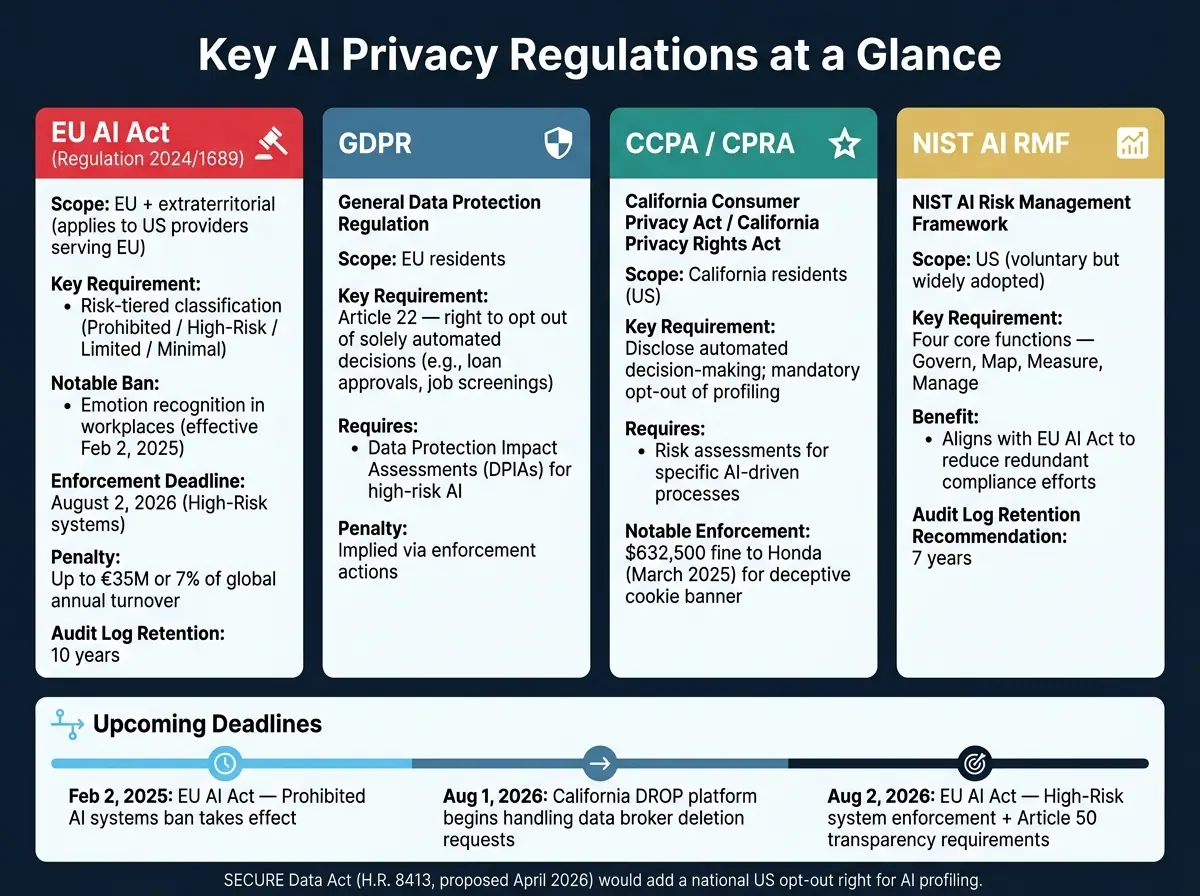
AI Privacy Regulations Compared: EU AI Act vs GDPR vs CCPA vs NIST RMF
The world of AI privacy regulations is a mix of general data protection laws and newer, AI-specific rules. For U.S. businesses, staying compliant means keeping an eye on both. Let’s break down the key regulatory requirements, from established frameworks to AI-focused laws.
General Data Protection Laws with AI Provisions
Laws like GDPR, CCPA, and CPRA aren’t exclusively about AI, but they still shape how AI-driven data processing is handled. Take the GDPR, for example. Under Article 22, EU residents can’t be subjected to decisions made solely by automated systems - think loan approvals or job screenings - unless they’ve given explicit consent or another lawful basis applies. Additionally, the GDPR requires Data Protection Impact Assessments (DPIAs) for high-risk AI processes.
In the U.S., the CCPA and its update, the CPRA, also address AI. They require companies to disclose when automated decision-making is used and give people the option to opt out of profiling. California’s regulations go even further by mandating risk assessments for specific AI-driven processes, mirroring GDPR’s approach.
AI-Specific Laws and Soft-Law Frameworks
Building on these broader laws, AI-specific regulations bring more precise obligations. The EU AI Act (Regulation 2024/1689) organizes AI systems into four risk levels: Prohibited, High-Risk, Limited Risk, and Minimal Risk. For example, using certain types of emotion recognition in workplaces is banned as of February 2, 2025. High-risk AI systems face stricter enforcement deadlines, initially set for August 2, 2026, though amendments may push some to December 2, 2027.
The EU AI Act’s impact isn’t limited to Europe. Its extraterritorial scope means that U.S.-based providers offering AI systems in the EU - or whose outputs are used there - must comply. The penalties for non-compliance are steep: up to €35 million or 7% of global annual turnover, whichever is higher.
In the U.S., the NIST AI Risk Management Framework (RMF) has become a popular tool for AI governance. Though voluntary, it helps companies align with the EU AI Act by focusing on four key areas: Govern, Map, Measure, and Manage. This alignment reduces redundant compliance efforts.
Meanwhile, the SECURE Data Act (H.R. 8413), introduced in April 2026, proposes a national framework that would give consumers the right to opt out of AI profiling for decisions with legal or significant effects. It would also require companies to disclose when decisions are made without human involvement.
Standards and Regulatory Guidance
Beyond laws, established standards provide a roadmap for AI privacy compliance. The OECD AI Principles, adopted by over 40 countries including the U.S., emphasize transparency, accountability, robustness, and human oversight in AI systems. While not legally binding, these principles influence how regulations are interpreted and enforced.
Certifications like ISO/IEC 42001 (AI Management Systems) and ISO/IEC 27701 (Privacy Information Management) offer structured ways for businesses to prove they have strong AI governance and privacy practices in place. These frameworks help companies demonstrate due diligence and build trust in their AI systems.
Strategies for AI Privacy Governance
Understanding the regulations is just the starting point. The real challenge lies in creating internal processes that ensure your AI systems remain compliant every day. These strategies build on the regulatory frameworks discussed earlier, focusing on practical steps to maintain privacy and accountability.
Privacy by Design and Engineering
Incorporate data protection into the design of AI systems right from the beginning. As the UK's Information Commissioner's Office (ICO) explains:
"Data protection by design and by default is about considering data protection and privacy at the start of everything you do."
Start by limiting the use of real data. Use synthetic or anonymized data during pilot phases, turning to real data only when absolutely necessary. France's data protection authority, the CNIL, advises running small-scale tests with fictitious data to confirm design choices before moving to full-scale development.
On the technical side, implement methods like pseudonymization, anonymization, and encryption to protect training data. To minimize risks like model memorization - where a model might inadvertently reproduce sensitive training data - set clear retention periods. Rather than storing data indefinitely, archive it for bias audits or other compliance needs.
Transparency and User Consent
Users deserve to know when AI systems are influencing decisions that affect them - and they should have the ability to challenge those decisions. Laws like the CCPA and the proposed SECURE Data Act require businesses to provide clear, upfront notices about automated decision-making in areas such as hiring, credit, and healthcare. These regulations also mandate an easy-to-use opt-out option.
A common pitfall is designing consent mechanisms that favor acceptance over rejection. For example, in March 2025, Honda faced a $632,500 fine for using a cookie banner that made rejecting tracking unnecessarily difficult and required excessive identity verification for opt-out requests. The solution? Make the "Reject" option just as visible and accessible as "Accept."
Consent notices should appear at the moment data collection begins, not buried in lengthy terms-of-service agreements. This "just-in-time" approach provides users with meaningful transparency. If your AI system's decision-making process is too complex to explain, take it as a warning sign. The ICO emphasizes:
"If a system is too complex to explain, it may also be too complex to meaningfully contest, intervene on, review, or put an alternative point of view against."
To simplify explanations, tools like SHAP (SHapley Additive exPlanations) or LIME can help create user-friendly insights into how AI systems make decisions. These tools are becoming essential, especially for high-risk applications.
Data Governance for AI Systems
Effective data governance starts with knowing exactly what data your AI systems handle and maintaining control at every stage. Keep an up-to-date inventory of all AI tools in use, including unsanctioned ones. By 2026, the average mid-sized company is expected to use 25–30 AI tools, many of which may not have undergone legal review or signed a Data Processing Addendum (DPA).
Classify data carefully to separate regulated information from proprietary or public data. Use prompt-level redaction before sending data to third parties and implement output filters to catch any generated content that might include personal information. When working with vendors, ensure due diligence by reviewing their data residency policies, training-data opt-outs, and sub-processor transparency before signing contracts.
Finally, maintain tamper-proof, time-stamped audit logs for every AI interaction. These logs are more than just a regulatory requirement - they're your best defense in case of an investigation. For example, the EU AI Act mandates that technical documentation be retained for 10 years, while NIST AI RMF guidance recommends keeping audit logs for at least 7 years. These records ensure accountability and demonstrate compliance when it matters most.
sbb-itb-5f36581
Tools to Support AI Privacy Compliance
Ensuring compliance with AI privacy regulations requires a solid foundation of tools that handle data discovery, enforce consent, and provide ongoing monitoring.
Data Discovery and Classification Tools
Data discovery tools are essential for scanning datasets, cloud systems, SaaS platforms, and on-premises environments to locate Personally Identifiable Information (PII) and map how data flows within an organization. These tools help meet regulations like GDPR Article 5 and EU AI Act Article 10. A key feature to prioritize is inline redaction - tools that analyze prompts and responses in real time, masking sensitive information such as Social Security numbers with safe placeholders.
For instance, in 2024, a major healthcare insurer used Protecto to safeguard over 50 million subscriber health records in a recommendation system. This approach enabled HIPAA-compliant data masking in less than a month, saving an estimated $1,000,000 in manual remediation costs.
"I want to bring enterprise data into RAG, embeddings, analytics jobs, and agents. But I cannot let PII or PHI flow into those systems just because a pipeline picked it up. I need the data protected before AI use, without losing the context that makes it useful." - AI Platform Lead, Healthcare Insurance Provider
Top-tier data discovery platforms can track data across thousands of sources - over 12,000 in some cases - and provide pre-classified profiles for more than 2,500 third-party vendor technologies. With this information, organizations can better enforce user consent.
Consent and Preference Management Tools
Traditional consent management platforms (CMPs) were designed for cookies and browser tracking, but AI-specific tools go further. These tools intercept data streams to enforce real-time user preferences during LLM prompts, training, and inference processes. This is particularly important given that 75% of websites fail to honor user opt-outs.
In early 2024, NextRoll adopted Relyance AI to manage their data processing activities. Within three weeks, they identified a 1,660% increase in processing activities.
"If consent isn't connected to AI processing, it's not governance, it's paperwork." - Ketch
When choosing a tool, look for features like a "Do Not Train" toggle and tamper-evident audit logging for every LLM interaction. These capabilities are becoming essential under regulations like the EU AI Act and CCPA. Beyond consent, maintaining oversight requires tools that actively monitor and verify AI behavior.
AI Monitoring and Anomaly Detection Tools
Continuous monitoring is the final layer of compliance, building on data management and consent enforcement. AI monitoring tools create centralized audit logs that track every interaction with a model, flag anomalies, and provide evidence for regulatory reviews. These features align with requirements under EU AI Act Article 12 and GDPR Article 22.
However, standard log files are not enough. True audit trails must be tamper-evident, cryptographically signed, and structured for regulatory scrutiny.
"Logs are not an audit trail. An audit trail is tamper-evident, cryptographically signed, and structured for regulator review." - SpanForge
The industry is moving toward the Compliance Evidence Chain (CEC), which consolidates scan reports, consent logs, and policy records into a single, cryptographically signed document. Platforms like OneTrust are adopting this model to help governance teams embed oversight throughout the AI lifecycle.
Despite these advancements, adoption of such tools remains inconsistent. Gartner predicts that by 2027, 60% of organizations will fail to achieve the expected value of their AI initiatives due to fragmented governance frameworks. The solution lies not in adding more tools but in integrating the right ones into a unified, continuously operating compliance strategy. This approach ensures that governance supports the broader objectives of privacy and ethical AI use.
Using Reform for AI Privacy-Compliant Lead Collection
Privacy Risks in Lead Collection Workflows
Lead collection workflows often introduce hidden privacy risks, even when businesses think they’re compliant with regulations like GDPR and CCPA. For example, lead generation forms - often the first step in your data pipeline - can unintentionally create vulnerabilities. AI-powered enrichment tools might add demographic or firmographic details before obtaining explicit consent, which can lead to regulatory violations when this enriched data is used for predictive lead scoring or automated segmentation. These risks can escalate quickly.
Another common issue is embedding a YouTube video or similar media on your forms. This can activate tracking scripts and share user data before consent is given. Even more concerning, noscript tags may execute tracking code even when JavaScript is disabled, bypassing your consent framework entirely. These kinds of implementation errors can easily put businesses at odds with privacy laws, even if they believe they’re following the rules.
Designing AI-Compliant Data Collection Forms
One way to mitigate these risks is by collecting only the data you truly need. Reform's multi-step forms and conditional routing features make this easier. You can require explicit consent before any data enrichment occurs and route leads based on geography or consent preferences, ensuring compliance with regional regulations.
Reform also focuses on transparency. Its customizable forms include plain-language disclosures that clearly explain how data might be used - for instance, in predictive lead scoring. By placing these disclosures prominently, rather than hiding them in a privacy policy or footer, Reform helps businesses meet regulatory expectations for clear communication.
These thoughtful design elements are seamlessly integrated into Reform's tools, making compliance more straightforward.
Reform Features for Privacy Compliance
Reform’s CookieFlow™ system takes the guesswork out of compliance by using IP-based geolocation to apply the appropriate privacy settings automatically:
| Compliance Zone | Regulatory Framework | What Users See |
|---|---|---|
| ZONE_1 | Basic Notice (130 countries) | Simple dismissible notice |
| ZONE_2 | CCPA/Opt-Out (US & territories) | "Do Not Sell My Personal Information" option |
| ZONE_3 | GDPR/Opt-In (EU, UK, and 50+ regions) | Granular opt-in for Marketing, Analytics, and Personalization |
If geolocation data isn’t available or is invalid, CookieFlow™ defaults to ZONE_3 - the strictest setting - minimizing the risk of accidental non-compliance.
Reform also anonymizes IP addresses before storing them, masking the last octet (e.g., 192.168.1.123 becomes 192.168.1.0). Each consent interaction is logged with a unique 28-character ID and timestamp in a dedicated Supabase database. Consent cookies expire after six months by default, aligning with guidance from regulatory bodies in France and Italy. Additionally, Reform automatically detects and respects browser signals like Do Not Track (DNT) and Global Privacy Control (GPC), opting users out by default when such signals are present.
For businesses integrating Reform with their CRM, the platform uses OAuth 2.0 to ensure secure, least-privilege data transfers. Behavioral bot detection adds an extra layer of security, ensuring lead data remains accurate and compliant without relying on additional tracking methods.
Conclusion
AI privacy compliance is a constant responsibility that influences every aspect of how businesses handle data - from collection to processing and usage. By 2026, over 20 U.S. states will have enacted comprehensive privacy laws. Major deadlines are also on the horizon, such as the transparency requirements under Article 50 of the EU AI Act, which take effect on August 2, 2026, and California's DROP platform beginning to handle data broker deletion requests starting August 1, 2026.
The stakes for non-compliance are high. Recent enforcement actions, including record-breaking settlements under the CCPA, show that regulators are no longer just monitoring - they're actively taking action.
"Regulators are emphasizing transparency, human oversight, and verifiable operational controls, not just policies." - O'Melveny
To navigate these evolving regulations, businesses need robust governance practices. This includes maintaining detailed AI inventories, conducting thorough impact assessments, and routinely testing technical controls like opt-out mechanisms. These measures not only help ensure compliance but also build customer trust - an essential factor for long-term engagement.
Lead collection is often a weak spot when it comes to compliance. Using specialized tools can help address this vulnerability. For instance, Reform's form builder allows businesses to integrate compliance measures directly into their data collection processes. With features like multi-step forms, conditional routing, lead enrichment, spam prevention, email validation, real-time analytics, and secure CRM integrations, Reform helps you design workflows that meet regulatory standards while maintaining strong conversion rates.
FAQs
Does the EU AI Act apply to U.S. companies?
Yes, it does. The EU AI Act has an extraterritorial reach, meaning it applies to any provider or deployer of AI systems that are either placed on the EU market or produce outputs used within the EU. This holds true regardless of where the company is based.
For example, if your AI system impacts EU residents - like screening job candidates or evaluating creditworthiness - you are required to comply. Non-compliance can lead to hefty penalties, so understanding and adhering to the Act is crucial for any business operating in this space.
What counts as 'high-risk' AI under the EU AI Act?
The EU AI Act categorizes certain AI systems as "high-risk" due to their potential to affect health, safety, or fundamental rights in a meaningful way. These systems fall into two main groups:
- Safety-critical systems: These are used as safety components in products that require third-party conformity assessments.
- Annex III systems: This includes AI applications in areas like recruitment, credit scoring, and law enforcement.
Additionally, any system that profiles individuals is considered high-risk unless its scope is very limited and it does not significantly influence outcomes.
What should an AI audit trail include?
An AI audit trail serves as a record of governance events and inference data throughout the system's lifecycle, helping organizations comply with regulations like the EU AI Act and GDPR. To build a comprehensive audit trail, focus on these key components:
- Identification Details: Include actor or tenant IDs, model ID and version, timestamps, and input/output hashes.
- Governance Information: Track safety filters, policy matches, and detection of personally identifiable information (PII).
- Operational Metrics: Monitor token usage, latency, and associated costs.
To protect privacy, ensure PII is either pseudonymized or stored separately from other data. This approach helps maintain compliance while safeguarding sensitive information.
Related Blog Posts
Get new content delivered straight to your inbox

The Response
Updates on the Reform platform, insights on optimizing conversion rates, and tips to craft forms that convert.




Drive real results with form optimizations
Tested across hundreds of experiments, our strategies deliver a 215% lift in qualified leads for B2B and SaaS companies.
