
.webp)
BCRs vs. SCCs: Impact on Data Security



When transferring personal data outside the EEA, companies must comply with GDPR. Two key tools for this are Binding Corporate Rules (BCRs) and Standard Contractual Clauses (SCCs). Both mechanisms help ensure data security, but they differ significantly in implementation, cost, and use cases:
- BCRs: Custom policies for multinational corporations, requiring regulatory approval (2-3 years). Ideal for internal data transfers within corporate groups. High upfront costs but offer long-term legal certainty.
- SCCs: Pre-approved, ready-to-use contracts for quick compliance. Best for SMEs or vendor relationships. Require ongoing Transfer Impact Assessments (TIAs) to address third-country risks.
Quick Comparison
| Feature | BCRs | SCCs |
|---|---|---|
| Approval | Requires DPA approval | No approval needed |
| Timeline | 2–3 years | Immediate upon signing |
| Cost | High | Low |
| Use Case | Internal corporate transfers | Vendor or external transfers |
| Legal Certainty | High (DPA-approved) | Moderate (self-assessed TIAs) |
Both frameworks require strong safeguards, including encryption and TIAs, especially after the Schrems II ruling. Choosing between them depends on your organization's structure, resources, and data transfer needs.
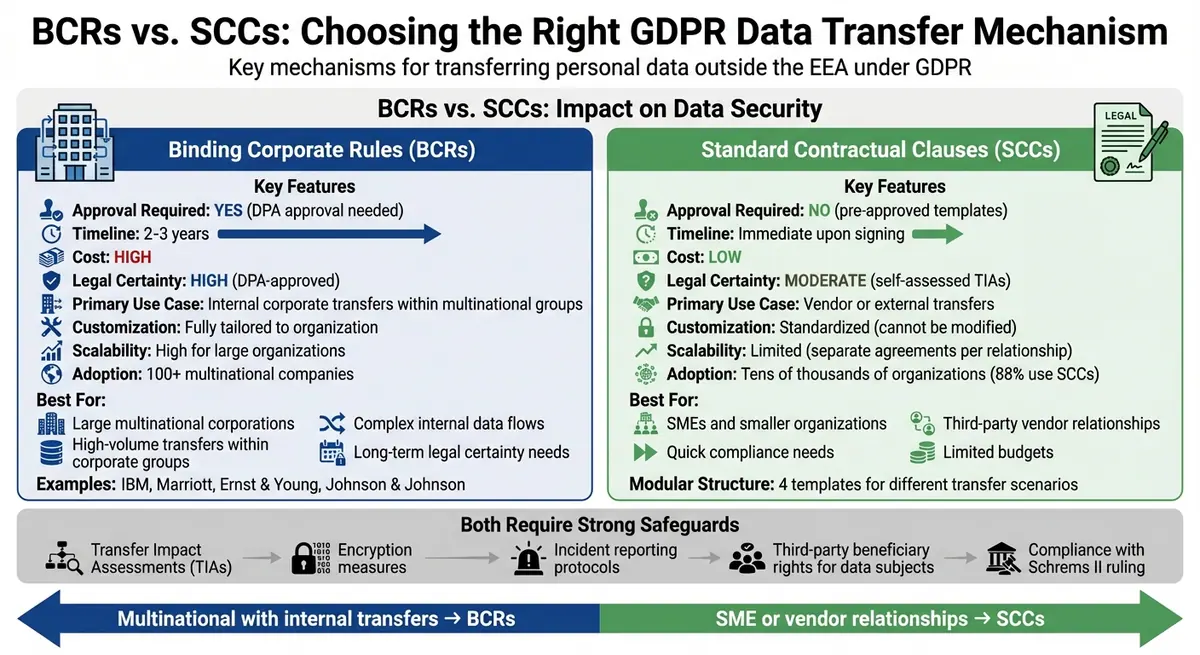
BCRs vs SCCs Comparison: Key Differences for GDPR Data Transfers
🌍 Mastering Global Data Transfers: Unveiling BCRs and SCCs under GDPR 🌍
sbb-itb-5f36581
What Are Binding Corporate Rules (BCRs)?
Binding Corporate Rules (BCRs) are internal policies that companies use to manage cross-border data transfers within their corporate group while staying compliant with EU and UK data protection laws. Unlike one-size-fits-all solutions, BCRs are custom-built for each organization's structure and data operations. These rules act as enforceable agreements within the company and give data subjects rights as third-party beneficiaries. They include legal agreements, staff training, audits, and reporting systems to ensure compliance over time. Once approved, BCRs create a framework that allows personal data to flow freely between global subsidiaries without requiring separate agreements for every transfer.
Main Features of BCRs
To use BCRs, a company needs formal approval from a lead supervisory authority - usually the Data Protection Authority (DPA) in the EU country where the company’s European headquarters is based. This lead DPA works with other EU DPAs to ensure the rules are accepted across the EU.
One key advantage of BCRs is that the lead DPA assesses the adequacy of safeguards during the approval process. As Wouter Seinen and Lukas Feiler from Baker McKenzie explain:
"The burden on assessing the adequacy of the safeguards rests with the supervisory authorities if a company uses BCRs, while the user of SCCs must... make its own adequacy assessment and is accountable if wrong".
This means the DPA validates the framework upfront, reducing the organization's risk of liability later.
BCRs are specifically designed for transfers within a corporate group. They are particularly useful for companies with complex sub-processing arrangements. For example, a tech company might contract with EU clients through its EU subsidiary but rely on non-EU affiliates for sub-processing. BCRs must legally bind every member of the corporate group and cover all internal data transfers. These attributes make BCRs especially beneficial for large multinational organizations.
Benefits of BCRs
BCRs are often referred to as the "gold standard" for international data transfers because they are the only mechanism that requires individual regulatory approval. This approval provides strong legal certainty, as it’s unlikely a DPA would challenge transfers based on a framework it has already approved.
For large organizations, BCRs simplify operations. Instead of drafting separate contracts for every relationship between corporate entities, a single approved BCR framework covers all internal data flows worldwide. By March 2026, over 100 multinational companies - including IBM, Marriott, BCG, Ernst & Young, and Johnson & Johnson - had successfully obtained EU Commission-approved BCRs.
Another advantage is flexibility. Unlike model clauses, which are rigid and cannot be altered, BCRs are tailored to fit a company’s specific structure and data processing needs. This adaptability makes BCRs ideal for organizations with complex or high-volume internal data transfers, where managing numerous individual contracts would be impractical. These features also help strengthen data security, an essential element in cross-border data management.
Drawbacks of BCRs
Despite their advantages, implementing BCRs can be challenging. The approval process typically takes 2 to 3 years, which makes them unsuitable for companies that need an immediate solution. In such cases, SCCs (Standard Contractual Clauses) can serve as a temporary measure while waiting for BCR approval.
The process also involves significant upfront costs, including legal fees, documentation, and internal resource allocation. As Jetty Tielemans from IAPP points out:
"The BCR process is lengthy, complex and costly in terms of in-house resources and outside legal spending".
Organizations must be prepared to invest both time and money into this multi-year process.
Even after approval, BCR holders must maintain compliance through regular audits, staff training, and updated reporting. Additionally, following the Schrems II ruling, companies may still need to conduct individual Transfer Impact Assessments (TIAs) for data transfers to countries with intrusive surveillance laws. While BCRs provide a strong framework, these additional requirements can add complexity to ongoing operations.
What Are Standard Contractual Clauses (SCCs)?
Standard Contractual Clauses (SCCs) are pre-approved data protection clauses developed by the European Commission to facilitate personal data transfers from the European Economic Area (EEA) to countries lacking an adequacy decision. Unlike Binding Corporate Rules (BCRs), which require a lengthy approval process spanning 2 to 3 years, SCCs are ready-to-use templates. They serve as "appropriate safeguards" under Article 46 of the GDPR, creating binding obligations between data exporters and importers.
The European Commission highlights their practicality:
"Through their standardisation and pre-approval, SCCs are a 'ready-made' and easy-to-implement tool. This is particularly important for SMEs or other companies that may not have the resources to negotiate individual contracts."
SCCs are widely used for cross-border data transfers - 88% of respondents in a privacy governance survey identified them as their primary mechanism. They work seamlessly across various types of business relationships, whether transferring data to a cloud provider or sharing information within a corporate group. This flexibility makes them distinct from the more customized approach required by BCRs.
Main Features of SCCs
The current SCC framework uses a modular structure, offering four templates tailored to specific transfer scenarios:
- Module 1: Controller-to-Controller transfers
- Module 2: Controller-to-Processor relationships
- Module 3: Processor-to-Processor arrangements
- Module 4: Processor-to-Controller transfers
Unlike BCRs, which are designed for specific corporate structures, SCCs provide a standardized approach suitable for a wide range of business relationships. The inclusion of a docking clause allows additional parties to join an existing SCC agreement without drafting entirely new contracts.
The core text of SCCs is standardized and cannot be modified. Any alterations would void their pre-approved status, requiring individual approval from a Data Protection Authority. Organizations must also complete three annexes with specific details:
- Annex I: Identifies the parties involved.
- Annex II: Describes the technical and organizational security measures.
- Annex III: Lists any sub-processors.
Additionally, SCCs grant data subjects the right to enforce the clauses as third-party beneficiaries, enabling individuals to hold data importers accountable if necessary.
Benefits of SCCs
SCCs are ready for immediate use, cutting down on legal drafting time and costs. This makes them particularly appealing for organizations needing quick compliance solutions. While only around 100 multinational companies use BCRs, SCCs are relied upon by tens of thousands of organizations worldwide.
Their broad applicability is another advantage. SCCs work well for both commercial partnerships and internal data transfers within corporate groups, making them a versatile choice for businesses of all sizes operating in regions without an adequacy decision.
Drawbacks of SCCs
The Schrems II ruling introduced additional responsibilities for organizations using SCCs. They must now conduct a Transfer Impact Assessment (TIA) to ensure that local laws in the destination country do not undermine the protections provided by SCCs. These assessments must be updated whenever laws change or new transfers occur. In cases where risks are identified, technical safeguards like end-to-end encryption (where the importer cannot access the decryption key) or pseudonymization may be more effective than relying solely on contractual guarantees.
The importance of compliance was underscored in 2023 when the Dutch Data Protection Authority fined Uber €290 million for transferring European taxi driver data to the United States without proper transfer mechanisms. This case highlights the need for strict adherence to SCC requirements.
However, SCCs do have limitations. Their standardized format offers little room for customization, which can be a challenge for organizations with complex corporate structures. In some cases, separate agreements may need to be executed for each bilateral relationship, creating additional administrative work. The docking clause helps mitigate this issue, but it doesn't eliminate it entirely.
BCRs vs. SCCs: Main Differences
Approval Process Comparison
When it comes to approval, Binding Corporate Rules (BCRs) and Standard Contractual Clauses (SCCs) have very different requirements. BCRs need formal approval from a lead Data Protection Authority (DPA), followed by mutual recognition from other DPAs. This process can take anywhere from 2 to 3 years. On the other hand, SCCs are standardized agreements that can be used immediately after signing, without the need for regulatory approval.
However, this convenience comes with a catch. While BCRs benefit from regulatory validation, organizations relying on SCCs must conduct their own Transfer Impact Assessments (TIAs) to ensure adequate data protection. If these assessments fall short, the organization remains liable.
The Schrems II decision and Brexit have added complexity to this landscape. Since then, there's been a noticeable increase in BCR applications, creating backlogs for supervisory authorities that are often understaffed. Meanwhile, businesses using SCCs faced a strict deadline of December 27, 2022, to replace outdated EU SCCs with the updated 2021 versions. These distinct timelines highlight the differences in how each framework operates, particularly in terms of legal validation and practical application.
Legal Certainty and Flexibility Comparison
Legal certainty and operational flexibility are two areas where BCRs and SCCs diverge significantly. BCRs are often seen as the "gold standard" for international data transfers because they come with direct regulatory approval. This approval shifts the responsibility for assessing data safeguards to supervisory authorities, offering a higher degree of legal certainty. For example, once a company’s BCRs are approved, it’s unlikely that regulators would challenge transfers covered under them. Over 100 multinational companies, including IBM, Marriott, Ernst & Young, and Johnson & Johnson, have successfully adopted BCRs.
That said, there’s a growing concern that this advantage might be diminishing. Some regulators are now approving BCRs with the condition that individual transfers still require case-by-case assessments. As Seinen and Feiler point out:
"Passing the bucket by approving BCRs with the caveat that individual transfers have to be assessed case-by-case would render BCRs devoid of what makes them popular in the first place - legal certainty."
By contrast, SCCs offer immediate flexibility due to their modular structure. They support various types of transfers, including Controller-to-Controller, Controller-to-Processor, Processor-to-Processor, and Processor-to-Controller. This makes them ideal for smaller organizations or businesses transferring data to third-party vendors. However, BCRs are tailored for large multinational companies. Their complexity and resource requirements make them impractical for smaller businesses. These differences in legal certainty and flexibility directly affect how organizations manage data security and compliance risks.
Side-by-Side Comparison Table
Here’s a quick comparison of the key features of BCRs and SCCs:
| Feature | Binding Corporate Rules (BCRs) | Standard Contractual Clauses (SCCs) |
|---|---|---|
| Approval Requirement | Requires approval from lead and co-lead DPAs | No regulatory approval needed |
| Implementation Timeline | 2–3 years | Immediate upon signing |
| Legal Certainty | High; backed by regulatory approval | Moderate; depends on self-assessments and TIAs |
| Scalability | High for large organizations; covers all internal data flows once approved | Limited; separate agreements needed for each exporter/importer pair |
| Primary Use Case | Designed for multinational corporations managing global data flows | Best for SMEs and vendor relationships |
| Cost | High (includes legal fees, internal resources, and DPA fees) | Low (mainly administrative costs) |
Data Security: BCRs vs. SCCs
When navigating cross-border compliance, it's essential to grasp the differences between Binding Corporate Rules (BCRs) and Standard Contractual Clauses (SCCs). Both frameworks enforce strict data security measures, but their methods vary. BCRs require regulatory approval, with Data Protection Authorities (DPAs) reviewing elements like audit plans, training initiatives, and security policies. SCCs, on the other hand, rely on self-assessment, with the data exporter conducting these evaluations.
Both frameworks also mandate additional encryption measures when Transfer Impact Assessments (TIAs) reveal potential legal conflicts. For encryption to be effective, the data importer must be unable to access the decryption keys. This often involves implementing advanced safeguards like zero-knowledge encryption or split processing to protect against government surveillance.
Incident reporting and sub-processor controls further highlight the differences. SCCs require importers to notify exporters promptly in the event of a breach. BCRs go beyond this by obligating companies to inform the competent Supervisory Authority of any legal requirements in a third country that could undermine BCR guarantees. This includes disclosing legally binding requests from law enforcement or state security agencies.
When it comes to sub-processor controls, SCCs use a modular approach. Module 2 (Controller-to-Processor) and Module 3 (Processor-to-Processor) specify how sub-processors are authorized - either through specific written consent or general approval with an objection period. BCRs simplify this by employing a group-wide framework, eliminating the need for individual legal agreements.
Security Features Side-by-Side
The table below compares the security features of BCRs and SCCs:
| Security Feature | Binding Corporate Rules (BCRs) | Standard Contractual Clauses (SCCs) |
|---|---|---|
| Encryption Requirements | Extra measures applied if TIAs reveal risks | Listed in Annex II as a required security measure |
| Incident Reporting | Legal conflicts reported to Supervisory Authorities | Breaches promptly reported to the controller |
| Sub-processor Authorization | Group-wide binding policy covers transfers | Managed via Module 2 or 3 with specific/general consent |
| Audit Requirements | Audit plans submitted for DPA approval | Contractual audit rights agreed between parties |
| Third-Party Beneficiary Rights | Enforceable by data subjects | Data subjects can enforce clauses directly |
| Oversight Mechanism | Proactive DPA approval with ongoing checks | Relies on exporter's TIA and contractual compliance |
Compliance Requirements and Risk Distribution
Let’s dive deeper into how compliance responsibilities and risk distribution vary between Binding Corporate Rules (BCRs) and Standard Contractual Clauses (SCCs). These differences play a crucial role in determining the best framework for managing international data transfers.
When it comes to Standard Contractual Clauses, the data exporter is responsible for evaluating whether the laws of the destination country provide adequate protection. This means the exporter must conduct a thorough Transfer Impact Assessment (TIA) and remains fully accountable if legal risks are overlooked. In contrast, with BCRs, the supervisory authorities take a more active role, assessing safeguards and providing ex-ante approval. However, BCR users are still required to stay informed about legal developments in third countries and collaborate with controllers to conduct TIAs.
BCRs also centralize liability within the EU-based member of the corporate group, simplifying accountability and ensuring there’s a clear path for redress. Recent guidance from the European Data Protection Board (EDPB) emphasizes the importance of this centralized structure, requiring BCR members to monitor legal changes and notify controllers as needed.
Compliance Responsibilities Comparison
| Responsibility | Standard Contractual Clauses (SCCs) | Binding Corporate Rules (BCRs) |
|---|---|---|
| Primary Accountability | Data exporter (bilateral contract) | Liable BCR Member (corporate group) |
| Transfer Impact Assessment | Exporter conducts TIA independently for each transfer | BCR members assess in agreement with controller |
| Supervisory Authority Role | Ex-post enforcement after breach or complaint | Ex-ante approval with ongoing annual reporting |
| Liability for Non-Compliance | Shared between specific contracting parties | Centralized in Liable Member with sufficient EU assets |
| Third-Country Monitoring | Exporter must track legal changes independently | BCR members must notify controllers of legal changes |
How to Reduce Risks Under Each Framework
Managing compliance and reducing risks under SCCs and BCRs requires a proactive approach. Here’s how organizations can strengthen their data protection efforts:
-
For SCC users, it’s critical to:
- Use end-to-end encryption to ensure the data importer cannot access decryption keys.
- Regularly update TIAs and stay informed about legal changes in destination countries.
-
For BCR users, organizations should:
- Appoint an EU-based Liable Member with sufficient financial resources to address claims.
- Conduct regular BCR audits using independent auditors to ensure compliance.
- For transfers to the US, verify recipient certification under the Data Privacy Framework to bypass the need for SCC/TIA processes.
Both frameworks can benefit from advanced techniques like zero-knowledge architecture or pseudonymization. Applying these measures on the EU side before transferring data can significantly reduce the risk of government access requests in the destination country. These strategies not only minimize exposure but also provide a clear pathway for selecting the most suitable compliance framework.
When to Use BCRs vs. SCCs
Deciding between Binding Corporate Rules (BCRs) and Standard Contractual Clauses (SCCs) depends largely on your organization's size, the complexity of its data flows, and the resources available to manage compliance.
When BCRs Are the Better Choice
BCRs are ideal for large multinational corporations handling complex and high-volume internal data transfers. According to Baker McKenzie, BCRs are viewed as the "gold standard" for international data transfers because they require individual regulatory approval, making them a highly trusted mechanism.
If your company operates globally - imagine managing employee records that move between your EU headquarters and offices in Asia, Latin America, or North America - BCRs can simplify compliance. Instead of juggling hundreds of individual transfer agreements, BCRs provide a single, unified framework. This is why many major multinational corporations have opted for approved BCRs.
BCRs are also particularly useful for technology providers with EU-based subsidiaries that contract with customers but rely on non-EU sub-processors. This setup allows you to manage complex sub-processing chains without creating direct legal ties between customers and every affiliate involved. However, it's worth noting that implementing BCRs is a lengthy and costly process, often requiring 2–3 years for regulatory approval.
For scenarios where immediate action or external vendor relationships are key, other options may be more practical.
When SCCs Are the Better Choice
While BCRs are tailored for large, intricate organizations, SCCs are the go-to solution for most other cases. SCCs are particularly effective when transferring data to third-party vendors like cloud service providers, SaaS platforms, or external processors, rather than within a corporate group. Smaller organizations, in particular, find SCCs more manageable and efficient compared to BCRs.
One of the biggest advantages of SCCs is their quick implementation. Unlike BCRs, which require years of regulatory approval, SCCs can be activated rapidly. This makes them an excellent choice for small to medium-sized businesses, companies with limited budgets for legal expenses, or those with occasional data transfer needs rather than constant flows.
Even for larger organizations, SCCs remain a practical choice for external partnerships. Whether you're working with tools for marketing automation, customer support, or analytics, SCCs offer flexibility through their modular structure to address various types of relationships. If you're transferring data to the US, check whether the recipient is certified under the EU-US Data Privacy Framework, which can simplify the Transfer Impact Assessment process for both SCCs and BCRs.
Ultimately, selecting between BCRs and SCCs affects your compliance approach and data security measures. It's important to choose the framework that aligns best with your company's operational needs and structure.
Conclusion
Deciding between Binding Corporate Rules (BCRs) and Standard Contractual Clauses (SCCs) depends heavily on your organization's specific needs, including its structure, resources, and how it handles data transfers. BCRs are often seen as the most reliable option, given their individual regulatory approval, making them ideal for multinational corporations managing intricate internal data flows. However, they come with a hefty price tag and a lengthy 2–3 year approval process. On the other hand, SCCs offer quicker implementation and greater flexibility, making them a practical solution for organizations working with third-party vendors or those needing an immediate compliance framework. Transfer Impact Assessments (TIAs) remain vital for maintaining compliance in all scenarios.
As Wouter Seinen and Lukas Feiler from Baker McKenzie explain:
"Passing the bucket by approving BCRs with the caveat that individual transfers have to be assessed case-by-case would render BCRs devoid of what makes them popular in the first place - legal certainty".
This highlights the importance of comprehensive safeguards in every transfer. For example, in April 2023, Meta Platforms Ireland was fined €1.2 billion for transferring data to the U.S. using SCCs without adequate supplementary measures. With penalties potentially reaching up to 4% of global annual revenue, these cases emphasize why organizations must adopt a proactive and tailored approach to compliance.
FAQs
Do BCRs eliminate the need for TIAs?
BCRs (Binding Corporate Rules) do not remove the requirement for Transfer Impact Assessments (TIAs). TIAs remain necessary for transfers based on Standard Contractual Clauses (SCCs), as mandated by rulings like the Schrems II decision. That said, BCRs are viewed as a strong alternative since they undergo individual regulatory approval and are not directly affected by Schrems II.
What counts as “supplementary measures” beyond SCCs?
Supplementary measures go beyond Standard Contractual Clauses (SCCs) to strengthen data protection during cross-border transfers. These include conducting Transfer Impact Assessments to evaluate potential risks, examining the legal environment of the destination country, and introducing additional safeguards to uphold privacy standards. These steps align with the latest guidance following Schrems II and EU data transfer regulations, ensuring both compliance and security.
When should we use both BCRs and SCCs together?
Using both Binding Corporate Rules (BCRs) and Standard Contractual Clauses (SCCs) is a smart way to strengthen data protection and maintain compliance across different regions. BCRs, often referred to as the "gold standard", offer reliable safeguards but come with the requirement of regulatory approval. On the other hand, SCCs serve as a practical complement to BCRs, especially in scenarios where BCRs are either not yet approved or don't fully apply. They provide extra protection for data transfers to third parties or regions outside the scope of the BCR. Together, this layered approach creates a strong framework for compliance.
Related Blog Posts
Get new content delivered straight to your inbox

The Response
Updates on the Reform platform, insights on optimizing conversion rates, and tips to craft forms that convert.



Drive real results with form optimizations
Tested across hundreds of experiments, our strategies deliver a 215% lift in qualified leads for B2B and SaaS companies.
