
.webp)
10 Benefits of Binding Corporate Rules for SaaS



If your SaaS company handles international data transfers, Binding Corporate Rules (BCRs) can simplify compliance with GDPR. These rules create a unified framework for managing personal data across borders, reducing legal risks and building trust with customers. Here's why they matter:
- Ensure GDPR Compliance: BCRs meet strict GDPR requirements for cross-border data transfers, avoiding fines of up to €20 million or 4% of global revenue.
- Streamlined Operations: Replace countless individual agreements with a single, organization-wide rulebook.
- Customer Trust: BCRs signal a strong commitment to data privacy, enhancing your reputation.
- Market Advantage: Approved BCRs speed up B2B sales and simplify vendor evaluations.
- Simpler Internal Data Sharing: Eliminate the need for repetitive legal agreements between subsidiaries.
- Faster Regulatory Approvals: Work with a single EU authority for consistent decisions.
- Built-In Privacy Standards: Embed GDPR principles like data minimization and security into processes.
- Better Breach Protection: Uniform security protocols and audits reduce risks.
- Support for Global Growth: Expand into new markets without rebuilding compliance frameworks.
- Flexible Partnerships: Simplify data-sharing agreements with external partners.
BCRs aren't just about compliance - they streamline operations, reduce risks, and position your SaaS company as a privacy leader.
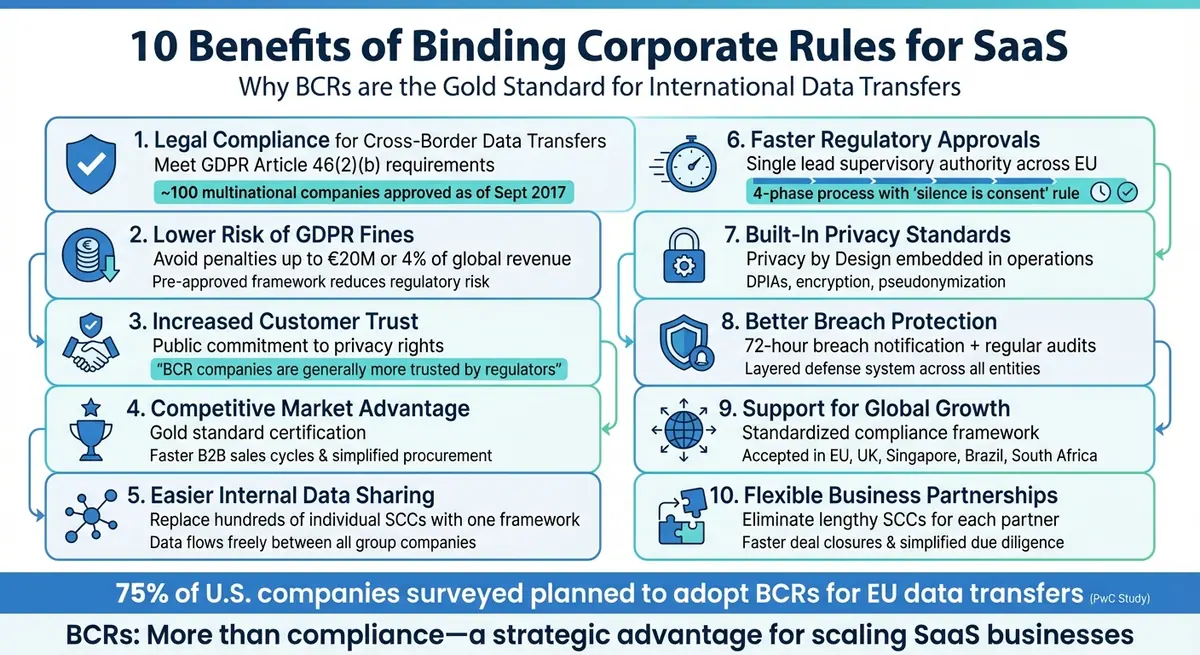
10 Key Benefits of Binding Corporate Rules for SaaS Companies
Why Use Binding Corporate Rules For Cross-Border Data? - AI and Technology Law
1. Legal Compliance for Cross-Border Data Transfers
Transferring personal data outside the EEA comes with strict requirements under GDPR. To meet these standards, Binding Corporate Rules (BCRs) serve as a reliable safeguard, as outlined in GDPR Article 46(2)(b) and Article 47. These rules provide a dependable legal framework for international data transfers, making them essential for global SaaS companies aiming to stay compliant.
BCRs undergo a thorough review process by European Data Protection Authorities. They must legally bind all corporate entities within the organization while ensuring enforceable rights for individuals, such as the ability to access, correct, or delete their data.
"Binding Corporate Rules were able to defend their reputation as the most robust mechanism and 'gold standard' for international transfers of personal data subject to the GDPR." – Hogan Lovells
To align with GDPR, BCRs must reflect key principles like purpose limitation, data minimization, storage limitation, and data quality. The approval process involves appointing a lead supervisory authority - usually based at the company’s EU headquarters - and demonstrating enforcement mechanisms, such as penalties for non-compliance.
As of September 2017, approximately 100 major multinational companies had completed the EU’s BCR approval process. Additionally, a PwC study revealed that 75% of U.S. companies surveyed planned to adopt BCRs for handling EU data transfers. This rigorous approach not only ensures compliance but also strengthens data protection practices, laying the groundwork for further discussion in the following sections.
2. Lower Risk of GDPR Fines and Penalties
BCRs (Binding Corporate Rules) don't just ensure compliance - they also help reduce the chances of costly fines and operational disruptions.
Under GDPR, violations can lead to fines of up to €20 million or 4% of your global revenue, whichever is higher. Even less severe breaches can result in penalties reaching €10 million or 2% of turnover. What makes this even more challenging is that these fines apply to the entire corporate group. A single mistake in one country - like a data transfer error - could result in penalties tied to your global earnings.
By implementing BCRs, companies establish safeguards that have already passed rigorous EU scrutiny. This pre-approval signals to regulators that your organization complies with Article 46 of the GDPR, reducing the likelihood of penalties.
Beyond fines, regulators can impose bans on data processing, potentially halting your operations. BCRs provide the legal framework authorities expect during audits, helping you avoid such corrective actions.
Additionally, aligning with updated EDPB guidance by enforcing internal sanctions for non-compliance strengthens your position. This demonstrates that your company takes GDPR obligations seriously, further lowering regulatory risks.
3. Increased Customer Trust and Better Reputation
Binding Corporate Rules (BCRs) are a public declaration of your dedication to privacy rights, which can significantly enhance your organization's reputation. By adopting BCRs, you're not just checking off compliance boxes - you’re showcasing that your data protection practices have passed a rigorous regulatory review.
This process sets BCRs apart from standard contracts, reinforcing trust in your ability to safeguard data. The thorough scrutiny involved in obtaining BCR approval doesn’t just satisfy regulators - it also fosters greater confidence among your customers.
"BCR companies are generally more trusted by the regulators and transfers subject to BCRs tend to be scrutinized less." - McDermott Will & Emery
BCRs also strengthen your reputation with customers by granting them third-party beneficiary rights. This means data subjects can legally enforce the rules if necessary, offering a clear pathway for recourse. This level of accountability builds trust and can be a game-changer during vendor evaluations, where enterprise clients often see BCR approval as a sign of a well-established privacy program.
To take it a step further, you can publish a transparent version of your BCRs on your website. This openness sends a powerful message: your company is fully committed to protecting customer data and has nothing to hide.
4. Competitive Advantage in the Market
Beyond trust and reputation, BCRs provide a distinct edge in competitive markets. Often regarded as the "gold standard" for international data transfers, BCRs set SaaS companies apart by showcasing their commitment to stringent regulatory compliance. For enterprise clients, BCR approval signifies that a company has undergone rigorous regulatory evaluation.
"BCRs are often seen as the gold standard for privacy and data protection management programs. They also act as a 'soft certification,' demonstrating an organization's commitment to and compliance with data privacy rules to business partners and individuals." - Bojana Bellamy, President, Centre for Information Policy Leadership
For SaaS providers managing cross-border data transfers, BCRs offer a clear sales advantage by simplifying the procurement process. Instead of navigating the complexities of Standard Contractual Clauses, companies with approved BCRs can onboard B2B customers more efficiently. This streamlined approach reduces the time it takes to finalize agreements, eliminating administrative hurdles that competitors may still face. The result? Faster sales cycles and a stronger foothold in the market.
Moreover, BCRs provide long-term legal certainty, which appeals to risk-averse enterprise clients. This assurance fosters stable, multi-year partnerships, making your company a more reliable choice for businesses planning extended collaborations.
"BCR companies are generally more trusted by the regulators and transfers subject to BCRs tend to be scrutinized less." - McDermott Will & Emery
5. Easier Data Sharing Within Your Organization
For global SaaS companies, transferring data between offices, subsidiaries, and teams can quickly become a logistical headache. Without Binding Corporate Rules (BCRs), every interaction between your international entities would require individual Standard Contractual Clauses (SCCs) - potentially leading to hundreds or even thousands of separate agreements. This creates unnecessary administrative bottlenecks, slowing operations and stretching your legal team thin. A unified BCR framework solves this problem.
BCRs streamline this process by acting as a single framework that allows personal data to move freely between all group companies, as if they were all operating within the European Economic Area. Once approved, BCRs eliminate the need for separate agreements or repeated legal approvals under Article 49 for every internal transfer.
"Once approval is obtained for the group's BCR, it is a 'catch all' meaning personal data can flow freely between the group companies... without the need to conclude Standard Contractual Clauses between different group entities." - Liedekerke Wolters Waelbroeck Kirkpatrick
This framework also scales effortlessly. If you open a new office or acquire a subsidiary, they can be added to your existing BCRs without starting the process all over again. This reduces the legal team's workload, allowing them to shift focus to supporting business growth.
On top of that, scalability brings consistency. With BCRs in place, your organization can standardize data handling procedures, audits, and employee training across all locations. This ensures your teams follow the same compliance protocols no matter where they are, simplifying internal operations and reinforcing a strong data protection strategy.
sbb-itb-5f36581
6. Faster Approval Process Across EU Countries
Managing operations across multiple EU countries can be a regulatory maze for SaaS companies. Without Binding Corporate Rules (BCRs), you’re left juggling feedback from various national data protection authorities, often with conflicting requirements. BCRs simplify this by introducing a single lead supervisory authority that oversees the entire approval process, ensuring consistent communication and decisions across the EU.
Here’s how it works: instead of negotiating with every country’s regulator, you deal with one designated "BCR Lead." This lead authority, usually in the EU member state where your European headquarters is based, becomes your main point of contact. They coordinate with other regulators via the GDPR's consistency mechanism, guiding your application through a structured, four-phase review.
The approval process breaks down into these phases:
- BCR Lead Review Phase: Takes 2–4 weeks for the lead authority to confirm its competence.
- Co-Review Phase: Lasts about a month, during which one or two additional authorities review your draft and provide feedback.
- Cooperation Phase: Another month for all concerned authorities to review the consolidated draft and raise any objections.
- EDPB Opinion Phase: Spanning 8–14 weeks, this final phase involves the European Data Protection Board issuing its formal opinion, as per Article 64 of the GDPR.
On March 19, 2025, an updated procedure was introduced to streamline this process further. One key improvement is the "silence is consent" rule. If authorities don’t object within a specified timeframe, their lack of response is treated as approval, reducing unnecessary delays. Additionally, regular BCR sessions allow regulators to resolve issues internally before providing unified feedback.
"The updated BCR approval procedure could further encourage companies to implement BCR, as it brings greater clarity and predictability to the BCR approval process."
Once approved, your BCRs apply across all EU member states, creating a unified framework for data transfers within your organization. This mutual recognition eliminates the hassle of seeking separate approvals in each country, allowing your legal team to focus on driving strategic growth instead of navigating regulatory red tape.
7. Built-In Privacy Protection Standards
Binding Corporate Rules (BCRs) integrate data protection into SaaS operations right from the start. This approach aligns with GDPR's "Privacy by Design" principle, which emphasizes that privacy considerations should be woven into every stage of a system or service's lifecycle. Instead of tacking on privacy measures later, BCRs embed them directly into the foundation of your business processes.
A key requirement of this framework is conducting Data Protection Impact Assessments (DPIAs) before initiating any new data transfers or processing activities. This proactive step helps identify potential privacy risks early, allowing for quick solutions. Additionally, BCRs require essential technical safeguards like encryption and pseudonymization to ensure consistent data protection across all regions. Together, these measures create a solid foundation for accountability.
"Data minimisation is also a core component of the 'Privacy by Design' principle in GDPR which mandates that organisations should consider privacy and data protection aspects throughout the entire lifecycle of their systems, and services." – Bethany Ayers, CEO, Metomic
Take Mapfre, for instance. In November 2024, it became the first Spanish financial institution to secure approval from the European Data Protection Board for its BCRs. The company introduced measures aimed at ensuring transparency and minimizing data usage across all its international subsidiaries. This included strict protocols for handling sensitive data and robust internal controls to monitor compliance globally. Mapfre’s example shows how BCRs turn high-level privacy concepts into practical, operational strategies.
BCRs also enforce accountability by designating Data Protection Officers and conducting regular audits. These steps ensure privacy standards are actively upheld, not just documented. With GDPR penalties reaching up to €20 million or 4% of global turnover, embedding these measures into your operations is crucial for maintaining compliance and protecting your SaaS business.
8. Better Protection Against Data Breaches
Binding Corporate Rules (BCRs) provide a layered defense system designed to minimize both the chances of data breaches and their potential impact. Unlike generic compliance frameworks, BCRs require SaaS companies to implement consistent security protocols across all global entities. This uniformity ensures a high standard of protection no matter where the data is processed.
A key feature of BCRs is the 72-hour breach notification rule. If a personal data breach occurs, companies must notify EU regulators within 72 hours of detection - unless the breach is unlikely to risk individual rights and freedoms. This swift action helps contain potential damage and ensures affected individuals are informed promptly.
To further reduce risks, BCRs mandate employee training and internal sanctions. Employees who handle personal data must undergo training to understand and follow security protocols, addressing vulnerabilities like human error or social engineering attacks. Companies are also required to document internal policies and disciplinary measures, fostering a culture where security isn’t just theoretical - it’s actively practiced every day.
Another critical component is the requirement for regular audits. These audits are designed to spot vulnerabilities before they turn into breaches. Organizations must establish audit schedules and action plans to address any identified gaps. This ongoing evaluation ensures that security measures remain effective as businesses evolve and threats change.
BCRs also introduce a clear liability framework. A designated EU entity serves as the guarantor, taking responsibility for breaches caused by any group member. This financial accountability motivates companies to uphold stringent security standards across all operations. Furthermore, if a third country fails to meet these standards, BCRs require companies to either return or delete the transferred personal data, ensuring protection even in challenging local conditions.
9. Support for International Business Growth
Binding Corporate Rules (BCRs) play a key role in supporting international business expansion by creating a standardized compliance framework across borders. Instead of crafting separate data protection policies for each new market, BCRs establish a single set of rules that applies to all entities within your corporate group worldwide. This means your SaaS company can seamlessly open an office in Berlin, expand to Singapore, or launch operations in São Paulo without having to build a compliance framework from scratch every time. By simplifying compliance, BCRs help speed up market entry and reduce administrative headaches.
Once in place, BCRs require minimal ongoing management. They replace the need for maintaining hundreds of individual Standard Contractual Clauses (SCCs), significantly cutting down administrative work. This streamlined approach ensures your compliance framework scales effortlessly as your organization grows globally.
One of the standout benefits of BCRs is their recognition in multiple jurisdictions. Beyond the EU, they are accepted as a compliant data transfer mechanism in the UK, Singapore, Brazil, and South Africa. This interoperability means that compliance efforts in one region often meet the requirements in others, making it easier to serve customers worldwide without running into legal obstacles.
BCRs also enhance operational flexibility. When launching new features or making changes to how data is processed, BCRs allow you to implement these updates globally without needing to create separate compliance frameworks for each region. For SaaS companies, this agility is essential to keep up with market demands and iterate quickly across multiple regions. It also opens doors to more adaptable and efficient business partnerships.
10. More Flexible Business Partnerships
Binding Corporate Rules (BCRs) simplify the way businesses handle data-sharing agreements, eliminating the need for tedious Standard Contractual Clauses and their accompanying annexes for every partner. This allows personal data to move smoothly across group companies without the hassle of renegotiating contracts repeatedly. This pre-approved structure is especially useful for external partnerships, where traditional methods often demand lengthy legal reviews for each new vendor.
For SaaS companies acting as vendors, Processor BCRs can make a big difference in speeding up B2B sales processes. As noted by McDermott Will & Schulte LLP:
"BCRs are often used by large service providers, allowing them to receive personal data from their B2B customers without concluding rather lengthy Standard Contractual Clauses (completing the required detailed annexes), cutting down the time needed to conclude data protection agreements".
This efficiency not only accelerates deal closures but also reduces friction in enterprise procurement workflows. It mirrors the internal compliance benefits that BCRs provide, creating smoother processes both within and outside the organization.
BCRs also act as a badge of trust, showcasing a company's dedication to data privacy. Bojana Bellamy, CIPP/E at IAPP, highlights this:
"BCRs are often seen as the gold standard for privacy and data protection management programs. They also act as a 'soft certification,' demonstrating an organization's commitment to and compliance with data privacy rules to business partners and individuals".
This reputation for high standards simplifies due diligence, making companies more appealing to potential partners, particularly in industries with strict regulations.
On top of that, BCRs offer operational flexibility. They enable global updates to data practices without the need to draft separate documentation for every partner or region. By making partner engagements easier while maintaining strong data protection measures, BCRs help businesses uphold international compliance standards and strengthen relationships with partners.
Conclusion
Binding Corporate Rules (BCRs) go beyond being just another regulatory requirement - they’re a strategic move that combines robust data protection with opportunities for business growth. By adopting BCRs, you create a privacy management framework that not only meets GDPR accountability standards but also positions your company as a leader in managing data responsibly.
Throughout this article, we’ve highlighted how BCRs offer tangible benefits. They provide legal stability even when adequacy decisions are contested, simplify administrative processes, and speed up B2B transactions by showcasing your commitment to privacy. Plus, the ability to launch new products or enter new markets without starting compliance efforts from scratch makes BCRs a game-changer for SaaS businesses aiming to scale.
BCRs act as a badge of privacy excellence, fostering trust, simplifying due diligence, and helping your company stand out in competitive markets. Their operational flexibility ties directly to the internal safeguards and auditing practices discussed earlier, ensuring a culture of compliance. Regular audits and training not only reduce the risk of data breaches but also help avoid regulatory penalties. This integrated approach strengthens your competitive position while aligning your global compliance efforts.
Yes, the approval process for BCRs is rigorous, requiring annual updates to align with the European Data Protection Board’s (EDPB) guidelines and proper designation of a lead supervisory authority. However, once approved, BCRs provide a lasting framework that supports international expansion and solidifies your market position for the long haul.
For companies dedicated to protecting data and driving global growth, BCRs are more than a compliance tool - they’re the foundation for trusted, scalable operations across borders.
FAQs
What are the advantages of Binding Corporate Rules for SaaS companies under GDPR?
Binding Corporate Rules (BCRs) provide SaaS companies with a dependable framework to comply with GDPR requirements for transferring data internationally. By using BCRs, businesses maintain consistent data protection practices across all their global operations, making compliance simpler and lowering legal risks.
Another advantage of BCRs is that they remove the need for multiple data transfer agreements, which can save both time and resources. They also highlight a company’s dedication to privacy and openness, strengthening trust with customers and stakeholders while easing the process of regulatory approvals for cross-border data exchanges.
How do Binding Corporate Rules (BCRs) give SaaS companies a competitive edge in global markets?
Binding Corporate Rules (BCRs) give SaaS companies a major advantage in global markets by allowing compliant cross-border data transfers within multinational organizations. These internal policies are legally binding and adhere to the strict standards of GDPR, even when transferring data to countries outside the European Economic Area (EEA) that may have weaker data protection laws. This approach minimizes regulatory risks, strengthens customer trust, and highlights a company’s dedication to safeguarding privacy.
BCRs also simplify compliance for the entire corporate group by eliminating the need for separate frameworks tailored to individual countries. This unified approach not only reduces long-term compliance costs but also positions companies as leaders in privacy protection - something highly valued by both customers and regulators, especially in privacy-focused regions like the United States. By ensuring secure and smooth global data transfers, BCRs enable SaaS companies to operate effectively while upholding strong privacy and security standards.
How do Binding Corporate Rules (BCRs) improve data security and build customer trust?
Binding Corporate Rules (BCRs) strengthen data security by establishing a unified, legally enforceable framework for managing personal data within an organization. This approach ensures consistent data protection practices across all operations, significantly lowering the risk of data breaches.
In addition to meeting GDPR requirements, BCRs showcase a company’s dedication to privacy. This commitment helps build trust with customers, reassuring them that their personal data is handled securely and in line with international regulations.
Related Blog Posts
Get new content delivered straight to your inbox

The Response
Updates on the Reform platform, insights on optimizing conversion rates, and tips to craft forms that convert.




Drive real results with form optimizations
Tested across hundreds of experiments, our strategies deliver a 215% lift in qualified leads for B2B and SaaS companies.
