
.webp)
Why CAPTCHA Alternatives Improve Lead Quality


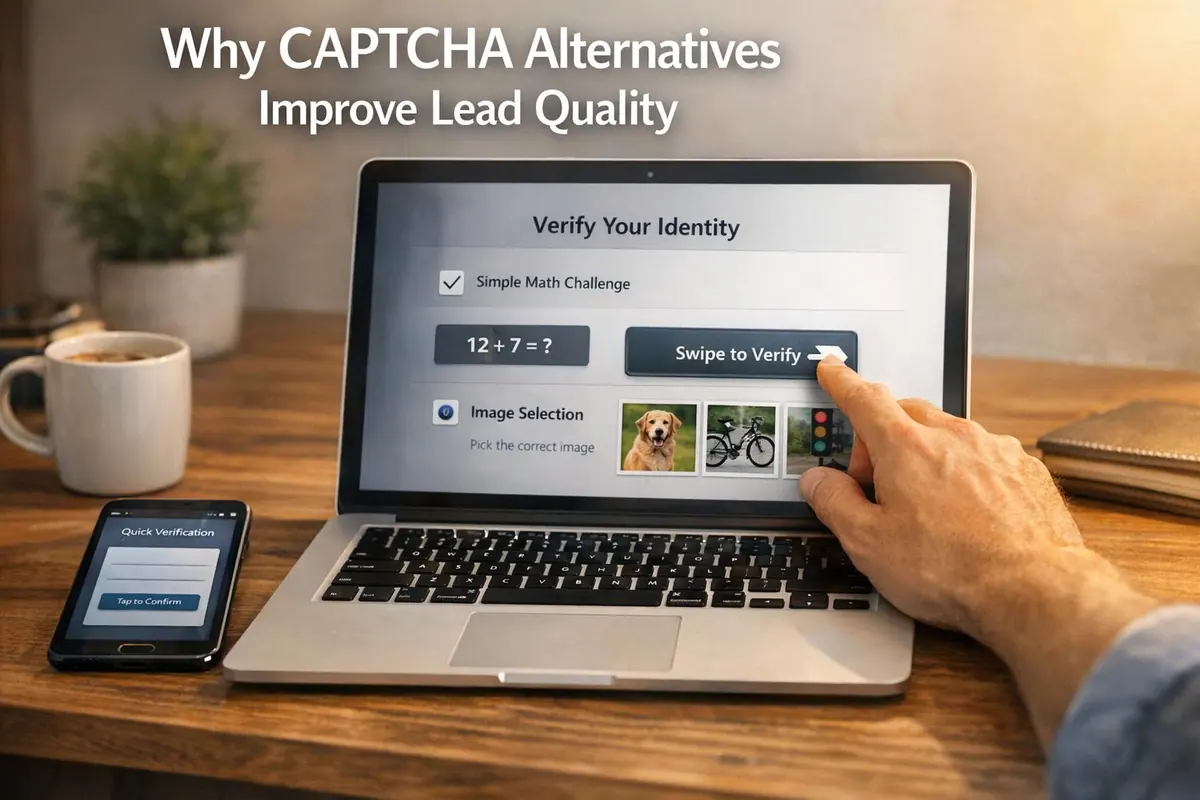
CAPTCHAs are supposed to block bots, but they often frustrate users and reduce conversions. Studies show:
- 71% of users abandon CAPTCHAs without solving them.
- Conversions drop by up to 40% due to CAPTCHA friction.
- Bots can solve CAPTCHAs faster and more accurately than humans.
Modern alternatives solve these issues by using invisible verification methods like behavioral analysis and honeypot fields. These tools quietly detect bots without annoying users, leading to:
- Higher conversion rates (up to 3% increase).
- Better lead quality with accurate data.
- Stronger spam prevention (99.9% accuracy in blocking bots).
Businesses like NEXT and Cabify have already seen success with these methods, reducing fraud and improving user experience. Reform, a form-building platform, offers invisible spam protection and lead enrichment tools to streamline form completion while ensuring only genuine leads make it through.
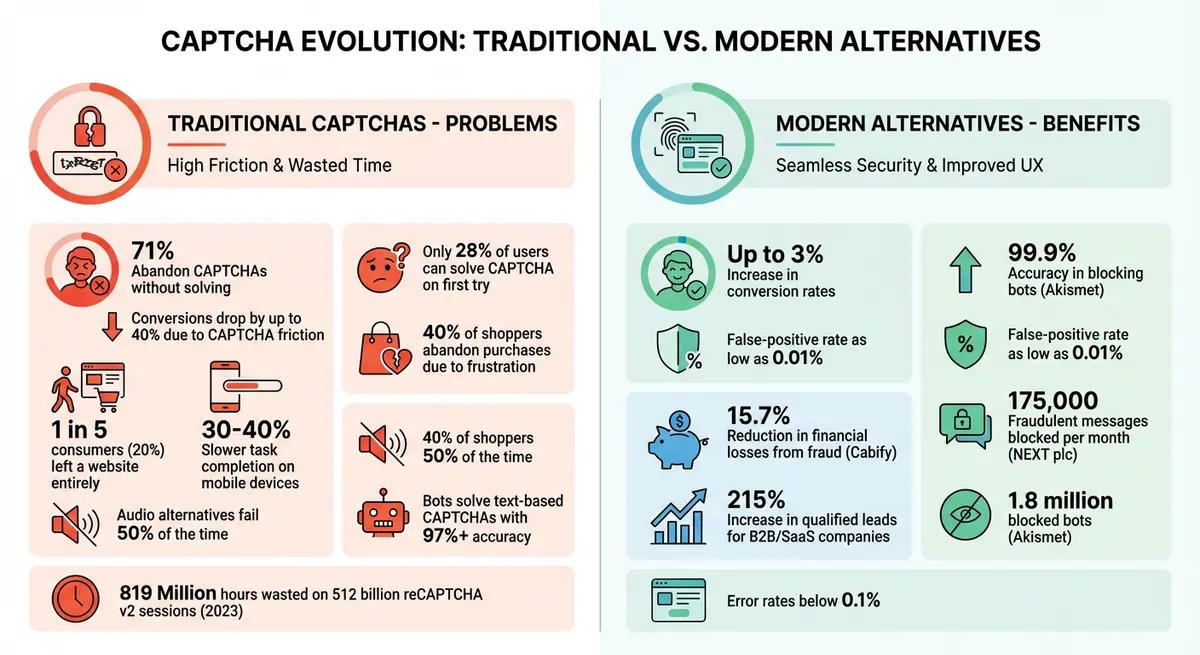
CAPTCHA vs Alternatives: Impact on Conversions and Lead Quality
Problems with Traditional CAPTCHAs
Traditional CAPTCHAs come with three main drawbacks: they frustrate users to the point of abandonment, they exclude individuals with disabilities, and they fail to block bots effectively. These issues highlight the need for better, more user-friendly verification methods.
User Friction and Form Abandonment
Daniel D'Alessandro, Co-Founder of Peakhour, once described CAPTCHAs as, "Every CAPTCHA is a time tariff imposed on your customers". And he’s right - each puzzle adds friction, driving users away. The numbers are telling: visible CAPTCHAs can slash form conversions by up to 40%, and nearly 1 in 5 consumers have left a website entirely because of a CAPTCHA encounter.
The problem gets worse on mobile devices. CAPTCHAs slow task completion by 30–40% and confuse users with hard-to-distinguish characters like "9" versus "g" or "0" versus "O". Add case sensitivity, and the failure rate skyrockets from 8.66% to 29.45% - a 300% jump in errors. Only 28% of users say they can solve a CAPTCHA on the first try, and 40% of shoppers have abandoned purchases out of sheer frustration with these puzzles. This friction not only disrupts user experience but also erodes trust, which leads us to the next issue: accessibility.
Accessibility Barriers
CAPTCHAs are a nightmare for users with disabilities. Visual challenges are impossible for screen readers to interpret, and while audio alternatives exist, they fail 50% of the time. In a 2023–2024 WebAIM survey, screen reader users ranked CAPTCHA as the single most problematic online feature - a complaint that’s remained consistent for over a decade.
"CAPTCHAs were meant to keep bots out, but too often, they lock people with disabilities out, too. From image classification to click-based tests, many 'human checks' are anything but inclusive."
– Eleanor Hecks, Editor-in-Chief, Designerly Magazine
The challenges don’t stop there. Motor-impaired users struggle with tasks requiring precise clicks, like selecting tiny image squares, while those with cognitive disabilities often find the puzzles overwhelming. To make matters worse, assistive devices can trigger CAPTCHA systems to flag users as bots, leading to even tougher challenges for those who already face the most barriers.
Limited Effectiveness Against Bots
Ironically, while CAPTCHAs frustrate real users, they’re failing at their primary goal. Machine learning models can solve text-based CAPTCHAs with over 97% accuracy in mere seconds. By 2024, bots have been shown to achieve near-perfect accuracy on image-based CAPTCHAs as well. This failure undermines lead quality by letting sophisticated bots slip through while turning away genuine prospects.
"CAPTCHA's accessibility issues could be forgiven if it were an effective security tool, but it is far from foolproof since bots get it right more than humans do."
– Eleanor Hecks, Editor-in-Chief, Designerly Magazine
Modern bots have become smarter, mimicking human behavior by slowing down submission times and bypassing hidden honeypot fields. Meanwhile, users have collectively wasted over 819 million hours on more than 512 billion reCAPTCHA v2 sessions as of 2023. That’s countless hours spent on a system that fails to deliver on its promise of security. With traditional CAPTCHAs faltering on both usability and effectiveness, it’s clear that better solutions are needed to ensure quality leads and a smoother user experience.
How CAPTCHA Alternatives Improve Lead Quality
CAPTCHA alternatives don’t just simplify form completion - they transform the type of leads you gather. By reducing friction, effectively blocking bots, and encouraging thorough submissions, these modern solutions lead to higher-quality results.
Reduced User Friction
Modern tools like Proof-of-Work, behavioral analysis, and honeypot fields operate quietly in the background, allowing users to complete forms without interruptions during crucial actions like signups or checkouts. According to a study by Moz, implementing a CAPTCHA alternative led to a 3% increase in overall conversion rates.
This boost stems from eliminating unnecessary steps. Invisible verification removes these obstacles, offering a smoother, more natural experience. Advanced systems also maintain impressively low false-positive rates - sometimes as low as 0.01% - ensuring legitimate users are almost never blocked.
For example, in 2025, UK-based retailer NEXT plc adopted signal-based bot protection to replace manual verification. This change blocked around 175,000 fraudulent messages per month while ensuring a seamless experience for real customers. Similarly, Cabify, a mobility platform operating in over 40 cities, reduced financial losses from fraudulent traffic by 15.7% within three months of switching to AI-driven fraud prevention instead of traditional CAPTCHA challenges. These examples highlight how such approaches don’t just improve user experience - they also deliver tangible results.
Better Spam Prevention
Modern techniques don’t just make life easier for users; they actively combat spam. Honeypot fields, for instance, use hidden inputs that bots are likely to fill, automatically marking those submissions as spam. Time-based analysis adds another layer by identifying bots that complete forms almost instantly, compared to the 3–15 seconds humans typically take. Behavioral analysis further strengthens this process by tracking factors like mouse movements, typing patterns, and device details to confirm authenticity.
Akismet, a cloud-based spam protection service, achieves a 99.9% accuracy rate in identifying spam by leveraging machine learning and extensive databases of known spam patterns. This multi-layered approach ensures bots are effectively blocked while real users remain unaffected.
More Accurate Data
By eliminating barriers and keeping bots at bay, these advanced methods ensure you capture accurate and meaningful data. Forms without CAPTCHA interruptions tend to have higher completion rates, as users are more likely to provide correct details when the process feels effortless. Features like real-time email validation, often integrated into these systems, verify addresses as users type, reducing bounce rates and ensuring the data collected is actionable. Lead enrichment tools can even auto-fill known details, shortening forms and minimizing errors. Some systems go a step further by capturing partial responses from users who abandon forms, offering insights that would otherwise be lost.
The payoff? Modern spam prevention and data optimization strategies have been shown to increase qualified leads by 215% for B2B and SaaS companies. It’s not just about collecting more leads - it’s about gathering better leads with accurate information, clear attribution, and genuine interest in your offerings.
What to Look for in CAPTCHA Alternatives
When choosing CAPTCHA alternatives, focus on solutions that safeguard your forms without disrupting the user experience. The ideal option should provide strong protection while integrating effortlessly with your existing systems, avoiding unnecessary complications for both your team and users.
Background User Verification
The most effective alternatives rely on behavioral analysis and device intelligence to verify users discreetly. These systems monitor subtle signals like mouse movements, keyboard patterns, and scrolling behavior to assess user authenticity. Device intelligence evaluates over 100 indicators, including browser settings, network information, and device fingerprints, to create a detailed profile of each visitor.
This multi-layered approach ensures that visible challenges are only presented to high-risk interactions, sparing the majority of users from interruptions. With error rates below 0.1%, these systems rarely block legitimate users. Some solutions also employ cryptographic Proof-of-Work challenges that run silently on the user's device, confirming human presence without tracking behavior or collecting personal data. Additionally, it's crucial to select solutions that maintain high standards for privacy and accessibility.
Privacy and Accessibility Standards
To maintain user trust, opt for solutions that comply with regulations like GDPR and CCPA, especially if your business serves customers across different regions. It's equally important to ensure your forms meet WCAG and ADA guidelines, so users with disabilities can navigate them without difficulty.
"CAPTCHAs are the internet's equivalent of speed bumps. They slow everyone down, annoy legitimate users, and... hand over more data to Google than most people realize." – Fingerprint.com
Privacy-focused alternatives minimize data collection and steer clear of sharing behavioral data with ad networks. This approach reassures users that their information remains secure.
Integration with Business Systems
Beyond verification and compliance, seamless integration with your business tools is essential. Even the most advanced spam prevention solutions fall short if they don't work with your existing systems. Look for options that offer built-in integrations with CRMs like HubSpot, Salesforce, and Close, as well as marketing automation platforms. These integrations allow leads to flow directly into your systems for immediate action, reducing manual work and preventing lost opportunities.
Solutions that support webhooks and APIs are invaluable for creating custom workflows. Capturing UTM parameters is another key feature, as it helps you track the source of each lead and evaluate the effectiveness of your marketing campaigns. Features like real-time email validation and lead enrichment should also integrate smoothly, ensuring data quality without complicating your forms.
Before fully implementing a new tool, test it in a staging environment to confirm proper UI and accessibility functionality. After launch, keep an eye on conversion metrics to identify and address any signs of excessive user friction.
sbb-itb-5f36581
Reform: A Modern Form Builder for Lead Quality
Reform puts the focus on delivering high-quality leads. Instead of relying on outdated CAPTCHA challenges, it offers a smoother experience with invisible spam protection. This means users can fill out forms without encountering frustrating puzzles or image-based verifications that often cause drop-offs.
The platform blends no-code customization with features designed to improve conversions, such as multi-step forms, conditional routing, and lead enrichment. With real-time email validation and data enrichment, Reform ensures that only genuine, high-value leads make it through.
Reform's Spam Prevention Tools
Reform’s approach to spam prevention is all about simplicity and effectiveness. Its advanced filters work behind the scenes, analyzing submissions without requiring users to take any extra steps. Emails are validated instantly to minimize bounce rates and capture accurate contact details. This invisible process ensures bots are blocked while maintaining high form completion rates for legitimate users.
Additionally, Reform’s enrichment tools add another layer of quality control. Submitted information is automatically cross-checked with contact databases, flagging entries that don’t align as potentially fraudulent. The platform also tracks abandoned submissions, collecting partial answers to identify where real users drop off versus where bots are blocked. This helps businesses fine-tune their forms and reduce friction for genuine prospects.
No-Code Customization
Reform’s visual interface makes it easy for marketing teams to create and tweak forms without needing technical expertise. Multi-step forms with conditional routing can be designed to guide users through tailored questions based on their previous responses. This setup naturally filters out bots while simplifying the process for real users, improving the overall experience and lead quality.
The platform also supports flexible qualification rules. High-value leads can be routed directly to VIP scheduling links, while others are directed to automated resources. These rules can be adjusted instantly using real-time data, allowing businesses to refine their lead qualification strategy as needed.
Real-Time Analytics
Reform doesn’t just stop at form-building - it provides real-time insights to help businesses measure performance. Its analytics dashboard tracks key metrics like form completion rates, email validation failures, and submission sources. For example, a sudden spike in validation failures might indicate bot activity, while a drop in completion rates could suggest the form is too complex or off-putting.
Another key metric is time-to-completion. Since bots typically submit forms in seconds while humans take longer, this data can help identify suspicious patterns. Armed with these insights, businesses can A/B test different form setups, monitor conversion rates by traffic source, and use conditional routing to fine-tune the user experience. This continuous optimization ensures the highest possible lead quality based on real-world data.
Conclusion
Traditional CAPTCHAs often annoy users without effectively stopping advanced bots. On the other hand, CAPTCHA alternatives work quietly in the background, blocking spam while allowing genuine users to complete forms seamlessly. This not only improves the user experience but also ensures the data collected is more reliable and actionable.
The numbers back this up. Invisible solutions like Akismet use machine learning trained on billions of spam data points to protect over 100 million websites. Techniques such as honeypots, behavioral analysis, and time-based submissions effectively catch bots while maintaining higher form completion rates - avoiding the potential 40% drop caused by intrusive methods.
Reform takes these advancements a step further. With real-time email validation and automated lead enrichment, Reform ensures that only high-quality data makes its way into your CRM. Plus, conditional routing helps guide high-value prospects to the right next steps without adding unnecessary hurdles.
FAQs
How can using CAPTCHA alternatives improve the quality of your leads?
CAPTCHA alternatives aim to improve user experience while maintaining strong security, helping to reduce form abandonment rates. Instead of relying on traditional CAPTCHA methods, these alternatives use modern techniques like behavioral analysis, device fingerprinting, and layered security measures to detect bots more effectively.
By cutting down on fake or low-quality submissions, businesses can prioritize real leads, streamlining their workflows and boosting the effectiveness of their marketing campaigns. This strategy not only keeps forms easy to use but also ensures that the data collected comes from genuine prospects.
How do invisible verification methods enhance user experience and lead quality?
Invisible verification methods, like behavioral analysis and device fingerprinting, operate silently in the background to confirm a user's identity without disrupting their experience. Unlike traditional CAPTCHA challenges, these techniques remove unnecessary barriers, offering a smoother and more natural process for legitimate users.
By examining behaviors such as typing speed or mouse movements, these methods strike a balance between security and convenience. This approach not only lowers the chances of users abandoning forms but also enhances lead quality by weeding out bots and reducing false positives. The outcome? Cleaner data and improved conversion rates for your business.
How do modern CAPTCHA alternatives make forms accessible for people with disabilities?
Modern CAPTCHA solutions are evolving to prioritize inclusivity by adhering to accessibility standards like WCAG. Instead of depending on visual challenges, these alternatives are designed to work seamlessly with assistive technologies, such as screen readers. They provide features like clear error messages and use ARIA attributes to effectively communicate any issues.
These systems also support keyboard navigation, enabling users to complete forms without needing a mouse. With focus management, the first error is automatically highlighted after submission, simplifying the process for individuals with visual or motor impairments. These thoughtful adjustments help remove obstacles, ensuring everyone can interact with online forms more easily.
Related Blog Posts
Get new content delivered straight to your inbox

The Response
Updates on the Reform platform, insights on optimizing conversion rates, and tips to craft forms that convert.



Drive real results with form optimizations
Tested across hundreds of experiments, our strategies deliver a 215% lift in qualified leads for B2B and SaaS companies.
