
.webp)
Common Data Collection Mistakes in Attribution



Attribution models are only as reliable as the data they’re built on. But many marketers unknowingly rely on flawed data, leading to wasted budgets, inaccurate ROI calculations, and poor decision-making.
Here are five common data collection mistakes that compromise attribution accuracy:
- Inconsistent Tracking Tags: Typos, capitalization errors, or conflicting UTM parameters fragment data and misattribute conversions.
- Ignoring Cross-Device Data: Without unified tracking, user journeys across multiple devices appear disconnected, skewing channel performance metrics.
- Overlooking Offline Conversions: Offline touchpoints like phone calls or in-store purchases often go untracked, leaving gaps in attribution.
- Poor Data Validation: Spam, duplicate entries, and incomplete data distort insights, leading to wasted ad spend and missed opportunities.
- Neglecting Abandoned Forms: Partial submissions provide valuable insights but are often ignored, resulting in lost high-intent leads.
Key Takeaway:
Flawed data collection undermines even the best attribution models. Solutions like standardized tagging, cross-device tracking, CRM integrations, and spam prevention tools can help ensure accurate, actionable data from the start.
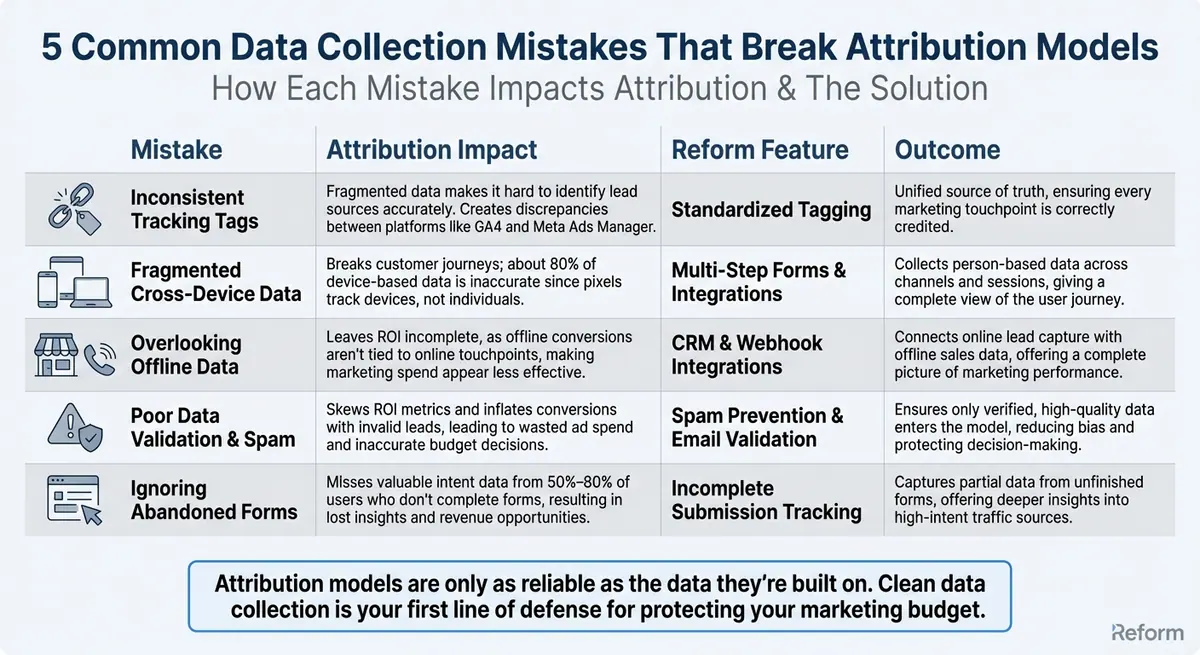
5 Common Data Collection Mistakes That Break Attribution Models
Mistake 1: Inconsistent Tracking Tags and UTM Parameters
What Causes Tagging Problems
Tagging issues often boil down to simple human error. Typos, extra spaces (like "utm_medium=email "), and inconsistent capitalization (e.g., "Social" vs. "social") can wreak havoc on your data. Analytics tools are case-sensitive, so even minor differences, like "Facebook" versus "facebook", can result in separate data buckets.
Beyond manual mistakes, many organizations lack a unified UTM strategy. When different team members or agencies use inconsistent naming conventions for the same campaign, it creates confusion. As Dylan Petersson from CampaignTracker points out:
Inconsistent naming can lead to fragmented data, making it nearly impossible to draw accurate insights.
Other common culprits include sales teams accidentally stripping UTM parameters when copying links or marketing automation tools generating conflicting UTMs. Technical issues, like lost parameters during redirects, misconfigured Google Tag Manager setups, or third-party double tagging, can further complicate matters.
How Bad Tags Affect Attribution
When tagging is inconsistent, it can disrupt your entire attribution system. For instance, if 20% of traffic from a high-performing ad campaign is mistagged, the campaign may appear far less effective in reports. At the same time, "Direct" traffic could be artificially inflated. Non-standard values, such as using "AdWords" instead of "google", can confuse platforms like GA4, leading to incorrect channel classifications and skewed performance analysis.
These errors result in distorted reports and misattributed conversions, which can ultimately cause budgets to be allocated to the wrong channels. Dan McGaw, CEO and Founder of UTM.io, highlights the problem:
The biggest roadblock to multi-touch attribution (MTA) is bad data. If you have bad data coming in, you're never going to be able to do multi-touch.
He adds:
What people don't understand is that when you have bad inputs, you get bad outputs. But if you have a bad input and then you throw it into automation, you'll have 10 times worse outputs.
To avoid these pitfalls, a standardized tagging process is critical.
Solution: Standardize Tags with Reform

The key to solving tagging issues is standardization, which ensures accurate and consistent data capture. The best way to achieve this? Remove manual entry from the equation. Reform’s real-time analytics and CRM integrations automatically capture and validate UTM parameters, reducing the risk of both human and technical errors.
Reform’s lead enrichment feature validates and standardizes data right at the point of capture, keeping your attribution data clean from the start. By creating a documented UTM strategy - using predefined lowercase values for parameters such as utm_source, utm_medium, and utm_campaign - and leveraging Reform’s integrations to enforce these standards, you can build a reliable foundation for accurate attribution across all channels. Jude Nwachukwu Onyejekwe, Founder of DumbData, underscores the importance of UTMs:
UTM parameters play a crucial role in digital measurement strategies by helping with collecting valuable attribution data points about a user visit and activity on your website.
| Common Tagging Error | Impact on Data | Typical Cause |
|---|---|---|
| Case Inconsistency | Splits "email" and "Email" into separate rows | Manual entry without a builder tool |
| Missing Trailing Slash | UTMs get stripped during redirects | Server-side URL normalization |
| Double Tagging | Overwrites intended attribution | Third-party sharing or lack of governance |
| Non-Standard Values | Traffic lands in "Unassigned" or "Other" | Using "AdWords" instead of "google" for source |
| Syntax Errors | Links break or result in 404 errors | Missing "?" or "=" in the URL string |
sbb-itb-5f36581
Digital Marketing Attribution in 2025: Challenges and Solutions
Mistake 2: Ignoring Cross-Device and Cross-Channel Data
Beyond tagging errors, neglecting cross-device tracking can severely disrupt accurate attribution.
Why Cross-Device Tracking Is Challenging
People constantly switch between devices. On average, U.S. households own 22 connected devices. In places like the U.S., U.K., and Germany, about 50–60% of users use multiple devices within a single month. This creates isolated data silos - what happens on one device often isn’t shared with another.
As Amplitude explains:
Devices don't naturally talk to each other. Your phone has no idea what your laptop is doing.
The main issue here is identity. How do you figure out if a user on one device is the same person on another? For most ecommerce sites, login rates hover below 30%, which means deterministic tracking (using verified identifiers like email addresses) only captures a fraction of users. On top of that, privacy regulations like GDPR and CCPA require explicit consent to use identifiers such as IP addresses. Apple’s App Tracking Transparency (ATT) framework has further complicated matters, with app tracking opt-in rates dropping to around 25%. Meanwhile, Chrome - responsible for 60% of browser traffic - is giving users even more control over tracking.
The Impact of Fragmented Data
Without unified tracking, customer journeys become fragmented, making it harder to understand campaign performance. For instance, a user might:
- Discover your brand through a mobile ad
- Research it later on a desktop at work
- Finally make a purchase on a tablet at home
Without cross-device tracking, these actions look like three unrelated visits. As Croud puts it:
The bias in marketing measurement is clear: user journeys appear much shorter and less multi-touch than they really are.
This disconnect can lead to major misattributions. Mobile campaigns might seem ineffective if users discover a brand on their phones but convert later on desktop. Similarly, top-of-funnel channels like social media, display, and video ads may appear undervalued because their broader role in influencing conversions isn’t captured. At the same time, last-click attribution can be overemphasized, making a single desktop click look like the entire journey.
Solution: Reform’s Multi-Step Forms and Integrations
One way to tackle these challenges is by capturing a verified identifier - like an email address - early in the customer journey. Reform’s multi-step forms are designed to do just that, creating an authenticated touchpoint that links user interactions across devices.
Reform also integrates with lead enrichment tools and CRMs, enabling what experts call "DIY linking". This means when a user provides their email on mobile and later returns on desktop, the system connects those sessions within your attribution model. Additionally, Reform’s incomplete submission tracking captures partial form data, even if users abandon the process, helping you gather more cross-device signals.
Mistake 3: Overlooking Offline and Assisted Conversions
When it comes to accurate attribution, offline interactions often get left out of the equation. And that’s a big problem.
Most digital attribution models focus solely on what happens online, ignoring the critical role offline touchpoints play in driving conversions. For instance, 74% of marketers say direct mail delivers a better ROI than any other channel, including email. Yet, many systems fail to account for these offline interactions, leaving marketers with an incomplete picture of what’s actually working.
Why Offline Conversions Can’t Be Ignored
B2B buyers don’t stick to just one or two channels. In fact, they typically use up to 10 different channels during their purchase journey, and many of these include offline interactions. Picture this: a prospect clicks on a LinkedIn ad, spends time researching the product online, and later finalizes the deal over a phone call or during an in-person meeting. If you’re not tracking that phone call or meeting, your attribution model might incorrectly credit the LinkedIn ad - or worse, just lump the lead under "direct" traffic.
Kyle Kienitz, Training and Development Director at Pathlabs, captures this well:
If the marketer overlooks how users act offline, they may miss out on a significant chunk of business.
Retailers face a similar challenge. Customers might browse products online but make their purchases in-store. Tools like Google Analytics 4 aren’t designed to automatically track these in-store transactions, which means the attribution process often stops at the website visit. This gap can lead to poorly allocated budgets and undervalued marketing efforts.
Bringing Offline Data Into the Picture
So, how do you ensure offline interactions are part of your attribution strategy? Start by using unique identifiers. Things like:
- Dedicated phone numbers for specific campaigns
- QR codes on print materials
- Custom promo codes for direct mail campaigns
These tools help connect offline actions to their digital origins, giving you a clearer picture of what’s driving results.
For more advanced tracking, consider integrating your CRM and Point-of-Sale (POS) systems with your advertising platforms. Tools like Facebook’s Conversions API (CAPI) and Google Offline Conversion Tracking make it possible to match CRM sales data with online ad clicks. Platforms like Reform simplify this further by automatically syncing form submissions with your CRM. This ensures every offline interaction is tied back to a verified touchpoint, whether the conversion happens online or off.
Mistake 4: Poor Data Validation and Spam Prevention
Once you've tackled tagging and cross-device tracking, there's another issue that can seriously derail your efforts: poor data validation. Bad data doesn't just clutter your system - it actively skews your attribution models. When spam submissions or invalid entries sneak in, they distort your understanding of what’s driving results. The danger? You might pour resources into underperforming channels while neglecting the ones that are actually working.
Common Validation Problems
Here are some typical data validation issues:
- Duplicate records: A single contact might be entered multiple times through different channels, inflating your lead count and fragmenting the customer journey [17, 18].
- Incomplete data: Missing critical details like email addresses or phone numbers makes it impossible to connect leads to their sources.
- Format mismatches: Errors such as missing "@" symbols, text in numeric fields, or broken UTM parameters disrupt proper source attribution [16, 18].
- Logic inconsistencies: Data that seems fine at first glance but doesn’t make sense - like a conversion date preceding a first website visit - can throw off your attribution efforts.
How Invalid Data Hurts Attribution and ROI
The impact of invalid data goes beyond just messy spreadsheets - it can directly harm your return on investment. For example, if your attribution model credits spam or bot-generated leads, advertising algorithms end up optimizing for the wrong audience. This misstep can cause campaigns to underperform, as modern platforms rely heavily on conversion signals to refine targeting.
To make matters worse, tracking methods like cookies and pixels are estimated to produce around 80% inaccurate data. Julie Molloy from Corvidae puts it clearly:
A low-quality input results in a low-quality output, and it's on this output that marketers are basing important decisions around spend.
Duplicate entries or bot submissions can inflate conversion rates, leading to wasted ad spend on non-human traffic. Meanwhile, legitimate channels might get overlooked. On top of that, your sales team could waste precious time chasing fake leads, driving up your cost per acquisition.
Solution: Reform's Spam Prevention and Email Validation
The solution begins at the source - where data is collected. Reform tackles this issue head-on by filtering out invalid submissions right at the entry point. Its email validation tools catch formatting errors instantly, while spam prevention features block bot traffic before it pollutes your system. These measures ensure that your attribution data stays clean and actionable.
Mistake 5: Ignoring Abandoned and Incomplete Form Submissions
After ensuring data validation, another major misstep in attribution is overlooking abandoned form submissions.
Did you know that 50%–80% of users abandon forms? In industries like retail and finance, this number can climb above 75%. Many businesses see these incomplete submissions as dead ends, but they’re actually a treasure trove of attribution data.
When you ignore incomplete forms, you’re not just losing potential leads - you’re also missing out on valuable insights into the marketing channels that brought those users in the first place. Without tracking partial submissions, your attribution model might fail to credit the campaigns or emails that initially sparked interest. This can lead to poor decisions, like cutting budgets from channels that are actually driving high-intent traffic. It’s a mistake that can distort performance metrics, similar to inconsistent tagging or fragmented cross-device data.
Why Abandoned Forms Are More Than Just Missed Leads
Even partial submissions can tell you a lot. If a user enters just their name or email, it’s a clear sign of intent. Research shows that around 30% of users abandon forms due to security concerns, while 25% leave because the form feels too long. These aren’t uninterested users - they’re potential leads who encountered friction.
This is critical for attribution. Let’s say a Google Ads campaign drives 100 form starts but only 20 completions. Without capturing data from the 80 users who dropped off, you might incorrectly assume the campaign isn’t working. The real issue could be the form design, not the targeting. By tracking those abandoned submissions, you can avoid misjudging the effectiveness of your campaigns and reallocating budgets incorrectly.
Solution: Reform’s Incomplete Submission Tracking
Reform offers a way to capture data from users who exit before hitting "submit." Its autosave feature records input after just three seconds. You can also set savepoints to capture data at each step or trigger a save about five minutes after the user’s last interaction.
This method helps you identify which marketing efforts are driving high-intent leads - even if they don’t complete the form. With this data, you can send personalized follow-up emails to encourage users to finish their submissions, turning potential losses into conversions. Reform’s analytics also highlight which form fields cause the most drop-offs, helping you determine whether the issue lies in the form itself or the traffic quality.
Best Practices for Data Collection
To avoid common pitfalls in attribution, it’s crucial to start with clean, reliable data. Understanding what disrupts your data is the first step toward fixing it. Below, we’ve outlined five frequent data collection mistakes, their impact on attribution accuracy, and how Reform’s tools help address these issues.
Comparison Table
This table highlights how specific features in Reform can streamline data collection and improve attribution accuracy.
| Mistake | Attribution Impact | Feature in Reform | Outcome |
|---|---|---|---|
| Inconsistent Tracking Tags | Leads to fragmented data, making it hard to identify lead sources accurately. This creates discrepancies between platforms like GA4 and Meta Ads Manager. | Standardized Tagging | Establishes a unified source of truth, ensuring every marketing touchpoint is correctly credited. |
| Fragmented Cross-Device Data | Breaks customer journeys; about 80% of device-based data is inaccurate since pixels track devices, not individuals. | Multi-Step Forms & Integrations | Collects person-based data across channels and sessions, giving a complete view of the user journey. |
| Overlooking Offline Data | Leaves ROI incomplete, as offline conversions aren’t tied to online touchpoints, making marketing spend appear less effective. | CRM & Webhook Integrations | Connects online lead capture with offline sales data, offering a complete picture of marketing performance. |
| Poor Data Validation & Spam | Skews ROI metrics and inflates conversions with invalid leads, leading to wasted ad spend and inaccurate budget decisions. | Spam Prevention & Email Validation | Ensures only verified, high-quality data enters the model, reducing bias and protecting decision-making. |
| Ignoring Abandoned Forms | Misses valuable intent data from 50%–80% of users who don’t complete forms, resulting in lost insights and revenue opportunities. | Incomplete Submission Tracking | Captures partial data from unfinished forms, offering deeper insights into high-intent traffic sources. |
Conclusion
The five data collection mistakes outlined earlier can throw your entire attribution model off course. Attribution models only work as well as the data they rely on. As the RevSure Team puts it:
When attribution data is broken at the source, no amount of model sophistication can rectify the issue downstream.
Whether it’s inconsistent tracking tags, fragmented cross-device data, overlooked offline conversions, poor validation, or ignored abandoned forms, these errors all share one critical flaw: they compromise data at the collection stage. And when the foundation is weak, every subsequent decision becomes less trustworthy. Ignoring these issues can lead to distorted marketing decisions and wasted budget.
Clean data collection isn’t just a technical box to check - it’s your first line of defense for protecting your marketing budget. Without reliable data, you risk funneling resources into underperforming channels, while key areas of your strategy might be left underfunded.
CaliberMind drives this point home:
Events are the Atomic unit... It is crucial to be able to track events correctly to understand what campaigns resonate with certain prospects.
This underscores a simple but vital truth: accurate attribution starts with flawless data collection.
Reform makes this process easier by standardizing tracking tags, connecting cross-device interactions, validating email data, and capturing incomplete submissions. Features like spam prevention and email validation ensure that only verified leads influence your metrics.
The benefits of clean data go far beyond better reporting. Reliable attribution fosters trust among stakeholders, enables confident budget decisions during quarterly planning, and aligns marketing KPIs with revenue outcomes that decision-makers value. With 77% of marketers struggling to measure performance accurately, addressing data collection issues at the source can set you apart from the competition.
FAQs
How do I create a UTM naming standard everyone follows?
To set up a UTM naming standard, start by defining clear and consistent rules for labeling parameters such as source, medium, campaign, term, and content. These rules should be easy to follow and leave no room for ambiguity.
A centralized system, like a shared spreadsheet or dedicated tool, is essential for recording and managing UTM codes. This helps everyone stay on the same page and ensures consistency across all campaigns.
It's also a good idea to assign someone to oversee the process. Their role would include ensuring everyone follows the standard and conducting regular audits of links. These audits help catch any errors or inconsistencies, so your data remains clean and reliable for attribution purposes.
How can I connect users across devices without third-party cookies?
Connecting users across devices without third-party cookies depends on privacy-focused approaches such as first-party data collection, device identifiers like session IDs or login credentials, and new APIs. Techniques include using consented first-party data for cookieless attribution and employing probabilistic matching to track users while staying within privacy guidelines. By blending these methods, it's possible to recognize users across devices accurately without sacrificing their privacy.
Which offline conversions should I import into attribution first?
Start by bringing in offline conversions linked to critical customer actions, like phone orders, in-person visits, or contract signings. These activities occur outside the online space but play a key role in creating precise attribution models.
Related Blog Posts
Get new content delivered straight to your inbox

The Response
Updates on the Reform platform, insights on optimizing conversion rates, and tips to craft forms that convert.




Drive real results with form optimizations
Tested across hundreds of experiments, our strategies deliver a 215% lift in qualified leads for B2B and SaaS companies.
