
.webp)
Consent Management Tools for Africa Privacy Laws



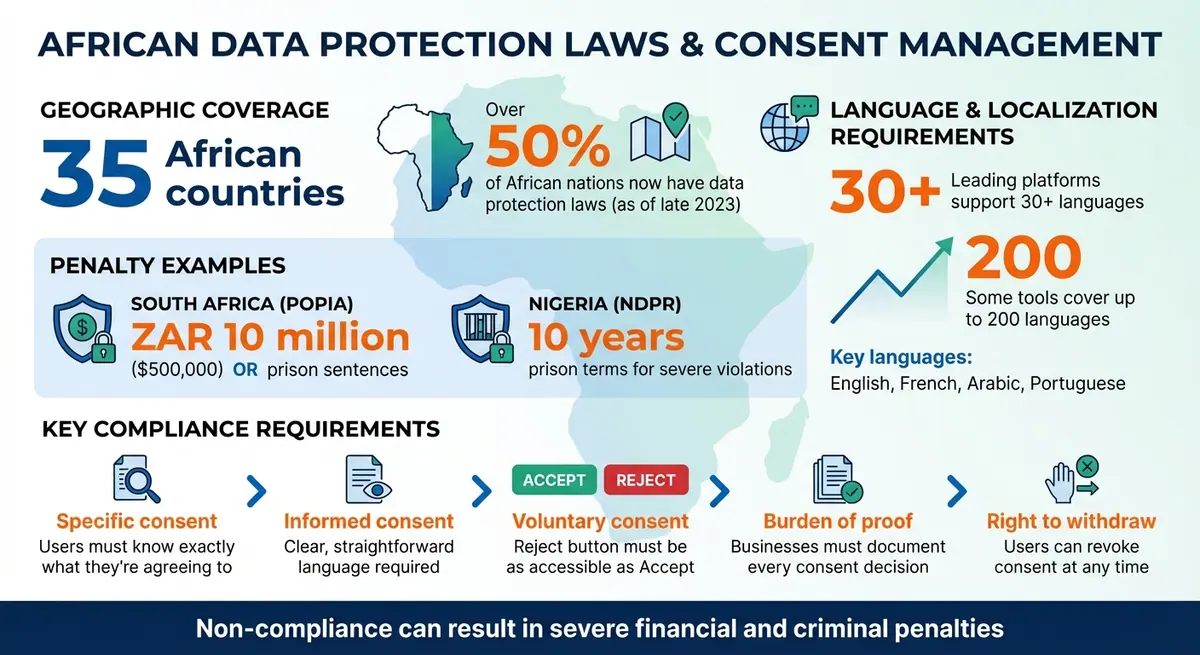
If your business collects data in Africa, you must comply with strict privacy laws. As of late 2023, 35 African countries have enacted data protection regulations, with severe penalties for non-compliance. For example, South Africa's POPIA can impose fines up to ZAR 10 million ($500,000) or even prison sentences for violations. These laws require you to prove users gave explicit, informed consent before processing their data, and managing this manually is nearly impossible.
Consent management tools help businesses comply by:
- Logging user consent with timestamps and proof.
- Blocking trackers until explicit consent is given.
- Allowing users to withdraw consent easily.
African privacy laws, like South Africa's POPIA and Kenya's Data Protection Act, demand specific, informed, and voluntary consent. Tools must also support location-based banners and multiple languages to meet local requirements. Integrating these tools with CRMs and marketing platforms ensures compliance across systems while maintaining user trust.
Businesses can use platforms like Reform to embed consent banners, automate workflows, and document consent records. These features simplify compliance with laws across Africa, helping businesses avoid fines and build user trust.
Africa Data Protection Laws: Compliance Statistics and Penalties
What to Look for in Consent Management Tools
Meeting the requirements of African privacy laws demands advanced consent management tools. As you evaluate your options, focus on features that address the burden of proof, granular control, and technical blocking required by regulations like POPIA and Nigeria's NDPR. Look for tools that can automate compliance and integrate seamlessly with your existing systems. These capabilities are critical for navigating the specific demands of African privacy frameworks.
Location-Based Banners and Language Options
Your consent tool should be able to detect a visitor's location and display the appropriate consent banner based on their jurisdiction. For instance, a visitor from South Africa should see a banner aligned with POPIA, while someone in Nigeria should receive one designed for NDPR compliance. Many modern platforms use IP-based geo-targeting to identify a user's country and automatically serve the correct legal flow.
Language support is another key feature. Africa is incredibly diverse, with thousands of languages spoken across the continent. While English, French, Arabic, and Portuguese are widely used, your tool should be able to detect a user's browser language and display consent banners in the appropriate language. Leading platforms now offer support for over 30 languages, with some even covering up to 200. This not only improves user experience but also ensures that consent is genuinely informed.
Consent Records and Documentation
POPIA places the burden of proof squarely on businesses, meaning you must document every consent decision. If South Africa's Information Regulator audits your organization, you'll need to provide detailed records showing when, how, and for what purposes users gave their consent. A robust consent management tool will handle this automatically.
Your tool should log and securely store detailed consent and revocation records, including timestamps, IP addresses, policy versions, and specific consent choices. These records must be easily accessible and securely stored to ensure you're audit-ready. Equally important is tracking withdrawal requests with the same level of detail. When a user revokes consent, the system should immediately log the event and stop any data processing tied to that consent. This creates a thorough audit trail that demonstrates your commitment to respecting user rights in real time.
Connecting with Marketing and CRM Platforms
Consent management doesn’t operate in isolation - it affects every system that handles user data. Your tool must integrate smoothly with your CRM, email marketing platforms, and analytics tools. This ensures that when a user opts out, their decision is updated across all systems instantly. Without this integration, you risk processing data unlawfully after consent has been withdrawn.
For businesses using form builders like Reform, integration becomes even more critical. When a user fills out a form and consents to specific activities - such as receiving marketing emails or enabling analytics tracking - the consent data should flow directly into your CRM alongside the form submission. This keeps your sales and marketing teams informed about who has opted in and who hasn’t, reducing the risk of compliance violations.
Additionally, your tool should support granular consent preferences across all platforms. This allows only approved activities to proceed, ensuring compliance while maintaining operational efficiency. By integrating granular consent settings into your broader systems, consent management evolves from a simple legal requirement into a key part of your data strategy.
How to Set Up Consent Management Tools with Reform
To align with African privacy regulations, you can use Reform's JavaScript capabilities to implement consent management tools. Reform allows you to embed these tools into your forms and website, ensuring no trackers are activated until users explicitly opt in. Here's how to get started: audit your trackers, integrate consent banners, and monitor user interactions.
Review Your Cookies and Trackers
Before implementing a consent banner, start by auditing your website's cookies and trackers. Use a scanning tool to identify and categorize them as Functional, Statistics, or Marketing.
This step is critical because African privacy laws require users to have specific control over what they consent to, rather than bundling all trackers together[9, 20]. For instance, a user might choose to allow functional cookies while rejecting marketing trackers. You'll also need to document the purpose of each tracker and any third-party associations. This information must be clearly disclosed in your consent banner[9, 20]. Once categorized, you can integrate this data into consent banners using Reform’s custom JavaScript support.
Add Consent Banners Using Reform
Choose a consent management tool that generates a JavaScript snippet compatible with Reform. With Reform's Pro Plan (priced at $35/month or $350/year), you can embed this snippet to auto-block non-essential scripts until users provide explicit consent[10, 17].
To comply with African privacy standards, your consent banner must:
- Provide both "Accept" and "Reject" buttons with equal visibility.
- Use clear, straightforward language to explain each tracker category.
- Include location-based detection to ensure compliance with POPIA for South African visitors[1, 10].
Geo-aware banners are especially important, as over 50% of African nations now have data protection laws. These banners ensure the correct legal framework is presented based on the user's location.
"Most websites will need to comply with some form of consent regulations. A properly configured consent management solution helps keep you out of trouble."
– Leila, Privacy Compliance Specialist, Termly
Track and Improve Consent Rates
Reform offers real-time analytics to help you track how users interact with your consent requests. Use these insights to test and refine your banners. Experiment with different designs, button labels, or placements to improve opt-in rates while staying compliant. For example, compare a two-step banner that explains cookies before offering choices with a single-screen design.
Be mindful of mobile usability as well. A banner optimized for desktop might be difficult to navigate on smaller screens, which could invalidate consent. Ensure the "Reject" button is just as accessible as the "Accept" button, as laws mandate that refusing consent must be as easy as granting it[1, 9]. Avoid using pre-ticked boxes or assuming consent through inaction - these practices violate the requirement for clear affirmative action and can lead to fines of up to ZAR 10 million ($500,000) under POPIA[1, 20].
Next, discover how Reform’s advanced features can simplify consent management even further.
sbb-itb-5f36581
Using Reform Features for Better Consent Management
Reform provides tools that simplify consent management while ensuring compliance with strict data protection laws. By leveraging features like conditional routing, multi-step forms, and CRM integrations, you can streamline consent processes effectively. Here's how to make the most of these features.
Set Up Conditional Workflows Based on Consent
With Reform's conditional routing, you can create user-specific workflows based on their consent choices. For instance, if a user declines consent for marketing purposes, the system can automatically bypass lead enrichment steps or redirect them to a form that collects only essential information. This setup aligns with frameworks like South Africa's POPIA and Kenya's Data Protection Act, which emphasize collecting and processing data solely for agreed-upon purposes.
Reform also supports workflows that allow users to withdraw consent whenever they choose, a right protected under Kenyan law. When users update their preferences, Reform syncs these changes with your CRM, maintaining an audit-ready record of consent.
Build Compliant Multi-Step Forms
Transparency in data collection starts with well-designed forms. Multi-step forms help simplify complex privacy notices by breaking them into smaller, understandable sections. For example, you can display a clear privacy notice upfront before requesting any personal data. This approach meets the "right to be informed" requirement under many African privacy laws.
To meet the need for specific and informed consent, design your forms with separate checkboxes for different processing activities, such as service delivery versus marketing communications. POPIA mandates that consent must be "voluntary, specific and informed", so users should know exactly what they're agreeing to. Reform's conditional logic ensures that integrations with tools like Zapier only activate when users have explicitly opted in.
Send Consent Data to Your CRM
Reform's integration capabilities ensure that consent data is automatically recorded in your CRM. This is crucial for compliance, as regulations like POPIA require proof of consent during audits. Non-compliance can lead to penalties, including fines of up to ZAR 10 million (around $500,000) or even imprisonment for severe violations.
To stay compliant, map each consent checkbox in Reform to a specific CRM property (e.g., "Marketing Opt-in: True"). If a user withdraws consent, the workflow can immediately stop sharing their data, ensuring your operations remain within legal boundaries.
Conclusion
Privacy laws across Africa, such as South Africa's POPIA and Nigeria's NDPR, require organizations to obtain verifiable and explicit consent from users. Non-compliance can lead to severe penalties, including fines of up to $500,000 and prison terms of up to 10 years. It's also the responsibility of organizations to provide proof of valid consent during audits.
Reform simplifies these compliance requirements by automating key aspects of African privacy law adherence. Its conditional workflows ensure data is processed only when users have explicitly opted in. Multi-step forms break down privacy notices into smaller, clear sections, meeting transparency standards. Furthermore, CRM integrations automatically sync user preferences and withdrawal requests, creating a real-time, audit-ready trail of consent records. This not only ensures compliance but also improves operational efficiency.
But compliance isn't just about avoiding penalties - it’s also about creating a better user experience. Reform achieves this with intuitive workflows and forms that limit unnecessary data collection while still improving conversion rates. As Dilyana Simeonova from Consentmo explains:
"Staying compliant with international privacy standards helps build a responsible data practice... reflecting a commitment to following global privacy norms".
With over half of African nations now enforcing data protection laws, Reform's adaptable form logic and automated tracking help your organization stay ahead of legal changes. By combining compliance with user trust and operational effectiveness, Reform ensures you remain prepared for the future without compromising lead quality.
FAQs
What are the consequences of not complying with African privacy laws?
Failing to comply with African privacy laws can result in serious penalties, which vary depending on the country and its specific regulations. For example, South Africa’s Protection of Personal Information Act (POPIA) enforces penalties that may include fines or other legal actions for violations. Similarly, nations like Ghana, Nigeria, and Kenya have implemented their own data protection laws. These laws are backed by enforcement mechanisms that can lead to fines, restrictions on data processing, or additional penalties for businesses that fail to comply.
Many African countries are also aligning their privacy regulations with global standards, such as the General Data Protection Regulation (GDPR). This means organizations operating in the region need to prioritize compliance to meet these growing expectations. As these laws continue to develop, staying informed and proactive is essential to avoid hefty fines or other consequences.
How can consent management tools work with my existing systems?
Consent management tools work by integrating with your existing systems through APIs and built-in platform connections. These tools automate the process of collecting, storing, and managing user consent, helping you stay compliant with privacy laws. For instance, they can include consent banners or pop-ups that interact with backend systems to log user preferences instantly.
Additionally, many of these tools link up with platforms like marketing software, CRM systems, and analytics tools to enforce user choices across all channels. This ensures user preferences are consistently respected and aligned with regional privacy laws, such as South Africa’s POPIA. When businesses effectively implement these tools, they simplify privacy management, meet legal obligations, and foster trust with their users.
Why is it important to customize consent based on location and language?
Customizing consent processes to align with location and language is a smart way to address the diverse legal and societal expectations across African countries. Since privacy laws and practices can differ greatly from one region to another, tailoring consent systems to meet these local standards helps ensure compliance while respecting users' rights.
Providing consent options in a user's native or preferred language makes the process more transparent and easier to understand. This reduces the chances of confusion and ensures users are fully aware of what they’re agreeing to. Beyond meeting legal obligations, this approach builds trust and fosters stronger connections between businesses and their users by showing sensitivity to local norms and preferences.
Related Blog Posts
Get new content delivered straight to your inbox

The Response
Updates on the Reform platform, insights on optimizing conversion rates, and tips to craft forms that convert.




Drive real results with form optimizations
Tested across hundreds of experiments, our strategies deliver a 215% lift in qualified leads for B2B and SaaS companies.
