
.webp)
How Cookieless Tracking Uses Server-Side Events



The shift to cookieless tracking is transforming digital marketing. With browsers like Safari and Firefox blocking third-party cookies and Google Chrome phasing them out since 2024, marketers are facing a 20–30% data loss. Privacy laws like GDPR and CPRA add further challenges, as users increasingly opt out of tracking.
Enter server-side event tracking: a method that replaces browser-dependent tracking with first-party data processed on your own server. This approach improves data reliability, ensures compliance with privacy regulations, and recovers lost conversions. Marketers report up to 100% more purchase events and 10–30% more pageview events using this method.
Here’s the key difference:
- Client-side tracking relies on browser cookies, which are easily blocked or deleted.
- Server-side tracking processes data on your server, bypassing browser restrictions and ad blockers.
While server-side tracking requires more setup and maintenance, it provides more accurate attribution and better control over user data. By prioritizing this shift, businesses can stay ahead in a world without third-party cookies.
1. Client-Side Cookie Tracking
Identity Handling
Client-side tracking works by embedding JavaScript code directly into your website. When a user clicks on an ad, the platform assigns a unique identifier to that click, often referred to as a "Click ID", which is passed through the URL. The JavaScript in the browser captures this identifier and stores it in a first-party cookie on the user's device. This cookie acts as a bridge, linking all subsequent website activity to the original ad, which helps connect your marketing efforts to user behavior.
However, this method has a key limitation: it’s stateless. If cookies are deleted or expire before a conversion happens, the connection between the user’s activity and the marketing source is lost. This is especially problematic for businesses with long sales cycles or B2B customer journeys, where delayed conversions are common. Without this link, accurately measuring a campaign’s success becomes a real challenge.
Data Resilience
Since client-side tracking depends on the browser, it’s vulnerable to disruptions like ad blockers and privacy tools. These can block 5%–10% of traffic, while Safari’s Intelligent Tracking Prevention (ITP) limits tracking cookies to just 7 days. This is a major hurdle for businesses with extended sales cycles or complex customer journeys.
The result? Signal loss - conversions that happen but aren’t recorded. This creates gaps in your data, leading to incomplete ROI analysis. For lead-generation businesses, missing form submissions can break the entire attribution chain, leaving you in the dark about which campaigns are driving revenue weeks or months later.
Privacy and Compliance
Client-side tracking also introduces challenges when it comes to complying with regulations like GDPR and CCPA. These laws require explicit user consent for non-essential cookies and mandate that businesses limit the amount of data collected. The problem is that third-party scripts often collect more information than necessary - like location data and browsing behavior - giving website owners limited control over what gets shared.
Additionally, data sent from the browser to third-party vendors can expose sensitive information such as API keys and personal user data, making it harder to ensure security and transparency. When users decline consent, they vanish from tracking altogether, creating gaps in your data. With 75% of iOS users opting out of tracking after Apple’s iOS 14.5 update in 2021, this issue has become even more pressing for marketers relying on client-side methods.
Lead Generation Workflows
For businesses that rely on forms to collect leads, client-side tracking failures can be especially damaging. Ad blockers, tracking script errors, and delays caused by client-side tag latency (which can reach up to 200 milliseconds) often disrupt the attribution chain, leading to missed lead events. Unlike e-commerce, where a missing purchase is immediately noticeable, a lost lead-generation event can go undetected until it becomes clear that your attribution model isn’t functioning properly.
Switching from client-side to server-side tracking can recover 10% to 25% of these lost lead events. The combination of data loss, compliance risks, and performance issues is driving many marketers to rethink their tracking strategies. These limitations highlight the need for a more reliable alternative, which will be explored in the next section.
2. Server-Side Event Tracking
Identity Handling
Server-side tracking shifts the responsibility of data collection from the user's browser to a server you control. Instead of relying on browser scripts, your server gathers identifiers like Click IDs and stores them securely. This ensures tracking continuity, even if cookies on the user’s side expire or are cleared. By keeping the data on your infrastructure, you create a more reliable tracking system that isn’t dependent on users’ browsers, which can be unpredictable.
With stable identifiers, server-side tracking can seamlessly link user journeys across multiple visits. For example, a form submission can still be tied back to the original ad click, a feature particularly beneficial for B2B companies where long sales cycles often make attribution challenging.
Data Resilience
Building on its strong identity-handling capabilities, server-side tracking also offers greater resilience against data loss. Since the communication happens directly between your server and advertising platforms, this method bypasses common issues like ad blockers or browser restrictions. Tracking requests are treated as first-party interactions, making them less likely to be blocked. As a result, you can recover 10–25% of conversions that might otherwise slip through the cracks.
Additionally, server-side setups are designed to handle errors more effectively. Failed events are queued and retried with exponential backoff, ensuring that no data is lost due to temporary connectivity issues. To prevent duplicate conversions during retries, idempotency keys - unique hashes generated from form data and timestamps - are used to maintain accuracy.
Privacy and Compliance
Server-side tracking aligns well with modern privacy regulations by giving you complete control over the data before it’s shared with third parties. Your server can filter, anonymize, or hash sensitive information, ensuring that personally identifiable details are removed unless they’re absolutely necessary for campaign optimization.
"With server-side tracking, your website collects data first, and you control how much or how little to share with external parties." – Ilkka Särkiö, Senior Product Manager, Supermetrics
This approach simplifies compliance with laws like GDPR and CCPA. By integrating with your Consent Management Platform, your server ensures that data is only forwarded when users have explicitly opted in. Sensitive credentials, such as API keys, remain securely stored on the server, reducing the risk of exposure in browser code and enhancing overall security.
Lead Generation Workflows
The technical benefits of server-side tracking also make for more reliable lead attribution. When a visitor submits a form, your server captures not only the submission but also key metadata, such as UTM parameters and Click IDs, and feeds this data directly into your CRM. This ensures that leads are accurately tracked from the moment they interact with your campaigns.
Later, when that lead converts into a paying customer, your CRM can send a "pathback" event directly to the advertising platform via a server-to-server API. This process attributes revenue to the correct campaign, even if the conversion happens weeks or months after the initial click. For B2B and SaaS companies, this setup makes it easier to measure the true effectiveness of campaigns, focusing on revenue generation instead of merely counting leads. It’s a powerful way to maintain accurate attribution in a cookieless world.
Client-Side vs Server-Side Tracking Explained: Pros and Cons
sbb-itb-5f36581
Pros and Cons
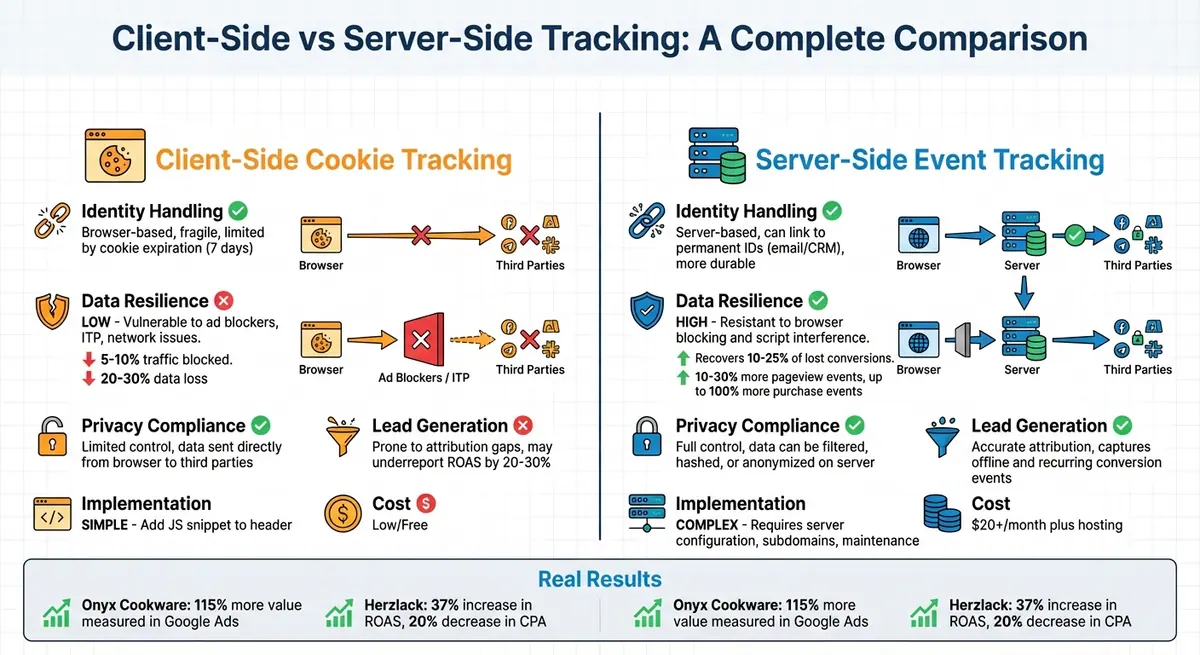
Client-Side vs Server-Side Tracking Comparison
Every tracking method comes with its own set of trade-offs that impact how effectively you can measure campaigns. The right choice depends on your technical capabilities, privacy considerations, and the level of data accuracy you require.
Client-side cookie tracking is straightforward to implement - just add a JavaScript snippet to your website's header, and you're good to go. However, this simplicity comes at a cost. Browser restrictions and ad blockers can result in a 20% to 30% loss of traffic data, making it less reliable.
On the other hand, server-side event tracking addresses many of these issues by processing data through your own infrastructure. This method has shown impressive results, with marketers reporting 10% to 30% more pageview events and up to 100% more purchase events compared to browser-based tracking. However, server-side tracking is more complex. It requires DNS updates, server configuration, and ongoing maintenance, which adds recurring costs. Managed solutions start at around $20 per month, plus additional fees for server hosting.
Here’s how the two methods compare across key features:
| Feature | Client-Side Cookie Tracking | Server-Side Event Tracking |
|---|---|---|
| Identity Handling | Browser-based; fragile; limited by cookie expiration (e.g., 7 days) | Server-based; can link to permanent IDs (e.g., email/CRM); more durable |
| Data Resilience | Low; vulnerable to ad blockers, ITP, and network issues | High; resistant to browser-side blocking and script interference |
| Privacy Compliance | Limited control; data sent directly from browser to third parties | Full control; data can be filtered, hashed, or anonymized on the server |
| Lead Generation | Prone to attribution gaps; may underreport ROAS by 20-30% | Accurate attribution; captures offline and recurring conversion events |
| Implementation | Simple; involves adding a JS snippet to the header | Complex; requires server configuration, subdomains, and maintenance |
These differences can have a real impact on campaign performance. For example, Onyx Cookware used server-side tracking with Stape and Obsidian Digital, enabling them to measure 115% more value in their Google Ads campaigns. Similarly, Herzlack partnered with ZweiDigital and saw a 37% increase in ROAS along with a 20% decrease in CPA, thanks to better data quality achieved through server-side tracking.
Conclusion
The shift from client-side cookies to server-side event tracking is reshaping how data is collected and managed. With 67% of U.S. adults either managing or outright blocking cookies and browsers enforcing stricter policies, server-side tracking emerges as a practical response to these challenges.
The key benefit here is control. By processing data on your own server before sharing it with third-party platforms, you can filter out sensitive information, extend cookie lifespans beyond browser restrictions, and maintain accurate attribution - even when ad blockers are in play. This approach addresses privacy concerns while ensuring you still capture the critical data needed to refine and improve campaigns.
"Server-side tracking fundamentally changes where data processing happens... This shift gives you more control over data collection, reduces your dependence on user browser settings, and provides more consistent data quality."
- Tom Wilkinson, Usercentrics
However, gaining this level of control comes with its own complexities. Server-side tracking demands a more advanced setup, including DNS updates, server configurations, secure hosting, and ongoing maintenance. While it requires technical investment, the payoff is a more reliable and effective tracking system.
To make the most of this approach, start by migrating your most valuable conversion events - like purchases or lead forms - to a server-side framework. Use a Consent Management Platform to ensure user preferences are respected, and set up a custom subdomain to maintain a first-party context. The cookieless future doesn’t mean the end of measurement; it’s an opportunity to build a stronger, more transparent foundation for digital marketing.
FAQs
How does server-side tracking enhance data accuracy and ensure privacy compliance?
Server-side tracking improves data accuracy by handling events directly on your server rather than depending on browser-based scripts. This method reduces data loss that can happen due to ad blockers, cookie restrictions, or browser limitations.
Additionally, it enhances privacy compliance by giving you complete control over the user information shared with third-party services. You can enforce strict consent policies and restrict the sharing of personal data, ensuring your practices align more closely with privacy regulations.
What are the key challenges of switching from client-side to server-side tracking?
Switching from client-side to server-side tracking isn’t exactly a walk in the park. It comes with its fair share of challenges that demand careful planning and execution. One of the biggest hurdles is the technical complexity involved. Setting up a server-side infrastructure means building entirely new systems, writing custom code, and committing to ongoing maintenance. This can quickly drain resources and drive up costs.
Another tricky area is maintaining data accuracy and consistency. Unlike client-side tracking, where browsers automatically handle much of the data collection, server-side tracking requires businesses to explicitly pass information to the server. This shift increases the chances of data gaps or mismatches, which can throw off analytics.
There’s also the potential for latency issues. Server-side systems need to process massive amounts of data, and if they aren’t optimized, they can slow things down. This could negatively affect analytics and even the overall user experience.
And let’s not forget about privacy compliance. While server-side tracking can sidestep some browser restrictions, it introduces new challenges. Businesses must ensure they’re managing user consent properly, securely handling data, and accurately mapping user identifiers to stay within the bounds of privacy laws.
To navigate these challenges, organizations often need to put solid backend systems in place, design clear data structures, and implement reliable consent management frameworks. These steps are essential for maintaining accuracy, security, and compliance in a world that’s moving away from cookies.
How does server-side tracking improve lead generation and conversion attribution?
Server-side tracking processes user events through your backend rather than relying on the browser. This method bypasses challenges like ad blockers, third-party cookie restrictions, or browser script failures, ensuring that critical actions - such as form submissions, demo requests, or trial sign-ups - are consistently recorded. For businesses focused on generating leads, this translates to fewer missed opportunities and a more accurate picture of the sales funnel.
Another advantage is its ability to improve conversion attribution. By linking touchpoints throughout a customer’s journey - from the first interaction to the final action - you can better measure metrics like cost-per-lead (CPL) and return-on-ad-spend (ROAS). This clarity allows for smarter budget distribution, focusing on the channels delivering the strongest results. On top of that, server-side tracking boosts data security and lets you add valuable context to leads before syncing them with your CRM. In a world moving away from cookies, it’s an essential tool for dependable lead generation and actionable marketing insights.
Related Blog Posts
Get new content delivered straight to your inbox

The Response
Updates on the Reform platform, insights on optimizing conversion rates, and tips to craft forms that convert.




Drive real results with form optimizations
Tested across hundreds of experiments, our strategies deliver a 215% lift in qualified leads for B2B and SaaS companies.
