
.webp)
How Hotels Handle Cross-Border Data Transfers



Hotels frequently transfer guest data across borders to provide personalized services, manage loyalty programs, and streamline global operations. However, these transfers face strict privacy laws in over 130 countries, including the EU’s GDPR, China’s PIPL, and Brazil’s LGPD. Non-compliance risks severe penalties, such as fines of up to €20 million or 4% of global annual revenue under GDPR.
Here’s what you need to know:
- Why Data Transfers Happen: Guest preferences, payment processing, and global HR functions require centralized data sharing.
- Privacy Law Challenges: Laws vary by country. For example, GDPR mandates adequacy standards, while PIPL requires local storage and security checks.
- Security Risks: Data breaches and transfers to restricted nations pose significant threats.
- Solutions: Hotels use Standard Contractual Clauses (SCCs), local data storage, and privacy-compliant tools to meet legal requirements.
To avoid penalties and protect guest trust, hotels must prioritize compliance, map data flows, and adopt secure technologies.
Personal Data & the Airline Industry: the Challenge of Data Transfer
sbb-itb-5f36581
Main Challenges Hotels Face with International Data Transfers
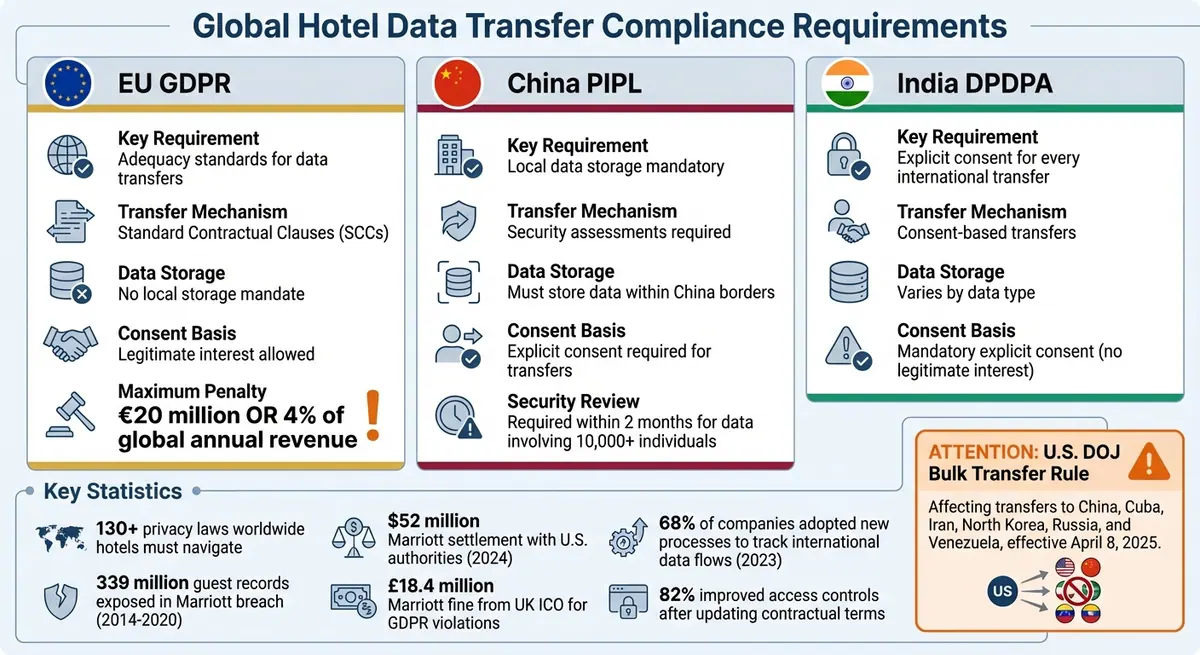
Global Hotel Data Transfer Compliance Requirements by Region
Transferring guest data across borders comes with a host of compliance, security, and operational challenges. For hotels, these issues can lead to significant fines, data breaches, and logistical headaches. The root of these problems lies in differing legal frameworks, increased risks, and complex operational demands.
Conflicting Privacy Laws Between Countries
Privacy regulations vary widely across the globe, and hotels must juggle these differences. For instance, China's PIPL requires local data storage and security checks before any data leaves the country. On the other hand, the EU's GDPR only permits transfers to countries with "adequate" data protection, meaning hotels often need intricate legal arrangements to comply.
India's DPDPA adds another layer of complexity by mandating explicit consent for every international transfer, while other countries allow transfers based on "legitimate interest". This creates a tangled web of over 130 privacy laws worldwide, forcing hotels to adopt region-specific strategies. This approach often clashes with the seamless, centralized systems that guests expect for loyalty programs and reservations. And as if navigating these legal differences wasn’t enough, security risks further complicate matters.
Security Risks When Moving Data Internationally
Data becomes more vulnerable when it crosses borders. Hotels often rely on third-party providers for data handling, which increases the risk of breaches during transit. If these providers lack proper security measures, sensitive information like payment details, IDs, and biometrics could fall into the wrong hands.
The risks are even higher when data is sent to "countries of concern" as identified by the U.S. government - places like China, Cuba, Iran, North Korea, Russia, and Venezuela. Starting April 8, 2025, the U.S. Department of Justice's "Bulk Transfer Rule" imposes strict controls on sensitive personal data sent to these nations. Ignoring these rules could result in severe penalties and even expose guests to blackmail, surveillance, or profiling by foreign entities.
"Access to Americans' bulk sensitive personal data or United States Government-related data increases the ability of countries of concern to engage in a wide range of malicious activities." - Executive Order 14117
Technical and Operational Difficulties
Beyond legal and security concerns, the technical and operational challenges are immense. Hotels must meticulously track how data flows through their systems, including Property Management Systems (PMS), payment processors, and third-party tools. This data mapping is critical for compliance but can be both time-consuming and expensive.
To stay compliant, hotels often rely on Transfer Impact Assessments (TIAs) and assemble cross-functional teams that include privacy experts, cybersecurity professionals, and procurement specialists. A high-profile example occurred in 2025 when a hotel subsidiary in Shanghai was fined for sending customer data to its French headquarters without proper transfer mechanisms. The violation was uncovered during a data breach investigation. That same year, TikTok faced scrutiny and fines from the Irish Data Protection Commission for its data transfers to China, highlighting the increasing regulatory focus on this issue.
"Companies are adapting rapidly, but many are doing so in a fog. At this stage, there is a lot of guesswork, and that's a shaky foundation for major potential restructuring in governance and compliance changes." - Nigel Cory, Director, Crowell Global Advisors
Data localization laws also force hotels to invest in local data centers instead of using global systems, significantly increasing costs. For example, two Chinese e-commerce platforms were recently fined $930,000 and $1.43 million in South Korea for unlawful data transfers. For hotels, the takeaway is clear: mishandling cross-border data transfers can be financially catastrophic.
How Hotels Can Manage Cross-Border Data Transfers
Hotels today face challenges in transferring guest data across borders while ensuring privacy and legal compliance. To address this, they must choose strategies based on where the data is going, its sensitivity, and the regulations in play. By tackling these issues head-on, hotels can adopt effective solutions to navigate the complexities of cross-border data transfers.
Using Standard Contractual Clauses
Standard Contractual Clauses (SCCs) are pre-approved legal agreements that allow hotels to transfer personal data outside the European Economic Area while remaining compliant with GDPR rules. These templates, approved by the European Commission, are tailored to various business relationships.
The 2021 EU SCCs introduced modules for different scenarios. For example:
- Module 2 (Controller-to-Processor): Common for hotels outsourcing data to third-party vendors, like cloud providers or property management systems.
- Module 1 (Controller-to-Controller): Useful for sharing data between independent companies or in partnerships.
If risks are identified during assessments, hotels should implement additional measures, such as end-to-end encryption or pseudonymization. For transfers to the U.S., it’s essential to check if the recipient is certified under the EU–US Data Privacy Framework.
A case in point: In August 2023, Uber was fined €290 million by the Dutch Data Protection Authority for mishandling data transfers from Europe to the U.S.. This highlights how crucial proper SCC implementation is.
"Security failures often trace back to ambiguous contractual terms between exporters and importers."
- Data Protection Authority Report, 2024
Hotels should map all international data flows, covering cloud storage, CRM systems, and booking platforms, and pick the right SCC module for each. Features like the "Docking Clause" make it easier to add new vendors or properties to existing agreements without drafting entirely new contracts. Alternatively, hotels can opt for local data storage to ensure compliance.
Storing Data Within Country Borders
Storing guest data within the country of origin can sometimes be legally required or simply a way to simplify compliance. For example, under China’s Personal Information Protection Law (PIPL), certain data processors must store data locally and undergo security assessments for "Important Data". If a hotel in China holds such data, it must apply for a security review within two months, especially if the data involves over 10,000 individuals.
Hotels can use "Data Residency-as-a-Service" platforms to securely store guest profiles, payment details, and employee records locally while maintaining a global system. These platforms often employ web proxies to redact sensitive information, ensuring global operations without violating local storage regulations.
"Data residency is a strategic imperative for modern hospitality."
An exception exists in China: data transfers necessary for contract performance (e.g., processing a booking) may be allowed without standard mechanisms. However, authorities like the Cyberspace Administration of China (CAC) stress that such exceptions should be narrowly interpreted. To further safeguard data, hotels should prioritize privacy-compliant tools from the start.
Using Privacy-Compliant Data Collection Tools
The tools hotels use to gather guest data play a significant role in maintaining compliance. Privacy-focused platforms should secure data from collection onward, not just during transfers. Key features include:
- End-to-end encryption: Ensures data remains unreadable even if intercepted.
- Pseudonymization: Protects identities by replacing sensitive details with placeholders.
- Zero-knowledge architecture: Prevents unauthorized access.
Additional features like explicit opt-in options, age verification for guardian consent, and automated "right-to-be-forgotten" processes help hotels meet privacy standards. Platforms such as Reform offer these capabilities, including email validation, spam prevention, and seamless CRM integration. These tools guide guests through consent processes with clear, multi-step forms.
Hotels should also select tools that integrate with property management and reservation systems. Automated data mapping features help track sensitive information, such as geolocation, biometric data, and financial records, as it moves to external vendors. A 2023 survey found that 68% of companies adopted new processes to track international data flows, and 82% improved access controls after updating contractual terms.
"The era of treating cross-border data transfers as routine business operations has ended, and data governance has been solidly recognized by the U.S. government as a strategic imperative."
Before implementing any solution, hotels should conduct a Transfer Impact Assessment to confirm that the recipient country’s laws provide GDPR-equivalent protections. Privacy tools should also include vendor screening features to avoid transfers to restricted entities, especially under new regulations like the U.S. DOJ's Bulk Transfer Rule, effective April 2025.
Examples of Hotel Data Transfer Challenges
These real-world cases shed light on compliance missteps and how technology can be leveraged to address them. Below, we explore two examples: one focusing on the financial and operational fallout of non-compliance, and another showcasing the role of technology in meeting regulatory demands.
Example 1: Penalties for Improper Data Transfers
Marriott International faced a costly lesson in compliance failure. In October 2024, the company agreed to a $52 million settlement with 50 U.S. attorneys general and the Federal Trade Commission. This settlement stemmed from data breaches occurring between 2014 and 2020, which exposed 339 million guest records worldwide. Among the compromised data were over 5 million unencrypted passport numbers, all linked to Starwood's reservation system - a system Marriott acquired in 2016, two years after it had already been breached.
The UK Information Commissioner's Office (ICO) also investigated the breach's impact on EU member states and fined Marriott £18.4 million ($23.8 million) in October 2020 for failing to comply with GDPR regulations. The ICO determined Marriott had not implemented adequate technical or organizational safeguards to protect guest data.
"Companies have an obligation to take reasonable measures to protect consumer data security. Marriott clearly failed to do that."
- William Tong, Connecticut Attorney General
As part of the fallout, Marriott is now required to undergo independent cybersecurity assessments for the next 20 years. Additionally, the company has been tasked with implementing a zero-trust architecture, ensuring continuous verification before granting access to sensitive systems. These measures underscore how compliance failures can lead to both financial penalties and long-term operational changes.
Example 2: Using Technology to Meet Compliance Requirements
In the wake of these settlements, Marriott turned to technology to address compliance gaps. The company introduced an online portal for Marriott Bonvoy members, enabling guests to report suspicious activity and request the deletion of their personal data. Marriott also implemented automated data retention systems to ensure guest information is removed once it is no longer needed.
A separate case in September 2024, handled by the Guangzhou Internet Court, provided further clarity on cross-border data transfers under China's PIPL. A French-based hotel group was found to have violated PIPL by transferring a Chinese customer's data - such as name, phone number, and email - to third parties for marketing without obtaining "separate consent." While the court ruled that transferring data necessary for bookings (to Myanmar and France for reservation purposes) was permissible, the marketing-related transfers were deemed illegal. As a result, the hotel was ordered to delete the data, issue a private apology, and cover CN¥20,000 (approximately $3,000) in legal and translation costs.
This case clarified that while data transfers essential for services like bookings and loyalty memberships do not require separate consent, marketing-related transfers do. Hotels operating in China have since begun implementing consent management systems within their booking platforms to capture the necessary permissions, reducing the risk of similar penalties.
Conclusion
Cross-border data transfers have evolved from routine tasks into highly regulated processes demanding constant attention. Hotels now navigate a maze of global privacy laws, each with its own rules for consent, storage, and security. The financial risks are steep - violations of regulations like GDPR can result in fines reaching up to €20 million or 4% of global annual revenue.
To stay ahead, hotels need to focus on three main areas: precise data mapping, strong security measures (such as SSL encryption and regular system updates), and clear, transparent privacy policies. As Ashish Lal from QloApps aptly puts it:
"Data privacy isn't just about avoiding fines. It's about building trust by showing guests that their personal information is safe with you".
Technology has become a cornerstone in managing compliance. Many hotels are turning to tools like automated consent management systems, data residency solutions to ensure compliance with local storage requirements, and real-time monitoring to track data flows. These tools do more than meet legal obligations - they help hotels gain a competitive edge by boosting direct bookings and fostering guest loyalty. This growing reliance on technology is setting the stage for even stricter regulations on the horizon.
Looking beyond 2026, the regulatory landscape is expected to demand tighter limits on tracking, stricter data minimization practices, and greater accountability for third-party vendors. Adapting to these changes will require hotels to strengthen their data governance strategies. This includes regular staff training, rigorous vendor management, and embedding privacy-by-design principles into all aspects of their operations.
The industry's approach to data privacy has shifted significantly, reflecting a deeper strategic focus. What was once a technical formality has become a critical business priority, influencing guest relationships and overall operational success. Hotels that view privacy as a core business value, rather than just a compliance requirement, are positioning themselves to succeed in an increasingly regulated world.
FAQs
What data counts as a cross-border transfer for hotels?
Cross-border transfers for hotels involve handling guest personal data - like names, payment information, or identification details - across national or regional borders. These transfers must comply with varying data residency and privacy laws depending on the location.
When do hotels need guest consent to transfer data internationally?
Hotels must secure guest consent for international data transfers when required by privacy laws such as GDPR. GDPR specifically mandates explicit consent, ensuring guests are fully informed about how and where their data is being shared. Similar regulations, like CCPA and PDPB, also stress the importance of transparency and obtaining clear permission before transferring personal information across borders.
What steps should a hotel take before using an overseas vendor?
When working with vendors abroad, hotels need to take specific precautions to ensure data security and regulatory compliance. Here’s a breakdown of the key steps:
- Check Data Transfer Laws: Understand the vendor's local regulations, especially any restrictions on cross-border data transfers or localization requirements.
- Obtain Guest Consent: Make sure guests are aware of and agree to any transfer of their personal data to another country.
- Confirm Regulatory Compliance: Verify that the vendor complies with relevant laws, such as GDPR or CCPA, to avoid legal complications.
- Evaluate Vendor Security: Ensure the vendor has strong data protection protocols to safeguard sensitive information.
- Define Contractual Terms: Clearly outline responsibilities for data handling and compliance in the contract to mitigate risks.
By addressing these steps, hotels can better protect guest data and maintain trust while collaborating with overseas vendors.
Related Blog Posts
Get new content delivered straight to your inbox

The Response
Updates on the Reform platform, insights on optimizing conversion rates, and tips to craft forms that convert.



Drive real results with form optimizations
Tested across hundreds of experiments, our strategies deliver a 215% lift in qualified leads for B2B and SaaS companies.
