
.webp)
Data Sharing Compliance: Reporting Tips


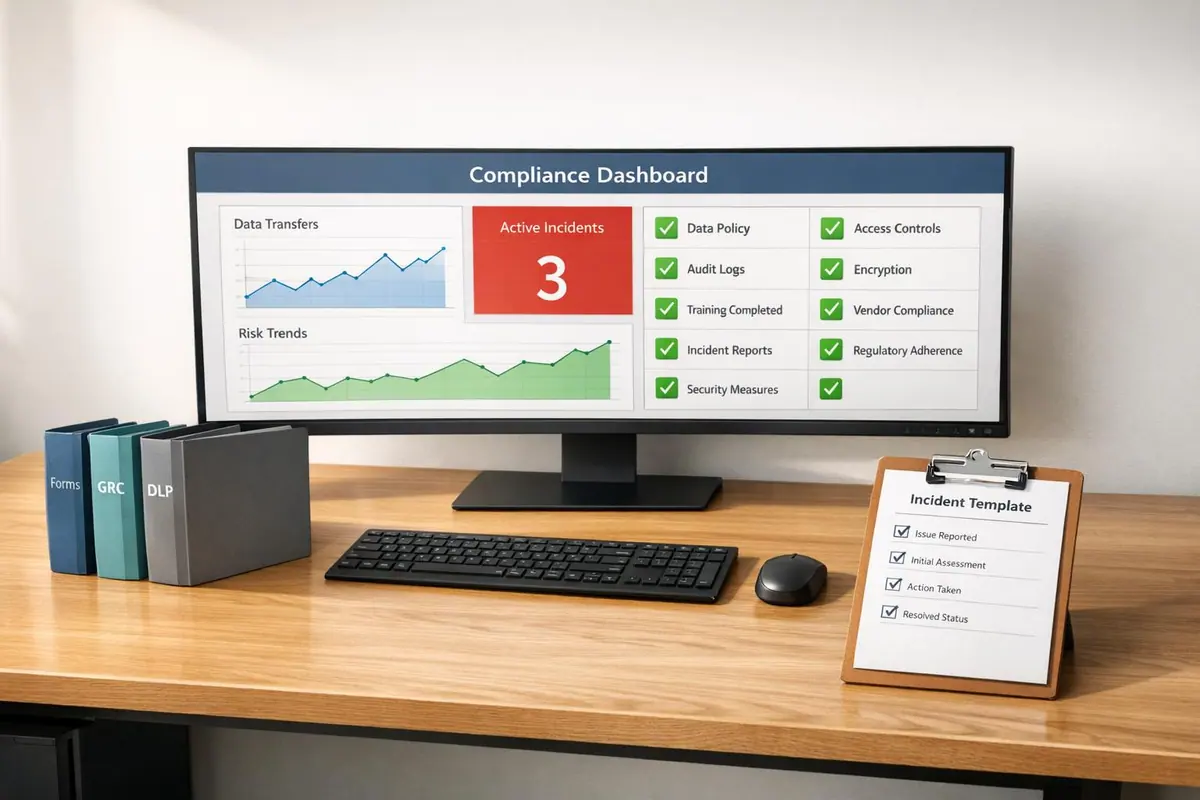
Data sharing compliance is non-negotiable for protecting your business and maintaining trust. Without effective reporting processes, gaps can lead to regulatory fines, operational risks, and lost consumer confidence. Here’s how to stay compliant:
- Use tools like Reform to simplify data collection with no-code forms, conditional routing, and integrations with existing systems.
- Centralize compliance efforts with Governance, Risk, and Compliance (GRC) platforms that automate evidence collection, align controls across multiple regulations, and save time on audits.
- Deploy automated DLP solutions to monitor and secure data in motion, reducing risks of breaches and creating audit-ready logs.
- Standardize incident reporting with templates that ensure consistent documentation of breaches and regulatory notifications.
- Leverage real-time dashboards to track compliance metrics, identify risks, and make informed decisions quickly.
Fines under regulations like GDPR, HIPAA, and CCPA can reach millions. Adopting structured processes and reliable tools is critical to avoid penalties and ensure accountability.
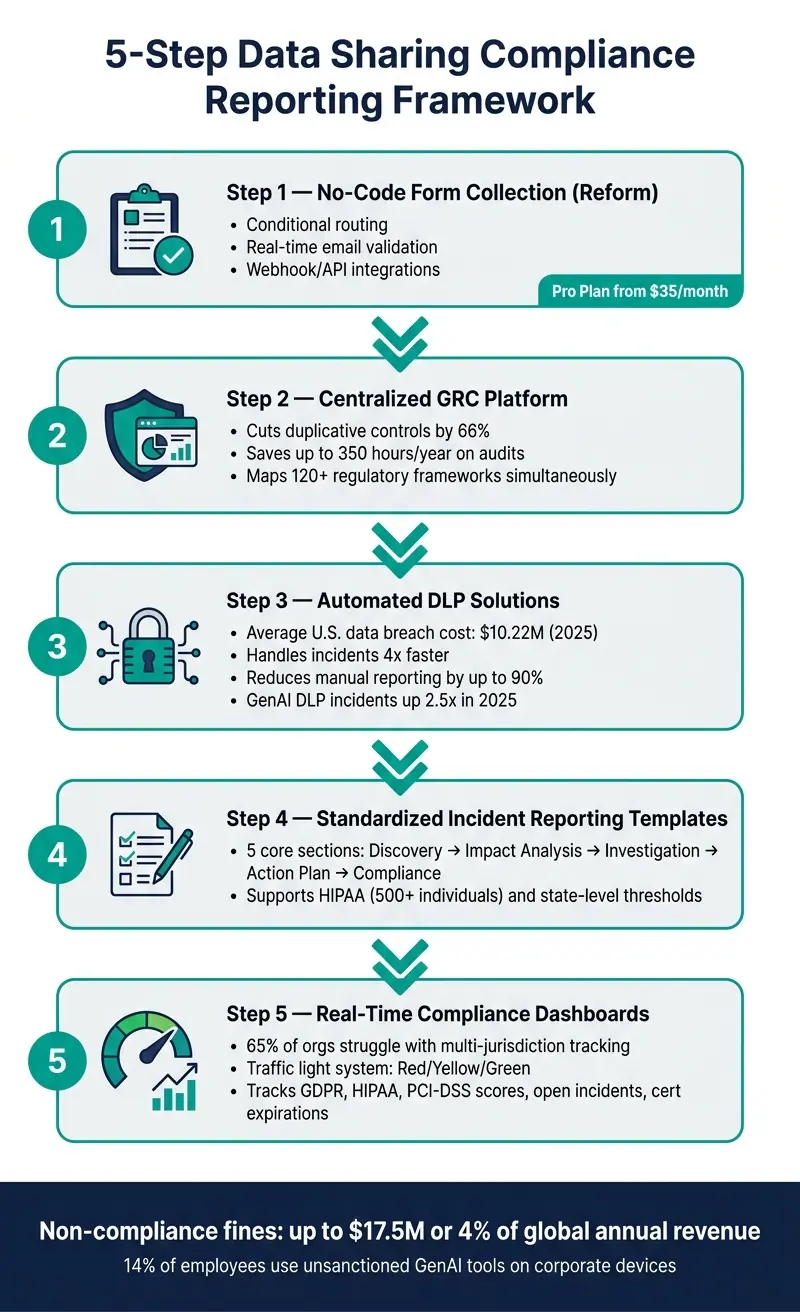
5-Step Data Sharing Compliance Reporting Framework
Data Sharing in Life Sciences: Best Practices for Compliance & Collaboration
sbb-itb-5f36581
1. Reform: A No-Code Form Builder for Compliance Reporting
Creating compliance forms the old-fashioned way often slows down workflows, requiring developer assistance and constant upkeep. Reform eliminates that hassle. Now, compliance officers and legal teams can design, launch, and update forms independently - no coding skills needed. In fast-paced environments, the ability to deploy forms instantly is crucial, and Reform makes this process even smoother with conditional routing.
What sets Reform apart in compliance workflows is its conditional routing feature. This ensures high-risk vendor data requests are automatically flagged and sent to your legal team, while routine internal queries are directed to a standard review queue. This system helps ensure no critical issues are buried in a crowded inbox.
For more complex compliance tasks, like vendor risk assessments or data subject access requests, Reform offers features such as the "Finish Later" option and abandoned submission tracking. These tools capture partial submissions, ensuring incomplete reports don’t leave gaps in your audit trail.
When it comes to integration, Reform connects seamlessly with CRMs and internal tools through Webhooks and APIs. This means compliance data flows directly into your existing governance, risk, and compliance (GRC) systems - no more manual exports or tedious copy-pasting. Plus, with real-time email validation and spam filtering, you can trust the data you receive is accurate and tied to a real, contactable person.
"Reform is a simple, fast forms solution. A no-brainer to reach for anytime I need to (quickly!) throw up a form without hacking around with code. I like that it's customizable too." - Brian Casel, Founder, ZipMessage
For teams needing advanced features, Reform's Pro Plan ($35/month) includes file uploads, draft saving, incomplete response tracking, and custom CSS. These tools are especially helpful for compliance teams that need to collect and manage supporting documents alongside form submissions.
2. Centralized Governance, Risk, and Compliance (GRC) Tools
After streamlining data collection, centralized GRC tools become the go-to resource for managing risks, controls, policies, and audit evidence in one place. This unified setup simplifies compliance reporting by making it automated and integrated.
Automation takes center stage. GRC platforms take over repetitive tasks like evidence collection, control testing, task assignments, and approval workflows. This approach eliminates manual effort, cutting down duplicative controls by 66% and saving teams up to 350 hours annually on audit prep. Tools such as ServiceNow GRC and Workiva can be connected via APIs to automatically gather evidence from IT, financial, and sustainability systems. For tech-heavy teams, platforms like Sprinto integrate directly into development tools like GitHub, AWS, and Jira, ensuring that evidence is captured in real time without disrupting workflows. Before choosing a platform, it’s essential to match your entire tech stack with the vendor’s integration options to prevent any manual data gaps.
"The audit trail, inherent control environment, and change management functionality are invaluable. Being able to see from an audit perspective what has changed, when it's changed, and having a built-in workflow to approve that change is really everything." - Executive User, Workiva Platform
Another critical feature to consider is cross-framework control mapping. Advanced platforms can align controls with over 120 regulatory frameworks simultaneously. This means one control can meet the requirements for SOC 2, GDPR, HIPAA, and ISO 27001 at the same time. For organizations juggling multiple state or international regulations, this feature is a game changer, significantly reducing redundant work.
3. Automated Data Loss Prevention (DLP) Solutions
Automated DLP solutions work hand-in-hand with centralized GRC tools to protect how data moves and reduce the risk of leaks. By focusing on securing data in motion, these tools help ensure all data states - in use, in motion, and at rest - are monitored and protected effectively.
DLP tools are designed to automatically intervene when specific rules are triggered. For example, they can block unauthorized transfers, encrypt sensitive attachments, or quarantine flagged documents. These automated actions are essential, especially considering that the average cost of a data breach in the U.S. reached $10.22 million in 2025, and one-third of organizations have already faced regulatory fines due to breaches. Each automated action is logged, creating a detailed and auditable record, which is invaluable for compliance reporting.
To make compliance easier, many DLP solutions come with pre-configured templates for regulations like GDPR, HIPAA, and PCI DSS. These templates allow organizations to align DLP rules with regulatory requirements quickly. This is particularly critical as AI-related risks grow. For instance, incidents involving generative AI (GenAI) surged more than 2.5 times in early 2025, now making up 14% of all DLP incidents in SaaS traffic. As Palo Alto Networks highlighted:
"So far in 2025, we're seeing the total number of GenAI-related DLP incidents increase more than 2.5X, now comprising 14% of all DLP incidents across our SaaS traffic."
Automated workflows in DLP solutions significantly enhance efficiency. They can handle incidents four times faster while reducing the need for manual reporting by as much as 90%. Each blocked action, override, or quarantined file is automatically documented, creating a streamlined audit trail. Pairing DLP tools with a SIEM system takes this a step further by correlating data movement alerts with other security events, enabling quicker and more precise responses. Additionally, simulation modes allow teams to test new policies without disrupting legitimate operations, making audits and policy adjustments much smoother.
4. Incident Reporting Templates and Frameworks
Even with automation and real-time analytics in place, clear and consistent incident reporting remains a cornerstone of effective compliance.
When a data-sharing incident occurs, standardized templates play a pivotal role in ensuring all critical details are documented accurately and consistently. Lenny Zeltser, Chief Information Security Officer at Axonius, emphasizes this point:
"Preparation also includes creating a template that the team can use as the basis for the incident report, which is critical to ensuring that the incident is handled well."
A well-designed template generally includes five key sections:
- Incident Discovery: Collects basic details like the reporter's name, the date and time of the incident, and a unique reference ID.
- Impact Analysis: Outlines the types of data affected, the systems involved, and the level of risk posed.
- Investigation: Summarizes the root cause, key findings, and assigns responsibility to an investigator.
- Action Plan: Details containment steps, assigns tasks to specific individuals, and sets deadlines for resolution.
- Compliance: Tracks notifications to regulatory bodies, legal reviews, and the final resolution date.
These elements work hand-in-hand with automated systems, ensuring every incident is documented thoroughly and efficiently.
Templates should be adaptable to various incident types and regulatory requirements. For example, HIPAA mandates breach reporting for incidents affecting over 500 individuals, while Alabama sets its threshold at 1,000 individuals. Templates also need fields for the specific type of compromised data, such as Social Security numbers, protected health information (PHI), or location details.
Dynamic placeholders can simplify the process by auto-filling details from internal systems, minimizing errors and speeding up the reporting workflow. This approach aligns with earlier integrations of real-time dashboards, creating a seamless compliance process. Many organizations take it a step further by linking their templates with tools like Slack, Trello, or Airtable through automation platforms. This ensures incident data is automatically routed to the right team members.
To wrap up, each report should include the submitter's signature and undergo a formal administrative review to ensure accountability and completeness .
5. Real-Time Compliance Dashboards and Analytics
Real-time dashboards provide a dynamic, up-to-the-minute view of your compliance status. Once incident reports and templates are in place, these dashboards help identify potential compliance issues before they escalate. Unlike static reports that quickly become outdated, a compliance dashboard continuously pulls data from internal systems, turning raw information into meaningful insights across various departments.
"A compliance dashboard is the single screen that transforms compliance from a black box into visible, measurable, actionable operations data." - FileFlo
These dashboards work by integrating data from systems like ERP, CRM, HR, and finance through APIs, breaking down the silos that often make managing compliance across departments a challenge. Research shows that 65% of organizations struggle with tracking compliance across multiple jurisdictions. A centralized dashboard solves this by consolidating data from multiple sources into one cohesive view.
The key to an effective dashboard is focusing on actionable metrics rather than overwhelming users with data. For instance, displaying "12 employees with compliance gaps" is far more practical than simply listing "250 employees in the system." Similarly, highlighting "7 alerts unresolved after 14+ days" provides a sense of urgency, while "100 alerts sent this month" offers little actionable value. Visual aids, such as a traffic light system - red for critical issues, yellow for pending tasks, and green for compliant areas - make it easy to quickly identify where attention is needed.
Your dashboard should highlight essential metrics like compliance scores by regulation (e.g., GDPR, HIPAA, PCI-DSS), open incidents categorized by severity, certification expiration timelines (e.g., 30, 60, or 90 days), and average resolution times. Role-based views can further enhance usability: executives may need a high-level summary of risks, while compliance managers benefit from detailed insights and drill-down capabilities to identify root causes.
"Static compliance reports can't keep up with fast-moving deployments. A real-time dashboard aligns control monitoring with the pace of modern engineering." - Hoop.dev
For industries operating under strict regulations, real-time updates are essential. They ensure that critical insights are delivered to the right people at the right time, enabling faster and more informed decision-making.
Conclusion
Ensuring compliance with data-sharing regulations isn't something you can check off a list and forget about. It’s an ongoing responsibility that demands structured workflows, effective tools, and a team fully committed to safeguarding sensitive information. As Integrate.io aptly states: "Treat data compliance as a continuous process in constant need of adjustments and refinements."
The tools highlighted earlier - whether centralized GRC platforms, automated DLP systems, or real-time dashboards - are most effective when they work together. Even the best systems can fail if the data they rely on is incomplete or inconsistent. Platforms like Reform assist compliance teams by streamlining data collection through multi-step forms with real-time validation. These seamless integrations reduce manual data entry, ensuring well-organized, accurate information from the start. This kind of connected approach is essential, especially as the consequences of compliance missteps grow more severe.
The stakes couldn’t be higher. Violating basic data processing regulations can lead to fines as steep as $17.5 million or 4% of total global annual revenue, whichever is greater. To make matters worse, a recent study revealed that 14% of employees use generative AI tools on corporate devices via unsanctioned logins. These habits introduce new compliance risks that traditional, periodic audits simply can’t catch in time.
"Data compliance is more than just a regulatory requirement - it's a critical component of maintaining consumer trust and protecting your business." - Donal Tobin, Integrate.io
The way forward is clear: embrace a dynamic compliance strategy. This involves conducting regular internal audits (at least once a year), updating reporting templates to align with evolving regulations, and fostering a company-wide understanding of compliance responsibilities. While automation can handle much of the workload, a strong culture of compliance is what keeps these practices effective between audits.
FAQs
What should a data-sharing incident report include?
A data-sharing incident report needs to deliver a clear, straightforward account of the event. Be sure to include key details like the date, time, and location. It’s also important to document the names and roles of everyone involved, gather witness statements, and note any injuries, property damage, or potential hazards. Stick to the facts and ensure the report covers all relevant information to aid in compliance and resolution efforts.
How do I connect compliance forms to my GRC tools without manual work?
To link compliance forms with your GRC tools effortlessly, automated data integration and curation are key. Using no-code form builders can simplify the process of gathering data, directing it appropriately, and integrating it into your GRC systems. These tools often come with features like conditional routing, real-time analytics, and APIs, which allow for smooth data transfer, cutting down on manual work while maintaining compliance and improving efficiency.
Which compliance metrics should a real-time dashboard track?
A real-time dashboard is essential for keeping track of key compliance metrics. These include privacy management activities, risk mitigation efforts, and evidence of ongoing compliance. By monitoring these areas, organizations can showcase their commitment to accountability and quickly spot potential violations. Early detection helps minimize the chance of issues escalating into larger problems.
Related Blog Posts
Get new content delivered straight to your inbox

The Response
Updates on the Reform platform, insights on optimizing conversion rates, and tips to craft forms that convert.



Drive real results with form optimizations
Tested across hundreds of experiments, our strategies deliver a 215% lift in qualified leads for B2B and SaaS companies.
