
.webp)
Developing Economies vs. Data Privacy: A Comparison



Data privacy laws vary widely between developed and developing nations, reflecting differences in priorities, resources, and enforcement capabilities. Here's a quick breakdown:
- Developed Nations: Countries like those in the EU focus on individual rights, with stringent regulations like GDPR. These laws emphasize transparency, user consent, and strong enforcement through well-funded regulators. For instance, GDPR violations can result in fines up to 4% of global revenue.
- Developing Economies: Emerging markets, such as India and many African nations, prioritize economic growth and digitization. Laws like India’s DPDP Act take a "light-touch" approach to reduce compliance costs, but enforcement is often weak due to limited funding and resources.
Key Challenges:
- Enforcement Gaps: Developing nations struggle with limited budgets and staff for regulatory agencies. For example, African regulators operate on a median budget of $500,000, compared to $58 million in North America.
- State Exemptions: Broad exemptions for government agencies are common in developing nations, making enforcement inconsistent.
- Cross-Border Data Transfers: Developed nations use mechanisms like Standard Contractual Clauses (SCCs) for global data flows, while many developing countries enforce strict data localization rules, increasing costs for businesses.
Quick Comparison
| Feature | Developed Nations (e.g., EU) | Developing Economies (e.g., India, Africa) |
|---|---|---|
| Focus | Individual rights | Economic growth, digitization |
| Enforcement Resources | High (e.g., $58M budget in NA) | Low (e.g., $500k budget in Africa) |
| State Exemptions | Narrow | Broad |
| Data Transfers | SCCs, adequacy decisions | Localization rules, blacklists |
Businesses must navigate these differences by integrating compliance into their systems, balancing privacy with operational needs, and staying informed about regional enforcement trends. Treating privacy as a core operational priority helps build trust and ensures smoother global operations.
Data Privacy Laws: Progress and Differences
Major Laws in Developing Economies
Over the past few years, developing nations have taken meaningful steps toward establishing data privacy regulations. By December 2023, 35 African countries had implemented data protection laws, with 13 of those laws introduced in just the last five years. Brazil's LGPD and India's DPDP Act of 2023 are prime examples of how emerging markets are shaping their own privacy frameworks.
However, these laws often diverge significantly from the regulatory philosophies seen in Western countries. For instance, India's DPDP Act intentionally omitted several elements of the GDPR, such as the authority for regulators to create detailed codes of conduct and the requirement for data portability. This approach, often labeled as "light-touch" regulation, aims to lower compliance costs while fostering innovation in fields like artificial intelligence and digital infrastructure. Similarly, Nigeria introduced its Nigeria Data Protection Act (NDPA) in June 2023, which established the Nigeria Data Protection Commission as an independent regulatory body.
In many African countries, the push for data protection laws has been closely tied to broader government digitization efforts, such as implementing digital ID systems or managing social welfare programs. However, these laws often face challenges in execution, remaining more theoretical than practical.
"In most of these countries, data protection laws are still in the teething stage, and people are currently experiencing the impact of challenges stemming from early implementation efforts." - Bridget Andere and Megan Kathure, Access Now
Another notable feature of data privacy frameworks in developing economies is the broad exemptions granted to state agencies, particularly for reasons such as national security, investigations, or delivering government services. These exemptions often create enforcement challenges, which will be discussed in the next section. In contrast, developed nations tend to adopt stricter, more resource-intensive regulatory models.
Data Privacy Laws in Developed Nations
In developed nations, data privacy frameworks are typically more stringent and comprehensive, offering a sharp contrast to the innovation-focused approaches seen in many emerging markets. The European Union's General Data Protection Regulation (GDPR), which became effective in May 2018, is widely regarded as the global standard for data privacy. This regulation emphasizes privacy by design and grants significant authority to independent regulators. A key feature of the GDPR is its extraterritorial reach, which applies to any organization handling the data of EU residents, regardless of where the company operates. Non-compliance can result in severe penalties - up to 4% of global annual revenue. By 2021, GDPR violations had led to over $1.3 billion in fines across the EU.
In the United States, privacy regulation takes a more sector-specific approach rather than relying on a single federal framework. California's Consumer Privacy Act (CCPA), effective since January 1, 2020, set the stage for state-level privacy protections and has influenced similar laws in other states.
These frameworks in developed nations prioritize individual data rights, treating them as fundamental human rights. They emphasize transparency, informed consent, and giving users control over their personal information. Additionally, independent and well-funded Data Protection Authorities play a critical role in enforcing compliance.
Side-by-Side Comparison of Laws
| Feature | Developed Nations (e.g., EU/GDPR) | Developing Economies (e.g., India/Africa) |
|---|---|---|
| Primary Focus | Individual Rights & Agency | Economic Growth, State Security, & Digitization |
| Regulator Status | Fully independent & well-funded | Often Ministry-linked & Resource-constrained |
| Compliance Burden | High (Privacy by Design, Portability) | Variable (Moving toward "Light-touch") |
| State Exemptions | Narrow / Strictly Defined | Broad (National Security, Public Order) |
| Median DPA Budget | $2.2M (Europe) - $58M (N. America) | $400k (S. America) - $500k (Africa) |
2025 Data Protection Africa Summit - Opening Ceremony
Enforcement and Compliance: Comparing Effectiveness
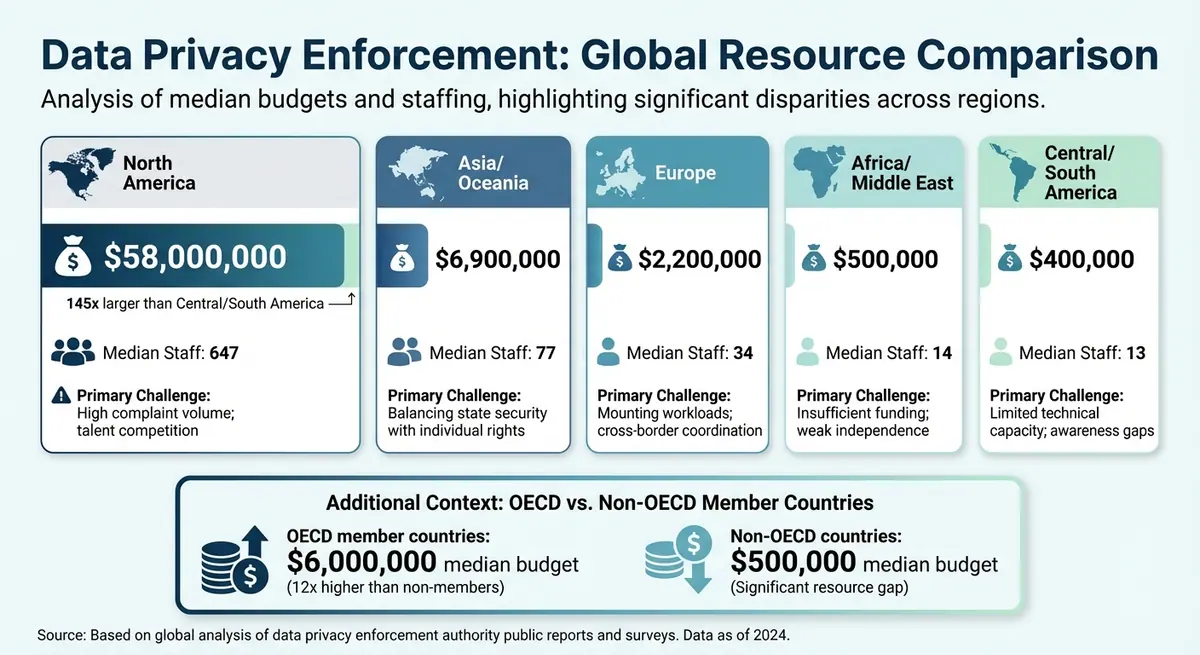
Data Privacy Enforcement Resources: Developed vs Developing Nations by Region
When it comes to enforcement, the differences between regions reveal stark contrasts in their ability to uphold privacy laws.
Enforcement Challenges in Developing Economies
For many developing economies, the gap between having privacy laws on paper and actually enforcing them is a persistent issue. Limited resources are a major hurdle - Data Protection Authorities (DPAs) in African and Middle Eastern nations operate on an average budget of just $500,000 with a staff of 14. Compare that to North America, where DPAs boast an average budget of $58 million and 647 staff members. This funding disparity explains why many developing regions focus on basic awareness campaigns rather than more complex investigations.
But funding isn't the only issue. A lack of trust in regulatory authorities further weakens enforcement. Many people perceive these authorities as extensions of the government, which discourages individuals from filing complaints and reduces pressure on companies to comply. On top of that, low public awareness of data privacy rights means that many citizens don’t even realize they can hold organizations accountable.
"The practical implementation and enforcement of data protection laws and regulations are in their nascent stages [in Africa]." – Unwanted Witness, Privacy Scorecard Report 2023
Small and medium-sized enterprises (SMEs) in these regions also face steep compliance costs. For some, the expense is so high that they either ignore the laws altogether or avoid operating in jurisdictions with stricter rules. Without resources for regular audits, non-compliance often goes unchecked.
How Developed Nations Enforce Privacy Laws
Developed nations, on the other hand, benefit from stronger enforcement mechanisms. The European Union (EU), under the General Data Protection Regulation (GDPR), uses well-funded and independent DPAs to oversee compliance. These authorities have the power to impose fines as high as 4% of a company’s global annual revenue for serious violations. Unlike in many developing regions, EU regulators don’t rely solely on complaints - they also conduct ex officio investigations, proactively auditing companies to uncover privacy violations before they affect consumers. Additionally, companies must submit Data Protection Impact Assessments (DPIAs) for high-risk activities, creating a detailed record that aids enforcement.
However, even in the EU, challenges remain. While 69% of EU citizens were aware of the GDPR by 2020, many still misunderstand their rights, leading to a flood of trivial or unfounded complaints. Moreover, the workload for EU DPAs has grown significantly since the GDPR was introduced, with increases in complaints, data breach notifications, and cross-border cases straining even the most well-resourced authorities.
In the United States, enforcement takes a different shape. Instead of a unified framework like the GDPR, the U.S. relies on sector-specific laws and the Federal Trade Commission (FTC) to address "unfair or deceptive acts." This results in a patchwork system where enforcement varies widely depending on the industry and state.
Enforcement Metrics by Region
| Region | Median Budget | Median Staff | Primary Challenge |
|---|---|---|---|
| North America | $58,000,000 | 647 | High complaint volume; talent competition |
| Asia/Oceania | $6,900,000 | 77 | Balancing state security with individual rights |
| Europe | $2,200,000 | 34 | Mounting workloads; cross-border coordination |
| Africa/Middle East | $500,000 | 14 | Insufficient funding; weak independence |
| Central/South America | $400,000 | 13 | Limited technical capacity; awareness gaps |
The contrast becomes even sharper when comparing OECD member countries to non-members. OECD nations have a median DPA budget of $6 million, which is twelve times higher than the $500,000 median for non-member countries. These budgetary and staffing gaps create significant challenges, especially when dealing with cross-border data transfers.
sbb-itb-5f36581
Cross-Border Data Transfers and Storage Requirements
Cross-border data regulations highlight a stark divide: developed nations often push for global data protection standards, while developing economies focus on keeping data under local control to maintain data sovereignty.
Data Localization Rules in Developing Economies
Many developing economies enforce strict data localization laws. For example, China and Russia mandate that personal data of their citizens be stored within their borders. Russia's Federal Law No. 242-FZ requires all personal data to be recorded and stored in local databases. Failure to comply can result in fines ranging from $31,000 to $280,000.
India, on the other hand, has introduced a more flexible approach with its Digital Personal Data Protection Act (DPDP) of 2023. Instead of requiring all data to remain local, India uses a "blacklist" model - data can be transferred to any country except those explicitly restricted by the government. However, this model introduces uncertainty for businesses.
"The DPDPA... offers no framework for determining countries to which data transfers will be prohibited... without requiring any justification of adequacy or offering mechanisms - such as standard contractual clauses." – Shreya Ramann and Rahul Matthan, Trilegal
For entities classified as Significant Data Fiduciaries (SDFs) - typically large platforms handling high volumes of data - India may impose stricter requirements. These organizations might be required to process specific types of personal and traffic data entirely within India. Violations of the DPDP Act can lead to penalties of up to ₹250 crore (around $30 million) per instance.
Pakistan employs a three-tier system for data classification: Regular, Sensitive, and Critical, with stricter localization requirements as data sensitivity increases. Globally, about 75% of countries have adopted some form of data localization rule, creating significant challenges for international businesses.
These stringent localization policies stand in sharp contrast to the frameworks used by developed nations.
Data Transfer Frameworks in Developed Nations
Developed nations generally avoid strict localization and instead rely on established mechanisms to facilitate cross-border data flows. The European Union (EU), for instance, uses "adequacy decisions" and "appropriate safeguards" to ensure data protection without requiring local storage. The European Commission has granted adequacy decisions to 15 regions, including Argentina, Japan, New Zealand, South Korea, and the United Kingdom, confirming these areas meet EU data protection standards.
When adequacy decisions are unavailable, EU businesses turn to Standard Contractual Clauses (SCCs) to safeguard data transfers. According to a 2019 IAPP-EY report, 88% of organizations used SCCs for cross-border transfers. In 2021, the EU updated these clauses to include a modular structure (e.g., Controller-to-Controller, Processor-to-Processor) to address modern, complex supply chains.
However, the Schrems II ruling added a layer of complexity. Companies using SCCs must now conduct Transfer Impact Assessments (TIAs) to ensure the destination country’s laws don’t undermine data protection standards. This requirement poses particular challenges in countries with extensive surveillance laws.
The United States has taken a different route by introducing security-focused restrictions. The Data Security Program (DSP) prohibits transferring bulk sensitive data - like biometric, geolocation, genomic, health, or financial data - to "countries of concern", including China, Russia, and Iran. Violations of the DSP can result in penalties of up to $368,136 per violation or twice the transaction value.
"The DSP aims to prevent 'countries of concern' from accessing U.S. government-related data and Americans' bulk sensitive personal data... including geolocation, biometric, genomic, health, financial and certain personally identifying information." – Davis Polk
Adding to the complexity, the U.S. CLOUD Act allows U.S. law enforcement to access data stored abroad, often clashing with localization rules and regulations like the GDPR.
Transfer Mechanisms Comparison Table
| Feature | Developed Nations (e.g., EU, USA) | Developing Economies (e.g., India, China, Russia) |
|---|---|---|
| Primary Mechanism | Adequacy decisions, SCCs, Binding Corporate Rules (BCRs) | Data localization, "Blacklists", prior government approval |
| Localization | Generally not required if protection standards are met | Often mandatory for personal, financial, or "sensitive" data |
| Transfer Criteria | Based on recipient's level of data protection | Based on national security or sovereign discretion |
| Business Challenge | High administrative burden for legal safeguards and impact assessments | High infrastructure costs for local servers; technical fragmentation |
| Predictability | Rules-based pathways with transparent criteria | High uncertainty due to discretionary government power |
"This regulatory architecture forces U.S. technology leaders to divert substantial engineering, legal, and financial resources from core innovation activities to building India-specific compliance infrastructure that cannot be leveraged for other markets." – ITIF
What This Means for Global Businesses
Navigating the maze of data privacy laws is a growing challenge for global companies. With more jurisdictions rolling out their own data protection regulations, businesses are dealing with rising compliance costs and operational hurdles. The real test lies in creating systems that can handle the diverse enforcement practices across different regions. This complexity makes it essential to weave compliance directly into the fabric of business operations.
Using Technology to Maintain Compliance
The smartest way to tackle this issue is by merging legal strategies with technical solutions - a concept often referred to as a "techno-legal" approach. Instead of scrambling to retrofit systems every time new regulations emerge, businesses can build compliance into their systems from the ground up. This proactive strategy helps address the enforcement differences that exist across global jurisdictions.
"In this 'techno-legal' approach... every innovation cycle will already have regulatory guardrails in place by design of the system."
- Charukeshi Bhatt and Anirudh Burman, Carnegie India
This is where tools like Reform come into play, especially for companies operating internationally. When gathering user data - whether for lead generation, onboarding, or service requests - businesses need tools that automatically adjust to local regulations. Reform offers features like conditional routing, which directs data based on a user’s location, alongside email validation, spam prevention, and real-time analytics to ensure data quality and track compliance. Its no-code interface is a game-changer, allowing legal and compliance teams to tweak forms and data workflows without needing help from engineering teams. This flexibility is crucial for adapting quickly to shifting regulatory requirements.
Reform also supports customized data handling for different jurisdictions. For example, data collected from regions with recognized adequacy agreements can follow simplified workflows, while data from other areas may require additional compliance steps.
Incorporating advanced compliance tools like these not only simplifies operations but also helps businesses stay agile in the face of complex regulatory demands.
Balancing Privacy Requirements with Business Operations
Beyond managing enforcement challenges, companies must align their operations with both local and international data privacy laws. One effective strategy is collaborating with regulators to create sector-specific codes. This approach has been successful in Brazil, where the data protection authority allowed a 12-month grace period between the passage of the LGPD in August 2020 and the start of enforcement, giving businesses time to adjust.
Relying solely on user consent is becoming less practical, as it often places an "unreasonable burden" on users. To address this, companies should explore alternative legal frameworks, such as legitimate purpose tests or appointing data fiduciaries, to manage data responsibly.
When it comes to data localization requirements, companies should carefully evaluate whether local cloud providers can match the security and cost-efficiency of global providers. The financial stakes are high - UK firms, for instance, faced an estimated cost of £1 billion to £1.6 billion (about $1.23 billion to $1.97 billion) after failing to secure GDPR adequacy status.
Enforcement trends are another critical factor. In August 2023, Kenya suspended Worldcoin's operations after the company allegedly disregarded orders from the Office of the Data Protection Commissioner to stop collecting biometric data. This highlights that even in regions with limited resources, non-compliance can lead to serious consequences. Companies should keep an eye on the independence and funding of Data Protection Authorities to gauge the likelihood of strict enforcement.
The key is to treat privacy not as a mere compliance task but as a business advantage. As Michael Pisa, Pam Dixon, and Ugonma Nwankwo from the Center for Global Development explain:
"Effective data protection laws and regulations help build trust in digital tools and systems by establishing rights that protect citizens against the misuse of their personal data".
Companies that prioritize privacy from the start, rather than as an afterthought, are better equipped to confidently expand into new markets while building trust with their users.
Conclusion
The challenges surrounding data privacy often arise not from a lack of laws but from the limited ability to enforce them. Wealthier nations typically have well-funded Data Protection Authorities, while regions like Africa and the Middle East struggle with minimal resources to uphold their legal frameworks. This disparity has created what experts call the "privacy enforcement gap" - a disconnect between strong legal standards on paper and their actual implementation. For businesses, this gap demands a fresh perspective on compliance.
Global companies now operate in a landscape where many new data laws are introduced by low- and middle-income countries, which frequently face enforcement hurdles. As Teki Akuetteh Falconer of Africa Digital Rights' Hub points out:
"The key issue is not whether countries have the 'right' laws or the 'right' institutions in place. Rather, it is whether they have the resources needed to effectively implement existing laws."
To navigate these uneven enforcement environments, businesses must embrace flexible, risk-based compliance strategies. Companies that embed privacy protections into their technical systems - a "techno-legal" approach - are better equipped to adapt to shifting regulations. Additionally, regional initiatives like Smart Africa's efforts to unify fragmented digital markets present opportunities to simplify compliance across multiple jurisdictions.
Treating data privacy as a strategic asset can set businesses apart in the global market. By acknowledging regional differences and creating adaptive systems, companies not only minimize risks but also build trust - an essential ingredient for expanding into new markets. Integrating privacy into business strategies is no longer optional; it’s a crucial component for success in today’s digital economy.
FAQs
Why do developing countries focus on economic growth over strict data privacy regulations?
Developing countries frequently focus on boosting economic growth rather than imposing strict data privacy regulations. This is because digital data is often viewed as a powerful tool for driving development. Tight privacy laws can lead to hefty compliance costs and may deter foreign investment - both of which are essential for building digital infrastructure and encouraging innovation.
Moreover, many of these nations face financial and institutional limitations that make enforcing comprehensive privacy laws challenging. As a result, they tend to adopt more flexible frameworks that promote economic participation and digital trade. Over time, as their regulatory capabilities improve, they aim to strengthen privacy protections. This strategy helps them address their immediate growth priorities while keeping an eye on long-term data privacy objectives.
What challenges do businesses in developing countries face due to data localization laws?
Data localization laws mandate that businesses store personal and transactional data within the borders of a specific country. While intended to enhance data control and security, these laws often create hurdles for companies operating in developing economies. For many businesses, this means investing in local data centers or working with regional cloud providers - steps that can significantly drive up costs related to infrastructure, operations, and compliance.
Adding to the challenge, many developing nations face issues like inadequate technological infrastructure and unclear regulations. These factors complicate compliance efforts and can delay the implementation of robust privacy protections. They may also expose businesses to greater cybersecurity risks and disrupt cross-border trade. The result? Higher operational costs, reduced access to international markets, and fewer opportunities for economic growth in these regions.
What challenges do developing countries face in enforcing data privacy laws?
Developing countries encounter several hurdles when it comes to enforcing data privacy laws. One of the biggest obstacles is limited resources. Data protection agencies often struggle with inadequate funding and staffing, which makes it tough to monitor and ensure compliance across different sectors effectively.
Another challenge is the shortage of technical and regulatory expertise. Without the necessary knowledge, drafting clear regulations and training officials to enforce them becomes a significant struggle. This lack of expertise can lead to poorly implemented rules and inconsistent enforcement.
The independence of data protection authorities is also a concern. Many of these regulators are closely tied to government ministries or depend on funding from the executive branch. This dependency can make it difficult for them to act impartially, especially when dealing with powerful organizations or influential individuals.
Lastly, many developing economies prioritize growth-focused policies over privacy protections. This emphasis often results in incomplete privacy frameworks that fail to address the complexities of modern data issues. Together, these challenges create substantial gaps in enforcement, leaving personal data vulnerable in many parts of the world.
Related Blog Posts
Get new content delivered straight to your inbox

The Response
Updates on the Reform platform, insights on optimizing conversion rates, and tips to craft forms that convert.




Drive real results with form optimizations
Tested across hundreds of experiments, our strategies deliver a 215% lift in qualified leads for B2B and SaaS companies.
