
.webp)
How ePrivacy Audits Improve Lead Quality



- Accurate Data: Audits verify that your tracking systems comply with regulations like GDPR, keeping your lead data clean and reliable.
- Improved Lead Quality: By ensuring consented data collection, you attract prospects who are genuinely interested and more likely to convert.
- Reduced Risks: Non-compliance can lead to fines, legal issues, and wasted marketing budgets. Audits minimize these risks.
- Boosted Marketing ROI: Compliant and accurate data leads to better targeting, higher conversion rates, and stronger customer trust.
Key Benefits:
- Higher Conversion Rates: Compliant data collection reduces bounce rates and increases qualified leads.
- Legal Protection: Avoid fines like GDPR penalties, which can reach up to $20 million or 4% of global revenue.
- Streamlined Processes: Tools like automated compliance scanners cut audit time and improve data monitoring.
Regular audits not only protect your business but also enhance your marketing performance by ensuring your data is accurate, compliant, and actionable.
How Do You Conduct A Data Privacy Audit? - Law School Prep Hub
sbb-itb-5f36581
Problems Caused by ePrivacy Non-Compliance
Failing to comply with ePrivacy regulations doesn't just create messy data - it can derail your entire marketing strategy, leaving you exposed to compliance issues and financial risks. Non-compliant tracking can corrupt critical lead data, throwing off everything from audience segmentation to sales outreach efforts.
Inaccurate Data from Non-Compliant Tracking
Non-compliance can wreak havoc on your analytics. Faulty consent banners alone can cause data loss ranging from 40% to 70%, leaving you with an incomplete view of your prospects' behavior. Beyond that, personal identifiable information (PII) like email addresses, phone numbers, or names can unintentionally leak into tracking systems through URL parameters or custom events. This type of contamination undermines data hygiene, making accurate personalization nearly impossible.
Another major issue? Invalid consent records. Many businesses assume that purchased leads come with valid consent, but this is often not the case. Under the FCC's updated one-to-one consent rule for 2024, generic consent for "marketing partners" no longer cuts it. Consent must now be specific to each individual seller. This renders older or aggregated lead lists legally questionable or outright unusable.
"The legal liability falls on the company that made the call, not the company that generated the lead." - LeadCompliant
Contacting leads without verified consent isn't just risky - it can result in penalties while wasting time and money on prospects who may never convert. These data integrity problems can quickly escalate into legal and financial headaches.
Legal and Financial Risks
The consequences of non-compliance extend far beyond bad data. Violating ePrivacy regulations can lead to hefty fines and legal battles. For example, damages under the TCPA start at $500 per violation but can rise to $1,500 if the violation is deemed intentional. A single campaign involving 100,000 non-compliant calls could rack up between $50 million and $150 million in penalties. The FTC also imposes fines of up to $50,120 per incident for breaches of the Telemarketing Sales Rule, while GDPR violations can cost up to €20 million or 4% of global annual revenue.
These risks aren't hypothetical. In Q3 2024 alone, the UK Information Commissioner's Office issued £12.7 million in GDPR fines, with 40% targeting cookie consent violations. Regulators are stepping up their game, using automated tools to audit hundreds of websites simultaneously. For instance, one 2024 operation reviewed over 800 sites.
The financial impact doesn't stop at fines. Non-compliance can put you at a competitive disadvantage. Today, 85% of digital marketing RFPs require privacy compliance as a prerequisite. Falling short on these standards means losing out on lucrative partnerships and contracts. On top of that, 81% of consumers say they avoid businesses they don't trust, and non-compliant tracking practices can directly erode that trust.
Failing to keep your leads clean adds another layer of risk. For example, neglecting to scrub leads against the National Do Not Call Registry every 31 days eliminates your "safe harbor" legal defense. And when prospects opt out, you have just 10 days to update your dialer, CRM, and internal lists. Missing these deadlines can turn routine outreach into a regulatory violation.
How ePrivacy Audits Fix Lead Quality Problems
Regular ePrivacy audits are a game changer when it comes to fixing compliance issues and improving lead data quality. These audits help pinpoint instances where tracking scripts fire without user consent and reveal data flows that violate privacy regulations. While manual audits typically catch only about 65–70% of tracking cookies, AI-powered automated scanning can achieve over 93% accuracy. This higher accuracy ensures more reliable lead data, making audits an essential step in maintaining compliance and improving data integrity.
Steps to Conduct an ePrivacy Audit
To start, focus on analyzing your website's runtime behavior instead of just reviewing static HTML. Many tracking scripts are dynamically loaded through tools like Google Tag Manager, so it’s critical to see what fires in a live browser environment. Open your lead pages in incognito mode without accepting cookies, and use the browser's Network tab to monitor analytics and ad scripts that activate before consent is given. Filter network requests for well-known tracking domains (e.g., doubleclick.net, google-analytics.com) and observe activity for a few seconds after the page loads.
Your audit should confirm that only essential cookies - like those needed for security or consent banners - are active before user consent is obtained. Next, review your privacy policy to ensure it lists all tools in use, the types of data being collected (e.g., IP addresses, user behavior, device details), and the legal basis for processing this information. GDPR Article 5(1)(d) mandates that personal data must be accurate and updated promptly, with errors corrected or removed "without delay". For ongoing monitoring, consider using automated runtime compliance scanners. These tools can continuously detect hidden trackers and consent violations, cutting audit times from 4–6 hours per site to just minutes. By following these steps, your lead data stays compliant and reliable, ultimately improving lead quality.
Auditing Form-Based Lead Generation
Lead forms are another critical area to review since they serve as the main entry point for new data into your system, requiring optimized conversion paths to maintain quality. To ensure accuracy, design the perfect landing page form with input validation to catch errors like typos or fake email addresses as the information is submitted. This prevents bad data from entering your CRM. You can also use data verification tools to cross-check submitted details against trusted sources, ensuring they are correct.
Set clear data quality standards to guide how information is entered and processed. Offering self-service portals is another effective strategy - these allow leads and customers to update their own information, keeping records accurate and aligned with GDPR’s storage rules. Document any data inconsistencies along with the steps taken to resolve them, creating a detailed audit trail for compliance purposes. Additionally, schedule periodic reviews of historical records to identify outdated or "stale" data and address it according to your retention policies. By maintaining clean and accurate lead data, you can avoid compliance pitfalls while improving the quality of your leads.
How Reform Supports ePrivacy Compliance
Reform makes meeting ePrivacy regulations easier while also helping you capture better-quality leads by filtering out incorrect or unauthorized data. Its form builder is designed to ensure compliance from the moment a visitor interacts with your form, all while maintaining high standards for data accuracy and lead quality.
Privacy-Compliant Form Features
Reform tackles common data issues like bot submissions and invalid emails before they even reach your CRM. This reduces the risk of processing unauthorized data, a critical requirement under ePrivacy regulations, and ensures your sales team is working with genuine prospects. The platform also supports explicit opt-ins, meeting the consent requirements laid out by PECR and GDPR, so you can confirm lead intent and interest upfront.
The lead enrichment feature (available with the Pro Plan) takes compliance a step further by minimizing the amount of information users need to enter manually. With the "Form Shortening" toggle, fields are dynamically hidden when enrichment data is available, streamlining the user experience while collecting only the necessary data. If enrichment isn't successful, the field remains visible for manual entry. This setup aligns with ePrivacy's focus on collecting only essential data while maintaining accuracy. Additionally, Reform incorporates ISO 27001 access controls, such as Role-Based Access Control (RBAC) and Multi-Factor Authentication (MFA), to safeguard lead data and meet security audit standards. These features are backed by real-time monitoring for added protection.
Real-Time Analytics and Monitoring
Reform's real-time analytics dashboard provides continuous oversight of form performance and privacy compliance. With the "Preview and Test" feature, you can verify that data enrichment and field population are functioning as intended. This ensures only authorized data is collected and that your forms consistently meet privacy guidelines.
The Team-Level Enrichment Management feature simplifies control over data sources like ExactBuyer. Instead of managing API keys for each form individually, Team Owners can handle them globally, reducing the risk of unregulated integrations. This centralized approach also makes it easier to audit who has access to form responses and lead data. When combined with seamless integrations, these tools help marketers maintain a compliance-first mindset throughout the lead management process.
Integrations with Marketing Tools
Reform works seamlessly with popular CRM and marketing platforms. Its integrations enable real-time lead routing, ensuring leads are directed to the right workflows immediately. At the same time, cross-border data transfers comply with Standard Contractual Clauses (SCCs) and Transfer Impact Assessments (TIAs), safeguarding personal data every step of the way.
Measuring the Impact of ePrivacy Audits on Lead Quality
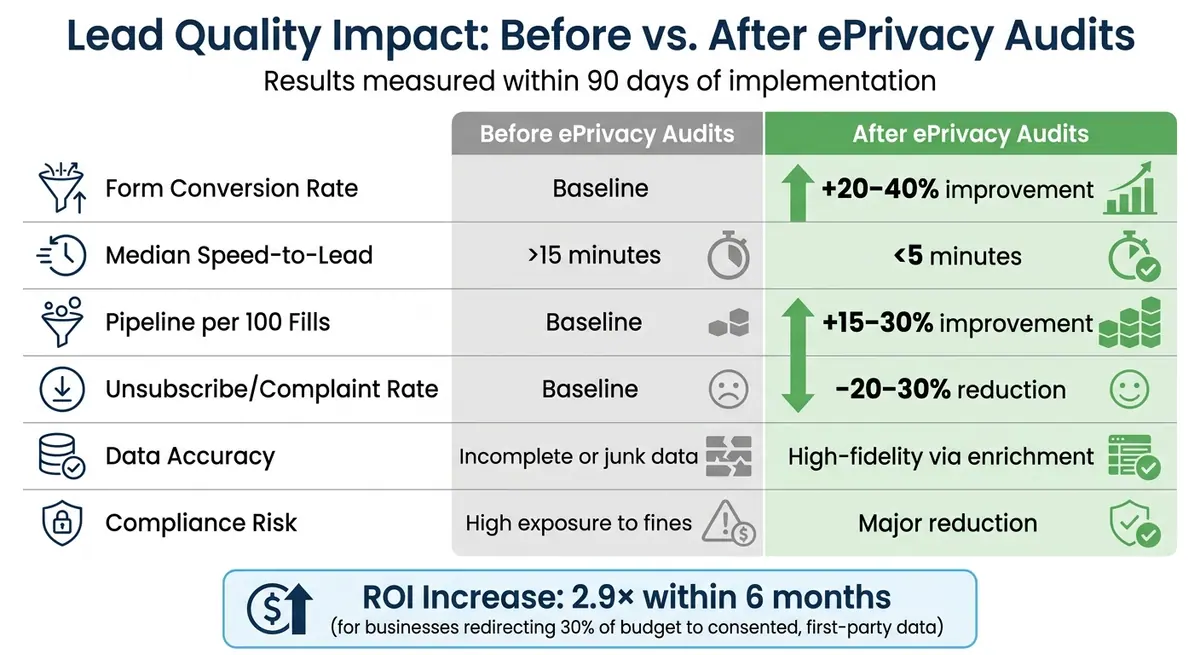
Lead Quality Metrics Before and After ePrivacy Audits
Key Metrics to Track Before and After Audits
When ePrivacy audits are implemented, they can significantly influence lead quality by improving data integrity. To see these effects, it's essential to monitor specific metrics. One of the most telling indicators is the Sales-Accepted Rate (SAR) - the percentage of leads your sales team deems worth pursuing. By ensuring forms only collect necessary information with proper consent, SAR often remains stable or even improves, as low-intent leads are filtered out.
Another critical factor is speed-to-lead. Christine Makhoul from BusySeed highlights its importance:
"Data minimization increases conversions and speeds up follow-up, which improves revenue far more than adding extra form fields".
Evaluating the median first-touch response time before and after an audit can show whether streamlined data collection is helping your team respond faster. Engaging potential customers within five minutes can boost conversion rates by up to 85%.
Beyond these metrics, tracking opt-out and complaint rates can provide additional insights into data quality improvements. When data is collected transparently with clear consent, unsubscribe rates typically drop by 20–30%. This not only builds trust but can also lead to stronger, longer-lasting customer relationships.
Comparison Table: Lead Quality Before and After Audits
Below is a comparison of key metrics, showcasing improvements observed within 90 days of implementing ePrivacy audits and data minimization efforts:
| Metric | Before ePrivacy Audit | After ePrivacy Audit | Target Improvement |
|---|---|---|---|
| Form Conversion Rate | Baseline | Higher due to reduced friction | +20–40% |
| Median Speed-to-Lead | Often >15 minutes | Faster automated routing | <5 minutes |
| Pipeline per 100 Fills | Baseline | More qualified submissions | +15–30% |
| Unsubscribe/Complaint Rate | Baseline | Lower due to consent-based data | -20–30% |
| Data Accuracy | Incomplete or "junk" data | High-fidelity via enrichment | Significant improvement |
| Compliance Risk | High exposure to fines | Documented compliance | Major reduction |
Additionally, businesses that redirected just 30% of their budget to consented, first-party data programs saw a 2.9× ROI increase within six months. These results highlight a shift toward more efficient marketing strategies that turn budgets into measurable revenue growth.
Conclusion
Regular ePrivacy audits do more than just ensure compliance - they can turn privacy into a competitive edge. By implementing accurate and compliant tracking, businesses not only maintain data integrity but also avoid hefty legal penalties, such as GDPR fines that can reach $20 million or 4% of global revenue. Beyond avoiding risks, compliant practices directly improve lead quality. Research indicates that compliant websites experience a 15–20% increase in lead quality scores, which translates into measurable revenue growth.
The benefits of regular audits go even further. They can reduce bounce rates by 30%, increase qualified leads by 40%, and improve conversion rates by 25%. For instance, one SaaS business saw its lead quality jump from 65% to 92%, cut customer acquisition costs by 28%, and added $50,000 in monthly recurring revenue.
Reform provides a streamlined solution to help businesses achieve these outcomes. With features like consent management, spam prevention, and email validation - all integrated without requiring custom coding - Reform simplifies the audit process. Its real-time analytics enable continuous monitoring, cutting audit times in half while integrating seamlessly with tools like HubSpot [article context].
These tools make it easier for companies to act immediately. As noted earlier, data precision and compliance are essential for sustainable growth. Without regular audits, businesses risk wasting up to 70% of their marketing budgets on invalid data. By adopting automated compliance tools and starting with a self-audit checklist, companies can turn privacy regulations into a foundation for better marketing performance and stronger customer loyalty.
FAQs
How often should I run an ePrivacy audit?
It's a good idea to perform an ePrivacy audit on a regular basis - once a year is a solid benchmark. You should also consider conducting an audit whenever there are major changes, like updates to privacy laws or shifts in your data practices. This keeps your information accurate and ensures you're staying compliant.
What’s the fastest way to spot trackers firing before consent?
The fastest way to spot trackers firing before user consent is by keeping an eye on network traffic during a browser session. Tools like the Chrome Developer Tools' Network tab can be incredibly useful here. Watch for third-party scripts, such as analytics tags or tracking pixels, that load as soon as the page opens - without any user interaction. This approach can help uncover potential GDPR compliance issues tied to pre-consent tracking.
Which lead-quality metrics should I track after an audit?
After completing an audit, keep an eye on critical lead-quality metrics such as data accuracy, lead qualification scores, and lead engagement speed. Tracking these ensures your information stays reliable, follow-ups happen promptly, and overall lead quality improves.
Related Blog Posts
Get new content delivered straight to your inbox

The Response
Updates on the Reform platform, insights on optimizing conversion rates, and tips to craft forms that convert.



Drive real results with form optimizations
Tested across hundreds of experiments, our strategies deliver a 215% lift in qualified leads for B2B and SaaS companies.
