
.webp)
EU-U.S. Data Privacy Framework Dispute Process Steps



The EU-U.S. Data Privacy Framework (DPF) helps protect personal data transferred from the EU, UK, or Switzerland to U.S. companies. It provides a structured, three-step process to address privacy violations:
- File a Complaint with the Organization: Contact the U.S. company directly. Use the official DPF list (www.dataprivacyframework.gov) to confirm their participation and find their contact details. Companies must respond within 45 days.
- Submit to an Independent Recourse Mechanism (IRM): If the company doesn’t respond or resolve the issue, escalate the complaint to their designated IRM. This step is free and ensures impartial review.
- Request Binding Arbitration: If the IRM process fails, you can pursue binding arbitration as a final option. Arbitration decisions are enforceable but cannot award monetary damages.
This process ensures privacy rights are upheld and disputes are resolved without cost to individuals. Always document your steps and verify the company’s participation in the DPF before filing a complaint.
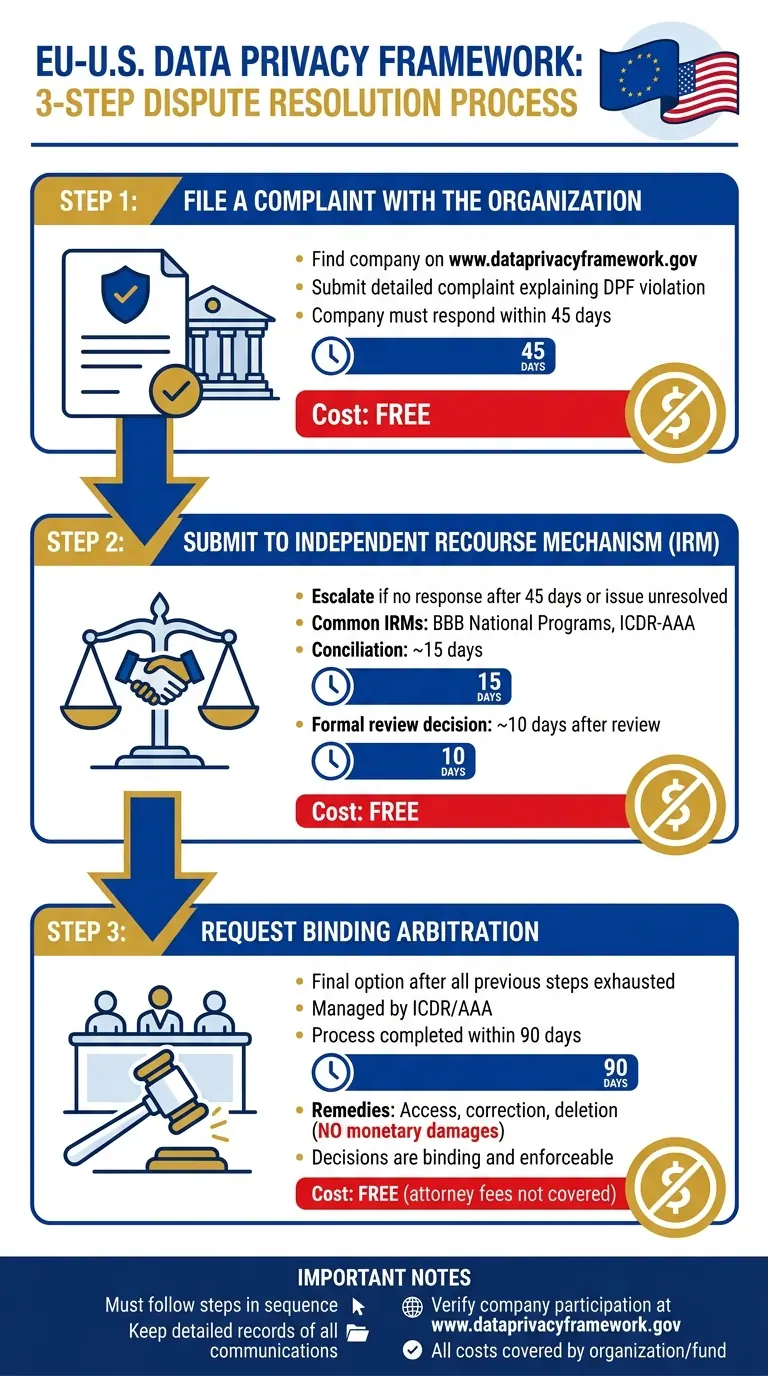
EU-U.S. Data Privacy Framework 3-Step Dispute Resolution Process
Step 1: File a Complaint with the Organization
This step allows the organization to address and resolve the issue internally before further action is taken.
How to Find the Participating Organization
Head to the official Data Privacy Framework Program website at www.dataprivacyframework.gov. There, you'll find a searchable list of participating businesses. Once you locate the organization in question, click on its profile and look under the "Dispute Resolution" section. This will provide the contact details for privacy complaints. Double-check that the listing includes these details and take note of the organization’s designated Independent Recourse Mechanism (IRM), as you might need it for escalation later.
What to Include in Your Complaint
Once you’ve identified the correct contact, craft a detailed complaint. Clearly explain how the organization violated the Data Privacy Framework (DPF) Principles. Specify the principle in question and the rights affected - whether it’s about accessing your data, limiting its use, or addressing security concerns using secure form builders. If the data involves a child under 13, make this clear. Additionally, confirm that the data in question originated in the EU, EEA, UK, or Switzerland and was transferred to the U.S. organization.
"Your complaint must allege a violation of the Data Privacy Framework Principles by the Participating Business or assert your rights under the Principles in relation to your personal data."
– BBB National Programs
Response Timeline and Next Steps
Organizations are required to respond to complaints within 45 days of receiving them. Make sure to note the date you submit your complaint so you can track this timeline. If the organization doesn’t respond within 45 days - or if their response fails to resolve the issue - you can escalate your complaint to their designated Independent Recourse Mechanism. These dispute resolution services are provided at no cost to you.
"The entity is then required to respond to your complaint within 45 days of receipt."
– National Data Protection Commission (CNPD), Luxembourg
If the organization’s response is delayed or unsatisfactory, move on to Step 2.
sbb-itb-5f36581
Step 2: Submit to an Independent Recourse Mechanism
If the organization doesn’t respond within 45 days or offers a resolution that doesn’t address your concerns, it’s time to escalate your complaint to an Independent Recourse Mechanism (IRM). This step ensures your issue is reviewed by an impartial body if the organization fails to resolve it within the required timeframe.
Select an Approved Recourse Mechanism
When a company certifies under the Data Privacy Framework, it designates an IRM to handle disputes. To identify the assigned IRM, visit the "Dispute Resolution" section on the company’s profile at www.dataprivacyframework.gov. Commonly used IRMs include BBB National Programs and the International Centre for Dispute Resolution-American Arbitration Association (ICDR-AAA). For complaints involving human resources data, a panel of European Data Protection Authorities (DPAs) may handle the case.
Each IRM operates differently. For example, BBB National Programs focuses on conciliation first, aiming to help both parties reach a voluntary agreement. If that fails, you can request a Data Privacy Review, where an impartial expert makes a binding decision for the business. Conciliation typically wraps up within 15 days of starting the case, and formal written decisions are issued within 10 days of the review's conclusion.
Documents and Information Required
When submitting your complaint to an IRM, you’ll need to provide specific details and evidence, including:
- Your full name, mailing address, and email address.
- A detailed explanation of the Data Privacy Framework violation and your efforts to resolve the issue directly with the organization.
- Supporting documents, such as your initial complaint and any responses received - or proof that 45 days have passed without a response.
- A clear statement of the resolution you’re seeking, such as data correction, deletion, or changes to the company’s privacy practices.
For complaints filed with VeraSafe, you must include a declaration under penalty of perjury affirming the truthfulness of your information. Additionally, your email must state: "I represent and warrant that I have read, understand, and agree to be bound by the terms of the VeraSafe Data Privacy Framework Dispute Resolution Procedure". You’ll also need to give explicit consent for the IRM to share your complaint with the organization. BBB National Programs, on the other hand, takes steps to verify your identity before proceeding with the case.
How Long Resolution Takes
Once your documents are submitted, the IRM begins its review process. Timelines vary depending on the IRM and whether the issue is resolved through mediation or moves to a formal review. Typically, the business has 20 business days to respond to your complaint. BBB National Programs aims to complete voluntary conciliation within 15 days of starting the case. If conciliation fails and you request a formal review, expect a written decision within 10 days after the review concludes.
"A Participating Business must comply with BBB National Programs' final determination of any dispute. However, our process is non-binding on the consumer, which means that using our dispute resolution process will not affect your legal rights as an individual."
– BBB National Programs
It’s important to note that IRMs can order corrective actions like granting data access, making corrections, or suppressing data. However, they cannot award monetary damages. If the organization refuses to comply with the IRM’s decision, the case is escalated to the Federal Trade Commission (FTC) or the Department of Transportation for enforcement.
Step 3: Request Binding Arbitration
If the IRM process doesn't resolve your complaint, binding arbitration is your final option. However, this step is only available after you've completed all prior steps: reaching out to the organization directly, waiting 45 days for a response, working through the designated IRM, and seeking assistance from your national Data Protection Authority and the U.S. Department of Commerce. Essentially, arbitration ensures that every possible avenue for resolution has been pursued.
Requirements for Arbitration
To qualify for arbitration, certain conditions must be met. Your complaint must involve an alleged violation of the Data Privacy Framework Principles, and you must reside in the European Union, United Kingdom, or Switzerland, with your data transferred to a participating U.S. organization. Additionally, the claim cannot have been previously resolved or adjudicated. You'll also need to submit a formal Notice that outlines your prior resolution attempts, details the alleged violation, and provides supporting documentation.
How the Arbitration Process Works
The arbitration process is overseen by the International Centre for Dispute Resolution (ICDR), a division of the American Arbitration Association (AAA). Once the Notice is delivered, the process must be completed within 90 days. Arbitrators are selected from a maintained list of experts in U.S. privacy and EU data protection law, each serving 3-year terms. Participants can join the proceedings via video or phone, and interpretation services are available unless deemed disproportionately costly.
A fund managed by the ICDR covers all arbitration costs and arbitrator fees, meaning individuals pay $0 in arbitration fees. However, if you choose to hire an attorney, you'll be responsible for their fees.
What Arbitration Can Achieve
The arbitration panel can enforce equitable remedies tailored to the specific violation. These remedies might include actions like granting access to your data, correcting inaccuracies, deleting information, or returning data. However, the panel cannot award monetary damages. Importantly, the decisions are binding for everyone involved and can be enforced in U.S. federal district courts under the Federal Arbitration Act. All materials submitted during arbitration remain confidential and are used exclusively for the process.
"The Data Privacy Framework Panel... has the authority to impose individual-specific, non-monetary equitable relief (such as access, correction, deletion, or return of the individual's data in question) necessary to remedy the violation."
– RWS Group
Conclusion
The EU-U.S. Data Privacy Framework offers a structured, three-step dispute resolution process designed to protect your rights and ensure organizations address your concerns. It begins with filing a direct complaint with the company, progresses to an Independent Recourse Mechanism if needed, and concludes with binding arbitration for unresolved issues. This methodical approach ensures every possible option for resolution is explored before reaching the final stage.
It's important to follow the steps in sequence to avoid complications. Independent Recourse Mechanisms usually require proof that you made a "prior good faith attempt" to resolve the issue directly with the organization before they will accept your complaint. Similarly, binding arbitration is reserved for "residual claims" that remain unresolved after all other avenues have been exhausted - it cannot be used as a first or second step. Skipping any part of the process may result in an "Ineligibility Determination" and closure of your case.
Keep detailed records throughout the process. Save copies of all communications, including your initial complaint, responses from the organization (or evidence of their failure to respond within 45 days), and any mediation outcomes. A well-documented paper trail not only meets procedural requirements but also strengthens your case.
The good news? You won’t face any fees during this process. Under the Data Privacy Framework, all costs related to Alternative Dispute Resolution (ADR) and binding arbitration are covered by the respondent organization and a dedicated fund. This ensures financial concerns won’t stand in the way of protecting your data privacy rights.
Lastly, confirm that the U.S. organization in question is listed on the official Data Privacy Framework List at www.dataprivacyframework.gov before proceeding. This verification step is crucial to ensure eligibility under the framework.
FAQs
How do I know if a U.S. company is covered by the DPF?
To determine if a U.S. company is part of the DPF, check whether it has self-certified its adherence to the DPF Principles with the U.S. Department of Commerce. Additionally, the company should be listed on the annually updated Data Privacy Framework List.
What proof should I keep before escalating to an IRM?
Before taking your case to an IRM under the EU-U.S. Data Privacy Framework, make sure to keep thorough documentation of your compliance efforts and any communication related to the dispute. This should include records of the original complaint, all correspondence with the organization, and proof of attempts to resolve the issue directly. Having detailed records will be crucial in supporting your claim during the dispute resolution process.
What can binding arbitration actually force the company to do?
Binding arbitration may compel a company to offer specific, non-monetary solutions tailored to the individual when there are violations of the EU-U.S. DPF Principles. These solutions might include granting access to personal data, correcting errors, deleting certain information, or even returning the individual's data.
Related Blog Posts
Get new content delivered straight to your inbox

The Response
Updates on the Reform platform, insights on optimizing conversion rates, and tips to craft forms that convert.



Drive real results with form optimizations
Tested across hundreds of experiments, our strategies deliver a 215% lift in qualified leads for B2B and SaaS companies.
