
.webp)
How Teams Scale Lead Nurturing Automation



Scaling lead nurturing automation is about creating workflows that send the right message to the right person at the right time. Here's what you need to know:
- Why it matters: 80% of B2B leads fail to convert due to poor nurturing. Automated workflows can increase revenue by 320% and make leads 21 times more likely to convert when contacted quickly.
- Audit your process: Map the lead journey, refine lead scoring, and avoid over-automation. Behavioral triggers outperform scheduled emails by 3–8x.
- Team alignment: Clearly define roles for marketing, sales, and operations. Misalignment costs companies over 10% of revenue annually.
- Use the right tools: Reliable CRM integrations and error monitoring prevent lead loss. Real-time data sharing ensures fast follow-ups.
- Personalized campaigns: Action-based triggers and tailored messaging improve engagement. Multi-channel strategies (email, ads, sales touches) drive better results.
The bottom line: Streamline workflows, align teams, and use smart tools to nurture leads effectively and scale your efforts.
This 1 System Makes All Your Marketing Work
sbb-itb-5f36581
Review Your Current Workflows and Team Capacity
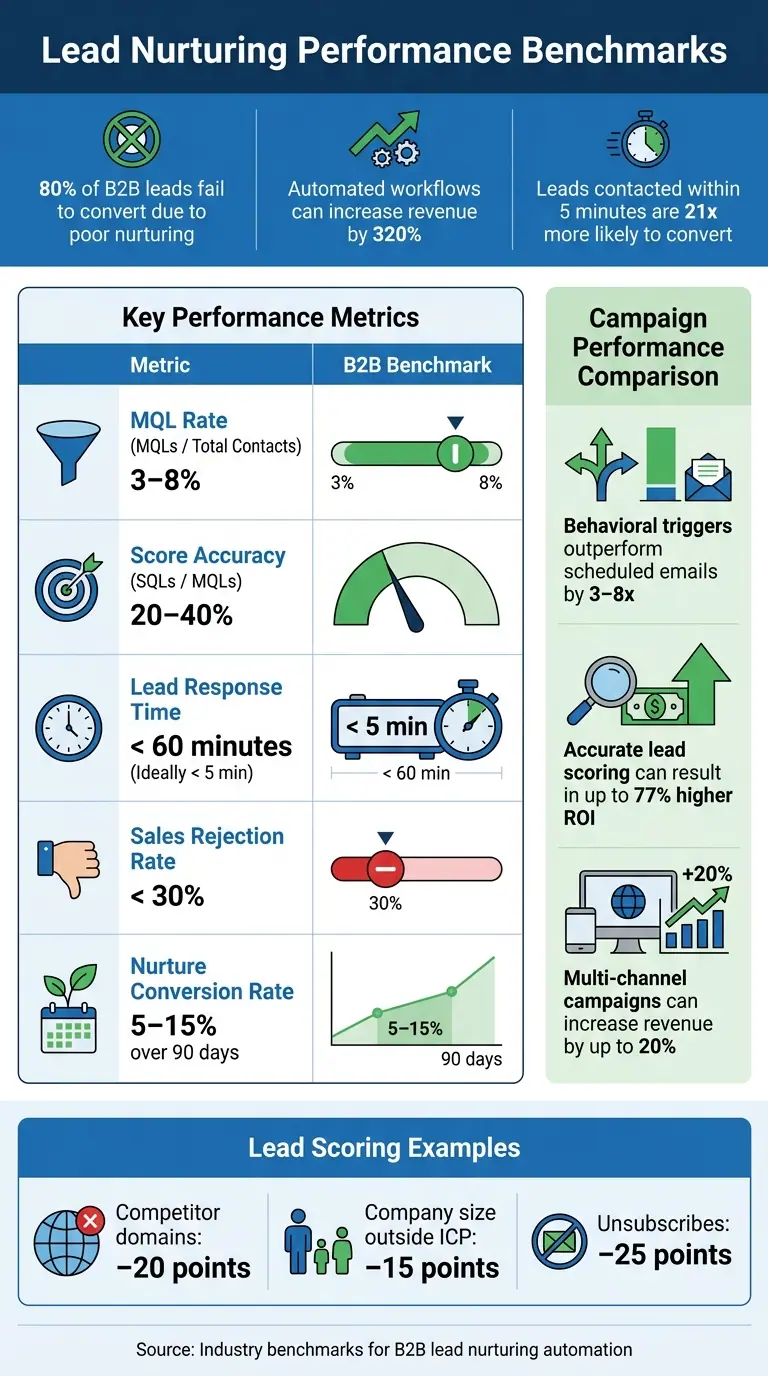
Lead Nurturing Automation: Key Performance Metrics and Benchmarks for B2B Teams
Before scaling your operations, take a close look at your existing workflows and team capacity. Outdated processes, staff turnover, and quick fixes can lead to fragmented systems that make scaling a challenge.
Audit Your Automation Processes
Start by mapping the entire lead journey - from the initial touchpoint to deal closure. This helps identify delays, drop-offs, and inefficiencies that could limit your ability to handle a larger volume of leads.
Take a closer look at your lead scoring model. Accurate scoring can result in up to 77% higher ROI. To get there, balance demographic factors (like whether a company matches your ideal customer profile) with behavioral engagement. Use negative scoring to automatically disqualify leads that don’t fit. For instance:
- Competitor domains: –20 points
- Company size outside your ICP: –15 points
- Unsubscribes: –25 points
Compare your campaign performance as well. Behavioral triggers often outperform scheduled email blasts by 3–8x. If your sales team frequently rejects marketing-qualified leads (MQLs) with reasons like "not ready" or "wrong contact", it might be time to recalibrate your scoring weights.
"The problem is not volume - it is signal-to-noise. Without a system to separate genuinely ready buyers from casual browsers, sales reps waste time on cold outreach." – Digital Applied
Use these industry benchmarks to measure your performance:
| Metric | B2B Benchmark |
|---|---|
| MQL Rate (MQLs / Total Contacts) | 3–8% |
| Score Accuracy (SQLs / MQLs) | 20–40% |
| Lead Response Time | < 60 minutes (Ideally < 5 min) |
| Sales Rejection Rate | < 30% |
| Nurture Conversion Rate | 5–15% over 90 days |
Also, check for over-automation. Sending too many messages at once can make your outreach feel robotic, increasing unsubscribe rates. To avoid this, set a cap - no more than three emails per week.
Map Team Skills and Knowledge Gaps
After addressing process inefficiencies, assess your team’s ability to manage these workflows effectively.
If no one on your team can explain a workflow without walking through each step, it’s a sign of an orphaned process. This often happens when the original creator has left or moved to a different role.
Be cautious of workflow sprawl - when new workflows are created instead of updating existing ones. This adds unnecessary complexity, making even minor changes cumbersome. If error rates exceed 5% or the same problems persist for more than two quarters, it’s better to rebuild the workflow rather than patch it.
"Workflows don't scale by accident. The ones that survive growth were designed with growth in mind. The rest become the thing your ops team dreads maintaining." – Ricardo Martinez
Finally, evaluate whether your team is equipped to handle the complexity of modern B2B deals, which often involve around 13 stakeholders. Make sure they can deploy role-based trigger sequences that deliver targeted, persona-specific content.
Your automation setup should also support fast sales follow-ups. Reaching out within five minutes can make leads 21 times more likely to convert. Don’t miss this critical opportunity.
Assign Clear Roles and Responsibilities
Once you've audited your workflows, the next step is assigning clear roles to ensure every automated process is handled effectively. Mapping workflows and identifying gaps is only part of the equation - defining ownership is what keeps things running smoothly. Without clear accountability, automation can stall, duplicate efforts, or even let valuable leads slip through the cracks. By assigning roles, you can create a seamless transition between nurturing and conversion.
Here's something to consider: misalignment between sales and marketing costs B2B companies over 10% of their revenue annually. The solution isn’t endless meetings. Instead, it’s about setting clear boundaries and shared accountability right from the start.
Coordinate Marketing, Sales, and Operations Teams
Each team needs its own lane to avoid overlap and confusion. Here’s how responsibilities break down:
- Marketing: Handles early-stage nurturing, personalizes content, and converts inbound traffic into qualified leads. Their focus is on building campaigns that educate prospects until they’re ready for sales.
- Sales: Steps in once a lead shows high intent or meets a specific scoring threshold. Their role involves prioritizing leads, direct outreach, and relationship building.
- Operations or RevOps: Manages the technical infrastructure - CRM integrations, data quality, and automation logic. They’re responsible for routing rules, platform reliability, and ensuring real-time data flows smoothly between systems.
To make this even clearer, here’s a breakdown of ownership across key workflow stages:
| Workflow Stage | Operations/RevOps Owns | Sales Owns | Shared Responsibility |
|---|---|---|---|
| Intelligence & Monitoring | Signal configuration, data quality | Account interpretation | Shared platform view |
| Opportunity ID | Relevance criteria, mapping | Prioritization & pursuit | Scoring logic |
| Campaign Creation | Sequence logic, timing rules | Message review & approval | Quality standards |
| Execution | Platform management | Inbox monitoring, follow-up | Engagement tracking |
| Handoff | Routing rules, MQL definition | Qualification & next steps | Conversion criteria |
One tip for reducing friction is to move beyond generic lead scores. Work together to define specific account signals that trigger a handoff, such as leadership changes, budget announcements, or visits to your pricing page.
"The goal is not a faster nurture sequence. The goal is a workflow that sales actually uses and RevOps can actually improve." – SalesPlay
Set Task Ownership and Accountability
Clearly assigning ownership for every part of the workflow is essential. Document responsibilities so everyone knows their role.
Start by creating a formal Service Level Agreement (SLA) between marketing and sales. For example, marketing may commit to delivering a set number of qualified leads, while sales agrees to contact those leads within 24 hours. Companies with aligned teams often see 103% higher goal attainment and 38% higher sales win rates.
Use automation to keep things moving. For instance, when a lead takes a high-intent action like visiting the pricing page, the responsible salesperson should get an immediate notification via Slack or a task management tool.
To avoid confusion, maintain a shared document that outlines which team updates specific CRM fields and what actions trigger automated updates. This ensures data stays accurate as you scale.
"When more than one team has a stake in a lead nurture process, it'll be more likely to have eyes on it." – Marnie Consolante, Former Senior Partner Marketing Manager, Acquia
Hold short, weekly "smarketing" meetings - just 30 minutes - to review pipeline data, discuss lead quality, and adjust scoring criteria. Skip the status updates and focus on actionable insights.
Finally, establish a unified scorecard with shared KPIs like engagement rates, pipeline velocity, and revenue impact. When both teams track the same metrics, alignment becomes second nature.
Use the Right Tools and Integrations
Having reliable tools and smooth integrations is essential for scaling lead nurturing across a team. On average, B2B teams juggle 6 website forms, 3 form tools, and 2 CRMs. This setup often leads to duplicates and missed leads. Before adding more tools, take the time to map out your current setup. Create a spreadsheet listing every active form, its tool, the target CRM, and the integration method. This process can uncover "silent failures", where leads vanish from your pipeline. In fact, fragile automation stacks can lose around 7% of leads before they even hit the CRM. Identifying these gaps helps you build a more cohesive and reliable system.
Select Tools That Support Team Collaboration
It's important to choose tools that allow marketing, sales, and operations teams to work together effectively. For example, Reform offers multi-step forms and conditional routing, which help collect high-quality data right from the start. Real-time analytics ensure that every team has clear visibility into performance. To maintain consistency, make sure every form submission includes key fields like first name, email, lead source, and timestamp. Without this structure, your CRM can quickly fill up with incomplete records, making follow-ups inefficient.
Reform also includes lead enrichment and spam prevention features that operate in the background to maintain data quality. Email validation catches typos before they enter your system, and spam filters keep your pipeline clean without requiring constant manual effort.
Connect Systems for Automatic Data Sharing
Once you've selected tools that promote collaboration, the next step is ensuring seamless data flow between systems. The integration method you choose should depend on the volume of data and the complexity of your logic. Here's a quick breakdown:
| Method | Best For | Key Benefit |
|---|---|---|
| Native Integration | Low volume (<1,000/mo), simple logic | No setup cost, high reliability |
| Middleware (Zapier/Make) | Moderate volume, conditional routing | Flexible with options for data enrichment |
| Direct Webhooks | High volume, custom logic | Full control with lower per-task costs |
Reform integrates directly with popular CRMs like HubSpot and Salesforce, enabling data to sync in real time. This instant connection is critical because lead qualification rates drop significantly if the first follow-up happens more than 5 minutes after submission.
To ensure accurate marketing attribution, map UTM parameters using hidden fields in your forms. Automatically capturing data like utm_source, utm_medium, and utm_campaign helps your CRM track which campaigns are driving leads. Use email addresses as the primary key for deduplication. Without this, B2B teams can experience duplicate record rates as high as 18%. Configure your integration to check for existing contacts before creating new records. Additionally, use "update only if empty" logic to avoid overwriting information that sales reps have manually updated.
To catch integration errors early, set up error monitoring. For example, create a dedicated "Error" path in middleware tools that logs failures to a Slack channel or Google Sheet. Review these logs weekly to address any issues before they impact your leads.
"Form-to-CRM reliability is the foundation everything else sits on." – Victor Hoang, Co-Founder & CMO, Rework
Create Multi-Channel Nurture Campaigns That Scale
Once your systems are aligned and everyone knows their role, it's time to focus on creating multi-channel campaigns that can grow with your business. Multi-channel efforts are far more effective than single-channel ones, potentially increasing revenue by up to 20%. The idea is to move away from running campaigns in silos and instead build a unified system where email, ads, and sales touches work together seamlessly. Each channel serves a unique purpose: emails communicate value and guide prospects to the next step, retargeting ads keep your brand visible during the research phase, and sales touches provide clarity through direct interaction. By coordinating these channels, you ensure your message is consistent and impactful, driving better results. To take it further, use action-based triggers and tailor your messaging to make every interaction count.
Set Up Campaigns Triggered by User Actions
Action-based workflows are incredibly effective, delivering open rates that are 8x higher than standard broadcast campaigns. Instead of sticking to a rigid schedule, set up workflows that activate immediately based on high-intent actions. For example, if a prospect visits your pricing page, you can trigger an SDR email within five minutes and send an alert to your sales team via Slack. To make these workflows efficient, define clear enrollment triggers, set filters to avoid duplicate messages, and establish exit goals like scheduling a meeting.
To avoid overwhelming your leads, create global rules that ensure contacts are only part of one active nurture sequence at a time. Use conditional logic to adapt your approach based on engagement. For instance, if someone clicks a link in your first email, they could be routed to a more detailed educational sequence. If they remain unresponsive after three touches, move them to a re-engagement campaign instead.
Personalize Content and Test Variations
Personalization goes far beyond simply using someone's first name. Emails that are tailored to specific behaviors or interests can achieve conversion rates six times higher than generic ones. For example, you could say, "You downloaded our CRM guide - here's the checklist teams use next". For complex B2B sales that involve 13 or more stakeholders, consider creating content paths specific to different roles, such as ROI-focused materials for CFOs and technical guides for IT decision-makers.
Testing is another critical piece of the puzzle. A/B testing allows you to refine your strategy by experimenting with subject lines, send times, and call-to-action variations. Instead of just focusing on open rates, look at how prospects move through your pipeline to determine what works best. Interestingly, plain-text emails often perform better than HTML templates, achieving 20–40% higher reply rates. Tools like Reform make it easy to test different form variations and identify which ones generate the most qualified leads. Use real-time analytics to track performance across all channels and fine-tune your campaigns based on what drives results.
Track and Improve Performance Together
Once you’ve streamlined workflows and clarified team roles, the next step is to build a unified performance strategy. Why? Because even the best lead scoring - capable of increasing lead-generation ROI by up to 77% - won’t deliver results if the right metrics aren’t being tracked or insights aren’t shared across teams. The goal here is to create a feedback loop where marketing, sales, and operations align around the same data, working collaboratively to refine strategies.
Create Shared Performance Dashboards
A shared dashboard keeps everyone on the same page by providing access to the metrics that matter most. Instead of marketing focusing only on email open rates while sales tracks closed deals, create a unified scorecard that includes engagement metrics, funnel progression, and revenue impact. Key metrics to monitor include:
- MQL Rate: The percentage of Marketing Qualified Leads (MQLs) out of total known contacts, which typically ranges from 3–8% for B2B.
- Nurture Conversion Rate: How many leads graduate from nurture campaigns to MQL status.
- MQL-to-SQL Conversion Rate: A strong benchmark is 20–40% when scoring is accurate.
- Lead Response Times: Aim for under 60 minutes. Responding within five minutes makes your team 100 times more likely to connect than waiting 30 minutes.
- Lead Progression Velocity: Measure the time (in days) it takes leads to move between pipeline stages.
- Sales Rejection Rate: Keep this below 30% - if it’s higher, your scoring criteria or Ideal Customer Profile (ICP) may need adjustments.
For example, DocuSign improved sales rep productivity by over 30 minutes per day by moving away from manual spreadsheets and automating follow-up tasks with Outreach. This shift also enhanced funnel tracking.
Review Data and Refine Your Approach
Regular cross-team meetings are essential for analyzing performance and fine-tuning your strategy. During the initial rollout, hold weekly reviews to monitor MQL volume by source, SLA compliance, and open/click rates for sequences. Once workflows stabilize, transition to monthly meetings focused on win rates by score band, sales rejection trends, and nurture graduation rates. Every quarter, recalibrate your scoring model, review your ICP, and audit workflows to phase out outdated sequences.
These sessions should also be a space for gathering qualitative feedback from sales reps. For instance, if you notice high engagement but low conversion, it could signal that your messaging or scoring rules need adjustment.
In 2025, the agency DEPT used Madison Logic's intent data to optimize its lead nurturing strategy. By shifting from weeks- or months-long nurturing schedules to just hours for highly engaged accounts, DEPT shortened sales cycles and achieved faster conversions.
Experiment with individual variables like subject lines, send times, and messaging tones, then analyze dashboard data to pinpoint what drives improvement. To maintain pipeline accuracy, apply score decay rules - for example, reducing a lead’s score by 20% after 30 days of no engagement. These ongoing refinements will position your team for even more advanced automation strategies.
Conclusion
Scaling lead nurturing automation brings teams together under a unified strategy. When marketing, sales, and operations work with shared dashboards, clear responsibilities, and dependable data pipelines - as outlined in workflow audits and role assignments - you eliminate the bottlenecks that slow lead conversion rates. The real difference between teams that scale effectively and those that falter often lies in their execution: conducting quarterly workflow audits, fixing integration issues, and responding quickly to high-intent leads.
Reform’s conversion-focused forms simplify the process by capturing key data and integrating seamlessly with your CRM. Features like lead enrichment, email validation, and conditional routing ensure that every submission includes critical details such as first name, email, lead source, and timestamp. Plus, automated deduplication logic reduces duplicate entries - addressing the 18% duplication rate that drains sales resources.
A strong pipeline is non-negotiable for success. Research from Harvard Business Review reveals that lead qualification rates drop dramatically after just 5 minutes. This makes a reliable form-to-CRM connection essential. By incorporating middleware for error monitoring, setting up routing rules based on company size or territory, and mapping UTM parameters to hidden form fields, you preserve attribution accuracy - fueling smarter decision-making across teams.
This integrated approach strengthens the collaborative strategies discussed earlier.
Assigning clear ownership of tasks and creating shared dashboards to monitor lead qualification rates and response times ensures alignment across teams. Regular cross-team reviews allow you to refine your methods, laying the groundwork for personalized, multi-channel campaigns that scale while maintaining a personal touch.
FAQs
How do I know if our lead scoring is wrong?
If high-scoring leads aren’t converting or low-scoring leads are making it to sales, it’s a sign your scoring model might need tweaking. Take time to review closed-loop reporting regularly. This helps you see if the leads that convert match your scoring criteria. If there’s a gap between the scores and real-world outcomes, it’s time to refine your lead scoring system.
What should trigger a sales handoff from nurture?
When a lead meets the MQL (Marketing Qualified Lead) criteria, it's time to initiate the sales handoff. These criteria often include hitting a certain lead score or demonstrating strong engagement. Actions like visiting the pricing page or requesting a demo are clear signs of readiness. This process ensures sales teams prioritize leads that show genuine buying intent.
How can we prevent leads from getting lost in integrations?
To make sure no leads slip through the cracks, it's essential to audit your form-to-CRM integrations regularly. This helps uncover problems like missed or duplicate leads before they become bigger issues.
Pay close attention to forms that lack error monitoring. These are often the weak links in your system. Setting up quarterly reviews can help you spot and resolve potential problems early on.
By adding error detection and monitoring tools, you’ll maintain data accuracy and ensure every lead is captured, giving your team the chance to follow up effectively.
Related Blog Posts
Get new content delivered straight to your inbox

The Response
Updates on the Reform platform, insights on optimizing conversion rates, and tips to craft forms that convert.



Drive real results with form optimizations
Tested across hundreds of experiments, our strategies deliver a 215% lift in qualified leads for B2B and SaaS companies.
