
.webp)
GDPR vs. CCPA: Automating DSAR Compliance



Handling DSARs (Data Subject Access Requests) under GDPR and CCPA can be time-consuming, costly, and risky if mismanaged. Here's what you need to know:
- GDPR (effective May 2018) applies globally to any organization processing EU residents' data. It mandates opt-in consent and provides eight key rights, including access, erasure, and objection.
- CCPA (effective January 2020, updated by CPRA in 2023) applies to California-based for-profit businesses meeting specific thresholds. It emphasizes opt-out rights and grants six consumer rights, such as data deletion and limiting sensitive data use.
- Non-compliance risks high penalties: GDPR fines can reach €20M or 4% of global revenue, while CCPA fines range from $2,500 to $7,500 per violation.
- Manual DSAR handling is expensive, averaging $1,524 per request, and prone to errors. Automation reduces costs, improves accuracy, and ensures deadlines (30 days for GDPR, 45 days for CCPA) are met.
Quick Comparison
| Feature | GDPR | CCPA / CPRA |
|---|---|---|
| Scope | Any organization processing EU data | For-profit businesses meeting thresholds |
| Consent Model | Opt-in | Opt-out |
| Key Rights | 8 rights (e.g., erasure, objection) | 6 rights (e.g., opt-out, correction) |
| Sensitive Data | Requires explicit consent | Focuses on limiting usage |
| Response Time | 30 days (up to 90 with extension) | 45 days (up to 90 with extension) |
| Fines | Up to €20M or 4% of revenue | $2,500–$7,500 per violation |
Automating DSAR workflows simplifies intake, identity verification, data retrieval, and compliance tracking. Tools like Reform streamline these processes, cutting costs and ensuring timely, secure responses.
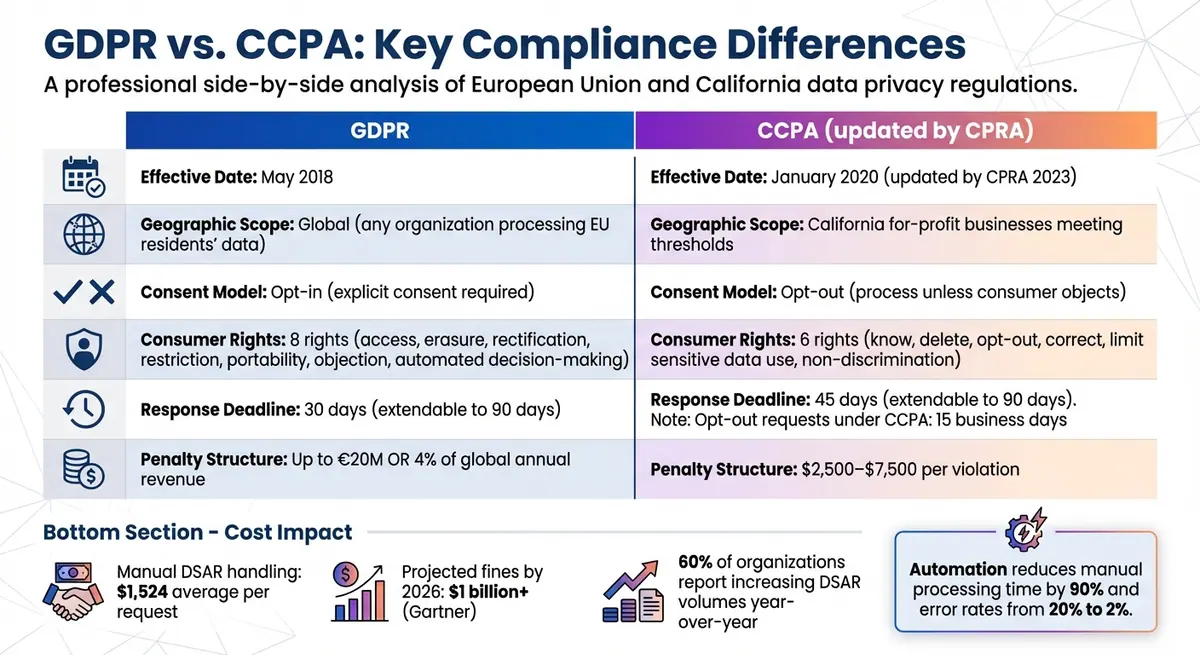
GDPR vs CCPA Compliance Requirements Comparison Chart
How GDPR and CCPA Differ
Scope and Who Must Comply
The GDPR applies to any organization that processes the data of EU residents, no matter where the organization is located. This means private companies, non-profits, and public bodies worldwide must comply if they handle data belonging to EU residents. Essentially, dealing with EU resident data triggers GDPR compliance, regardless of the organization's location.
On the other hand, the CCPA is specific to California-based for-profit businesses that meet certain thresholds. These thresholds include having annual gross revenue over $25 million, buying, receiving, or selling personal data of 50,000 or more California residents, households, or devices, or earning at least 50% of annual revenue from selling personal data. Unlike GDPR, which covers public bodies and institutions, CCPA focuses on specific for-profit entities.
The two laws also differ in how they handle consent. GDPR operates on an opt-in model, requiring explicit consent before processing personal data. In contrast, CCPA uses an opt-out approach, allowing businesses to process data unless consumers explicitly request otherwise.
Data Rights Under Each Law
When it comes to individual rights, GDPR and CCPA offer different sets of protections. GDPR provides eight key rights, such as access, rectification, erasure (often referred to as the "right to be forgotten"), restriction of processing, data portability, objection, and safeguards against automated decision-making. Meanwhile, CCPA, as updated by CPRA, grants six consumer rights: the right to know (access), delete, opt out of the sale or sharing of data, correct inaccurate information, limit the use of sensitive personal information, and non-discrimination.
Here’s a side-by-side comparison of some key features:
| Feature | GDPR | CCPA / CPRA |
|---|---|---|
| Primary Focus | Governing all data processing activities | Regulating the sale and sharing of data |
| Applicability | Any organization processing EU data | For-profit businesses meeting specific thresholds |
| Right to Opt-Out | Right to object to processing | Right to opt-out of sale or sharing of data |
| Sensitive Data | "Special categories" (e.g., race, health) | "Sensitive personal information" (e.g., biometrics) |
| Data Portability | Required in a structured, machine-readable format | Required (right to receive/portability) |
| Enforcement | Data Protection Authorities | California Attorney General / Privacy Protection Agency |
A major distinction lies in the handling of sensitive data. GDPR requires explicit consent upfront to process sensitive data categories, like health or racial information. CCPA/CPRA, however, focuses more on the consumer's right to limit how sensitive data is used after it has already been collected.
Response Time Requirements
Timelines for responding to data requests also diverge between GDPR and CCPA. Under GDPR, businesses must respond to Data Subject Access Requests (DSARs) within one calendar month from the date of receipt. For complex cases, this can be extended by up to two additional months (three months total). If an extension is necessary, the individual must be notified within the first month.
For CCPA, the timeline is slightly different. Businesses must respond to requests to know, delete, or correct within 45 calendar days, with the option of a 45-day extension (totaling 90 days) if the consumer is informed of the delay and its reason. Opt-out requests, however, require action within 15 business days.
The timing begins as soon as the request is received. If identity verification is needed, the clock starts only after verification is complete. Timely responses are crucial to avoid penalties and maintain consumer trust. As Matt Kelly puts it:
"The business needs a process to receive and answer DSARs at scale - because you might have dozens or hundreds of DSARs at any one time, requiring your business to sift through potentially millions of records."
BigID Demo: AI-Powered DSR Automation for GDPR, CCPA & Global Privacy Rights
Why Automate DSAR Compliance
Handling DSARs manually is time-consuming and expensive. On average, these workflows take 3–4 weeks to complete, which makes meeting the 30-day GDPR or 45-day CCPA deadlines challenging. The risks of non-compliance are steep. For example, in May 2025, Todd Snyder, Inc. faced a $345,178 fine for CCPA violations, including demanding excessive identity verification and delaying opt-out requests by over 40 days. Gartner projects that fines related to mishandling subject rights will surpass $1 billion by 2026. With 60% of organizations reporting an increase in DSAR volumes year-over-year, automation is no longer just helpful - it’s a necessity.
Simplifying Request Intake and Verification
Automation streamlines DSAR intake by consolidating requests from various channels - email, web portals, social media, and APIs - into a single, unified queue. This eliminates the risk of requests being lost in inboxes or scattered across departments. Instead of juggling spreadsheets and email chains, teams can manage everything from one dashboard.
Identity verification becomes quicker and more secure with tiered authentication. For straightforward requests, an email confirmation might suffice, while high-risk data requests can trigger multi-factor authentication or ID checks. This approach strikes a balance: it avoids the "excessive" verification barriers regulators penalize while safeguarding against unauthorized access. Automated systems use existing data to verify identities, eliminating the need for additional document collection.
Retrieving Data and Delivering Responses
With API-driven automation, systems can simultaneously search CRMs, HR platforms, cloud storage, and databases. What once took weeks of manual effort can now be completed in hours. By correlating identifiers like email addresses, account numbers, and phone numbers, these tools locate scattered personal data across various silos.
AI-assisted redaction enhances accuracy by identifying and masking third-party information in unstructured files. This reduces the error rate from around 20% with manual efforts to just 2%. It ensures that other individuals’ data isn't accidentally disclosed during the process. Final responses are delivered through encrypted portals instead of insecure email, keeping sensitive information safe from interception. Automation can cut work hours for identifying personal information by 90% and reduce the time spent assessing that data by 60%.
Monitoring Deadlines and Compliance
Automated tools handle jurisdiction-aware deadline tracking, calculating whether a request falls under a 30-day (GDPR) or 45-day (CCPA) timeline. As deadlines approach, the system triggers escalations, helping businesses avoid fines tied to missed timelines.
Every step of the process - receipt, verification, data discovery, and delivery - is automatically logged, creating an immutable audit trail. This detailed record demonstrates compliance during audits. As Omer Imran Malik, Data Privacy Legal Manager at Securiti, puts it:
"The motto for CCPA compliance needs to be 'automate where you can'."
sbb-itb-5f36581
Using Reform for DSAR Compliance
When it comes to managing DSAR (Data Subject Access Request) workflows, Reform provides a user-friendly way to create compliant forms and integrate them with your essential business tools. With its no-code platform, Reform simplifies the creation of DSAR forms that meet GDPR and CCPA standards. Instead of relying on generic email addresses or scattered submission channels, businesses can create forms that guide users through the process step by step. These forms then connect seamlessly with existing tools, ensuring an efficient workflow.
Building Compliance Forms Without Code
Reform allows teams to design DSAR forms without needing technical expertise. Conditional routing ensures that requests - whether for accessing, deleting, or transferring data - are sent to the appropriate department, cutting down on confusion and vague submissions. Features like drop-down menus let users specify their requests, such as "Access My Data", "Delete My Data", or "Opt Out of Sale", before providing additional details. To maintain accuracy, email validation filters out typos and fraudulent submissions, ensuring reliable contact information.
Connecting with CRMs and Business Tools
Once forms are built, Reform's integrations make processing DSARs even more efficient. The platform connects with tools like HubSpot, Zapier, Google Sheets, and Salesforce, automating data collection and response workflows. Submissions from DSAR forms can flow directly into your CRM or project management tools, eliminating manual data entry and reducing the risk of lost requests. This centralized intake system also consolidates submissions from various channels, such as web forms and social media, into one place. By leveraging existing CRM data, businesses can verify identities without requiring additional documentation. Automated workflows further streamline the process by assigning tasks immediately after identity verification, helping organizations meet GDPR's 30-day and CCPA's 45-day deadlines.
Protecting Data and Ensuring Accuracy
To safeguard resources, Reform includes spam prevention and email validation features that block bots and fraudulent submissions. Its lead enrichment capabilities also cross-reference submitted data with existing records, allowing teams to confirm identities using information already on file. This reduces the need to collect new sensitive documents, keeping the process secure and efficient.
Conclusion: Managing DSAR Compliance with Automation
The GDPR and CCPA impose strict deadlines - 30 days and 45 days, respectively - for responding to DSARs. Missing these deadlines can lead to hefty fines, underscoring the need for efficient, automated DSAR management.
Handling DSARs manually is not only time-consuming but also expensive. Automation offers a way to cut costs and speed up the process. According to Gartner, fines related to mishandling data subject rights are expected to surpass $1 billion by 2026.
"The motto for CCPA compliance needs to be 'automate where you can'."
- Omer Imran Malik, Data Privacy Legal Manager, Securiti
Automation isn’t just about avoiding fines. It also enhances customer trust. Providing fast, secure responses shows that you prioritize privacy, reducing the risk of legal disputes and fostering stronger brand loyalty.
FAQs
What are the key differences between GDPR and CCPA when it comes to handling DSARs?
The GDPR and CCPA approach Data Subject Access Requests (DSARs) differently, particularly in terms of scope, verification, and user rights.
GDPR applies to data concerning EU residents and enforces strict identity verification. Organizations must take reasonable steps to confirm the requester’s identity before proceeding. It also requires detailed disclosures, such as the types of data collected, its purpose, sources, retention periods, and sharing practices. GDPR grants individuals a wide range of rights, including access to their data, the ability to request erasure, and data portability.
Meanwhile, CCPA focuses on California residents and typically allows for simpler verification methods. This might include account-based authentication or straightforward processes like using passwords. While both laws mandate timely responses to DSARs, CCPA emphasizes transparency, granting consumers rights like knowing what data is collected, requesting its deletion, or opting out of data sales. GDPR, however, demands a more detailed and rigorous approach, reflecting its broader coverage and stricter compliance requirements.
How does automation help reduce the costs and risks of managing DSARs?
Automation streamlines the process of managing Data Subject Access Requests (DSARs), cutting down on costs and reducing risks for businesses. By automating workflows, companies can handle the collection, processing, and response to these requests with greater efficiency. This approach minimizes manual labor and lowers the chances of errors, ensuring adherence to regulations like GDPR and CCPA. Staying compliant helps businesses avoid fines and legal complications.
Another major advantage is faster response times. Automation helps track deadlines and verify the validity of requests, ensuring everything runs smoothly. It also strengthens data governance by maintaining accurate compliance records, offering an extra layer of protection against both operational and legal risks. Ultimately, automation saves time, reduces resource use, and protects your organization from expensive mistakes and regulatory penalties.
Why is it essential to meet GDPR and CCPA response deadlines for data subject requests?
Meeting deadlines for GDPR and CCPA responses is a must when it comes to staying compliant with legal requirements. These regulations mandate that organizations handle data subject access requests (DSARs) quickly - either by fulfilling the request or explaining why it can't be processed.
Missing these deadlines can result in hefty fines, harm to your organization's reputation, and a breakdown in customer trust. Responding on time not only shows that you take data privacy seriously but also helps build and maintain solid relationships with your users.
Related Blog Posts
Get new content delivered straight to your inbox

The Response
Updates on the Reform platform, insights on optimizing conversion rates, and tips to craft forms that convert.




Drive real results with form optimizations
Tested across hundreds of experiments, our strategies deliver a 215% lift in qualified leads for B2B and SaaS companies.
