
.webp)
Lead Generation and DSAR Compliance: Tips



When it comes to lead generation, collecting personal data like emails and names is essential - but it comes with legal responsibilities. Regulations like GDPR (30-day response deadline) and CCPA (45-day response deadline) require businesses to handle Data Subject Access Requests (DSARs) efficiently. Failing to comply can lead to severe fines - up to 4% of global revenue under GDPR or $7,500 per violation under CCPA - and damage your brand's trustworthiness.
Here’s how to handle DSARs while improving lead generation:
- Consent Management: Use clear, checkbox-based consent forms. Log timestamps, IP addresses, and consent details to simplify compliance.
- Identity Verification: Verify requesters securely through email or multi-factor authentication to protect data and avoid fraudulent claims.
- Data Mapping: Maintain a detailed record of where personal data is stored to ensure quick retrieval during DSAR processing.
- Automation: Use no-code tools to automate DSAR workflows, saving time and reducing costs by up to 98%.
- Templates and Redaction: Standardize response templates and implement automated redaction for consistent, compliant replies.
- Channel Tracking: Centralize DSAR intake across all communication channels to prevent missed requests.
- Team Training: Train marketing teams to spot DSARs and escalate them promptly.
- Metric Tracking: Monitor DSAR response times, volumes, and costs to improve compliance and lead management.
- Record Keeping: Document all data processing activities to streamline audits and DSAR responses.
- Privacy-Safe Lead Enrichment: Enhance lead details responsibly, ensuring enriched data complies with privacy laws.
How To Manage GDPR Data Subject Access Requests (DSARs)
1. Build Forms That Capture Proper Consent
As mentioned earlier, ensuring trusted consent practices is crucial for both DSAR compliance and successful lead generation. Your lead generation forms serve as the starting point for DSAR compliance. Every field and checkbox on these forms plays a role in how effectively you can respond to DSAR requests. Under GDPR, consent must meet specific criteria: it should be freely given, specific, informed, and unambiguous. This means pre-ticked boxes or vague consent statements simply won’t cut it.
Compliance with DSAR Requirements
To stay compliant, use unchecked checkboxes with clear, specific consent language. For example, include statements like: "I agree to receive marketing emails from [Your Company]." This approach not only complies with GDPR but also makes DSAR processing more straightforward by clearly documenting what each lead has agreed to.
When collecting consent, log key details such as the timestamp, IP address, form name, consent version, and the options selected. This ensures you can demonstrate when and how consent was provided, as well as the information the user received at the time. For U.S. audiences under CCPA, include a "Do Not Sell or Share My Personal Information" link near your forms and promptly honor any opt-out requests.
A well-structured consent framework not only simplifies compliance but also improves lead quality, making DSAR handling smoother and more efficient.
Impact on Lead Generation Efficiency
Getting proper consent doesn’t just help with compliance - it also builds trust, which can boost conversion rates by 20–30% when combined with strong value propositions. Leads who actively opt in tend to be more engaged, resulting in fewer DSAR disputes, lower churn rates, and better nurturing opportunities. Automated consent logging further saves time, eliminating the need for manual record searches when requests come in.
Keep your data collection minimal. Ask only for essential information, like first name, last name, work email, and company. Any additional fields should be optional and include a brief explanation, like: "Used to personalize content recommendations." Shorter forms reduce abandonment rates, and fewer fields make data retrieval, export, or deletion much easier during DSAR processing. Clean, well-organized data from thoughtfully designed forms can lead to significant cost savings.
Ease of Implementation
Streamlining consent collection doesn’t have to be complicated. No-code form builders like Reform make it easy to set up compliant forms without requiring developer support. Multi-step forms are another great option - they encourage users to complete the process by breaking it into smaller, manageable steps. For added flexibility, use conditional logic to show U.S. visitors CCPA-specific disclosures while displaying GDPR-compliant language to EU users. Directly integrating your forms with your CRM ensures that consent details - like timestamps and source information - are automatically recorded, turning what could be a manual task into a quick database query.
Write consent notices in plain U.S. English, using clear date formats (MM/DD/YYYY) and accessible language. Be upfront about what data you collect, why you collect it, how long you’ll keep it, and who it might be shared with. Include links to your Privacy Policy and, if applicable, a CCPA rights page. To strike the right balance between compliance and conversions, A/B test the placement and wording of your consent text.
Scalability for Growing Businesses
As your business grows, your consent-capturing forms should scale seamlessly without creating bottlenecks. Tools like advanced spam prevention and real-time email validation help maintain data quality, which becomes increasingly important as DSAR requests rise alongside your database size. Integrate your marketing tools - such as custom field mapping, duplicate handling, and automated workflows - to ensure consent data flows smoothly across your systems.
Keep an eye on metrics like opt-in rates (aim for 70% or higher), form abandonment rates (keep these under 20%), and the ratio of DSAR requests to total leads. A low DSAR-to-lead ratio often reflects strong consent practices. Some organizations have even cut DSAR processing costs by up to 98% by using automated systems that rely on clearly captured, searchable consent data. Lastly, when a user withdraws consent, update their record instead of deleting it entirely. This ensures you maintain an audit trail that shows their request was honored.
2. Set Up Identity Verification for Data Requests
Ensuring secure and efficient identity verification is a key step in protecting data and managing Data Subject Access Requests (DSARs) effectively.
Compliance with DSAR Requirements
Before sharing any personal data, it's crucial to verify the identity of the requester. GDPR mandates verifying identity by matching provided details with existing records, avoiding unnecessary demands for excessive proof. Organizations must adhere to GDPR's one-month deadline and CCPA's 45-day timeframe for processing requests. The CCPA also requires offering at least two submission methods, such as a toll-free number and a web form. Verification methods can include government-issued IDs, utility bills, or account details. If identity verification isn't possible, denying the request is allowed under these regulations.
Always use secure, encrypted channels for communication and maintain a detailed audit trail of the verification process. The level of verification should align with the sensitivity of the data. For less sensitive information, confirming an email address might suffice. However, for highly sensitive data, additional measures like document uploads or multi-factor authentication may be necessary.
Impact on Lead Generation Efficiency
Strong identity verification not only ensures compliance but also improves the quality of your leads. By preventing fraudulent data requests, you protect your database from disruptions that could hinder marketing efforts. Automated verification tools can significantly cut down on manual review times, transforming what used to take days into a matter of hours. This efficiency allows teams to focus on nurturing genuine leads rather than chasing incomplete or invalid requests. Plus, a seamless verification process builds trust with your leads, fostering long-term engagement and ensuring your marketing efforts target accurate, up-to-date contacts.
Ease of Implementation
Implementing an efficient verification process doesn’t have to be complicated. Start by assigning a dedicated DSAR contact or team and offering multiple request intake channels, such as email, web forms, or phone. Use a checklist to confirm key details like email addresses, names, and recent interactions (e.g., a webinar registration). Incorporate multi-step verification methods, such as sending confirmation codes or providing a secure portal for uploading documents like a masked driver’s license.
No-code tools like Reform make it simple to set up multi-step DSAR forms. These forms can include conditional logic to route requests to the right verification steps based on criteria like email matches. Reform also integrates spam prevention and real-time analytics, all without requiring developer involvement. For instance, one SaaS company reported an 80% reduction in verification time by using form-based, multi-step checks.
Scalability for Growing Businesses
As your business grows, scalable verification processes become essential to handle increasing DSAR volumes. Manual verification might work for smaller operations processing fewer than 100 requests annually, but automated workflows are necessary as volumes rise. Automated tools can integrate with your CRM to handle spikes in requests while meeting GDPR deadlines. AI-powered platforms, for example, can process thousands of requests monthly without requiring a larger team.
To ensure success, track metrics like a verification success rate above 95%, an average verification time under 24 hours, and false positive rejections below 5%. Regular audits can help you identify and fix bottlenecks before they affect your operations, ensuring compliance measures remain efficient and don’t slow down your marketing activities.
3. Map Your Data for Fast Retrieval
Once you've secured consent and verified identities, the next step in handling DSARs efficiently is mapping your data. Data mapping involves creating a detailed record of personal data: where it’s stored, how it moves between systems, and who has access to it. This process is crucial for meeting tight deadlines like GDPR's one-month and CCPA's 45-day response requirements. Without a clear map, you’ll find yourself scrambling through scattered systems when a DSAR lands on your desk.
To create a thorough data map, include every tool that processes lead data - CRMs, marketing automation platforms, email services, analytics tools, customer support systems, spreadsheets, and even ad platforms. For each system, document the specific data types (e.g., name, email, phone, IP address, consent status, or campaign source), the legal basis for processing, retention periods, and whether data is shared with third parties. This detailed record makes retrieving data systematic and far less time-consuming. Not only does this approach ensure compliance with deadlines, but it also slashes the time needed to respond to requests.
Impact on Lead Generation Efficiency
A well-maintained data map significantly reduces the time spent searching for data across multiple systems. Some providers report that automated workflows tied to a robust data inventory can reduce manual effort from days to mere minutes. This efficiency allows marketing and operations teams to focus on nurturing leads instead of chasing down data.
Quick, accurate DSAR responses also help avoid campaign disruptions. Without a proper map, teams might resort to drastic measures like halting campaigns or deleting data indiscriminately - moves that can hurt your sales pipeline. A strong data map helps identify which information is critical for effective segmentation and personalization, and which is unnecessary. This clarity supports leaner data usage while still enabling targeted campaigns that boost conversions and lead quality.
Ease of Implementation
If you’re just starting out, don’t worry - you don’t need a massive engineering team to build a data map. Begin with the basics: list all tools that handle personal data, talk to the owners of each tool to understand what data is stored and why, and document the flow of information (e.g., "website form → form tool → CRM → email platform"). Even a simple spreadsheet with columns like "System, Data types, Owner, DSAR search method, and Third-party sharing" can make a big difference in streamlining DSAR responses.
No-code tools can make the process even easier. For instance, Reform’s custom mapping features help track how lead data flows from forms into CRMs and marketing platforms, ensuring accurate data handling and eliminating duplicates. By connecting tools like your form builder, CRM, and DSAR management software, you can create a centralized system that quickly identifies where the requester’s data is stored.
Scalability for Growing Businesses
As your business grows and adopts new tools or channels, a well-structured data map ensures that you can scale without chaos. Using consistent fields like system name, owner, data categories, processing purpose, region, and retention periods allows you to add new systems seamlessly without having to rebuild the entire map. For larger organizations managing hundreds of data sources across cloud providers and SaaS tools, centralizing this information and automating updates are key to staying compliant.
Data mapping also uncovers undocumented "shadow IT" systems - tools or platforms being used without formal oversight. To prevent these from creating compliance gaps, document every new vendor or integration in your map before it goes live. Regular audits - twice a year for smaller teams and quarterly for larger ones - help ensure your map remains accurate. Running sample DSAR drills and comparing results to expectations can highlight any gaps. Tracking metrics like response times and the percentage of systems mapped also ensures your compliance efforts keep pace with your growing data environment. By staying on top of these practices, you’ll maintain an efficient DSAR process no matter how much your business expands.
4. Use No-Code Tools to Automate DSAR Workflows
Handling DSARs manually can drain resources that would be better spent on lead generation. No-code automation tools simplify the process by managing tasks like request tracking, identity verification, data retrieval, redaction, and response generation - all without needing a developer. These tools integrate seamlessly with your CRM systems and data stores, ensuring procedures remain consistent while meeting GDPR’s one-month and CCPA’s 45-day response deadlines.
Compliance with DSAR Requirements
No-code platforms make staying compliant with DSAR regulations more manageable. They automate tracking requests and managing deadlines, helping you consistently meet required timeframes. Advanced features like permanent redaction technology protect sensitive data, while detailed audit trails provide proof of compliance during inspections - often reducing the risk of penalties for incomplete or late responses. By automating these processes, you not only meet legal obligations but also free up resources to improve marketing workflows.
Impact on Lead Generation Efficiency
AI-powered no-code DSAR tools can cut processing costs by as much as 98% and significantly reduce the risk of violations. This efficiency lets marketing teams focus on driving campaigns instead of wasting time chasing data across multiple systems. Tools like Reform enhance lead generation by using multi-step forms, conditional routing, and lead enrichment to collect high-quality, consented leads - all while automating DSAR workflows. With real-time analytics and CRM integrations, these solutions ensure that compliance doesn’t come at the cost of marketing performance.
Ease of Implementation
One of the best parts of no-code tools is how easy they are to implement. You don’t need a technical background to get started. Begin by connecting the tool to your existing data stores and CRM systems - platforms like Reform offer built-in integrations to make this process simple. Use pre-built templates to standardize your workflows, and most teams can have everything up and running within just a few days. Set up automated tracking, deadline notifications, and connect request channels like forms and email. The drag-and-drop interface simplifies training, so your team can quickly adapt to the new system.
Scalability for Growing Businesses
No-code tools aren’t just efficient - they’re built to grow with you. As your business scales and lead volumes increase, these platforms can handle a higher number of DSARs across expanding data sources without driving up costs. AI-powered systems optimize workflows, track performance metrics, and ensure compliance even as your operations expand. Reform’s real-time analytics and conditional logic help manage larger lead volumes while keeping everything compliant. Regular audits through these tools reduce the risk of breaches, cutting response times from weeks to days and giving you peace of mind that your campaigns remain uninterrupted.
5. Create Standard Response Templates and Redaction Rules
Handling DSARs (Data Subject Access Requests) manually can eat up time and lead to inconsistent or noncompliant responses. By using standard response templates, you can streamline the process with predefined formats for full disclosures, redacted responses, or refusal notices for invalid requests. These templates should include placeholders for essential details like request IDs, dates, and requester information. This ensures every response aligns with regulatory standards while still allowing room for case-specific adjustments. Templates like these complement automated DSAR workflows, ensuring responses are both consistent and compliant.
Compliance with DSAR Requirements
To meet regulatory standards, templates must allow for full data disclosure or proper redaction within the required deadlines. Redaction rules should ensure sensitive, third-party, or legally protected information is permanently removed - not just hidden. This is critical because obscured data can sometimes be recovered, which has led to penalties in the past. Permanent redaction also creates clear audit trails, documenting every action taken. These records can demonstrate good faith compliance during regulatory inspections.
Impact on Lead Generation Efficiency
Standardized templates also improve efficiency by cutting out the need for manual searches and one-off responses to each DSAR that comes through lead forms or marketing channels. Automating these processes can significantly reduce costs and minimize the risk of violations. For marketing teams, this means fewer disruptions. Instead of scrambling to handle data requests, they can stay focused on campaigns, keeping lead generation efforts running smoothly.
Ease of Implementation
Start by creating 5–10 templates for common DSAR scenarios, such as full disclosures, partially redacted responses, and refusal notices that include appeal instructions. These can be paired with brief, one-hour training sessions to help your team apply the templates effectively. You can also integrate no-code tools for automated redaction - platforms like Reform make this easier by offering secure delivery options and built-in audit logging. With these tools, teams can establish consistent workflows in just a few days, no coding expertise required.
Scalability for Growing Businesses
As your business scales and lead volumes grow, standardized templates and automation can help you manage increasing DSAR requests without needing to hire more staff. Clear documentation and templates make it easy for any trained team member to take over the process, ensuring smooth transitions. By linking these systems directly to your data stores, you can scale your DSAR processing efficiently while staying compliant - and without sacrificing marketing performance.
6. Track Requests Across All Channels
DSARs (Data Subject Access Requests) can come from almost anywhere - web forms, emails, phone calls, live chat, social media DMs, in-app messages, or even physical mail. If your marketing team gathers leads through multiple touchpoints, you must have a system to track these requests across every channel. Missing a DSAR because it ended up in the wrong inbox or got lost in a sales thread can lead to costly compliance violations and erode trust with potential customers. This makes having a reliable tracking system absolutely critical to meeting regulatory obligations.
Staying Compliant with DSAR Requirements
Regulations impose strict deadlines for responding to DSARs, and they require thorough documentation of how each request is handled. To stay on top of this, you need to maintain detailed logs for every request. These logs should include key details like timestamps, the channel through which the request was received, verification steps taken, and the final response. Not only do these records demonstrate compliance during audits, but they also show regulators that your organization is acting in good faith. Businesses using automated platforms for DSAR tracking have reported up to a 98% reduction in processing costs and have significantly lowered their risk of violations.
Boosting Lead Generation Efficiency
Centralized tracking ensures no DSARs fall through the cracks, even when they come from different marketing channels. Without a unified system, your team could waste time searching for scattered data across various inboxes and tools. A centralized approach speeds up the process, freeing your team to focus on nurturing leads instead of chasing compliance issues. Plus, quick and accurate responses keep your lead database clean and respectful of consent, which improves email deliverability and fosters trust over time. In short, a unified tracking system not only streamlines DSAR responses but also sets the stage for scalable compliance as your business grows.
Simple Setup for Smooth Operations
To get started, assign a dedicated DSAR contact and implement a unified inbox or ticketing system that integrates seamlessly with your forms and CRM. For example, Reform offers branded, multi-step DSAR forms with features like email validation and conditional routing, which feed directly into your tracking system. Train your customer-facing teams - sales, marketing, support, and social media - to identify DSAR-related phrases like "access my data" or "delete my information" and forward them to the centralized process. With short training sessions and clear workflows, you can have your system up and running in just a few days. By consolidating DSAR tracking, you’ll enhance both your compliance efforts and your marketing efficiency.
Scaling for Business Growth
As your lead volume increases, managing DSARs across disconnected channels becomes a bigger challenge. Requests may be missed, delayed, or handled inconsistently. Automated systems that integrate with your growing data infrastructure solve this problem by standardizing processes and tracking key metrics like response times to ensure you remain compliant. By linking your DSAR workflow with your CRM and marketing automation tools, updates such as opt-outs or data deletions automatically sync across all databases and suppression lists. This eliminates the need for manual updates, keeping your systems aligned and ready to handle growth without compromising compliance.
sbb-itb-5f36581
7. Train Your Marketing Team to Recognize DSARs
Once you've established solid DSAR workflows, the next step is ensuring your marketing team can spot and escalate data requests effectively. Whether it’s an email, a social media message, or a chat inquiry, any request for data access or deletion should be treated as a DSAR. These requests come with strict legal deadlines - 30 days under GDPR and 45 days under CCPA/CPRA. Missing these deadlines not only risks regulatory fines but also damages the trust you’ve worked to build with your audience.
Recognizing and Handling DSARs
One of the biggest challenges is preventing DSARs from slipping through unnoticed. Regulators have fined businesses for failing to meet deadlines or for incomplete responses. Your marketing team needs to understand that DSARs don’t have to use formal legal terms. Phrases like “I want a copy of my data,” “Delete all my information,” “Stop selling my data,” or “I don’t want to be tracked” all qualify. These requests can come through various channels - email, social media, live chat, contact forms, phone calls, or even in-person interactions.
The key is training your team to recognize these signals and promptly escalate them to your privacy contact or DSAR tracking system. Make it clear that they shouldn’t promise specific outcomes or try to handle the request themselves through marketing tools. This approach ensures a smooth handoff, keeping your processes efficient and compliant.
Supporting Lead Generation Through DSAR Training
Proper DSAR training doesn’t just protect you from legal trouble - it also helps your marketing efforts. When your team can quickly identify and escalate these requests, you avoid complications like regulatory complaints, delays in campaigns, or email deliverability issues caused by mishandled opt-outs.
Companies that manage DSARs well often see healthier email lists, fewer spam complaints, and better engagement rates. Keep the training simple and practical - about 30 to 45 minutes per quarter should suffice. Focus on “spot-and-escalate” strategies rather than overwhelming your team with dense legal details. Tools like decision trees and pre-written escalation templates can help your marketers act quickly while staying focused on nurturing leads.
Making DSAR Training Easy to Implement
Rolling out DSAR training doesn’t have to be complicated. Start with a one-page playbook that includes real examples from your communication channels, such as “Delete my information from your mailing list and systems.” Provide clear instructions on how to log and escalate requests, emphasizing key do’s and don’ts. For example:
- Do: Acknowledge receipt immediately and escalate within 24 hours.
- Don’t: Delete records or promise deletion before verifying the requester’s identity.
Integrate DSAR recognition into your marketing onboarding process and run occasional drills with simulated DSAR requests to keep your team sharp. Tools like Reform can simplify the process by offering branded DSAR forms with features like email validation and conditional routing. These integrate seamlessly with your tracking system, making it easy for marketers to flag requests without disrupting their daily tasks.
Scaling DSAR Processes for Growth
As your business and lead volume grow, the likelihood of DSARs coming in from multiple channels increases. A scalable training program includes regular refreshers - at least once a year or whenever regulations change - and incorporates DSAR recognition into broader privacy training.
Track metrics like how often DSARs are identified correctly on the first contact and how quickly they’re resolved. Gather feedback from your team, including SDRs and campaign managers, to refine your scripts and playbooks based on real-world scenarios. By embedding DSAR awareness into your operations, you can stay on top of compliance while avoiding bottlenecks and missed deadlines as your organization expands.
8. Track DSAR Metrics to Improve Lead Generation
Compliance with DSAR Requirements
Under GDPR, organizations must respond to Data Subject Access Requests (DSARs) within 30 days, while CCPA allows up to 45 days. To stay compliant, it's essential to monitor key metrics like the monthly volume of DSARs (categorized by type - access, deletion, correction, opt-out), average and median response times, percentage of requests handled within legal deadlines, reasons for any refusals or extensions, and the channels through which requests are received (email, web forms, phone, or social media). Additionally, tracking the number of data sources searched per request is crucial for maintaining an efficient process.
Companies leveraging AI-powered DSAR platforms have reported up to 98% reductions in processing costs and fewer compliance violations compared to manual methods. Keeping a detailed audit trail allows you to assess how often marketing data is affected by data rights activities. This insight helps you understand the broader impact on your lead database. Beyond compliance, these metrics can guide you in refining your lead generation strategies.
Impact on Lead Generation Efficiency
Once compliance metrics are in place, use them to assess how DSARs influence your lead generation efforts. For instance, spikes in deletion or opt-out requests immediately after sign-ups, or DSAR surges linked to specific campaigns, could indicate issues with your consent language, targeting, or user expectations. Complaints like "I never signed up" or identity disputes might also highlight gaps in your data collection practices.
Prompt and accurate DSAR responses can enhance trust and reduce churn. Monitoring response times and ensuring requests are closed on time demonstrates respect for user rights, which can lead to fewer opt-outs caused by frustration with slow or unclear processes. This approach helps preserve your qualified lead pool. Additionally, tagging CRM records for contacts who submit DSARs allows you to analyze their behavior - such as conversion rates, unsubscribe patterns, and customer lifetime value - compared to those who don't submit requests. This data offers valuable insights for optimizing your lead generation funnel.
Ease of Implementation
Tracking DSARs effectively doesn’t require a complete overhaul of your technology stack. Centralize DSAR intake within your CRM or ticketing system by using standardized fields for details like request type, date received, verification status, data systems searched, and closure date.
Tools like Reform can streamline this process by providing branded DSAR intake forms with features like email validation and conditional routing. Over time, integrating your form tool with your CRM and privacy software can automate tasks such as request creation, deadline reminders, and status updates - reducing manual effort and improving accuracy.
Scalability for Growing Businesses
As your business grows, scaling DSAR management becomes critical. Start by automating deadline reminders and maintaining detailed audit logs. Design metrics and workflows that can be applied consistently across different regions, departments, and systems to handle increased DSAR volumes without significantly adding to your team’s workload or risking missed deadlines.
Using tools that integrate with major data repositories and provide exportable audit logs can help you manage higher request volumes efficiently. Regular reviews of DSAR trends - whether quarterly or monthly - should inform updates to your privacy policies, consent language, internal processes, and training materials. These adjustments not only strengthen compliance but also improve your lead generation strategies over time.
9. Keep Records of All Data Processing Activities
Compliance with DSAR Requirements
Under GDPR Article 30 and various U.S. state privacy laws, organizations must keep detailed records of how they handle personal data. For lead generation, this involves documenting key details like where leads come from, what data is collected (e.g., email addresses, job titles), why it’s collected (e.g., newsletter signups, sales outreach), and where it’s stored or accessed (e.g., CRM systems, email platforms, ad tools). Records of Processing Activities (RoPA) serve as evidence that your data handling complies with legal standards.
When you receive a Data Subject Access Request (DSAR), it’s essential to log every step: the date you received the request, how you verified the individual’s identity, which systems you searched, what data was disclosed or deleted, and when you responded. This detailed audit trail demonstrates a structured approach to compliance, which can help mitigate penalties if technical issues arise. Beyond meeting legal requirements, maintaining these records can also streamline your operations.
Impact on Lead Generation Efficiency
Keeping detailed records eliminates the need to hunt down lead data across multiple tools, saving time and effort. This efficiency not only ensures compliance but also allows your marketing team to focus on nurturing high-quality leads instead of getting bogged down in manual searches.
Additionally, analyzing these records can reveal recurring issues in your lead-generation process. For example, if DSAR logs highlight problems like outdated email lists or slow vendor response times for data deletion, you can address these bottlenecks to improve both compliance and the overall quality of your data.
Scalability for Growing Businesses
As your lead volume grows, managing data manually becomes increasingly impractical. Just like with automated DSAR processes, adopting RoPA tools can simplify lead management in a data-heavy environment. These tools integrate with your CRM and marketing platforms to centralize records, track deadlines automatically, and maintain detailed audit trails.
For instance, platforms like Reform can capture form submissions along with metadata such as timestamps, IP addresses, and consent details. By linking your form builder with your CRM and privacy management software, you create a system that scales effortlessly with your business - no extra manual effort required. This approach not only supports compliance but also keeps your operations running smoothly as your data needs expand.
10. Use Lead Enrichment with Privacy Safeguards
Compliance with DSAR Requirements
Incorporating privacy-safe lead enrichment into your streamlined DSAR workflows not only strengthens compliance but also improves the quality of your leads. Lead enrichment involves enhancing basic lead details - like job titles, company size, and social profiles - using external databases. However, under GDPR and CCPA, this enriched data qualifies as personal information and must be handled according to strict regulations. This means you need a lawful basis for processing (like consent or legitimate interest), clear privacy notices that explain the sources of the data, and the ability to include all enriched information in DSAR responses.
Regulators often view profiling and enrichment as high-risk activities, which may require a Data Protection Impact Assessment (DPIA) and greater transparency. Companies that fail to explain the origin of enriched data or omit it from DSAR exports face increasing scrutiny. To stay compliant, update your privacy notices to clarify that data is enriched using third-party sources. Be specific about the types of data being added and explain how it supports lead management or personalized outreach efforts.
Impact on Lead Generation Efficiency
When done correctly, privacy-compliant lead enrichment enhances efficiency by improving the accuracy and quality of your leads. Businesses that provide valuable content, like ebooks or webinars, in exchange for opt-ins before enrichment often achieve 20–30% higher conversion rates through more targeted marketing. Keeping enrichment focused on necessary data minimizes bounce rates and ensures resources are directed toward high-quality leads.
Automated platforms for consent-based enrichment can significantly cut costs related to DSAR processing - by as much as 98% - through detailed audit trails that log enrichment sources and timestamps. For instance, one marketing firm integrated enrichment into their automated DSAR workflows, enabling them to meet 30-day response deadlines while boosting lead conversion rates by 25%. Regularly evaluating whether enriched attributes improve conversion or lead qualification is essential. If certain fields don’t deliver results, removing them can lower privacy risks and reduce DSAR-related workloads.
Ease of Implementation
No-code platforms make it simpler than ever to implement privacy-compliant enrichment. Tools like Reform provide features such as lead enrichment, email validation, and spam prevention, all with GDPR/CCPA-compliant consent options accessible through an intuitive drag-and-drop interface. Multi-step forms allow you to collect only the data you need while seamlessly integrating with your CRM to ensure secure, real-time data flows that are DSAR-ready.
Technical safeguards are key to maintaining compliance. These include opt-in checkboxes (unchecked by default) for data appending, encryption for secure storage and transmission, and detailed logs that track enrichment sources. Reform also offers built-in threat detection to keep form submissions clean and compliant, all without requiring developer expertise.
Scalability for Growing Businesses
As your lead volume grows, manual enrichment quickly becomes unmanageable. Automated workflows integrated with CRMs can handle large volumes efficiently while maintaining compliance. Features like multi-channel request logging and performance metrics help ensure you meet DSAR response deadlines, even with thousands of monthly requests.
Moving toward first-party, consent-based enrichment - where data is gathered directly from users through forms and other owned channels - makes scaling easier. By combining Reform’s lead enrichment tools with your CRM and privacy management systems, you can automatically track consent updates, validate emails, and log every step of the enrichment process. This integrated approach eliminates bottlenecks as your data needs grow, with many organizations reporting significant efficiency improvements and stronger compliance.
Manual vs. Automated DSAR Processing
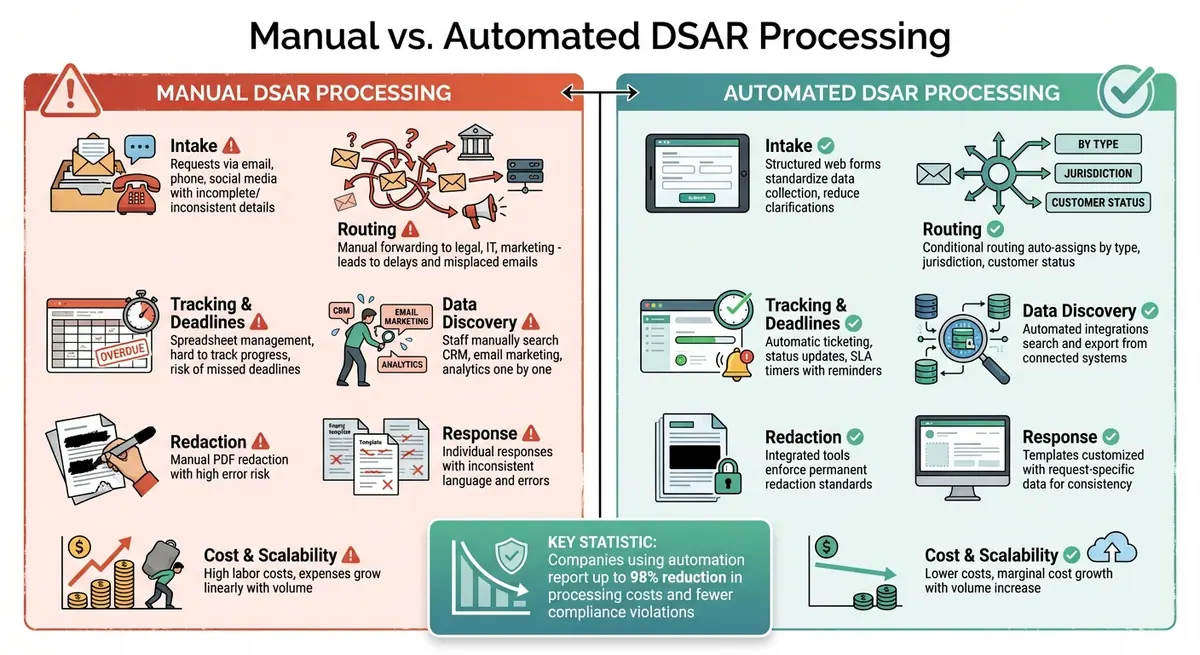
Manual vs Automated DSAR Processing: Key Differences and Benefits
Handling DSARs (Data Subject Access Requests) manually through various channels like email, phone, or social media can be a logistical nightmare. It often requires staff to juggle spreadsheets and manually redact sensitive information, which slows everything down, increases the chance of errors, and makes scaling nearly impossible. To address these issues, many organizations are turning to automated solutions for a more streamlined and reliable approach.
Automated workflows tackle these inefficiencies head-on. Companies using automation report lower costs and fewer compliance violations compared to manual methods. Instead of wasting time sifting through multiple systems, automated tools integrate directly with platforms like your CRM or marketing automation software to pull data seamlessly. Built-in redaction tools reduce the risk of errors, while pre-approved response templates ensure every communication aligns with company policies.
Here’s a side-by-side comparison of how manual and automated DSAR processing stack up:
| Aspect | Manual DSAR Processing | Automated DSAR Processing |
|---|---|---|
| Intake | Requests come in via email, phone, or social media, often with incomplete or inconsistent details. | Structured web forms standardize data collection, cutting down on back-and-forth clarifications. |
| Routing | Requests are manually forwarded to departments like legal, IT, or marketing, leading to delays or misplaced emails. | Conditional routing automatically assigns requests based on type, jurisdiction, or customer status. |
| Tracking & Deadlines | Managed through spreadsheets, making it hard to track progress and increasing the risk of missed deadlines. | Automatic ticketing, status updates, and SLA timers with reminders help ensure deadlines are met. |
| Data Discovery | Staff manually search through systems like CRM, email marketing, and analytics one by one. | Automated integrations search and export data from connected systems, reducing omissions. |
| Redaction | Sensitive data is manually redacted in PDFs, increasing the risk of errors. | Integrated redaction tools enforce permanent redaction standards within the workflow. |
| Response | Responses are written individually, which can lead to inconsistent language and errors. | Templates customized with request-specific data provide consistent, policy-compliant responses. |
| Cost & Scalability | Labor costs are high, and expenses grow linearly with request volume. | Costs are lower, and volume increases result in only marginal cost growth. |
Automation doesn’t just simplify DSAR processing - it ensures accuracy and efficiency while protecting the quality of your leads. With tools like Reform, conditional routing and CRM integrations handle DSAR submissions effortlessly. For example, when a DSAR form is submitted, the system can route employee requests to HR, marketing-related requests to the privacy team, and more complex cases to legal - all without manual intervention. Features like email validation and spam prevention keep your DSAR queue free of clutter, allowing your team to focus on legitimate requests without distractions.
Key DSAR Metrics for Lead Generation
Keeping tabs on the right DSAR (Data Subject Access Request) metrics not only ensures compliance but also highlights potential issues in your lead generation efforts. These metrics can pinpoint where your data collection might be creating unnecessary friction, show how efficiently your team handles privacy requests, and reveal whether your forms and campaigns inspire trust - or drive potential leads away.
Here’s a breakdown of key DSAR metrics that influence both compliance and lead generation success:
| Metric | Description | Target | Effect on Lead Generation |
|---|---|---|---|
| Response Time | Time taken from receiving a DSAR to fulfilling it | Under 30 days (ideally 7–14 days) | Quick responses build trust and reduce opt-outs, while delays can signal poor data practices, potentially hurting conversions. |
| Fulfillment Rate | Percentage of requests successfully completed | Over 95% | A high rate reflects strong data processes and supports better lead quality. |
| Accuracy Rate | Percentage of responses that are error-free and complete | Over 98% | Errors or incomplete responses damage trust and can reduce conversions by 15–25%. |
| DSAR Volume | Total number of requests received monthly | Less than 1% of total leads generated | A sudden spike could point to problems with consent practices; addressing this can improve conversion rates by 20–30%. |
| Cost Per Request | Resources spent per DSAR | Less than $50 for small teams | High costs often signal inefficiencies; automation can significantly reduce these expenses. |
| Requester Satisfaction | Measured through surveys on trust in data handling | Over 90% | Low satisfaction may harm reputation and lead to repeat requests, while improvements can boost opt-in rates by 10–20%. |
Tracking these metrics consistently can uncover compliance risks and inefficiencies in your processes. For instance, if DSAR volume spikes after launching a campaign, it might be a sign that your messaging or data collection methods need a closer look.
One organization, for example, boosted its fulfillment rate to 99% by conducting targeted audits, proving how focusing on these metrics can enhance both compliance and marketing outcomes. Tools like Reform can also streamline the process by integrating features such as email validation and spam prevention into your forms. This keeps your DSAR queue focused on legitimate requests while ensuring your lead data remains accurate and compliant from the start.
Conclusion
DSAR compliance isn’t just about meeting regulations - it can also be a powerful tool for generating leads effectively. By implementing strategies like creating consent-focused forms, mapping your data, automating workflows, and keeping an eye on key metrics, you build a system that safeguards both your business and your leads. Companies using AI-driven DSAR tools often see lower processing costs and fewer violations, showing that a smart approach can directly impact your bottom line.
The rise of automated, no-code solutions makes managing compliance easier than ever. Platforms like Reform simplify the process with features such as multi-step forms, conditional routing, lead enrichment, and spam prevention. These tools not only gather high-quality, compliant data but also reduce the need for manual work.
Staying compliant also means conducting regular audits, providing staff training, and keeping thorough records of your data processing activities. Regulations like GDPR and CCPA require responses within 30 and 45 days, respectively, and automated workflows help ensure you meet these deadlines while avoiding hefty penalties - potentially as high as 4% of annual revenue.
Beyond avoiding fines, efficient data handling builds trust with your customers. Treat compliance as more than a legal requirement - it’s an opportunity to show your commitment to privacy. When you manage data requests with speed and transparency, you send a clear message that you value privacy, which can resonate deeply with potential customers. This not only protects your regulatory standing but also creates a foundation for long-term growth.
Start by establishing scalable, automated DSAR processes and adjust them as your lead volume grows. Whether you’re managing a handful of leads or thousands each month, combining smart automation, clear consent practices, and consistent monitoring creates a system that supports both your compliance needs and your marketing ambitions.
FAQs
How does automation make DSAR processing more efficient?
Automation streamlines DSAR processing by taking over intricate tasks such as retrieving, validating, and routing data. This not only cuts down on manual effort but also helps reduce errors and ensures responses are both consistent and timely.
When businesses automate these steps, they can conserve resources, stay aligned with data privacy regulations, and handle requests more efficiently overall.
What makes a consent management system effective?
An effective consent management system prioritizes clear and straightforward communication, ensuring users fully understand what they’re agreeing to. Requests should be written in plain language, steering clear of confusing jargon. The system must also offer simple, user-friendly options for opting in or out, along with detailed controls that let individuals decide exactly how their data is used.
Transparency plays a crucial role here. Clearly explain how data will be used and give users the ability to update or withdraw their consent whenever they choose. On top of that, the system needs to securely store and manage consent preferences, ensuring compliance with regulations like DSAR while building and maintaining user trust.
Why is data mapping important for complying with DSAR requirements?
Data mapping plays a key role in DSAR compliance by helping organizations identify exactly where personal data is stored across their systems. This capability ensures they can effectively manage requests to access, delete, or correct data while adhering to regulatory requirements.
Having a clear and accurate data map allows businesses to simplify their processes, respond more quickly, and avoid the risks of non-compliance penalties. It also reinforces customer trust by showing a genuine dedication to safeguarding personal information.
Related Blog Posts
Get new content delivered straight to your inbox

The Response
Updates on the Reform platform, insights on optimizing conversion rates, and tips to craft forms that convert.




Drive real results with form optimizations
Tested across hundreds of experiments, our strategies deliver a 215% lift in qualified leads for B2B and SaaS companies.
