
.webp)
Global DPIA Standards for Tech Startups



Data Protection Impact Assessments (DPIAs) are crucial for startups handling sensitive data like health, financial, or biometric information. They help identify and address privacy risks before launching data processing activities. With privacy laws expanding globally, startups must navigate varying requirements under GDPR, US state laws, and India’s DPDPA. Here’s what you need to know:
- GDPR (EU): DPIAs are mandatory for "high-risk" activities, such as profiling or large-scale sensitive data processing. Even a single EU user triggers compliance.
- US State Laws: 18 states now require privacy assessments for activities like targeted advertising or sensitive data use. Thresholds (e.g., $26.6M revenue) often exempt early-stage startups.
- India’s DPDPA: Startups designated as Significant Data Fiduciaries (SDFs) must conduct annual DPIAs, covering all processing activities and cross-border data flows.
Key takeaway: Startups should establish a unified DPIA process, integrating privacy checks into workflows early to stay compliant as regulations grow more complex.
Maturing your GDPR compliance program: Data protection impact assessment (DPIA)
sbb-itb-5f36581
1. GDPR DPIA Baseline
The GDPR sets the standard for Data Protection Impact Assessments (DPIAs) worldwide - even for companies based in the U.S. If your business handles data from EU residents, these rules apply, no matter where your headquarters are.
DPIA Triggers
A DPIA is required when data processing is "likely to result in a high risk to the rights and freedoms of natural persons." Article 35 of the GDPR outlines three specific scenarios that trigger this requirement: automated profiling with significant effects on individuals, large-scale processing of sensitive data, and systematic monitoring of publicly accessible spaces.
In addition to these, the European Data Protection Board (EDPB) lists nine criteria to help assess high-risk processing. If your activity meets at least two of these criteria, a DPIA is recommended. For example, if a SaaS platform uses behavioral analytics to profile users for retention strategies, it would likely meet three criteria: evaluation/scoring, systematic monitoring, and large-scale processing.
| EDPB High-Risk Criterion | Implications for Tech Startups |
|---|---|
| Evaluation or scoring | Profiling or predicting user behavior, preferences, or performance |
| Automated decision-making | Decisions with legal or significant personal effects |
| Systematic monitoring | Tracking users in public or through covert methods |
| Sensitive data | Handling special categories like health, financial, or location data |
| Large-scale processing | High volumes of data or users across wide regions |
| Matching/combining datasets | Linking data from multiple sources |
| Vulnerable data subjects | Groups like children, employees, or elderly individuals |
| Innovative technology | AI tools, biometrics, or IoT applications |
| Rights prevention | Blocking access to services or contracts |
Understanding these high-risk scenarios helps businesses align their documentation and operational practices with GDPR requirements.
Scope and Documentation
A DPIA doesn’t have to be lengthy or overly complex. The UK Information Commissioner’s Office (ICO) emphasizes the importance of integrating DPIA findings into your project workflow:
"A DPIA is not simply a rubber stamp or a technicality as part of a sign-off process. It's vital to integrate the outcomes of your DPIA back into your project plan." - ICO
Key elements of a DPIA include documenting the processing activity, evaluating necessity and proportionality, identifying risks, and outlining safeguards. For similar processing activities with comparable risks, a single DPIA can cover multiple operations, reducing redundant paperwork. Even if a DPIA isn’t required, documenting your reasoning - such as a brief memo showing how the nine EDPB criteria were assessed - can be a valuable compliance tool during audits.
Cross-Border Data Handling
If your business involves transferring EU user data outside the European Economic Area (EEA) - for example, to a U.S.-based cloud provider - your DPIA must address this. Include safeguards like Standard Contractual Clauses (SCCs) or the EU-US Data Privacy Framework. This also extends to your vendors' sub-processors, as regulators frequently flag missing sub-processors in data maps.
"If you are sharing data with anyone... based outside the European Economic Area in a country that does not provide an adequate level of data protection... what safeguards do you have in place to protect the data in those third countries?" - Google Cloud
These safeguards should align with your broader compliance strategy as your company grows.
Startup-Specific Implications
For startups navigating GDPR compliance:
- Check national blacklists. Some EU countries, like France, have specific processing categories that always require a DPIA. Even if one country’s rules seem less stringent, stricter requirements in another can still apply.
- Treat your DPIA as a living document. Changes like introducing an AI feature, switching cloud providers, or onboarding a new vendor can trigger the need for an updated DPIA. If significant risks remain after implementing safeguards, Article 36 mandates notifying your supervisory authority before starting the processing activity.
2. US State Privacy Assessments
The privacy landscape in the US is evolving rapidly, with a growing number of state laws requiring businesses to perform data protection assessments. As of early 2026, 18 state privacy laws mandate assessments for processing activities that could pose significant risks. For tech startups operating across multiple states, this patchwork of laws means a one-size-fits-all approach won't cut it. Each state’s unique requirements call for tailored documentation processes.
DPIA Triggers
While the specifics vary, many state laws share common triggers for requiring Data Protection Impact Assessments (DPIAs). For instance, Virginia's Consumer Data Protection Act (VCDPA) and Colorado's Privacy Act (CPA) require assessments for high-risk activities like targeted advertising, processing sensitive data, and profiling that could lead to financial, physical, or reputational harm. California's privacy regulations go further, requiring assessments for high-risk activities such as AI training, biometric data processing, and automated decision-making technology (ADMT) starting January 1, 2026.
One standout exception is Utah, whose privacy law does not require assessments for targeted advertising, data sales, or sensitive data processing - making it an outlier among early state privacy laws.
| Processing Activity | California (CCPA/CPRA) | Colorado (CPA) | Virginia (VCDPA) |
|---|---|---|---|
| Targeted Advertising | Required for "Significant Risk" | Required | Required |
| Sale of Personal Data | Required for "Significant Risk" | Required | Required |
| Sensitive Data | Required | Required | Required |
| Profiling (Legal/Significant Effects) | Required | Required | Required |
| AI/ADMT Processing | Required | Required (Disclosures) | Not explicitly listed |
Scope and Documentation
State privacy assessments generally follow a similar structure: describe the activity, evaluate potential consumer harms, outline safeguards, and weigh the risks against the benefits. These documents need to be accurate and regularly updated, as regulators can request them at any time.
"Regulators can request these assessments at any time, organizations need accurate, regularly updated documentation of how personal data is collected, used, shared, and risk‑managed." - Nixon Peabody LLP
California adds an extra layer of complexity. For certain activities, assessments must include a senior executive attestation, and summaries of risk assessments conducted before 2026 must be submitted by April 1, 2028. Connecticut is also introducing a dedicated assessment for profiling with legal or significant effects, effective August 1, 2026, separate from its existing data protection assessment requirements.
Cross-Border Data Handling
Managing data transfers across state and national borders adds another layer of complexity for startups. Unlike the GDPR, US state laws don’t have an adequacy mechanism for international transfers. Instead, they regulate cross-border data flows through transparency requirements and vendor contracts. For example, if a startup shares personal data with an international cloud provider, it must disclose this in its privacy notice and ensure that Data Processing Agreements (DPAs) meet state-specific rules.
The risks of non-compliance are significant. In February 2026, the California Attorney General secured a $2.75 million settlement with the Walt Disney Company - the largest CCPA settlement to date - over non-compliance with opt-out rights. Similarly, in 2025, Connecticut’s Attorney General reached an $85,000 settlement with TicketNetwork, Inc. for a non-compliant privacy notice.
Startup-Specific Implications
Before building an assessment program, startups need to determine if they meet the thresholds for each state’s law. For instance, Delaware’s law applies to companies processing data from at least 100,000 Delaware consumers, while Rhode Island’s threshold is 35,000 residents. These thresholds vary widely, so startups with smaller user bases in certain states might not be subject to every law.
"With eighteen privacy laws now imposing assessment requirements, building a scalable, internal privacy assessment function has become essential for operational compliance." - Nixon Peabody LLP
To stay ahead, startups should focus on two key priorities: conduct assessments before starting any processing that poses significant risks, and keep an up-to-date inventory of all AI and ADMT tools in use. Automated decision-making remains a top enforcement priority in states like California, Colorado, and Connecticut.
3. India DPDPA Assessment Duties
India's Digital Personal Data Protection Act (DPDPA) takes a unique approach compared to GDPR and U.S. state laws by emphasizing an entity’s overall data processing responsibilities. Specifically, the obligation to conduct a Data Protection Impact Assessment (DPIA) is tied to whether a company is designated as a Significant Data Fiduciary (SDF) by the Central Government.
DPIA Triggers
The designation of SDFs depends on factors such as the volume and sensitivity of data processed, risks to Data Principal rights, and implications for national or public order. Once designated, an SDF is required to conduct a DPIA every year, regardless of whether new high-risk processing activities have been introduced.
This differs significantly from GDPR’s project-specific DPIA approach. Sunil Kumar Gupta, Chairman & Global Leader at SARC Global, explains:
“The GDPR DPIA is a scalpel: you use it on specific high-risk processing. The DPDP DPIA is a full-body scan: you assess everything, annually, and the regulator can look at the results whenever they want.”
This broader and more frequent evaluation carries serious consequences for non-compliance. An SDF that fails to conduct mandatory assessments could face penalties of up to INR 150 crore (approximately $18 million USD). This annual review process underlines the DPDPA’s expansive requirements for SDFs.
Scope and Documentation
The DPIA for SDFs must cover their entire data processing landscape. Documentation should include:
- A detailed account of all processing activities.
- An analysis of the impact on Data Principal rights, such as access, correction, erasure, grievance redressal, and nomination.
- Risk assessments based on likelihood and severity.
- Mitigation measures and any remaining residual risks.
The importance of thorough documentation cannot be overstated. As noted by SARC Data Protection Practice: "An enterprise that documents 'no residual risk' isn't being thorough; it's being unrealistic." For processing data involving individuals under 18, the DPIA must also include additional safeguards, such as obtaining verifiable parental consent and ensuring no behavioral tracking or targeted advertising, as the DPDPA prohibits such activities for children.
Cross-Border Data Handling
The DPDPA also regulates international data transfers through a "negative list" regime. Section 16 permits cross-border transfers unless a jurisdiction is restricted by the government. This requirement becomes fully effective 18 months after November 13, 2025, giving companies time to map foreign vendors. If a jurisdiction is restricted, companies may need to relocate data assets within 30–90 days.
SDFs are required to evaluate cross-border risks as part of their annual DPIA. This includes assessing whether overseas processors can comply with Data Principal rights, such as access or deletion requests, within the timelines mandated by the DPDPA.
Startup-Specific Implications
While most startups won’t immediately be designated as SDFs, they should still align with the framework. Adopting privacy-by-design practices early - such as using manual risk checklists for new features or embedding DPIA triggers into the development process - can help startups prepare for future scalability.
If a startup eventually becomes an SDF, it will need to appoint an in-country Data Protection Officer (DPO) to oversee DPIAs and act as a liaison with the Data Protection Board of India (DPBI). Since the DPBI can request DPIA documentation at any time, treating these assessments as formal regulatory deliverables from the start is crucial. These steps ensure startups are better positioned to navigate both local and global regulatory demands as they grow.
Pros and Cons
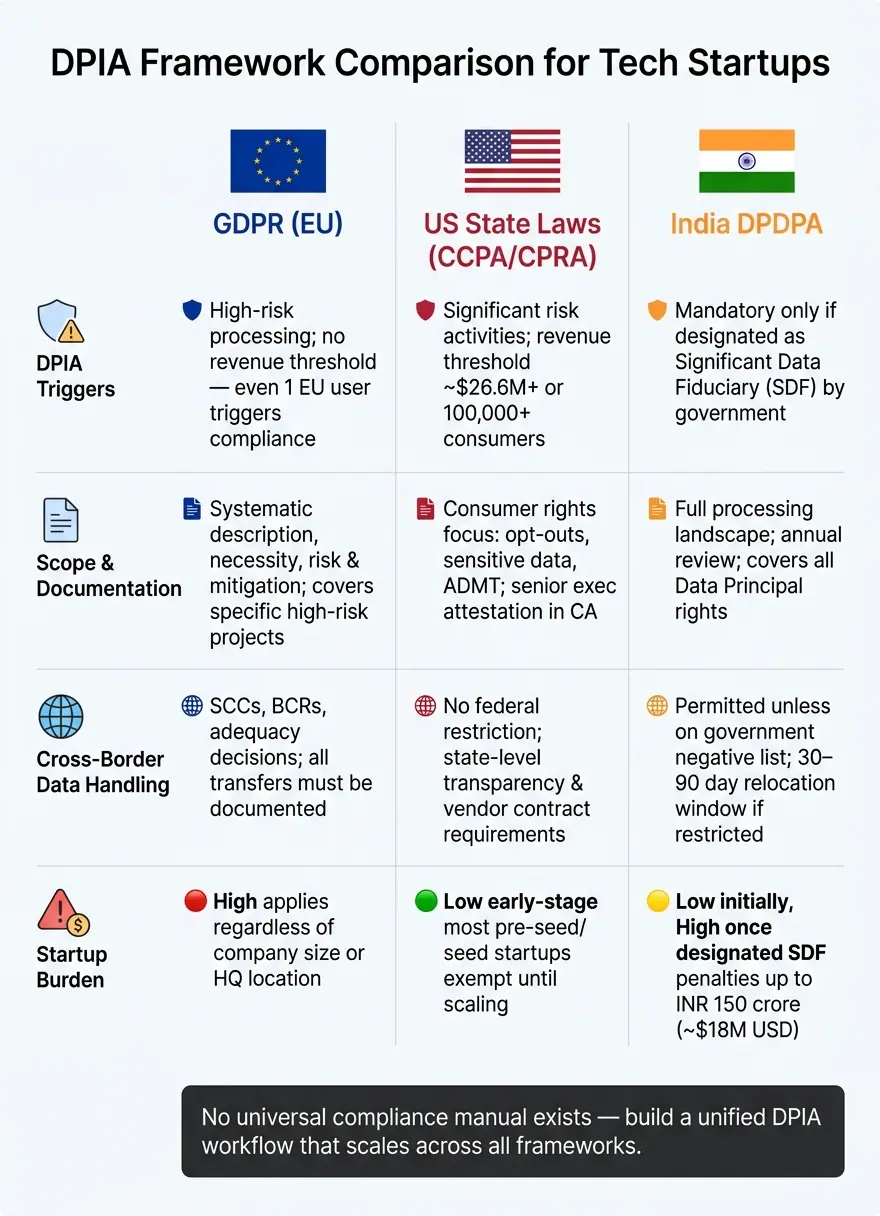
GDPR vs US State Laws vs India DPDPA: DPIA Requirements for Tech Startups
Each DPIA framework brings its own set of advantages and challenges for tech startups, and these choices can directly affect how easily a startup can scale. Here's a closer look at the practical impacts of these frameworks.
GDPR stands out as the most established framework, offering a reliable starting point. A well-executed DPIA under GDPR not only builds trust with users but also positions startups to comply with the EU AI Act's Fundamental Rights Impact Assessment (FRIA), which becomes mandatory in August 2026. That said, GDPR applies regardless of revenue, meaning even a single EU user triggers compliance requirements. Additionally, the somewhat ambiguous "high-risk" threshold can leave startups uncertain about when a DPIA is actually necessary.
US state laws are often seen as the most manageable for startups. Their threshold-based approach - typically triggered at $26.6M+ in annual revenue or 100,000+ consumers - means many pre-seed and seed-stage startups are exempt until they grow significantly. However, the challenge lies in the fragmented nature of these laws. By mid-2025, 19 states will have comprehensive privacy laws, and navigating this patchwork can become increasingly complex as a startup scales. Startups dealing with sensitive data (like health, biometric, or financial information) face additional hurdles, as processing such data triggers compliance across nearly all state frameworks.
India's DPDPA poses the greatest demands for startups that meet the Significant Data Fiduciary (SDF) threshold. These companies face annual DPIA requirements, must appoint in-country Data Protection Officers (DPOs), and risk penalties of up to INR 150 crore (around $18 million USD) for non-compliance. However, the staggered rollout of the framework, with full duties not required until May 2027, gives early-stage startups some breathing room to adopt compliant practices.
The table below provides a side-by-side comparison of how these frameworks stack up in areas most relevant to startups:
| Dimension | GDPR (EU) | US State Laws (e.g., CCPA/CPRA) | India DPDPA |
|---|---|---|---|
| DPIA Triggers | High-risk processing; no revenue threshold | Significant risk; revenue/volume thresholds apply | SDF designation by government; volume and sensitivity-based |
| Scope & Documentation | Systematic description, necessity, risk, and mitigation | Consumer rights focus: opt-outs, sensitive PI, ADMT | Full processing landscape; annual review; Data Principal rights |
| Cross-Border Handling | SCCs, BCRs, adequacy decisions; all flows must be documented | No federal restriction; state-level notice requirements | Permitted unless on government "negative list"; 30–90 day relocation window |
| Startup Implications | Applies to any EU user data regardless of HQ location | Most early-stage startups exempt until scaling milestones | Low burden initially; high burden once designated as SDF |
This breakdown highlights the importance of crafting a strategy that not only aligns with current obligations but also anticipates future requirements as the startup grows.
"The difference between a real DPIA and one that's purely ceremonial is honest risk identification. If your assessment concludes that everything is low-risk... you probably haven't thought hard enough." - Marcel van Rijn, Founder of Nixon Digital
Conclusion
The comparison of GDPR, US state privacy laws, and India's DPDPA highlights one key takeaway: there’s no universal compliance manual. Recent updates in regulations only emphasize these differences further. Startups that view Data Protection Impact Assessments (DPIAs) as mere legal checkboxes risk falling behind.
The smartest strategy? Create a unified DPIA workflow that aligns with multiple frameworks. A repeatable process addressing data flows, risks, mitigation strategies, and regular reviews can meet the core requirements of various regulations. Assigning a dedicated owner to manage this process is critical. As ComplySafe.io aptly puts it:
"The practical goal of data protection impact assessments is not just to interpret a requirement. It is to turn that requirement into a repeatable workflow with owners, documented decisions, and evidence that stands up under review."
Using structured tools like Reform can simplify intake and evidence collection, ensuring consistent and auditable data at crucial points like vendor onboarding or launching new features.
Ivana Ludiga, Partner at Vision Compliance, underscores the importance of early action:
"The cheapest path is getting it right early. Retrofitting compliance into a product with 50,000 users and three years of technical debt is 10x more expensive than integrating it early."
Start small, but start now. Even a basic privacy check integrated into your product planning process can flag high-risk activities before they escalate into regulatory issues. Early and consistent efforts safeguard both your startup’s reputation and its long-term growth.
FAQs
Do I need a DPIA if I have just one EU user?
A Data Protection Impact Assessment (DPIA) becomes necessary when your data processing activities carry high risks. This could include scenarios like managing sensitive data on a large scale or deploying AI systems that could have a notable effect on individuals. It’s important to note that the trigger for a DPIA isn’t tied to the number of users but rather to the level of risk involved. Even if you’re processing data for just one user in the EU, the requirement could apply based on how your data processing is structured.
How can a startup run one DPIA process that works for GDPR, US states, and India?
To conduct a single DPIA process that aligns with GDPR, US state laws, and Indian regulations, startups should adopt a framework that addresses the fundamental principles of all three. Start by pinpointing DPIA triggers - such as introducing new data types or changing processing purposes. Assign clear accountability within your team and ensure every step is documented in detail.
The process should evaluate how data processing impacts individual rights, include measures to reduce risks, and maintain documentation that is ready for audits. This approach helps ensure consistency across different legal requirements and jurisdictions.
What should I include in a DPIA for cross-border data transfers?
When conducting a DPIA for cross-border data transfers, it's crucial to evaluate the legal framework of the destination country, the chosen transfer mechanism (such as Standard Contractual Clauses (SCCs) or Binding Corporate Rules (BCRs)), and any extra steps required to maintain GDPR-level protection. These additional steps might involve encryption, pseudonymization, or implementing other technical, contractual, or organizational safeguards.
Related Blog Posts
Get new content delivered straight to your inbox

The Response
Updates on the Reform platform, insights on optimizing conversion rates, and tips to craft forms that convert.




Drive real results with form optimizations
Tested across hundreds of experiments, our strategies deliver a 215% lift in qualified leads for B2B and SaaS companies.
