
.webp)
Privacy Impact Assessments vs. Data Protection Impact Assessments


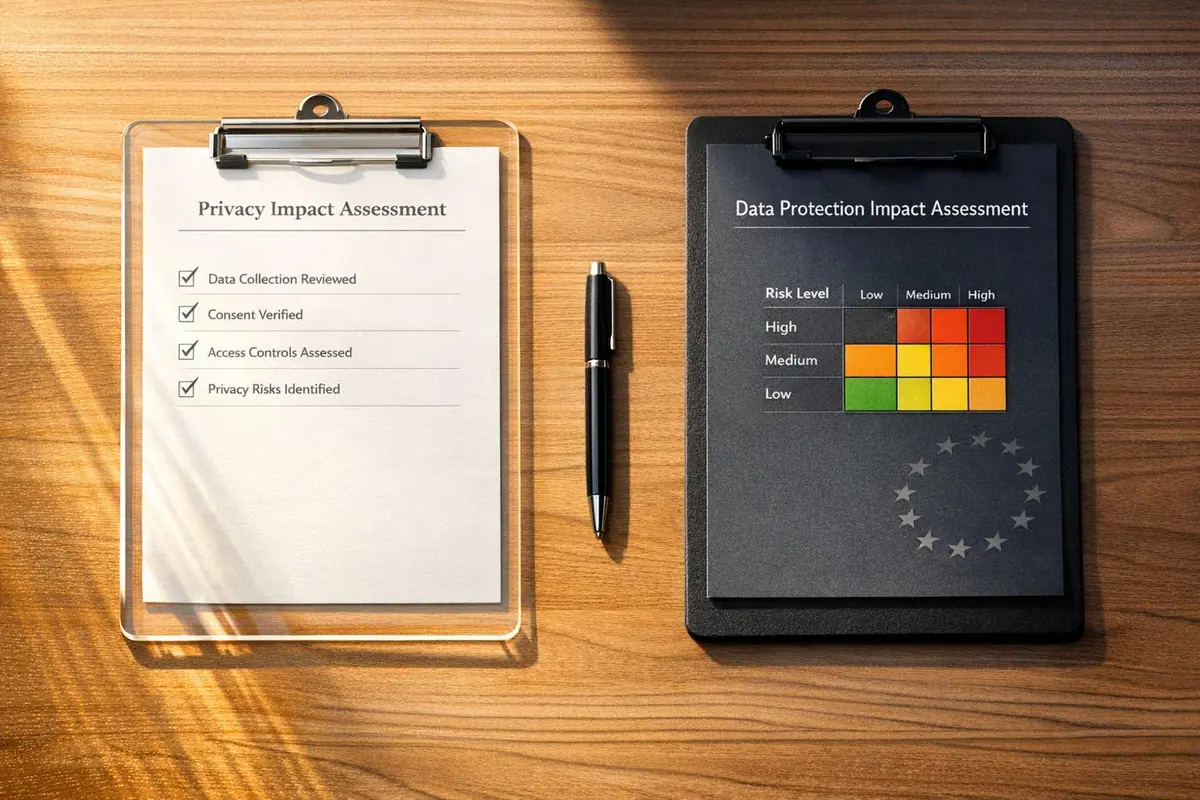
Privacy Impact Assessments (PIAs) and Data Protection Impact Assessments (DPIAs) are tools for managing privacy risks, but they serve different purposes and follow distinct rules. Here's what you need to know:
- PIAs focus on evaluating how personal data is collected, used, shared, and retained, ensuring compliance with U.S. privacy laws like the E-Government Act of 2002. They cover the full data lifecycle and are often required for government IT systems handling personal information.
- DPIAs are mandatory under GDPR for high-risk data processing activities, such as large-scale profiling or using AI. They assess risks to individuals' rights and freedoms and are integral to GDPR compliance.
Quick Comparison
| Aspect | PIA | DPIA |
|---|---|---|
| Legal Basis | U.S. laws (e.g., E-Government Act of 2002) | GDPR (Article 35) |
| Focus | Broader data lifecycle | High-risk data processing |
| Trigger | New systems or PII for 10+ individuals | High-risk activities (e.g., profiling) |
| Public Availability | Often public for transparency | Internal, shared with regulators if needed |
Both assessments are essential for protecting privacy and ensuring compliance, especially in government projects. PIAs are broader and transparency-focused, while DPIAs are risk-specific and legally required for high-risk data processing under GDPR.
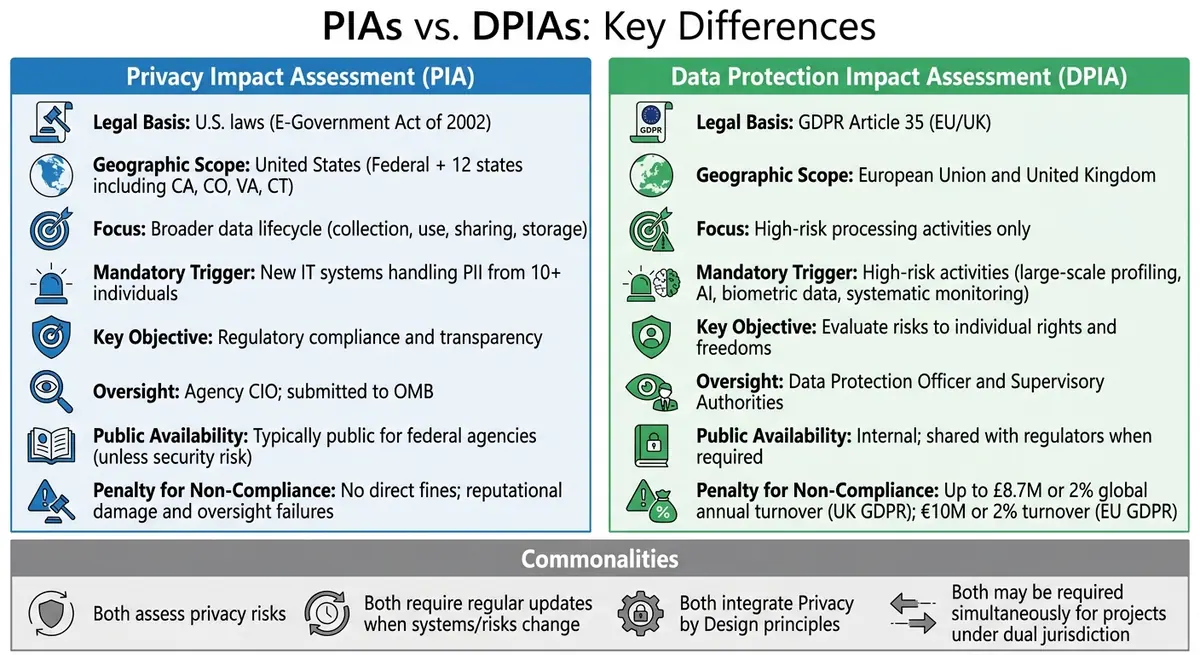
Privacy Impact Assessments vs Data Protection Impact Assessments: Key Differences
Privacy Impact Assessments (PIAs): Definition and Use Cases
What PIAs Cover
A Privacy Impact Assessment (PIA) is a process organizations use to evaluate risks related to the collection, use, sharing, and storage of personally identifiable information (PII). The Office of the Privacy Commissioner of Canada describes PIAs as:
PIAs are an early warning system, allowing institutions to identify and mitigate risks as early and as completely as possible.
- Office of the Privacy Commissioner of Canada
PIAs go beyond meeting legal requirements. They promote transparency by integrating privacy safeguards into system designs and help build public trust - an essential step, given that 93% of Canadians express concerns about privacy. The process is guided by principles like necessity (only collecting what’s required), proportionality (weighing privacy risks against benefits), and Privacy by Design.
The next section outlines instances where conducting a PIA is mandatory.
When PIAs Are Required
Federal agencies are required to conduct PIAs under Section 208 of the E-Government Act of 2002 for any IT system that handles PII. This includes new electronic collections of identifiable information from 10 or more individuals. Using multi-step forms can help manage these collections while reducing user friction.
State-level requirements differ. By late 2023, 11 states - including Virginia, California, and Texas - had enacted privacy laws requiring assessments [[12]](https://ktslaw.com/en/insights/alert/2023/11/us state privacy impact assessment requirements). Many states accept PIAs completed for other jurisdictions as long as they are "reasonably comparable" in scope [[12]](https://ktslaw.com/en/insights/alert/2023/11/us state privacy impact assessment requirements). Additionally, the Centers for Medicare & Medicaid Services (CMS) mandates that PIAs for existing systems be reviewed and re-approved every three years.
Common PIA Scenarios
Federal agencies apply PIAs across various systems and technologies. For example, the Federal Trade Commission has published PIAs for tools like Adobe Sign (January 2026), Azure Microsoft Cloud Service (November 2025), Facebook (November 2025), and Zoom for Government (November 2025).
PIAs also become necessary when systems undergo major changes. Examples include transitioning from paper to electronic records, merging databases, introducing biometric authentication for public systems, or incorporating data purchased from commercial sources. In June 2023, CMS updated its guidelines to require PIAs whenever a system experiences a "major change", such as adding Social Security Numbers to a database that previously didn’t collect them.
Some agencies, like the Department of Homeland Security, maintain public registries of PIAs for prominent programs. Examples include the "DHS Traveler Redress Inquiry Program (TRIP)" (PIA-002), "REAL-ID" (PIA-004), and the "TSA Pre-Check Application Program" (PIA-041).
sbb-itb-5f36581
Data Protection Impact Assessments (DPIAs): Requirements and Structure
GDPR Requirements for DPIAs
A Data Protection Impact Assessment (DPIA) is required by law under Article 35 of the GDPR whenever processing activities are likely to pose a high risk to individuals' rights and freedoms [14–16]. Unlike Privacy Impact Assessments, which are considered a best practice, DPIAs are mandatory in specific high-risk situations.
The DPIA must be completed before any data processing begins [14, 16]. As the Information Commissioner’s Office (ICO) explains:
"A DPIA is not simply a rubber stamp or a technicality as part of a sign-off process. It's vital to integrate the outcomes of your DPIA back into your project plan."
Organizations are also required to consult their Data Protection Officer (DPO) during the DPIA process, as stipulated in Article 35(2). If the DPIA reveals high residual risks that cannot be addressed, the organization must consult the relevant Data Protection Authority (DPA) before proceeding. The ICO generally provides feedback on such consultations within six weeks, though complex cases may take up to an additional month.
To meet these legal requirements, DPIAs must include specific components to evaluate and address potential risks effectively.
What DPIAs Must Include
To comply with GDPR, a DPIA must include four essential elements as outlined in Article 35:
| Mandatory Element | Description |
|---|---|
| Systematic Description | A thorough explanation of the processing activities, their purposes, and the legitimate interests involved. |
| Necessity & Proportionality | An analysis of whether the processing is necessary and proportionate to achieve its stated goals. |
| Risk Assessment | Identification and evaluation of risks to individuals' rights and freedoms. |
| Mitigation Measures | Safeguards, security measures, and mechanisms to ensure compliance and protect data. |
(Source: GDPR Article 35)
DPIAs are not static documents. They need to be reviewed and updated whenever significant changes occur in the processing activities or the associated risks [14, 17]. This dynamic nature ensures that DPIAs remain relevant and responsive to evolving circumstances.
Beyond these core elements, DPIAs are triggered by specific high-risk activities.
High-Risk Activities That Trigger DPIAs
The ICO highlights 10 types of processing activities that automatically require a DPIA. Article 35.3 specifically identifies three key triggers:
- Systematic profiling that produces legal effects.
- Large-scale processing of sensitive data, such as health or biometric information.
- Systematic monitoring of public spaces, like city-wide CCTV systems [14, 16].
Additionally, the Working Party 29 (WP29) guidelines outline nine criteria for identifying high-risk processing. A DPIA is typically required if an activity meets two or more of these criteria. Examples include using automated decision-making systems, processing data from vulnerable individuals (e.g., children or the elderly), employing advanced technologies like AI, or combining datasets from multiple sources.
Certain government agencies may be exempt from conducting a DPIA if the processing is explicitly authorized by law, has a clear statutory basis, and a data protection risk assessment was already conducted during the legislative process [15, 16]. However, this exemption is very narrow and does not apply to most projects.
Failing to conduct a required DPIA can result in severe penalties. Under UK GDPR, organizations may face fines of up to £8.7 million or 2% of their global annual turnover, whichever is greater. Under EU GDPR, the maximum penalty can reach €10 million or 2% of global annual turnover.
PIAs vs. DPIAs: Side-by-Side Comparison
Key Differences Between PIAs and DPIAs
Though both PIAs (Privacy Impact Assessments) and DPIAs (Data Protection Impact Assessments) evaluate privacy risks, they operate under different legal frameworks and serve distinct objectives. PIAs, rooted in U.S. law, are required for systems handling Personally Identifiable Information (PII) from a certain number of individuals. At least 12 states, including California, Colorado, Virginia, and Connecticut, have passed laws mandating similar assessments for high-risk data processing.
DPIAs, on the other hand, are required under Article 35 of the GDPR, focusing on processing activities that pose high risks to individuals' rights and freedoms. While PIAs take a broader approach, covering the entire data lifecycle - how data is collected, used, shared, and maintained - DPIAs zero in on specific high-risk activities, such as large-scale profiling or biometric data processing.
| Feature | Privacy Impact Assessment (PIA) | Data Protection Impact Assessment (DPIA) |
|---|---|---|
| Primary Legal Basis | E-Government Act of 2002 (U.S. Federal); State Laws | GDPR Article 35 (EU/UK) |
| Mandatory Trigger | New IT systems or PII collections involving 10+ individuals | High-risk processing (e.g., profiling, large-scale sensitive data) |
| Core Objective | Ensuring regulatory compliance and identifying privacy gaps | Evaluating risks to individual rights and freedoms |
| Oversight/Review | Reviewed by Agency CIO; submitted to OMB | Reviewed by Data Protection Officer and Supervisory Authorities |
| Public Availability | Typically public for federal agencies unless security is at risk | Mostly internal; shared with regulators if required |
Federal agencies in the U.S. generally make PIAs public unless doing so would compromise security. DPIAs, however, are usually internal documents, shared only with regulators when residual risks demand it.
How PIAs and DPIAs Work Together
Integrating PIAs and DPIAs can strengthen privacy compliance. The process often starts with a Privacy Threshold Analysis (PTA) - a multi-step questionnaire to determine whether a system involves PII and if a PIA is necessary. If the PTA identifies the need for further action, agencies should bring together cross-functional teams, including system managers, IT professionals, security experts, and legal advisors, to address both technical and legal requirements early in the process. This collaborative effort reflects the principles of "Privacy by Design".
Both assessments are dynamic and need regular updates. For PIAs, federal policy requires revisions when converting paper records to electronic formats, merging databases, or introducing new technologies like biometric authentication. Similarly, DPIAs must be revisited whenever processing activities or associated risks change significantly.
Legal Consequences and Compliance Risks
Risks of Skipping PIAs
U.S. federal agencies are required to conduct PIAs under Section 208 of the E-Government Act of 2002. Skipping this step doesn’t result in direct financial penalties but does lead to failures in transparency and oversight. Agencies that bypass PIAs fail to meet public disclosure obligations, which can harm their reputation with oversight bodies like the OMB. Moreover, State Attorneys General can demand PIAs through a Civil Investigative Demand during investigations into data practices. Ignoring PIAs often results in privacy issues surfacing later, which are more expensive and complicated to resolve.
Penalties for Missing Required DPIAs
The stakes are much higher under GDPR. Failing to conduct a required DPIA violates Article 35 and can lead to severe financial penalties. Under UK GDPR, the maximum fine for this violation could be £8.7 million or 2% of global annual turnover, whichever is greater. For broader GDPR non-compliance, fines can climb as high as €20 million.
"Failure to carry out a DPIA when required may leave you open to enforcement action, including a fine of up to £8.7 million, or 2% global annual turnover if higher." - Information Commissioner's Office (ICO)
Beyond monetary penalties, skipping DPIAs weakens an organization’s ability to demonstrate accountability, a key GDPR principle. Without this documentation, agencies cannot effectively show they’ve met "data protection by design and default" requirements, leaving them exposed to enforcement actions by Data Protection Authorities.
This strict framework highlights why regulators pay close attention to DPIAs.
How Regulators Review DPIAs
Given the potential for steep penalties, regulators thoroughly assess DPIAs to ensure compliance. Authorities like the ICO review DPIAs for evidence of proportional risk management. They expect organizations to include a clear description of processing activities, evaluate necessity and proportionality, and demonstrate active efforts to minimize risks - not merely identify them.
If significant residual risks remain, organizations are required to consult their Data Protection Authority before moving forward. Regulators focus particularly on projects involving advanced technologies like AI or biometrics, large-scale profiling, or the processing of data from vulnerable groups such as children or employees.
"A DPIA is not simply a rubber stamp or a technicality as part of a sign-off process. It's vital to integrate the outcomes of your DPIA back into your project plan." - Information Commissioner's Office (ICO)
Conclusion: Selecting the Right Assessment
Key Takeaways
PIAs and DPIAs serve different but complementary purposes. PIAs focus on ensuring transparency and complying with regulations, particularly in how U.S. government agencies handle personal information. On the other hand, DPIAs are designed to identify and address high risks to individual rights, especially under GDPR.
Their triggers are distinct. In the U.S., federal agencies must conduct a PIA when developing or acquiring IT systems that handle identifiable information or when collecting data electronically from 10 or more individuals. DPIAs, however, are required when processing activities are likely to involve high risks, such as using AI for automated decisions, handling biometric data, or conducting large-scale profiling. PIAs are typically made public to ensure transparency, whereas DPIAs are internal documents shared with regulators when risks cannot be fully addressed.
For projects governed by both U.S. and GDPR requirements, both assessments may be necessary. In such situations, PIAs cover broader compliance needs, while DPIAs provide a detailed evaluation of high-risk activities. Together, they help establish strong data management practices in government operations.
These points lead to actionable steps for effective implementation.
Practical Steps for Government Agencies
Start every project with a Privacy Threshold Analysis (PTA). This initial step helps determine whether a full PIA is needed, saving time and resources by focusing efforts where they’re most required. Integrating these triggers into procurement and planning processes - such as linking PIAs to OMB Exhibit 300 submissions - can make compliance more efficient.
"The conduct of a PIA is a multidisciplinary process, and operating units should coordinate the efforts of system managers as well as experts in information technology, security, and privacy law and policy." - U.S. Department of Commerce
Form cross-functional teams that include experts in IT, legal, security, records management, and relevant program areas. Early mapping of data flows is crucial to identify privacy risks and gaps. Regularly update assessments to reflect changes such as database mergers, digitization of paper records, or the introduction of biometric systems. This ensures compliance remains up-to-date and demonstrates accountability.
DPIA vs. PIA: The Privacy Risk Assessments You Can’t Ignore
FAQs
Can one assessment satisfy both PIA and DPIA needs?
When it comes to assessments, a single evaluation can sometimes address both Privacy Impact Assessment (PIA) and Data Protection Impact Assessment (DPIA) requirements. This largely depends on the project's scope and the specific regulations it must follow.
PIAs are designed to focus on identifying privacy risks and ensuring compliance with privacy standards. DPIAs, on the other hand, take a broader approach, covering areas like legal and operational compliance. While it's possible to combine the two into one thorough assessment, it’s often advisable to either keep them separate or explicitly integrate them. This approach ensures better clarity and alignment with compliance obligations.
How do I know if processing is “high-risk” under GDPR?
Under GDPR, processing is labeled as high-risk when it could significantly affect individuals' rights and freedoms. This includes activities like automated profiling with legal consequences, large-scale handling of sensitive information, systematic public area monitoring, or employing new technologies. To determine this, the nature, scope, context, and purpose of the processing must be carefully evaluated. If high-risk factors are identified, a Data Protection Impact Assessment (DPIA) must be completed before proceeding.
What should I do if a DPIA identifies risks I can’t mitigate?
If a DPIA uncovers risks that can't be addressed, it might be necessary to rethink moving forward with the project or activity. Ignoring these risks could mean stopping or redesigning the initiative to stay compliant and protect individuals' data. Ensuring compliance and safeguarding personal information should always guide your decisions.
Related Blog Posts
Get new content delivered straight to your inbox

The Response
Updates on the Reform platform, insights on optimizing conversion rates, and tips to craft forms that convert.


Drive real results with form optimizations
Tested across hundreds of experiments, our strategies deliver a 215% lift in qualified leads for B2B and SaaS companies.
