
.webp)
How AI Transparency Impacts Lead Generation



AI transparency means being upfront about when and how AI is used, what data is collected, and how decisions are made. This is especially important in lead generation, where AI often powers chatbots, lead scoring, and personalized offers. Transparency builds trust, ensures compliance with laws like GDPR and CCPA, and improves lead quality. For example:
- Why it matters: 73% of consumers trust companies that disclose AI use; 91% prefer transparency about data handling.
- Key challenges: Balancing clear disclosures with maintaining high conversion rates.
- Compliance requirements: Laws like GDPR, CCPA, and the EU AI Act mandate clear AI disclosures, consent options, and data minimization.
- Benefits: Transparent AI leads to better data sharing, higher-quality leads, and stronger customer relationships.
To implement transparency effectively, use clear consent notices, explain AI-driven decisions simply, and design forms that are easy to understand. Tools like Reform can help manage disclosures, ensure compliance, and optimize lead generation performance. Ultimately, transparency isn’t just about meeting regulations - it’s a way to build trust and drive better results.
Regulations Requiring AI Transparency
Data Privacy Laws Affecting AI Lead Generation
The GDPR sets strict guidelines for AI transparency in lead generation. It requires businesses to obtain explicit consent before processing personal data through AI tools like chatbots or scoring systems. Companies must clearly communicate what data is being collected, its purpose, and provide users with opt-out options. Additionally, businesses must follow data minimization principles - only collecting data that’s absolutely necessary. Non-compliance can lead to fines of up to 4% of global revenue. For AI chatbots specifically, businesses are required to disclose that users are interacting with an automated system.
In the United States, the CCPA gives California residents the right to know what personal data is collected by AI tools, such as those used for lead scoring or personalized ads. It also allows users to request data deletion or opt out of data sales. Companies targeting California residents must include clear disclosures about AI-driven data usage in their privacy policies. Penalties for violations can reach $7,500 per incident. The CPRA, which went into effect in 2023, adds further requirements, such as opt-out options for automated decision-making (e.g., profiling for ads) and detailed disclosures about AI data processing practices.
New AI Accountability Standards
AI transparency is also shaped by emerging accountability standards. The EU AI Act, rolling out in phases starting in 2024, categorizes predictive lead scoring as high-risk AI. Businesses using such systems must disclose their AI usage, explain decision-making processes, and conduct risk assessments. The Act also bans manipulative AI practices and imposes fines of up to €35 million for violations. Companies are required to document their AI workflows to demonstrate compliance.
In the U.S., the NIST AI Risk Management Framework, introduced in 2023, emphasizes transparency by recommending the creation of "explainability" maps for AI models used in lead scoring or chatbots. These maps should document data sources, algorithms, and any potential biases. Organizations are also encouraged to provide user-facing disclosures and conduct regular audits to meet FTC expectations for fair practices.
The FTC has updated its guidance (2023–2024) to prohibit deceptive practices involving AI, such as undisclosed chatbots or biased lead scoring. Businesses must back up their AI-related claims with evidence, offer clear opt-out options, and ensure that labels indicating AI involvement are both accurate and easy to understand.
Transparency Requirements for Common AI Use Cases
Different AI applications in lead generation require tailored transparency efforts. For predictive lead scoring systems, companies need to disclose the types of data being used - such as browsing history - explain the logic behind the scoring process, and provide opt-out options. The EU AI Act enforces conformity assessments for high-risk systems, while the CCPA/CPRA mandates that users are informed about profiling practices. Summarizing how scores are calculated can go a long way in building user trust.
AI chatbots, often used for lead capture, must clearly inform users that they are interacting with an automated system. Businesses should explain what data is being collected - like conversation logs - and obtain explicit consent for storing that data. Additionally, users should have the option to opt out of behavioral advertising tied to chatbot interactions. A simple disclaimer, such as "This is an AI assistant collecting lead data", can reinforce transparency.
For personalization engines, users should be notified when AI tailors content based on their browsing behavior. The EU AI Act requires real-time notifications, while NIST highlights the importance of explainability. Under GDPR, businesses must obtain consent for profiling, and the FTC discourages deceptive practices like "dark patterns" in disclosures. Clear consent banners, such as "AI personalizes offers using your data – opt out here", help ensure transparency and foster trust. These measures not only comply with regulations but also encourage higher-quality leads by building confidence with users.
Transform Your Lead Generation with AI-Powered Personalization & Compliance
How AI Transparency Affects Lead Generation Performance
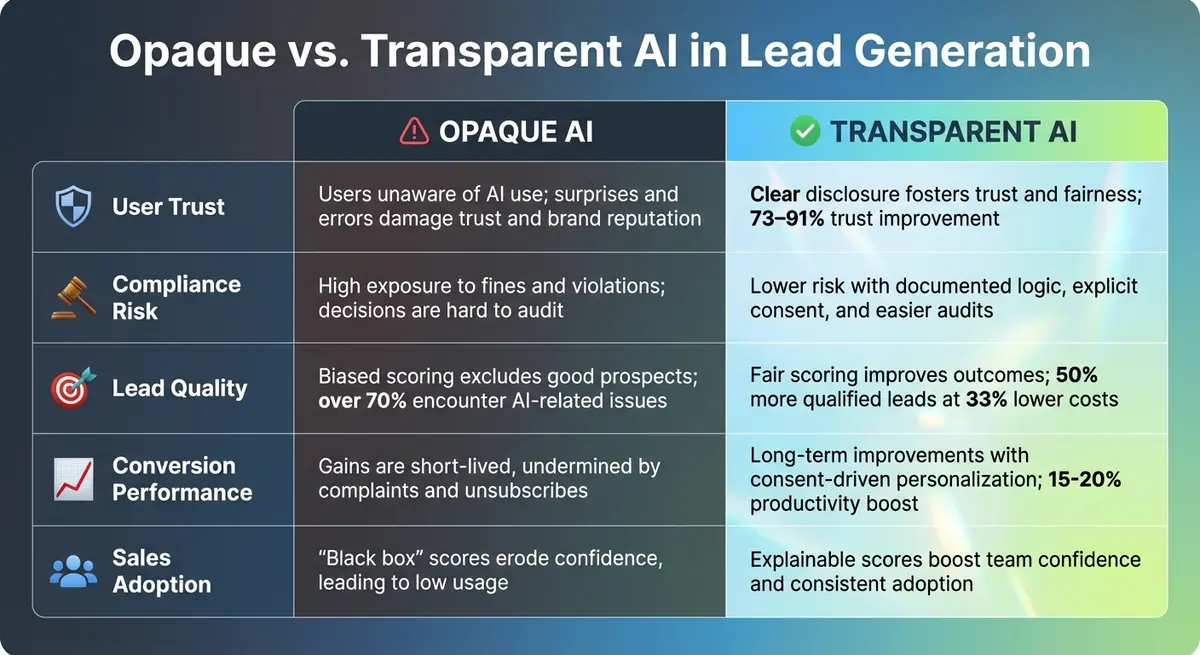
Opaque vs Transparent AI in Lead Generation: Performance Comparison
Risks of Non-Transparent AI
Using AI in lead generation without transparency can lead to serious consequences, including hefty fines and damage to a company's reputation. For instance, violations of GDPR can result in fines as high as 4% of global revenue, while under CCPA, penalties can reach $7,500 per incident. Beyond financial repercussions, opaque AI systems often perpetuate bias due to reliance on flawed historical data. This can result in unfair targeting, excluding diverse prospects and favoring certain groups unfairly.
A study by the IAB revealed that over 70% of marketers have encountered issues with AI, such as hallucinations, bias, or off-brand content. These problems reduce conversion rates and waste valuable sales resources. On top of that, when customers discover hidden AI usage or face unexplained targeting decisions, trust diminishes rapidly. In fact, 91% of customers say they are more likely to trust companies that operate transparently. These risks highlight why transparency is not just a buzzword - it’s essential for improving lead generation outcomes.
How Transparency Improves Lead Quality
Transparent AI is a game-changer for building trust and improving lead quality. When companies openly disclose their use of AI and explain how they collect and use data, they create a foundation of trust. This trust encourages prospects to engage more openly, share better data, and ultimately convert at higher rates. The result? Higher-quality leads and reduced follow-up costs.
Explainable AI models, which clarify criteria like behavioral signals, company size, and engagement levels, help mitigate bias and ensure fairer targeting. Businesses that adopt transparent AI systems have reported 15-20% increases in sales productivity. What sets transparent systems apart is their ability to align customer expectations with actual practices. This alignment fosters stronger, long-term customer relationships and sustained conversion success, unlike opaque systems that may deliver short-term wins but falter when trust erodes.
Opaque vs. Transparent AI: A Comparison
The difference between opaque and transparent AI systems is stark, impacting everything from user trust to conversion performance. Here's a breakdown:
| Dimension | Opaque | Transparent |
|---|---|---|
| User Trust | Users unaware of AI use; surprises and errors damage trust and brand reputation | Clear disclosure fosters trust and fairness; 73-91% trust improvement |
| Compliance Risk | High exposure to fines and violations; decisions are hard to audit | Lower risk with documented logic, explicit consent, and easier audits |
| Lead Quality | Biased scoring excludes good prospects; over 70% encounter AI-related issues | Fair scoring improves outcomes; 50% more qualified leads at 33% lower costs |
| Conversion Performance | Gains are short-lived, undermined by complaints and unsubscribes | Long-term improvements with consent-driven personalization; 15-20% productivity boost |
| Sales Adoption | "Black box" scores erode confidence, leading to low usage | Explainable scores boost team confidence and consistent adoption |
This comparison makes it clear: transparent AI doesn’t just help companies stay compliant - it drives better lead quality, stronger conversions, and greater trust. For example, Reform’s transparent AI strategies delivered a 215% increase in qualified leads for B2B and SaaS companies by focusing on clear, conversion-driven data practices.
sbb-itb-5f36581
How to Implement Transparent AI Lead Generation
Creating Transparent Lead Capture Forms
When designing lead capture forms, clarity and honesty about AI usage should be front and center. For example, include a simple disclaimer near the submit button, such as: "This form uses AI to analyze your responses for personalized recommendations." Why? Because transparency builds trust - 73% of consumers say they're more likely to trust companies that openly disclose their use of AI.
Keep the forms straightforward by asking only for the essentials - like name, email, and intent signals - to minimize friction. Offer separate, clearly labeled opt-in checkboxes, such as: "I consent to AI-powered personalization" or "I agree to share my data with third-party tools." This approach not only fosters trust but also ensures compliance with regulations like the CCPA. In fact, 62% of customers are more inclined to engage with businesses that are transparent about data collection and usage practices.
To avoid overwhelming prospects, adopt progressive profiling. This means collecting additional information gradually over time. For instance, when a user revisits, ask one or two new questions, always with updated consent. Combine this strategy with email validation and spam filters to ensure high-quality leads without overburdening users. ActiveProspect suggests tracking key performance indicators (KPIs) to measure how well your disclosure practices maintain conversions while staying compliant.
Building Explainable Lead Scoring Models
Once your forms are transparent, the next step is to create lead scoring models that are easy to understand. Use clear, interpretable criteria that your sales team can grasp. For instance, base scores on straightforward behavioral signals like page views, email opens, or company size. Document the logic in plain terms, such as: "Leads scoring above 80% are based on email opens (40%), industry match (30%), and company size (30%)."
This level of transparency not only simplifies audits but also minimizes bias. Tools like SHAP values can help identify the key factors driving scores. For example, if a lead's score increases due to a recent funding round, your sales team will see a note explaining this boost. Businesses using explainable AI scoring have reported a 50% increase in qualified leads while lowering costs by 33%.
Regular audits are essential to ensure fairness. Review your models periodically to spot and address unintended biases, such as the exclusion of certain industries or company types. AI-powered predictive scoring can analyze patterns more accurately than manual methods. By documenting your scoring logic, you not only reduce compliance risks but also create a transparent system that enhances lead generation outcomes.
Personalizing with Consent in Mind
Transparency is equally important when personalizing your marketing efforts. Start by obtaining explicit consent. For instance, include a checkbox on your forms that says: "Opt-in for AI-personalized content based on your form responses." Then, use this consent to tailor email sequences, content recommendations, and follow-ups based on the preferences and behaviors disclosed by the user.
Leverage conditional routing to create personalized experiences while staying within the boundaries of consent. For example, high-value leads who opt in could receive a VIP scheduling link, while others might be directed to a prerecorded demo. Always provide an easy way for users to update or withdraw consent by including a preference center link in every email. This not only respects informed consent requirements but also keeps users engaged with content that's relevant to them.
Be upfront about how you're personalizing. For example, explain recommendations with statements like: "We suggest this resource because you expressed interest in enterprise solutions." This approach builds trust while maintaining performance. Businesses that prioritize transparency in AI-driven personalization report 15-20% increases in sales productivity. When users understand and control how their data is being used, they’re more likely to engage and convert, leading to higher-quality results.
Using Reform for Transparent AI Lead Generation
Building Transparent, High-Converting Forms
Reform makes it easier to build forms that are both clear and effective, thanks to its multi-step forms and conditional routing. Instead of overwhelming users with all the details at once, you can break down complex AI-related questions into manageable steps. For example, the first step might gather basic contact information, while the second step explains AI usage and asks for consent. A statement like, "We use AI to personalize recommendations and prioritize follow-up. Please choose how we use your data below," helps set expectations clearly. This step-by-step approach resonates with U.S. audiences who are used to smooth, straightforward online experiences, while also boosting form completion rates.
Conditional logic ensures that AI consent language only appears when it's relevant. For instance, if a lead opts for "Yes, I'd like personalized content", the form can display an additional explanation and an opt-in checkbox. You can also add custom disclosure blocks with simple, clear statements such as, "This form uses AI to analyze your responses. Learn more about our data practices." Combined with email validation and spam prevention, these features not only help collect accurate data but also ensure that the process aligns with explainable AI practices. By balancing transparency and usability, these design choices support compliance and improve lead generation results.
Managing Data with Accountability
Once your forms are capturing leads effectively, managing that data responsibly becomes critical. Reform's integrations allow you to create an auditable trail by tagging submissions with consent indicators (e.g., "AI_scoring_enabled: yes") and campaign details before they move downstream. This makes it easier to segment leads transparently - for example, comparing the performance of leads who opted into AI personalization versus those who didn’t. Features like custom data mapping and duplicate handling prevent errors or misaligned data use, ensuring smooth workflows across your systems.
With real-time analytics, you can track completion rates and identify where users drop off, especially in sections involving AI disclosures or consent. This helps pinpoint and reduce friction in the process. Such tools ensure your data practices are not only compliant but also optimized for performance. And this matters - 73% of consumers are more likely to trust companies that openly disclose their use of AI. On top of that, advanced features like real-time threat detection, access controls, and role-based permissions keep sensitive lead data secure, meeting privacy standards as they evolve.
Adapting to New Regulations with Reform
Privacy laws and AI regulations are constantly changing, and staying compliant requires flexibility. Reform’s no-code design makes it simple for teams to adjust forms quickly. Whether it’s a new federal regulation or updates like the CCPA, you can add AI disclosures, update consent options, or tweak form logic in minutes - no need to wait for engineering support. For example, if the FTC introduces new guidelines on AI transparency, you can instantly add a centralized disclosure snippet and apply it across all relevant forms.
Reform also tracks form versions and timestamps, which makes it easy to show when compliance updates were implemented - an invaluable feature during audits. The platform’s commitment to staying current with regulatory changes ensures that your forms remain both transparent and effective, helping you maintain trust while driving high-quality leads.
Conclusion
AI transparency isn't just about meeting regulatory requirements - it's a powerful way to build trust, attract quality leads, and safeguard your business as rules and expectations shift. Studies show that transparency can drive trust levels as high as 91%. By clearly explaining how AI influences scoring, personalization, and engagement, you draw in more informed prospects who are comfortable sharing accurate data. This, in turn, leads to higher conversion rates and stronger revenue over time.
To make transparency a competitive edge, tools like Reform's no-code builder, multi-step forms, and conditional logic can help you clearly disclose AI's role while responsibly managing data. With features like real-time analytics, lead enrichment, email validation, and spam prevention, you ensure the data you collect is both reliable and handled with care. Plus, when regulations like updated FTC guidance or new state privacy laws come into play, you can quickly adjust disclosures and form logic - often in just minutes - keeping your processes compliant and your reputation intact. This seamless blend of clarity and technology strengthens both trust and performance.
When you treat AI transparency as an opportunity rather than a legal hurdle, your business is better positioned to succeed in a world where trust and ethical data practices are key differentiators. By prioritizing clear communication and responsible data handling, you turn compliance into a scalable and effective lead generation strategy.
FAQs
How does being transparent with AI enhance lead generation?
When businesses are upfront about their use of AI, it builds trust with potential customers - a critical factor in successful lead generation. By clearly explaining how AI processes data and makes decisions, companies can reassure prospects that their information is handled responsibly and ethically.
This openness not only strengthens trust but also enhances the effectiveness of targeting and lead qualification. When AI systems operate transparently and adhere to ethical standards, they tend to attract higher-quality leads. These leads are not only more likely to engage but also have a better chance of becoming long-term, loyal customers.
What are the risks of not being transparent about using AI in lead generation?
Failing to openly acknowledge the use of AI in lead generation can seriously damage the trust you build with your audience. Trust is the foundation of strong customer relationships, and when people feel deceived, they’re far less likely to engage with your business. This can directly impact your conversion rates and the overall quality of your leads.
On top of that, avoiding transparency could lead to legal troubles, especially as regulations surrounding AI and data privacy continue to expand. Non-compliance might result in hefty fines or even lawsuits, which can severely harm your reputation and weaken your standing in the market.
How can businesses stay compliant with AI transparency rules?
To comply with AI transparency regulations, businesses need to clearly explain how AI is involved in gathering and processing data. This means offering straightforward, easy-to-understand descriptions of how AI makes decisions and keeping thorough records of its activities.
One practical approach is using tools like customizable forms. These not only help with compliance but can also boost lead generation efforts. By being transparent and fostering trust, businesses can meet legal standards while strengthening customer confidence.
Related Blog Posts
Get new content delivered straight to your inbox

The Response
Updates on the Reform platform, insights on optimizing conversion rates, and tips to craft forms that convert.




Drive real results with form optimizations
Tested across hundreds of experiments, our strategies deliver a 215% lift in qualified leads for B2B and SaaS companies.
