

How Processors Handle Lead Data Rules


I treat lead data protection as a collection-to-deletion job - not just a form setting. Before sending leads to a vendor, I check who controls each use, sign the required data-processing terms, and test preference updates and deletion.
My review covers:
- Roles and reuse: Who decides how data is used, and can vendors use it for their own purposes?
- Contracts and security: What do processors and subprocessors agree to protect, report, return, or delete?
- Collection records: What notice did each person see, and which channel choices did they make?
- Requests and incidents: Can vendors find records, pass along deletion instructions, and report breaches without undue delay?
- Transfers and retention: Where can data be stored or accessed, and when do copies - including backups - expire?
Under GDPR Article 28, subprocessors need prior written authorization. A 30-day change notice can be a contract term, but it is not a statutory deadline.
My rule: <u>check the contract and test the workflow</u>. A form tool’s features alone do not establish compliance.
GDPR Data Processing Agreements Simplified Quickly
sbb-itb-5f36581
Controller and Processor Responsibilities
What each party actually does with data - not its contract label - determines its role. Review collection, enrichment, routing, sharing, and deletion separately. In California, status depends on the legal rules and contract limits that apply.
Who Decides How Lead Data Is Used
Once roles are clear, map each lead-data activity to the party directing it. The controller sets the purpose, fields, notices, recipients, and retention period. Processors follow documented instructions and use safeguards, but they also have their own legal duties.
| Activity | Controller duty | Processor duty | Evidence to retain | Common failure point |
|---|---|---|---|---|
| Lead collection | Set lawful basis and notices | Follow documented instructions | Notice versions; consent records where applicable | Fields collected without a lawful basis |
| Enrichment | Approve purpose; review vendor safeguards | Apply security controls; respect use limits | Due diligence records; processing terms | Overlooked independent reuse |
| Subprocessing | Give specific or general written authorization | Notify changes; flow down protection duties | Signed agreement; subprocessor change log | Vendors added without required notice |
Vendor Data Reuse and Subprocessor Rules
If a vendor independently reuses data for marketing, analytics, or enrichment, it may become a controller for that processing. That reuse can also put its service-provider status under U.S. law at risk. Check permitted-use clauses - not just role labels - and explicitly restrict independent purposes.
Under GDPR Article 28, subprocessors need prior specific or general written authorization. With general authorization, require notice of changes and time to object before a subprocessor is engaged. A 30-day notice period is a suggested contract term, not a statutory deadline. Keep track of every processor and subprocessor in the chain, spell out the objection procedure, and require written terms that pass protection duties down the chain. The initial processor remains liable to the controller for the subprocessor’s performance.
These role and reuse limits guide how you build forms and write contract terms. Form tools can support the controls, but they can’t create them.
How Reform Fits Into Lead Collection
Reform can support lead collection and routing, but your business still sets the lawful basis and notices for each processing step, including enrichment. Before sending live leads, check what consent logs record, test deletion functions, and verify contractual protections for every vendor involved. Product features alone don’t establish compliance.
Data Processing Agreements for Lead Forms
Once roles are set, the data processing agreement (DPA) should make them enforceable through handling instructions for each lead-form workflow. GDPR Article 28 requires controller-processor terms. CCPA/CPRA contracts separately limit how service providers and contractors can use data.
Define the Processing Scope and Allowed Uses
Spell out the processing subject matter, purpose, nature, and duration, along with the data types and data subject categories. Match the schedule to the fields you collect: names, email addresses, job titles, IP addresses, and device identifiers. List the lead sources covered, including demo requests, newsletter sign-ups, and event registrations. Document instructions for collection, storage, and international transfers, and set a retention period.
Name each allowed use. State whether enrichment can add business details, which analytics are allowed, and where marketing or CRM integrations can send records. Cover temporary API caches, not just the destination system. Avoid broad “service improvement” language that allows independent marketing or reuse.
California terms must prohibit selling or sharing personal information. They must also restrict retaining or using lead data outside the specific business purpose - including through CRM integrations - and combining it with data from other sources, subject to legally permitted exceptions. Tie any exception to the stated business purpose. It isn't blanket permission to reuse the data.
Set Security, Support, and Contract Exit Terms
Use this checklist to link each commitment to supporting records. Set support deadlines that leave your team time to act. Under GDPR, processors must report personal data breaches without undue delay.
| Term | Lead-generation relevance | Vendor evidence to request |
|---|---|---|
| ☐ Confidentiality | Limits access by staff handling lead records. | Confidentiality commitments and training records. |
| ☐ Security | Protects submissions, stored leads, CRM transfers, and temporary caches. | Technical and organizational measures; encryption specifications; relevant SOC 2 reports or ISO 27001 certification. |
| ☐ Subprocessors | Makes downstream handling enforceable. | Current list, authorization records, and notice procedure. |
| ☐ Rights-request assistance | Helps teams find or delete lead records. | Search and deletion documentation. |
| ☐ Breach response and notification | Gives the controller time to assess exposure and meet notification duties. | Incident response plan and breach logs. |
| ☐ Audit rights | Allows compliance checks and verification of privacy claims. | Completed security questionnaires or audit reports. |
| ☐ Return or deletion | Ends vendor access when services end. | Certificate of deletion or data export logs. |
Match these contract terms to the consent records and form controls recorded at intake.
Consent Records and Form Controls
Once the DPA sets the rules, the form must record the proof.
The processor records evidence of the controller’s chosen legal basis under documented instructions. For each lead submission, record the notice text, timestamp, source, and opt-in state. Consent is not always required for lead workflows.
What to Record for Each Submission
Keep privacy-notice acknowledgment separate from consent to processing or marketing. Acknowledgment shows that a notice was presented or acknowledged. It does not establish marketing permission. Record email, text, and phone preferences separately, since each channel may have different requirements.
The record should show exactly what the user saw and chose.
| Record element | Purpose | Source system | Retention rule | Responsible party |
|---|---|---|---|---|
| Form and notice versions; consent wording | Shows which fields, disclosures, and choices appeared | Form configuration / CMS | Controller-set retention period | Controller (content) / processor (logs) |
| Timestamp and time zone | Establishes when lead submission or consent occurred | Server logs | Linked to the relevant evidence record | Processor |
| Source URL and campaign parameters | Establishes collection context | Page URL / campaign parameters | Defined attribution period | Controller sets limits; processor records |
| Affirmative opt-in | Records affirmative opt-in for each purpose or channel | Lead submission payload | Until withdrawal or expiry | Controller |
| Channel preferences | Separates email, text, and phone choices | Form / CRM / marketing system | Until updated or withdrawn | Controller owns preference rules; processor syncs updates |
Store the exact notice text or a version reference, and set explicit retention periods for this evidence. Skip unnecessary metadata, such as device fingerprints.
Limit Form Fields and Track Preference Changes
Remove fields that aren't needed for the stated purpose. Use conditional logic to show only relevant questions. Validation improves accuracy, but it does not satisfy data minimization. Where affirmative consent is required, optional consent boxes must start unchecked. Keep optional marketing consent separate from required fields.
After submission, keep collection evidence and channel preferences in sync across CRM and marketing systems, including later changes. Sync withdrawals and unsubscribes immediately, passing preference changes and suppression records through those systems together. Keep lead data only as long as needed, and retain suppression records only to honor opt-outs.
Support for Privacy Requests and Data Incidents
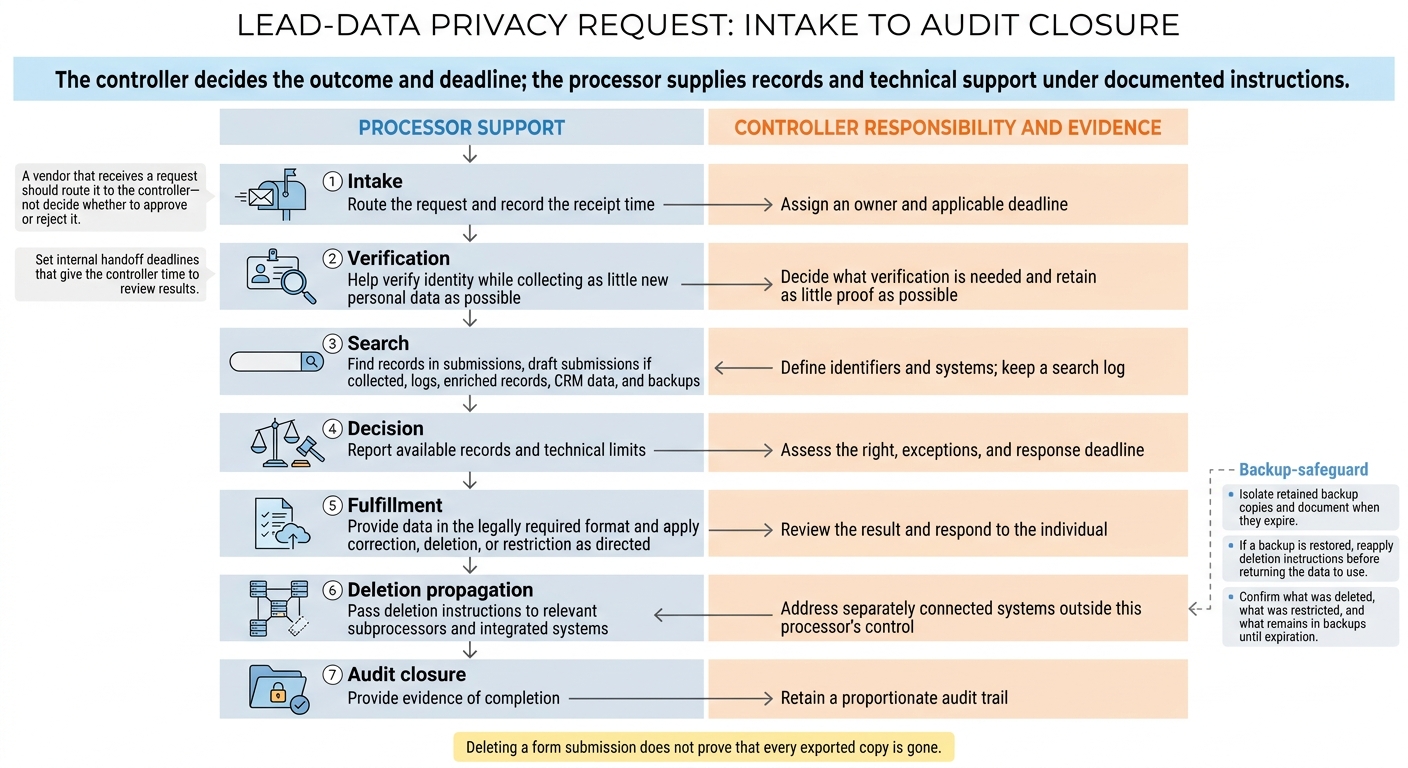
Lead Data Privacy Request Workflow
Records collected at submission support later privacy requests. The controller decides the outcome and deadline; the processor supplies records and technical support under documented instructions. These records provide the evidence needed to route, verify, search, and fulfill requests.
Handle Requests From Intake to Completion
Set internal handoff deadlines that give the controller time to review results. A vendor that receives a request should route it to the controller - not decide whether to approve or reject it. Follow authorized verification procedures and keep verification records only as needed.
| Stage | Processor support | Controller responsibility and evidence |
|---|---|---|
| Intake | Route the request and record the receipt time | Assign an owner and applicable deadline |
| Verification | Help verify identity while collecting as little new personal data as possible | Decide what verification is needed and retain as little proof as possible |
| Search | Find records in submissions, draft submissions if collected, logs, enriched records, CRM data, and backups | Define identifiers and systems; keep a search log |
| Decision | Report available records and technical limits | Assess the right, exceptions, and response deadline |
| Fulfillment | Provide data in the legally required format and apply correction, deletion, or restriction as directed | Review the result and respond to the individual |
| Deletion propagation | Pass deletion instructions to relevant subprocessors and integrated systems | Address separately connected systems outside this processor’s control |
| Audit closure | Provide evidence of completion | Retain a proportionate audit trail |
Find lead records and Confirm Deletion
Search submissions, draft responses, logs, enriched records, CRM data, and backups within the agreed scope. Document which systems were searched and what changed. Apply deletion or restriction as instructed. The controller decides whether a legal exception requires keeping particular records. Confirm what was deleted, what was restricted, and what remains in backups until expiration.
Backup deletion needs a recovery safeguard. Isolate retained backup copies and document when they expire. If a backup is restored, reapply deletion instructions before returning the data to use. The controller must also assign responsibility for separately connected systems outside that processor’s control. Deleting a form submission does not prove that every exported copy is gone.
The same records also support incident reviews and transfer mapping.
Report Incidents and Share Evidence
When a breach occurs, the processor must notify the controller without undue delay. It must provide the breach type, affected records, timing, likely impact, containment steps, and remediation plan across the systems it controls. The vendor should report immediately rather than wait for the controller’s regulatory assessment.
These evidence trails also support cross-border and vendor-location checks. Use the same logs to map where lead data and backups reside across vendors and regions.
Cross-Border Data Transfers and Vendor Reviews
Map Data Locations and Transfer Requirements
Use the incident and record trail to trace where lead data sits and where it moves. Record each processor’s and subprocessor’s legal name, address, and contact person - not just the brand name. Check the DPA, subprocessor list, and security documents, and ask vendors directly for missing details.
Map hosting locations, backup sites, and remote access points as lead records pass through forms, CRM routing, and enrichment. Use this map to identify flows that trigger transfer restrictions under applicable law.
For transfers covered by GDPR Chapter V, check whether an adequacy decision covers the destination and recipient. If a U.S. recipient relies on the EU-U.S. Data Privacy Framework, verify the exact legal entity, active certification, and covered scope. A U.S. address is not proof of a valid transfer mechanism.
Where adequacy does not apply, assess safeguards such as standard contractual clauses (SCCs), the relevant transfer impact assessment, and any needed supplementary measures. Explicit consent and other derogations have a limited role; they are not a routine workaround for regular lead-data processing. Check each mechanism’s current validity and scope, including onward transfers.
Review Security and Processing Location Changes
Once you confirm the legal transfer basis, review the controls and processing arrangements that could affect it. Use security reports and trust center disclosures to assess overseas access and transfer-specific safeguards. Request evidence of encryption, access controls, key management, and government-access response procedures that apply to those transfers.
Data residency is not transfer compliance. Local storage does not prevent overseas access, and security controls alone do not establish a lawful transfer basis.
Require advance notice of new subprocessors and processing locations, with time to object. Assign an owner to review recipient entities, countries, remote access, and transfer safeguards before processing changes.
Repeat vendor checks regularly: transfer status can change after onboarding. Keep dated evidence of certification status, contractual safeguards, and review decisions - not just the signed DPA.
Conclusion: Processor Oversight Checklist
Once you’ve mapped roles, requests, incidents, and transfers, use this checklist to confirm that your controls are documented and up to date.
- [ ] Roles and agreement: Keep a signed DPA that covers scope, security, subprocessor rules, and exit terms.
- [ ] Inventory and subprocessors: Maintain a lead data inventory with field mappings, storage locations, and each subprocessor’s legal entity and country of registration.
- [ ] Collection evidence: Save the collection notice and consent log for every submission.
- [ ] Incidents: Document the incident timeline, reporting format, and required evidence.
- [ ] Transfers: Map destinations, recipient entities, subprocessors, remote access, and transfer mechanisms.
- [ ] Retention and exit: Keep written instructions for data return, deletion, and backup expiry.
Any unchecked box means the processor file isn’t ready for live lead data.
FAQs
Can a vendor be both my processor and a controller?
Yes, a vendor can be both a processor and an independent controller, though usually not for the same processing activity. It acts as a processor when it handles data under your documented instructions to deliver a service.
It may act as an independent controller if it reserves the right to use customer data for its own purposes, such as service improvements, analytics, or profiling. Check its privacy policy for language that permits these uses.
How can I test deletion across my lead integrations?
Check that every vendor - including Reform, your CRM, and your email platform - supports deletion and has clear procedures for handling data requests. Submit a test lead, confirm it syncs to downstream systems, then trigger a deletion request.
Verify that the deletion reaches every connected system and that records are purged or anonymized according to your retention policies. Review logs to confirm the records were removed - not just hidden or flagged - and check for broken mappings or sync failures.
Do U.S.-only lead campaigns trigger international transfer rules?
No, if the data belongs only to individuals located in the United States. International transfer rules, such as those under the GDPR, apply when personal data from European Economic Area (EEA) residents moves outside that region.
If your workflow collects data from EU or EEA residents, you need a valid transfer mechanism, such as Standard Contractual Clauses or the Data Privacy Framework. This applies regardless of where your campaign is hosted.
Related Blog Posts
Get new content delivered straight to your inbox

The Response
Updates on the Reform platform, insights on optimizing conversion rates, and tips to craft forms that convert.


Drive real results with form optimizations
Tested across hundreds of experiments, our strategies deliver a 215% lift in qualified leads for B2B and SaaS companies.
