
.webp)
Key KPIs for Scalable Lead Nurturing Content



Scaling lead nurturing without clear KPIs is risky. You might waste effort, frustrate teams, and miss opportunities. Tracking the right metrics ensures your program drives engagement, qualifies leads, and delivers results. Here's what you need to know:
- Engagement KPIs: Measure how leads interact with emails, websites, and forms (e.g., click-through rates, reply rates, bounce rates). Optimizing your landing page form is critical for improving these engagement metrics.
- Lead Quality KPIs: Assess readiness for sales through MQL-to-SQL rates, lead scoring, and enriched data accuracy.
- Funnel Progression KPIs: Track stage-to-stage conversion rates and revenue attribution to connect content to pipeline growth.
- Operational Efficiency KPIs: Ensure workflows run smoothly, data is reliable, and testing leads to continuous improvement.
These metrics help you refine strategies, align marketing and sales, and scale effectively. Without them, you're flying blind.
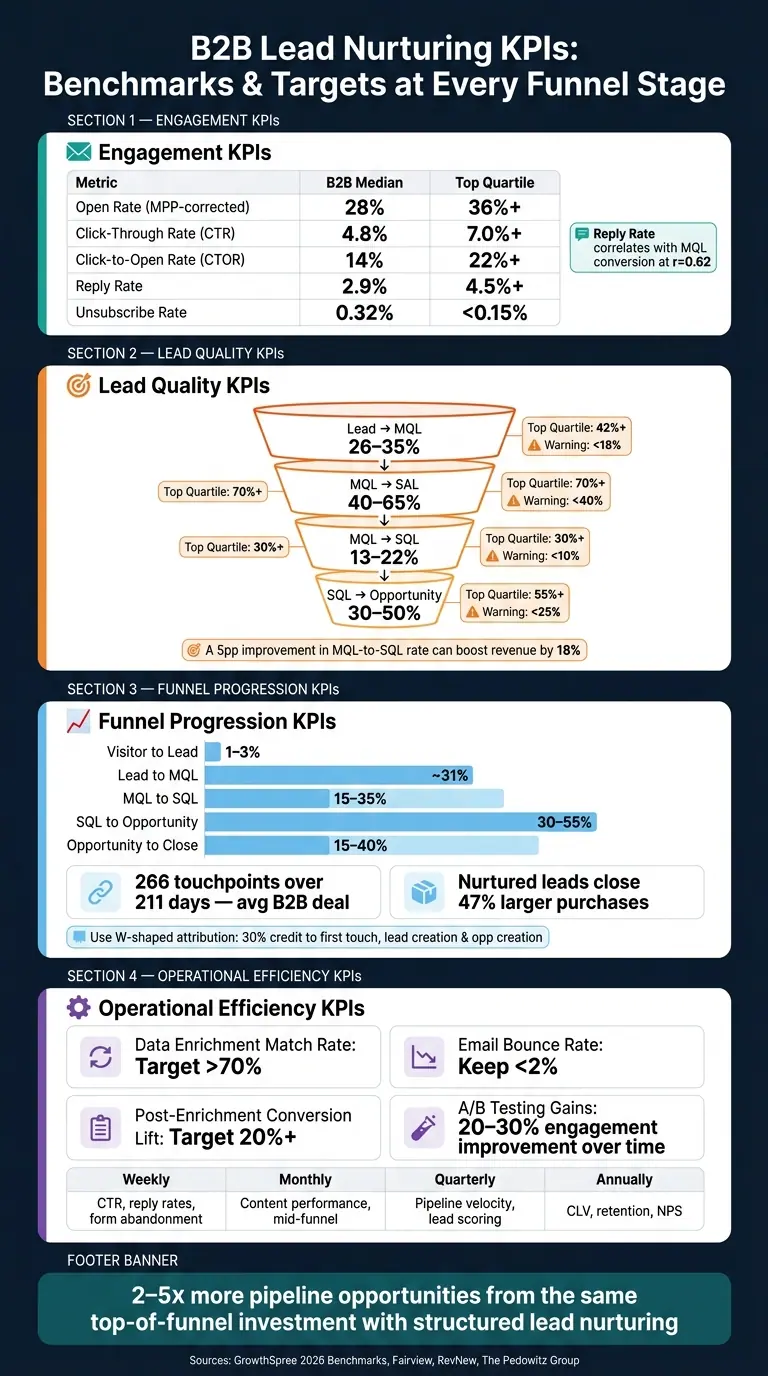
B2B Lead Nurturing KPIs: Benchmarks & Targets at Every Funnel Stage
How to Measure KPIs for B2B Lead Generation Success
sbb-itb-5f36581
Engagement KPIs: How Leads Interact With Nurturing Content
Understanding how leads engage with your automated nurturing content is key to determining what drives conversions. Before leads take the leap, they engage - opening emails, clicking links, visiting web pages, or completing forms. Tracking these interactions helps pinpoint what's effective and what needs adjustment.
Email Engagement Metrics
While email open rates are commonly tracked, they’ve become less reliable due to Apple Mail Privacy Protection (MPP), which inflates open rates by 12–18%. Adjusting for this margin is essential for accurate forecasting.
More telling metrics include click-through rate (CTR), click-to-open rate (CTOR), and reply rate. Among these, CTOR stands out because it focuses solely on how well the email content resonates, independent of the subject line:
"CTOR measures content effectiveness independent of subject line performance." - Erwann Lefevre, La Growth Machine
The reply rate is the strongest indicator of true engagement. In 2026, it showed a significant correlation (r=0.62) with MQL-to-SQL conversion, far outpacing the open rate (r=0.21). Median reply rates for B2B teams are currently at 2.9%, with top performers reaching 4.5% or higher.
| Metric | 2026 B2B Median | Top Quartile |
|---|---|---|
| Open Rate (Platform-reported) | 34% | 42%+ |
| Open Rate (MPP-corrected) | 28% | 36%+ |
| Click-Through Rate (CTR) | 4.8% | 7.0%+ |
| Click-to-Open Rate (CTOR) | 14% | 22%+ |
| Reply Rate | 2.9% | 4.5%+ |
| Unsubscribe Rate | 0.32% | <0.15% |
Source: GrowthSpree 2026 Benchmarks
Keep an eye on unsubscribe rates and spam complaints as well. Gmail and Yahoo set a maximum spam complaint rate of 0.3% for bulk senders, but staying below 0.1% is ideal. Spikes in these rates often indicate issues like overly frequent sends or irrelevant content.
Email engagement is just the first step. To truly gauge interest, you need to examine what happens after the click.
Website and Content Engagement Metrics
Once a lead clicks through, their on-site actions provide deeper insight. Metrics like content engagement rate, landing page bounce rate, and session duration help you understand whether your content is keeping their attention.
For instance, high bounce rates on nurturing landing pages often suggest a disconnect between the email’s promise and the page’s delivery. Meanwhile, session duration reveals whether leads are actively engaging with your content or just skimming. On average, B2B buyers review 3 to 7 pieces of content before engaging with a salesperson, so tracking which resources they interact with - and in what order - can clarify where they are in the decision-making process.
Behavior-based triggers are becoming increasingly common. Instead of a fixed schedule, modern nurturing programs send targeted messages based on specific actions, like visiting a pricing page or downloading a case study. Assigning point values to these actions (e.g., 2 points for opening an email, 15 points for downloading a whitepaper, 50 points for starting a trial) creates an engagement score that reflects actual interest rather than just elapsed time.
These post-click insights naturally lead to evaluating how well your forms perform.
Form Performance Metrics
Forms are the bridge between engagement and conversion, but they can also be a stumbling block. Two key metrics to track are view-to-start rate (the percentage of visitors who begin filling out a form) and start-to-completion rate (the percentage who finish once they start).
If your view-to-start rate is high but the completion rate is low, the issue likely lies with the form itself. Field-level drop-off data can reveal where users abandon the process - common culprits include fields asking for phone numbers, company size, or budget.
"If people start the form but quit on company size, phone number, or budget, the problem may be qualification friction rather than weak traffic." - Buildform
Tools like Reform provide real-time analytics and abandoned submission tracking, capturing partial data even when a form isn’t fully completed. This partial data can signal intent and help refine follow-up strategies. Additionally, conditional routing ensures that completed forms automatically direct leads into the appropriate nurturing workflows, eliminating delays caused by manual handoffs.
Lead Quality KPIs: Assessing Lead Readiness and Fit
Once you’ve measured engagement, the next step is to evaluate lead quality KPIs. While engagement metrics show who’s interested, lead quality KPIs reveal whether that interest is coming from leads ready for a sales conversation.
Tracking MQLs and SALs
A Marketing Qualified Lead (MQL) is identified by a combination of firmographic fit and specific actions, such as visiting a pricing page, requesting a demo, or clicking on targeted emails. When an MQL is reviewed and accepted by the sales team, it becomes a Sales Accepted Lead (SAL). For B2B SaaS companies, the typical MQL-to-SAL acceptance rate falls between 40% and 65%. If this rate dips below 40%, it may indicate issues with lead scoring or a disconnect between marketing and sales.
The MQL-to-SQL conversion rate - the percentage of MQLs that become Sales Qualified Leads - usually ranges from 13% to 22% in B2B SaaS. However, top-performing teams can hit conversion rates of 30% or more. Even a modest improvement of 5 percentage points in this metric can boost revenue by as much as 18%, all without increasing top-of-funnel spending.
| Funnel Stage | Metric | Median (B2B SaaS) | Top Quartile | Warning Threshold |
|---|---|---|---|---|
| Lead → MQL | Lead-to-MQL Rate | 26–35% | 42%+ | <18% |
| MQL → SAL | MQL-to-SAL Rate | 40–65% | 70%+ | <40% |
| MQL → SQL | MQL-to-SQL Rate | 13–22% | 30%+ | <10% |
| SQL → Opp | SQL-to-Opp Rate | 30–50% | 55%+ | <25% |
Source: Compiled from Fairview and RevNew benchmarks
One way to improve these metrics is by introducing a 48-hour SLA (Service Level Agreement), requiring sales to accept or reject every MQL within two business days. To further refine the process, include mandatory CRM fields for rejection reasons, such as "wrong vertical", "no budget", or "wrong timing". This feedback loop helps marketing teams fine-tune their targeting efforts.
Lead Scoring and Engagement Depth
Lead scoring assigns points to actions that reflect buying intent. Actions like visiting pricing pages, requesting demos, or making frequent site visits should carry more weight than early-stage actions like downloading a guide. Additionally, the source of the lead matters. For instance, a lead captured through a bottom-of-funnel LinkedIn ad and immediately checking the pricing page is far more sales-ready than someone who downloaded an ebook weeks ago.
Once a lead reaches the MQL threshold, stop the nurture sequence, assign the lead to a sales rep, and trigger a notification in your CRM or Slack system. To ensure your scoring model stays effective, audit thresholds every 90 days to account for market changes and conversion trends.
Improving Data Quality and Enrichment
Accurate data is the backbone of effective lead scoring. Without it, lead quality KPIs can’t reliably reflect the true value of your leads. The challenge? B2B contact data decays quickly - 25–30% of data becomes outdated annually due to job changes and company shifts. In high-turnover industries, that decay rate can hit 35–40%. Poor data quality costs organizations an average of $12.9 million per year.
To combat this, focus on capturing high-quality data right from the start. Tools like Reform offer email validation and lead enrichment features that verify email addresses in real time and fill in missing firmographic details. By keeping forms simple - asking only for an email address and letting enrichment handle the rest - you can reduce friction while maintaining data accuracy.
Track your enrichment efforts with these benchmarks:
- Match rate: Aim for over 70%
- Email bounce rate: Keep it below 2%
- Post-enrichment conversion lift: Target at least a 20% increase
Jonathan Maurin from Derrick App puts it best:
"Enriching data without measuring it is like driving without a dashboard. You're moving, but you have no idea how fast... or whether you're heading in the right direction."
To maintain accuracy, manually review 50–100 enriched records every quarter. This ensures your data stays reliable and supports better decision-making.
Funnel Progression KPIs: Connecting Content to Pipeline and Revenue
Engagement and lead quality metrics might show interest and readiness, but funnel progression KPIs tell you if your content is actually driving pipeline growth and revenue.
Stage-to-Stage Conversion Rates
Conversion rates at each funnel stage - Visitor to Lead, Lead to MQL (Marketing Qualified Lead), MQL to SQL (Sales Qualified Lead), SQL to Opportunity, and Opportunity to Close - highlight where your content is working and where it’s falling short. Here’s a look at current B2B benchmarks:
| Funnel Stage | Benchmark Range |
|---|---|
| Visitor to Lead | 1–3% |
| Lead to MQL | ~31% |
| MQL to SQL | 15–35% |
| SQL to Opportunity | 30–55% |
| Opportunity to Close | 15–40% |
If your Opportunity-to-Close rate is below 15%, the issue likely lies in mid-funnel qualification rather than bottom-funnel sales performance. This signals a need to review the content your leads are engaging with before reaching the sales team, rather than simply applying more pressure to close deals.
Another key metric is pipeline velocity. This is calculated as:
(# Opportunities × Avg. Deal Size × Win Rate) ÷ Sales Cycle Length (in days)
Pipeline velocity offers a reliable short-term revenue predictor. To get the clearest picture, track this metric monthly instead of weekly to avoid noise and focus on meaningful trends.
"If you're running a sub-$15k deal motion and your nurture program doesn't track pipeline velocity, you're flying blind on the metric that actually predicts revenue." - Prospeo Team
Next, let’s explore how revenue attribution uncovers the true impact of nurturing content.
Revenue Attribution for Nurtured Leads
Beyond conversion metrics, revenue attribution helps distinguish between content that directly generates revenue and content that indirectly supports conversions. This distinction is crucial - mixing the two can lead to poor budgeting decisions.
On average, a B2B deal involves 266 touchpoints over 211 days. This makes last-touch attribution problematic, as it often overlooks the content that builds momentum early in the buyer’s journey. A W-shaped attribution model works better for B2B, assigning 30% credit to first touch, lead creation, and opportunity creation, with the remaining 10% distributed across other interactions.
A practical tip? Pass your analytics platform's client ID into your CRM via hidden form fields during submission. This connects web activity directly to closed-won deals, giving you a clearer view of which content truly influenced revenue.
Cost and Efficiency Metrics
As your nurturing efforts scale, keeping an eye on cost efficiency and conversion improvements is essential for maintaining ROI. Here’s how to evaluate nurturing ROI:
- Cost per Nurtured Opportunity: Total spend divided by the number of opportunities generated.
- Incremental Conversion Lift: Compare conversion rates between nurtured and non-nurtured cohorts.
The ROI formula is simple:
ROI = (Incremental Revenue from Nurtured Cohort − Nurture Program Cost) ÷ Nurture Program Cost.
Well-executed nurturing programs can generate two to five times more pipeline opportunities from the same top-of-funnel investment. This means your costs stay steady while your returns grow.
"When nurture ROI is measured consistently, nurture programs become a managed portfolio of revenue plays - not just a series of disconnected email drips." - The Pedowitz Group
Nurtured leads also tend to close at higher values, with purchases averaging 47% larger than those from non-nurtured leads. This isn’t just about better conversion rates - it’s about higher-quality revenue, which deserves its own focus beyond just volume metrics.
Operational Efficiency KPIs: Keeping the Nurturing Program Running Well
Once you've measured engagement, lead quality, and funnel progression, operational efficiency KPIs step in to ensure that your nurturing program operates like a well-oiled machine. While earlier metrics focus on the impact of your content, these KPIs are all about keeping the systems behind the scenes running smoothly. Think of it this way: revenue and pipeline metrics tell you what your nurturing program produces, but operational KPIs reveal whether the engine driving it is in good shape. Keeping an eye on these metrics helps you spot and address issues before they snowball.
Workflow Performance and Content Coverage
Two critical metrics stand out when evaluating workflow efficiency: Time to First Value (TTFV) and ensuring every lead has a defined next step.
- TTFV measures how quickly a lead experiences your product's core benefit after their first interaction, like submitting a form. The faster they reach this point, the better their chances of sticking around and converting later on.
- The second metric ensures no lead is left in limbo. Whether it's further nurturing, sales outreach, or even disqualification, every lead should have a clear path forward. Leads without direction can quietly erode the program's overall efficiency.
"If you can't point to what improved or broke, you have activity instead of nurture." - Michael Buzinski, Founder, Buzzworthy Strategies
Operational metrics also help identify system inefficiencies. For example, unsubscribe and spam complaint rates exceeding 1% can signal a mismatch between your content and its intended audience. Over time, this misalignment can hurt your email deliverability. Using frequency caps and suppression logic can help address this before it impacts your pipeline. Once workflows are running smoothly, continuous testing becomes the key to unlocking further improvements.
Testing and Optimization Metrics
A/B testing is a powerful tool for refining your nurturing program. By experimenting with variables like subject lines, CTAs, and send times, you can achieve engagement improvements of 20–30% over time. To get the most out of A/B testing, focus on one variable at a time. This approach makes it easier to understand what’s driving the results.
Another important metric is testing frequency - how often your team updates workflows based on test outcomes. If your nurture sequences haven't been revised in six months, chances are you're no longer optimizing but simply coasting.
"Nurture is effective when it changes conversion and velocity. Everything else is a diagnostic signal." - The Pedowitz Group
But testing alone isn’t enough. For your program to truly thrive, the data fueling it needs to be reliable.
Data and Integration Reliability
No matter how well-designed your nurturing program is, unreliable data can throw everything off track. Outdated or incomplete records can disrupt workflows and lead to failed personalization efforts. To avoid this, monitor two key metrics:
- Field completeness rates: This measures the percentage of lead records with all required fields populated.
- Sync success rates: This ensures smooth data flow between your forms, CRM, and marketing automation tools.
Regular checks are essential. For instance, make sure form fields like "company size" or "industry" are correctly mapped to your CRM. This simple step can prevent one of the most common causes of personalization errors in automated workflows. Tools like Reform can help by providing real-time analytics and lead enrichment features, catching data gaps as soon as a lead submits a form.
Additionally, closed-loop analytics - where outcomes from your CRM feed back into your marketing automation - allow you to focus on metrics like cost per customer instead of just lead volume. This keeps efficiency front and center as your program scales.
Conclusion: Building a KPI Framework for Lead Nurturing
Creating a KPI framework takes effort, but the rewards are clear: better pipeline performance and increased revenue. Companies with structured lead nurturing programs report converting 2 to 5 times more leads into their pipeline from the same top-of-funnel investment. The secret lies in aligning your metrics to work in harmony, rather than pulling in different directions.
Organizing KPIs Into Layers
To ensure your metrics drive growth, structure them into three interconnected layers:
- Strategic: Metrics like pipeline velocity and revenue attribution focus on overarching business goals.
- Tactical: These include MQL-to-SQL conversion rates and lead scoring progression, bridging strategy with execution.
- Operational: Day-to-day signals such as click-through rates (CTR), form completions, and reply rates fall under this layer.
Each layer supports the others, creating a system that connects granular actions to broader growth objectives. A unified dashboard can serve as your central hub, pulling data from all layers. For instance, filtering leads with scores above 150 points can reveal patterns among high-intent prospects, helping you refine your approach.
Setting Targets and Review Schedules
Establishing benchmarks gives you a clear starting point. For example, SaaS companies often aim for a 13% MQL-to-SQL conversion rate, while a healthy Lead Velocity Rate typically falls between 15% and 25% month-over-month. These benchmarks can be adjusted based on your company’s growth stage.
Equally important is how often you review your metrics. Regular reviews ensure you stay on track:
| Frequency | What to Review |
|---|---|
| Weekly | CTR, reply rates, site traffic, form abandonment |
| Monthly | Content performance, mid-funnel progression, Lead Velocity Rate |
| Quarterly | Pipeline velocity, deal velocity, lead scoring calibration |
| Annually | Retention, CLV, expansion revenue, NPS |
"The quarterly calibration is where most teams fall off. Set a recurring meeting, bring sales and marketing into the same room, and recalibrate scoring thresholds based on what actually closed." - Prospeo Team
These reviews ensure your KPIs remain relevant and actionable, but accurate data is critical to their success.
Using Forms to Support KPI Measurement
Forms are the foundation of your KPI framework. They collect the initial data that feeds into every layer, from top-of-funnel engagement to final conversion. If your form data is inaccurate, it disrupts the entire framework, leading to unreliable metrics.
"Bad data is the silent killer of every nurture metric you track." - Prospeo Team
Tools like Reform can help by integrating real-time analytics, email validation, lead enrichment, and abandoned submission tracking. Clean, reliable form data ensures that what flows into your CRM and marketing automation tools reflects reality - not noise. This consistency is essential for measuring performance accurately across all stages of your lead nurturing process.
FAQs
Which KPIs should I track first for lead nurturing?
When analyzing your sales pipeline, it's crucial to prioritize outcome-driven metrics over vanity stats. These key performance indicators (KPIs) provide a clearer picture of how well your processes are driving revenue.
Two essential metrics to track are:
- Lead-to-Qualified Opportunity Conversion Rate: This measures how effectively leads are progressing through the funnel toward becoming revenue-generating opportunities. It’s a direct reflection of your pipeline’s health.
- Time-to-Opportunity by Cohort: This helps you evaluate whether your nurture sequences are shortening the sales cycle. By breaking it down by cohort, you can identify trends and fine-tune your approach.
To boost lead quality and streamline data collection, tools like Reform can help you design branded, high-performing forms. These forms ensure your touchpoints not only look professional but also gather the data you need efficiently.
How can I measure email engagement without relying on open rates?
To gauge email engagement effectively, prioritize metrics that reflect user interaction. Start with the click-through rate (CTR), which measures how many recipients clicked on links within your email. Next, consider the click-to-open rate (CTOR) - this reveals the percentage of people who opened your email and then clicked a link. Finally, monitor your conversion rate to tie email engagement directly to results, such as purchases or registrations.
How can I attribute revenue to nurturing content accurately?
To track revenue accurately, implement multi-touch attribution to assign credit to content across every stage of the customer journey. In your CRM, flag leads enrolled in nurture campaigns to monitor their progress. Then, compare these nurtured leads with non-nurtured ones to calculate the additional revenue generated. Pay close attention to metrics such as marketing-sourced and influenced revenue, deal velocity, and lead nurturing rates. These will help you evaluate how well your content is driving conversions and speeding up the sales process.
Related Blog Posts
Get new content delivered straight to your inbox

The Response
Updates on the Reform platform, insights on optimizing conversion rates, and tips to craft forms that convert.




Drive real results with form optimizations
Tested across hundreds of experiments, our strategies deliver a 215% lift in qualified leads for B2B and SaaS companies.
