
.webp)
Lead Generation After GDPR Cookie Restrictions



Tracking users with cookies is becoming obsolete. GDPR regulations, browser updates, and stricter consent rules have forced businesses to rethink lead generation. Here’s what’s changed and how to adapt:
- GDPR Rules: Explicit consent is now required before collecting personal data via cookies. Non-compliance can lead to fines of up to €20 million or 4% of global revenue.
- Declining Cookie Consent: Consent rates dropped from 46% to 35% between 2022 and 2023, leaving 41% of marketers struggling to collect accurate data.
- Third-Party Cookies Are Dying: Major browsers like Safari and Chrome are phasing out or limiting cookies, making cross-site tracking unreliable.
- Revenue Impact: Publishers risk losing 50–70% of revenue, while marketers face higher costs to maintain results.
The Solution? First-Party Data. Collecting data directly from users through forms, surveys, and interactions is compliant, precise, and builds trust. Strategies include:
- Offering value (e.g., free resources) in exchange for user information.
- Using multi-step forms to reduce friction and improve completion rates.
- Validating email addresses to ensure high-quality leads.
- Employing tools like Reform for GDPR-compliant forms and real-time analytics.
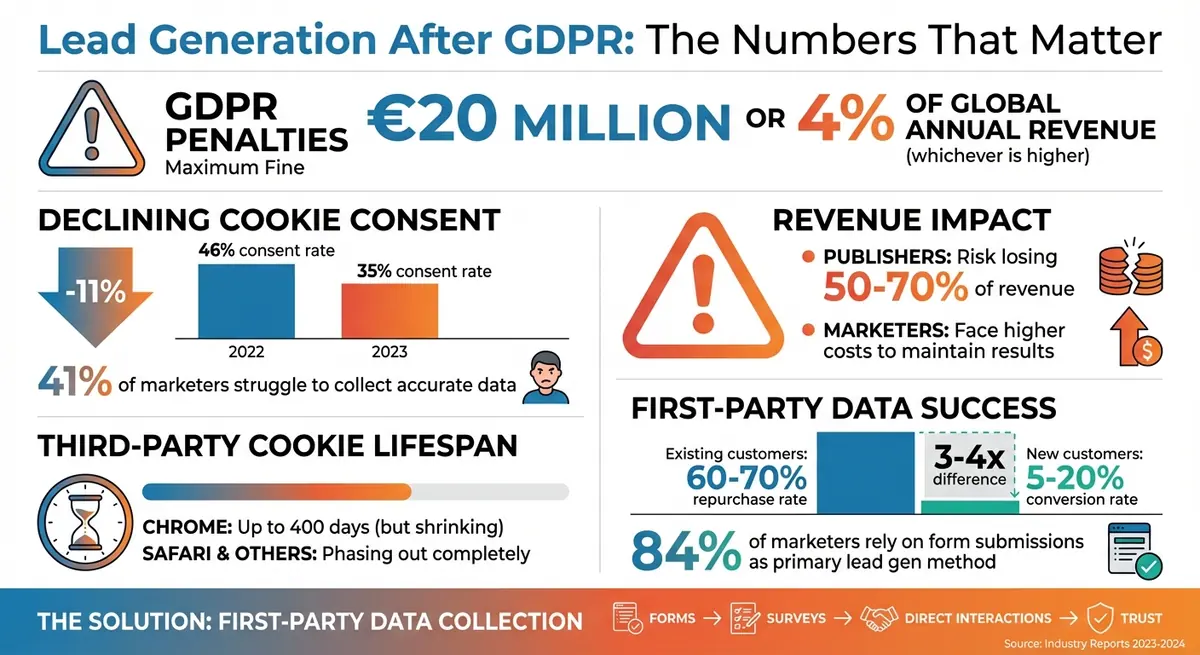
GDPR Impact on Lead Generation: Key Statistics and Cookie Consent Trends 2022-2024
GDPR Implications for Marketers
What GDPR Means for Cookies and Data Collection
Under GDPR, cookies are considered personal data if they can identify an individual. GDPR Recital 30 states: "Natural persons may be associated with online identifiers provided by their devices... such as internet protocol addresses, cookie identifiers or other identifiers... This may leave traces which... may be used to create profiles of the natural persons and identify them". This means that nearly every cookie used for lead generation falls under strict regulatory rules.
The regulation applies to any company, worldwide, that processes personal data of individuals within the EEA. Non-compliance carries steep penalties - fines can reach up to €20 million or 4% of annual global revenue, whichever is higher.
GDPR Requirements for Collecting Data
To comply with GDPR, you must secure explicit user consent before storing any non-essential cookies. Consent must be freely given, specific, informed, and clear. Methods like pre-checked boxes, scrolling, or continued browsing do not qualify as valid consent.
For lead generation forms, users must be able to provide separate consent for different purposes. For example, they shouldn’t be forced to agree to receive marketing emails just to download a resource.
Additionally, tracking scripts should remain inactive until a user clicks "Accept" on a cookie banner. This ensures tools like marketing pixels and analytics only run after valid consent is obtained. Keeping detailed records of when and how consent was given is essential, and withdrawing consent should be as easy as granting it.
These strict rules make traditional lead generation methods more challenging, pushing businesses to adopt compliant, direct data collection strategies.
Here’s a quick breakdown of cookie types and their consent requirements:
| Cookie Type | Purpose | Consent Required? |
|---|---|---|
| Strictly Necessary | Essential site functions (e.g., security, shopping carts) | No (but must be disclosed) |
| Preferences | Stores user choices (e.g., language, region) | Yes |
| Statistics | Gathers usage data to improve site performance | Yes |
| Marketing | Tracks activity for targeted advertising | Yes |
Why Third-Party Cookies Are Disappearing
Third-party cookies have long been a go-to tool for cross-site tracking, but their privacy risks have led to their decline since GDPR’s introduction. Browser updates have further shortened cookie lifespans, making it harder to track users over time.
This shift complicates lead attribution, as tracking multiple touchpoints becomes challenging when cookies expire before a conversion occurs. For instance, while Chrome still allows cookies to last up to 400 days, this window is shrinking. Businesses are now being pushed to rely more on first-party data collection through owned channels like CRM systems and lead forms.
These changes highlight the urgency of moving away from outdated tracking methods and focusing on direct, first-party data strategies.
Moving to First-Party Data Collection
With GDPR and cookie restrictions reshaping the landscape, businesses need a fresh approach to lead generation. The focus now shifts to first-party data collection - information that users willingly share with your business through forms, surveys, and website interactions. This method not only ensures compliance but also establishes a direct, trust-based relationship with your audience. It’s the backbone of the GDPR-compliant strategies we’ll explore next.
Why First-Party Data Is More Effective
First-party data solves many of the challenges introduced by GDPR and cookie restrictions. By collecting information directly from users, you build trust while ensuring compliance. Unlike third-party data, which often involves unclear consent, first-party data is transparent and straightforward.
It’s also more precise and relevant. When users share their data directly, it leads to better engagement and higher conversion rates. For instance, existing customers have a 60–70% chance of repurchasing, compared to just 5–20% for new customers. That’s a significant advantage.
First-party strategies also align naturally with GDPR’s data minimization principle. Consider this: when someone downloads an eBook, you typically ask for only the most essential information, like an email address. This focused approach not only keeps you compliant but also reduces friction, which improves conversion rates.
"With third-party cookies on their way out, first-party data is soon to be the undisputed king for marketing and advertising teams alike." – Kate Miller, Content Marketing Manager, Inflow
Tips for Collecting First-Party Data
Understanding the benefits is one thing, but putting it into action is where it counts. Here’s how to effectively collect first-party data:
- Offer value in exchange for data: Provide something users find worthwhile, such as discounts, free demos, exclusive webinars, or gated content. When the exchange is clear, users are more likely to provide accurate information.
- Use progressive profiling: Start small. Ask for basic details like an email address and name at first. As users return, gradually request additional information, such as their job title or company size. This step-by-step approach avoids overwhelming users and reduces the risk of abandoned forms.
- Implement double opt-ins: After someone submits a form, send a confirmation email to verify their address. This extra step ensures active consent and helps filter out fake or mistyped submissions.
- Leverage chatbots: Use chatbots to gather preferences and contact details in real time. These tools can seamlessly integrate with your CRM, making data collection efficient and user-friendly.
- Prioritize transparency: Always provide clear and simple ways for users to opt out, whether through unsubscribe links or straightforward data deletion requests. Transparency isn’t just about compliance - it’s about building trust and showing respect for your audience’s choices.
Lead Generation Strategies That Follow GDPR Rules
Building on first-party data strategies, these GDPR-compliant lead generation methods can help you achieve better conversion rates without compromising user trust.
Using Multi-Step Forms to Capture More Leads
Multi-step forms break down long forms into smaller, manageable sections, making them less overwhelming for users. This approach can boost completion rates by 20%-35% compared to traditional single-page forms. Starting with simple fields like name and email feels less daunting and encourages users to engage.
This method also aligns with GDPR's data minimization principle, as you collect only what’s necessary at each stage. Instead of overwhelming users with a long list of questions upfront, multi-step forms gradually build a complete lead profile while keeping the process user-friendly.
Arham Khan, Founder and CEO of Pixated, shared an example: "For a B2B software client, we added a simple 'Company Size' drop-down. Lead volume decreased by 22%, but qualified prospects jumped 37%."
To make forms even more effective, start with low-sensitivity fields, include a progress bar to set expectations, and replace generic "Submit" buttons with action-driven text like "Get My Free Guide" or "Start My Trial." Using first-person language on buttons (e.g., "Start my free trial") can outperform second-person language by as much as 90%.
Once you've captured initial details, lead enrichment can take your data collection to the next level.
Getting Better Data with Lead Enrichment
Lead enrichment tools allow you to gather detailed information without burdening users. Instead of asking for extensive details, you can request just an email address and use enrichment tools to automatically gather additional business data. This keeps the form short and user-friendly while still delivering valuable insights.
With explicit consent, appending publicly available business data is generally GDPR-compliant. This doesn’t involve tracking users across the web - it simply enhances the information they’ve already provided. For example, Google’s Enhanced Conversions for Leads uses hashed first-party data to attribute offline conversions to ad campaigns, eliminating the need for third-party cookies. Advertisers using this method report an average 10% improvement in measured conversions compared to standard imports.
By starting with basic fields like name and email, enrichment tools can automatically supply additional details, enabling your sales team to prioritize follow-ups effectively. However, ensuring the quality of these leads requires robust spam prevention and email validation.
Preventing Spam and Validating Email Addresses
GDPR compliance also means ensuring the leads you collect are genuine. Spam submissions not only waste time but also distort your analytics. Email validation is key to confirming that each submitted address belongs to a real person who has opted in to hear from you.
Double opt-in is the most reliable approach. After a user submits a form, sending a confirmation email for verification ensures active consent and filters out typos or fake entries.
For spam prevention, avoid traditional CAPTCHAs, which can frustrate users and lead to abandonment rates as high as 30%. Instead, use alternatives like "honeypot" fields - hidden fields that bots tend to fill out - or invisible reCAPTCHA, which blocks bots without adding friction for real users. Time-based validation, which rejects submissions completed in under two seconds, can also help distinguish bots from humans. Inline validation, which checks email formats as users type, further ensures clean and accurate data without disrupting the user experience.
| Strategy | GDPR Benefit | Conversion Benefit |
|---|---|---|
| Multi-Step Forms | Collects only essential information initially | Reduces friction and lowers abandonment |
| Double Opt-In | Verifies explicit, trackable consent | Ensures high-quality, engaged leads |
| Honeypot Fields | Maintains data integrity without user friction | Blocks bots without annoying real users |
| Enhanced Conversions | Uses privacy-safe hashed data | Improves attribution accuracy by 10% |
With 84% of marketers relying on form submissions as their primary lead generation method, fine-tuning these strategies is essential for building a strong, GDPR-compliant foundation.
sbb-itb-5f36581
How Reform Helps with GDPR-Compliant Forms
Reform takes the challenge of collecting first-party data in a post-GDPR world and makes it easier for businesses to generate leads while staying compliant. With its no-code form builder, Reform enables U.S. marketers to create branded, accessible forms that prioritize conversion and incorporate essential compliance features right out of the box. This means you can quickly design forms that not only look great but also meet GDPR standards, including consent mechanisms built directly into the process.
Let’s take a closer look at the features and integrations that make Reform a go-to tool for GDPR-compliant lead generation.
Reform Features for Lead Generation
Reform’s multi-step forms are designed to improve user experience and compliance. These forms increase completion rates by an impressive 40–50% compared to traditional single-page forms. They also align with GDPR’s requirement for explicit, step-by-step consent, ensuring users clearly opt in before providing sensitive details like their email address.
Conditional routing is another standout feature. It dynamically adjusts the form based on the user’s previous answers, showing only the fields that are relevant. This approach supports GDPR’s principle of data minimization by avoiding unnecessary data collection. It also improves lead quality by 15–20% through verified enrichment. For example, a question about company size will only appear if it’s relevant to the user’s earlier responses, ensuring that only essential information is gathered.
Reform also includes real-time email validation, which ensures that only legitimate and consented email addresses make it into your database. On top of that, its spam prevention tools help keep your leads clean without creating unnecessary friction for users.
To help you refine your forms, Reform provides real-time analytics. These tools track user interactions and drop-off points using first-party data, giving you actionable insights while respecting user privacy. This transparent approach to data handling builds trust with your audience.
Connecting Reform to Your CRM and Marketing Tools
Reform goes beyond form creation by seamlessly integrating with your existing marketing and CRM platforms, making lead management and GDPR compliance even simpler.
The platform connects directly with tools like HubSpot, Salesforce, Google Sheets, and Mailchimp via no-code APIs. These integrations allow you to sync consented leads, complete with timestamps and opt-in proofs, straight into your CRM. This not only simplifies compliance but also makes handling data deletion requests much easier .
Reform’s drag-and-drop builder also supports A/B testing, helping you optimize your forms to boost conversions by 20%. At the same time, it keeps detailed records of user actions to ensure you meet GDPR’s requirement for clear affirmative consent.
Tracking Lead Generation Performance After GDPR
Measuring lead generation performance has become trickier since GDPR came into play, but it’s far from impossible. The secret lies in moving away from intrusive tracking methods and embracing privacy-first analytics. This approach respects user consent while still delivering the insights you need to fine-tune your campaigns.
Monitoring Performance with Analytics
First-party data is your best friend for tracking performance without depending on third-party cookies. Tools that focus on aggregate trends can provide valuable insights without breaching GDPR consent requirements.
Key metrics to watch include conversion rates, form interaction rates, and lead quality scores. Businesses that actively monitor these indicators often see growth rates exceeding 30% year-over-year. Reform’s real-time analytics dashboard is a great example - it uses first-party data to pinpoint where users drop off in forms, all while keeping privacy intact.
It’s also important to track micro-conversions, like newsletter sign-ups or time spent on key pages such as pricing. These smaller actions can reveal friction points before they hurt your overall conversions. For instance, if visitors linger on your pricing page but don’t complete the lead form, it’s a clear signal that something needs adjustment. By addressing these issues, you not only gain better insights but also stay aligned with GDPR’s strict consent rules.
"There's a strong correlation between how much time users spend on the page and the quality of the lead." - Monica Carol, Team Bonding NYC
Take Calendly as an example. In 2024, they implemented sitewide tagging and enhanced conversion tracking to monitor users upgrading to paid accounts. By leveraging first-party data, they boosted their return on ad spend by 2X - a huge win.
Using A/B Testing to Improve Results
Once you’ve got a handle on the basics, it’s time to refine your approach with A/B testing. This method is invaluable for improving the performance of GDPR-compliant forms. The key is to test one variable at a time - whether it’s a headline, the color of your CTA button, or the number of form fields - so you can pinpoint what’s driving the changes.
Before starting any test, determine your sample size and aim for 95% confidence before declaring a winner. While 60% of companies already A/B test their landing pages, many fall into the trap of making decisions too early, without enough data to back them up.
"Statistical significance tells you whether the difference in performance between Variant A and Variant B is real - or just due to random chance." - Leadpages
Focus your tests on elements that have a direct impact on conversions. For example, a headline change can sometimes boost conversion rates by over 300%, while adding a progress bar to multi-step forms has been shown to increase conversions by 28%. Reform’s built-in A/B testing feature allows you to experiment with form designs and track which versions bring in more qualified leads. This way, you can achieve both higher lead volume and better lead quality.
Conclusion
Switching from third-party cookies to first-party data collection isn't just a regulatory requirement - it’s a smart move for building better relationships with your audience. The General Data Protection Regulation (GDPR) doesn’t have to stifle your lead generation efforts. By focusing on first-party data gathered directly through meaningful interactions, you can stay compliant while fostering trust. As Daniela Atanasovska from GDPR Local states:
"Adhering to GDPR not only ensures legal compliance but also builds trust with leads and clients, promoting accountability and safeguarding individual privacy."
To stay on the right side of GDPR and keep your lead generation effective, make sure you’re securing explicit consent through active checkboxes, only collecting what’s absolutely necessary, and being transparent with clear privacy policies. With the B2B lead generation market expected to reach $33.37 billion by 2027, compliance isn’t just about avoiding penalties - it’s a way to stand out in a crowded marketplace.
Tools like Reform make this shift easier by offering features such as built-in spam prevention, email validation, real-time analytics, and smooth CRM integrations. These make the transition less daunting and set you up for long-term success.
Remember, GDPR compliance isn’t a one-and-done task. Regular audits, A/B testing, and performance tracking are essential to fine-tune your strategies and stay ahead of evolving regulations. These efforts align with the adaptive lead generation methods we’ve discussed.
Ultimately, compliance and conversion go hand in hand. By prioritizing transparency and respecting user privacy, you not only build trust but also improve lead quality and drive sustainable growth. Embracing these practices ensures your lead generation strategy thrives in a privacy-first world.
FAQs
How can businesses collect first-party data while staying GDPR compliant?
To gather first-party data while staying compliant with GDPR, businesses need to prioritize obtaining clear and explicit consent from users. This means using opt-in forms that are straightforward and easy to understand. Explain exactly what data you’re collecting, how it will be used, and provide a link to your privacy policy - all without overwhelming users with complicated legal terms or unnecessary checkboxes. Keep it simple and user-friendly.
Tools like Reform can make this process easier by offering features such as consent management, spam prevention, and lead enrichment. These tools not only streamline GDPR compliance but also help ensure the data you collect is accurate and useful. By focusing on transparency, giving users control, and handling data securely, businesses can build trust and grow their audience responsibly while meeting GDPR standards.
What are the benefits of using multi-step forms for lead generation?
Multi-step forms bring a range of benefits to lead generation by simplifying the process for users and boosting conversion rates. Instead of overwhelming visitors with a long, daunting form, this approach breaks it into smaller, easier-to-handle steps, making the experience more user-friendly and encouraging completion.
Another key advantage is the ability to gather data more effectively. With features like conditional logic, the form can adapt based on a user’s previous answers, displaying only the most relevant questions. This not only keeps users engaged but also ensures the information collected is more accurate and useful, leading to higher-quality leads and better outcomes for your business.
How has GDPR changed the way marketers use third-party cookies?
The GDPR has tightened regulations around user consent and data privacy, making it much more challenging for marketers to rely on third-party cookies to track user behavior or personalize ads. These stricter rules have reshaped how businesses approach data collection and advertising strategies.
In response, many companies are turning to first-party data - information gathered directly from users in a way that complies with privacy laws. This can include methods like branded forms, email sign-ups, and surveys. These tools not only help businesses respect user privacy but also allow them to maintain strong conversion rates without depending on third-party data.
Related Blog Posts
Get new content delivered straight to your inbox

The Response
Updates on the Reform platform, insights on optimizing conversion rates, and tips to craft forms that convert.



Drive real results with form optimizations
Tested across hundreds of experiments, our strategies deliver a 215% lift in qualified leads for B2B and SaaS companies.
