
.webp)
Why Real-Time Monitoring Matters For Lead Quality


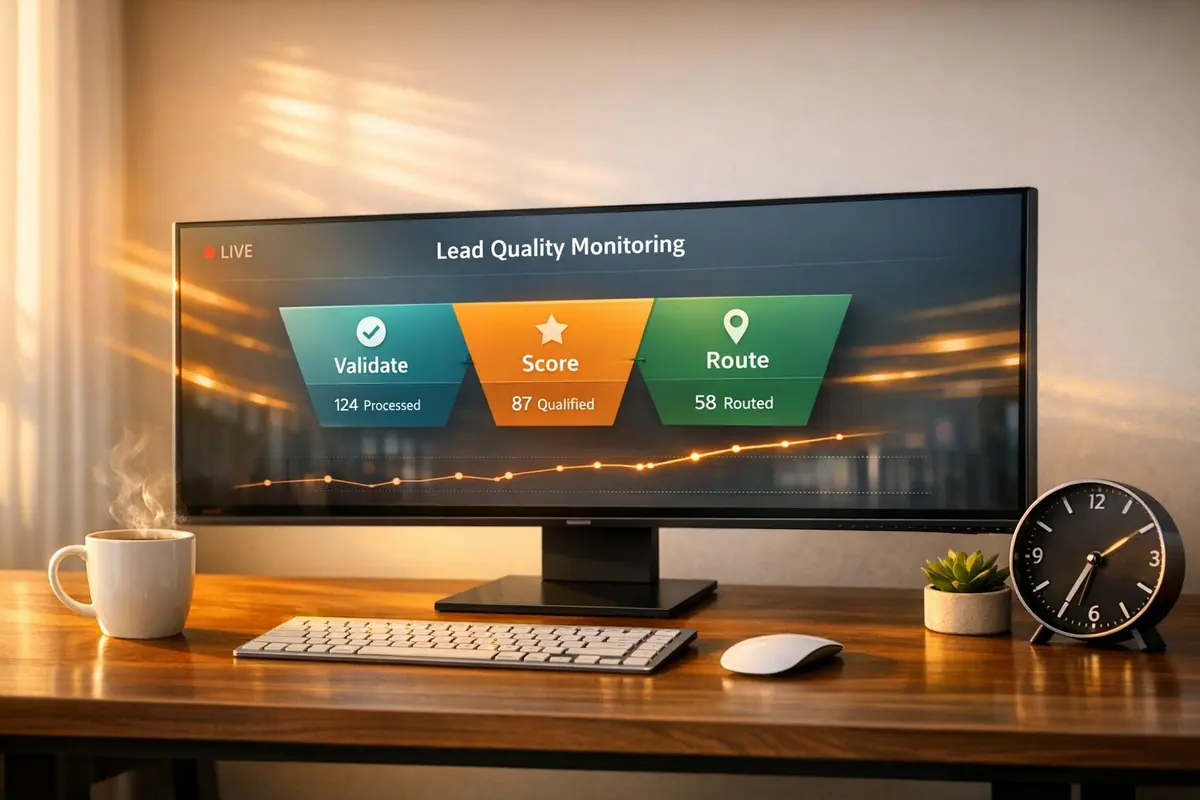
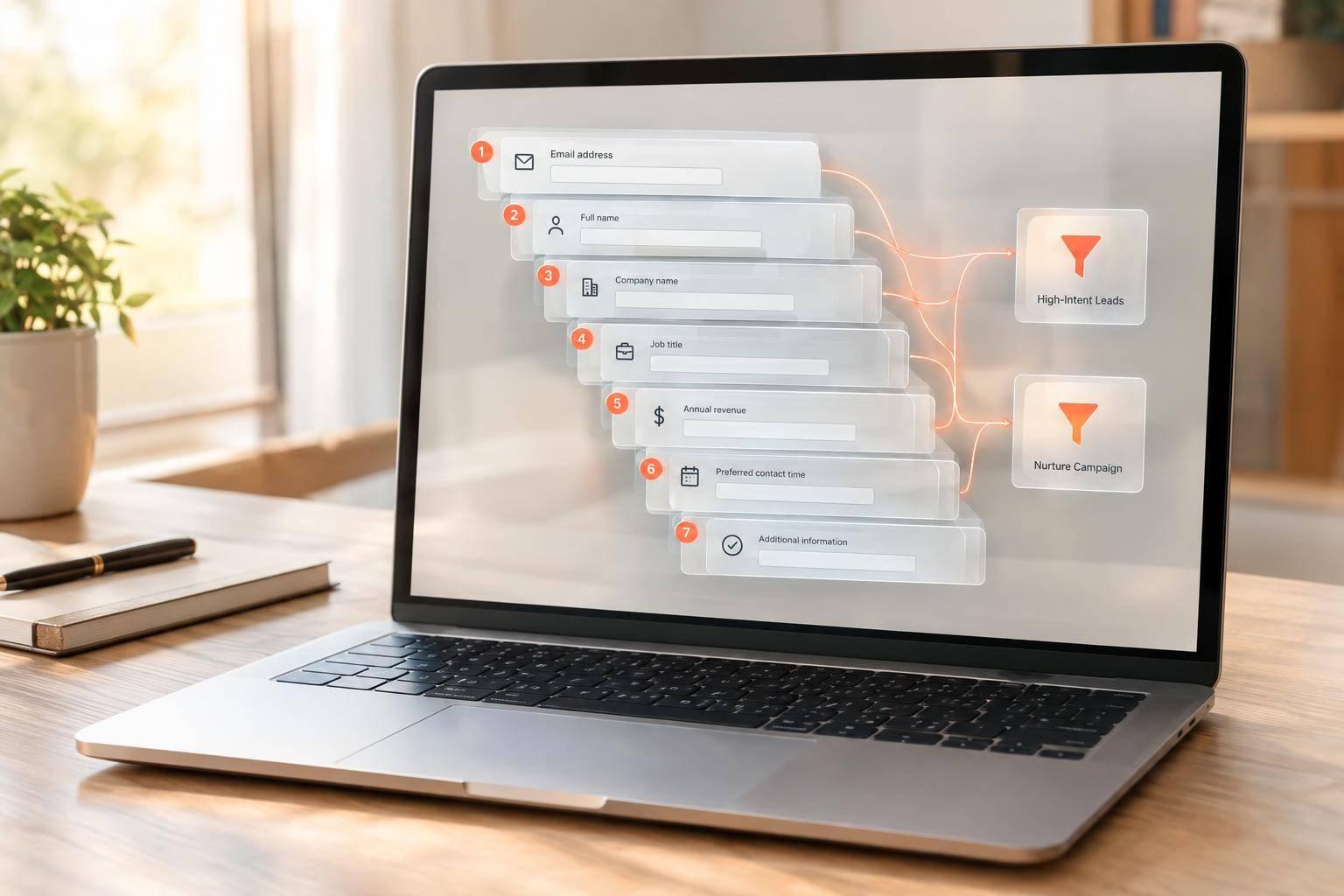
More leads don’t always mean more sales. Without the right form building tools, your sales team can waste time chasing unqualified prospects. Real-time monitoring solves this by validating, scoring, and routing leads instantly, so your team focuses on those ready to buy. Unlike delayed tracking, which processes leads in batches, real-time systems ensure faster follow-ups, accurate data, and improved conversion rates.
Here’s why real-time monitoring outperforms delayed tracking:
- Data Accuracy: Typos and fake entries are caught immediately.
- Faster Follow-Ups: Leads are routed to sales reps within seconds.
- Improved Conversions: Responding quickly keeps prospects engaged.
- Up-to-Date Insights: Decisions are based on live data, not outdated information.
Delayed tracking, while simpler, risks lost opportunities due to slower processing and outdated data. If lead quality and speed are priorities, real-time monitoring is the clear choice.
The Ultimate Guide To Lead Automator in PropStream
sbb-itb-5f36581
1. Real-Time Submission Monitoring
Real-time submission monitoring processes form data the moment it's submitted. Instead of relying on batch uploads or manual reviews, this system instantly validates, scores, and routes leads. This shift streamlines how you handle incoming prospects, ensuring higher-quality leads make it to your sales team.
Lead Quality Detection
Real-time validation prevents bad data from entering your CRM. For instance, email verification catches typos like "gmail.con" and flags disposable addresses right at the source. Phone numbers are checked for proper formatting and suspicious patterns, while tools like invisible reCAPTCHA and honeypot fields block bots.
Immediate lead scoring prioritizes high-quality prospects for fast follow-up while filtering out low-value submissions. Conditional logic in forms tailors questions based on user responses, helping you gather more detailed data from serious buyers without overwhelming casual visitors.
Without this filtering, sales teams waste time chasing invalid leads. In fact, research shows that only 12% of B2B marketing-generated leads convert to revenue, often due to prioritizing quantity over quality. Real-time monitoring flips this approach, ensuring that only qualified leads enter your pipeline.
Conversion Rate Impact
Speed matters when responding to leads. Real-time monitoring allows instant lead routing, assigning prospects to the right sales rep within minutes. This quick follow-up can make all the difference, cutting down response times from hours - or even days - to just minutes. Faster routing also reduces errors and speeds up the sales cycle.
Real-time analytics also highlight where prospects drop off during form submissions. By spotting and fixing high-friction fields as they happen, you can improve high-converting lead forms on the spot. It’s no surprise that 80% of companies report revenue growth after adopting real-time analytics. Acting on updated data rather than outdated reports can mean the difference between winning a lead and losing one. This agility underscores the efficiency gap between real-time and delayed tracking methods.
Data Freshness
Real-time monitoring ensures your decisions are based on the most current data. With near-zero latency, there's almost no delay between data collection and analysis. This ensures your sales team is always working with fresh insights that reflect actual buyer interest. As the Netdata Team puts it, "Real-time monitoring ensures that your digital environments run smoothly and securely, keeping your operations on track.". Relying on outdated data can leave you playing catch-up.
Integration Efficiency
Smooth API integrations make real-time monitoring even more effective by ensuring only quality leads reach your sales team. These systems connect directly to your CRM, automatically syncing lead data, qualification responses, and scores. Automated routing rules trigger instant notifications or CRM tasks when a lead meets specific criteria. Progressive profiling adds new qualification data from returning prospects without asking repetitive questions, enriching the lead profile over time.
Platforms like Reform demonstrate how real-time submission monitoring can fit seamlessly into your workflow, ensuring every lead is validated and routed for immediate follow-up.
2. Delayed Submission Tracking
Delayed submission tracking processes data in batches, creating noticeable lags. These processes often depend on manual reviews, scheduled uploads, or periodic syncs that can take hours - or even days - to complete. Unlike the immediacy of real-time monitoring, this approach slows down decision-making and can result in missed opportunities to capture revenue.
Lead Quality Detection
Batch processing makes it easier for low-quality leads to slip through unnoticed. Spam submissions and unqualified entries can end up in your CRM without being flagged, cluttering your system with unreliable data. Without instant validation, sales teams might waste time chasing leads with incorrect or incomplete contact details.
Conversion Rate Impact
The delay in processing submissions directly affects conversion rates. Leads sitting in a queue for hours - or even overnight - may lose interest. For instance, A lead who submits a landing page form at 2:00 PM might not be routed to a sales rep until the next day, especially if the submission occurs late in the workday. On top of that, manual handling increases the likelihood of errors, further delaying follow-ups and reducing the chances of closing deals.
Data Freshness
Batch processing also means your CRM is updated less frequently, leaving your team working with outdated information. This lag can lead to missed opportunities, as decisions are made based on stale data. For example, if a campaign generates a surge of high-quality leads, delayed updates might prevent your team from capitalizing on those prospects in real-time. Adjusting lead routing strategies becomes harder when the data isn’t current.
Integration Efficiency
Integration challenges are another drawback of delayed tracking. Batch API integrations often require manual intervention to address errors, turning what should be a seamless process into a reactive one. This added administrative workload not only slows down operations but also reduces overall efficiency.
Pros and Cons
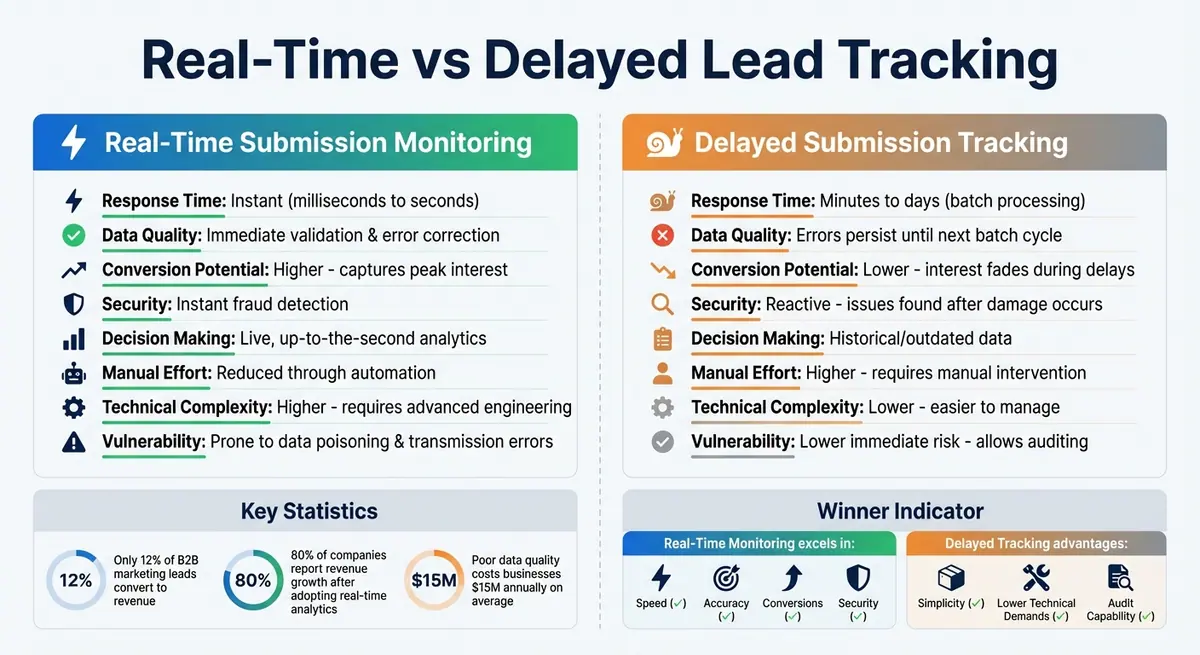
Real-Time vs Delayed Lead Tracking: Key Differences and Performance Metrics
Both monitoring methods come with their own set of trade-offs, impacting how effectively you can capture and manage leads. By understanding these differences, you can choose the approach that best fits your business objectives.
| Feature | Real-Time Submission Monitoring | Delayed Submission Tracking |
|---|---|---|
| Response Time | Instant assignment; leads are routed in milliseconds to seconds | Can take minutes, hours, or even days; processed in batches |
| Data Quality | Immediate validation and error correction | Errors persist until the next batch cycle |
| Conversion Potential | Higher; captures lead interest at its peak | Lower; interest may fade during delays |
| Security | Instant fraud and breach detection | Reactive; issues identified after damage occurs |
| Decision Making | Based on live, up-to-the-second analytics | Relies on historical or outdated data |
| Manual Effort | Reduced through automation | Higher; requires manual intervention and periodic checks |
| Technical Complexity | Requires more advanced engineering to optimize pipelines | Easier to manage; lower storage and technical demands |
| Vulnerability | Prone to data poisoning and transmission errors | Lower immediate risk; allows for auditing before use |
The table highlights the key differences: real-time monitoring excels in speed and data accuracy, while delayed tracking offers simplicity and lower technical demands.
Real-time monitoring enables lead responses in mere seconds, compared to the hours or days required by delayed tracking. This rapid response is crucial, especially when you consider that poor data quality costs businesses an average of $15 million annually. Real-time systems ensure errors are caught early, preventing them from spreading throughout your pipeline. However, the downside is the need for advanced infrastructure and engineering expertise.
On the other hand, delayed tracking is easier to implement and manage but relies on outdated information. While the buffer period allows time for manual audits, the delays can result in your sales team acting on stale data, leading to poor decisions and missed opportunities. Ultimately, the choice depends on whether speed and accuracy or simplicity and reliability are more important for your business.
Conclusion
Real-time monitoring ensures leads are assigned instantly and errors are corrected on the spot, engaging prospects when their interest is at its highest. On the other hand, delayed tracking often results in outdated data and missed chances to connect.
Speed-to-lead is a game-changer for conversion rates. Assigning leads within seconds instead of hours allows you to capture prospects when they’re most likely to engage. At the same time, automating data validation eliminates manual errors, ensuring your team works with accurate and reliable information. This kind of efficiency can transform your lead management process.
For businesses prioritizing lead quality, real-time monitoring is non-negotiable. It enables you to quickly spot issues like high-abandonment form fields and capitalize on live analytics - advantages that delayed systems simply can’t offer.
Converting quality leads demands swift action paired with ongoing, real-time insights. Reform’s platform makes this possible by offering instant lead routing, live analytics, and automated validation. This ensures every lead submission is handled promptly and accurately, optimizing your lead capture process so no opportunity is ever wasted.
The investment in real-time systems pays off when you consider the alternative: missed conversions and unreliable data.
FAQs
What counts as a “qualified” lead?
A “qualified” lead refers to a prospect with a strong likelihood of becoming a customer. This determination comes from real-time processes that sift through potential buyers, weeding out those who show little to no interest. By focusing on engaged prospects, businesses can zero in on serious buyers, boosting both the quality of leads and the chances of conversion.
How fast should I follow up after a form submission?
Timing is everything when it comes to turning leads into customers. Reaching out within minutes of receiving a form submission can make all the difference. A quick response shows you're engaged and ready to help, which builds trust and keeps potential customers interested.
To make this process smoother, consider using real-time monitoring tools. These tools can alert you as soon as a new lead comes in, ensuring you can respond quickly and efficiently. A fast follow-up not only boosts your chances of conversion but also leaves a positive impression on the lead.
What data should I validate in real time?
Validating key data in real time is essential to ensure it remains accurate, consistent, and complete. This process applies to critical details such as product information, pricing, inventory levels, and lead data. By implementing real-time validation, you can catch errors as they happen, maintain reliable data, and enable smarter, more informed decision-making.
Related Blog Posts
Get new content delivered straight to your inbox

The Response
Updates on the Reform platform, insights on optimizing conversion rates, and tips to craft forms that convert.


Drive real results with form optimizations
Tested across hundreds of experiments, our strategies deliver a 215% lift in qualified leads for B2B and SaaS companies.
