
.webp)
Predictive vs. Real-Time Lead Scoring Models



Lead scoring helps sales teams identify and prioritize prospects likely to convert. There are two main approaches: predictive lead scoring and real-time lead scoring. Here’s the difference:
- Predictive Lead Scoring: Uses historical data and machine learning to predict which leads are most likely to convert. It processes data in batches, offering deep insights but often with delays.
- Real-Time Lead Scoring: Updates scores instantly based on live interactions like form submissions or page visits. Using multi-step form design can further improve the quality of these signals. It emphasizes speed, enabling sales teams to act quickly when interest is high.
Key Differences:
- Timing: Predictive models rely on batch processing (e.g., daily), while real-time models provide instant updates.
- Data: Predictive requires extensive historical data (6 months–2 years), while real-time focuses on immediate behavioral signals.
- Goals: Predictive scoring excels at long-term qualification, while real-time scoring is best for fast responses.
When to Use:
- Predictive: Ideal for complex sales cycles and businesses with rich historical data.
- Real-Time: Best for fast-paced industries where acting quickly is critical.
Quick Comparison:
| Feature | Predictive Lead Scoring | Real-Time Lead Scoring |
|---|---|---|
| Data Input | Historical outcomes, demographic signals | Real-time actions, intent signals |
| Speed | Batch processing (e.g., daily) | Instant updates (milliseconds) |
| Infrastructure | Data warehouse-centric | API-driven |
| Primary Use | Long-term trends, accuracy | Immediate response to interest |
| Data Requirement | 6 months–2 years of historical data | Real-time event streams |
For many businesses, a hybrid approach works best: predictive scoring for long-term insights and real-time scoring for immediate opportunities.
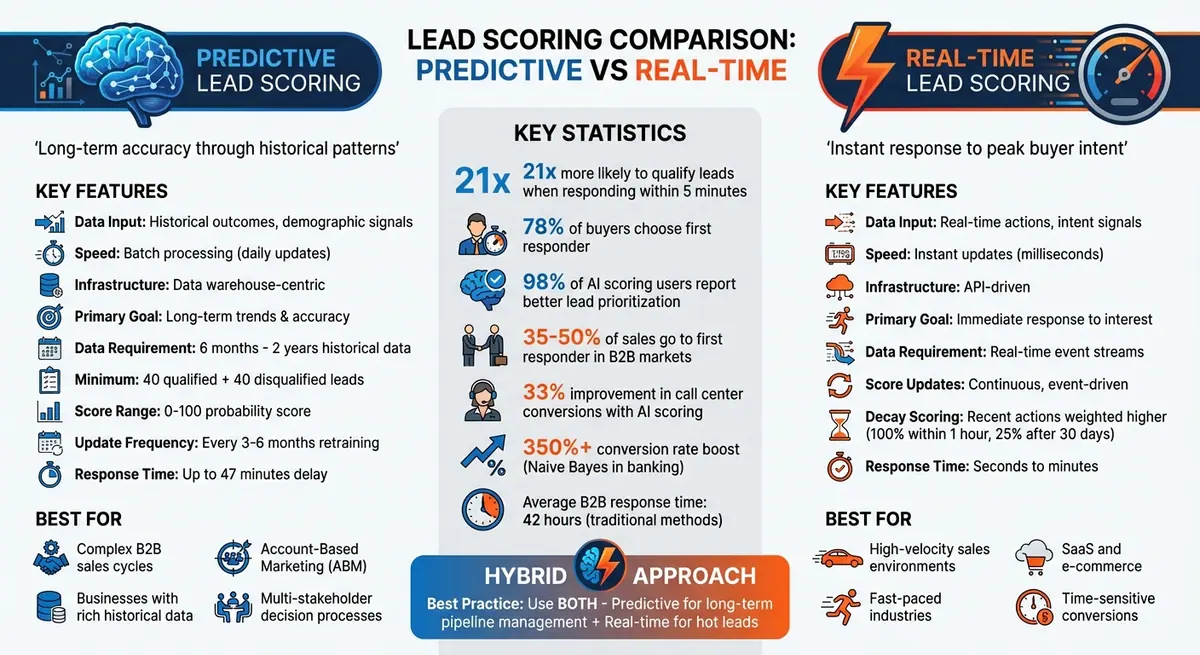
Predictive vs Real-Time Lead Scoring: Key Differences and Use Cases
Lead Scoring & Fit Webinar: How to Build a Scoring Model Sales Teams Will Trust
sbb-itb-5f36581
How Predictive Lead Scoring Works
Predictive lead scoring uses machine learning to predict which leads are most likely to convert into customers. Instead of relying on gut feelings or manual scoring systems, these models analyze years of historical customer data to identify patterns. By comparing current leads to those past patterns, the system generates scores based on actual outcomes rather than assumptions.
The process involves pulling data from several sources, including demographics (like job titles and locations), behavioral signals (such as multi-step form interactions, website visits, or email clicks), firmographics (company size, revenue, or industry), and CRM records. Through a process called feature engineering, raw data - like "time spent on site" - is transformed into actionable metrics, such as "lead engagement scores", to improve prediction accuracy.
"Predictive lead scoring flips that script. By analyzing your historical data - who actually converted, when, and why - machine learning models generate scores for new leads that reflect real patterns, not assumptions."
- Ben Rose, Growth Marketing Manager, Faraday
Most systems assign a probability score between 0 and 100, with higher scores signaling a stronger likelihood of conversion. For example, HubSpot's predictive model estimates the probability of a contact closing within a 90-day timeframe. While six months of historical data is the minimum needed for these systems to work effectively, having two years’ worth of data provides the best results for training the models.
Main Features of Predictive Models
Predictive models work by recognizing patterns in historical data to uncover hidden relationships. Algorithms like Random Forest and Gradient Boosting are particularly effective at identifying complex, non-linear patterns in large datasets that might go unnoticed through manual analysis. Commonly used algorithms include Logistic Regression, known for being efficient and easy to interpret, and Naive Bayes, which has been shown to boost conversion rates by over 350% in specific banking scenarios.
These algorithms are dynamic, meaning they adjust weights and priorities based on new data from recent conversions. Many systems automatically rank leads into categories such as Very High, High, Medium, and Low based on their percentile scores. This allows sales teams to prioritize the top-performing 25% of leads.
"Computational efficiency, accuracy, model transparency & rule extraction, and ease of understanding & interpretation are some of the advantages that have made Logistic Regression the choice of many experts."
- Amir A. Darbani, RS Transformation
Predictive models typically operate on a schedule rather than in real time. They need regular retraining - usually every 3 to 6 months - to stay relevant as market conditions, buyer behaviors, or product offerings evolve.
Benefits of Predictive Lead Scoring
Beyond technical precision, predictive lead scoring offers practical advantages. These models can process enormous datasets, analyzing hundreds of behavioral, demographic, and contextual signals simultaneously - something traditional rule-based systems simply can't match. This approach removes the guesswork by basing scores entirely on data.
Another major benefit is the reduction in manual effort. Sales and marketing teams no longer need to constantly adjust point systems for different lead actions. Instead, the algorithm identifies the most impactful combinations of attributes that signal high intent. For example, using AI-driven lead scoring has been shown to improve call center conversions by up to 33% through better lead prioritization and routing.
"Machine learning introduces a new level of precision and efficiency to lead scoring by leveraging advanced algorithms to analyze vast amounts of data and uncover patterns that human analysts might miss."
Additionally, predictive models provide insights into "Influential Factors" or "Feature Importance" scores. These highlight the specific attributes - like downloading a particular whitepaper or holding a specific job title - that most strongly influence a lead's likelihood of converting.
How Real-Time Lead Scoring Works
Real-time lead scoring updates a lead's score instantly with every new interaction - whether it’s a page view, email click, or form submission. This system uses event streaming architecture to route data through a scoring engine in real time. As a prospect interacts with your site, the system enriches their profile by pulling in external data and analyzing behavioral and intent signals simultaneously. The result? A single, up-to-date score that reflects their current interest level. When that score hits a certain threshold, the system springs into action, triggering tasks like notifying sales reps on Slack, assigning the lead to a team member, or sending out a calendar link for booking.
The speed of real-time scoring is a game-changer. While traditional systems might take hours - or even days - to process leads, real-time systems respond in seconds or minutes. Considering the average B2B company takes 42 hours to reply to an inbound lead, this is a massive improvement. And speed matters: responding within five minutes makes a company 21 times more likely to qualify a lead, and 78% of buyers go with the first company to respond. Unlike batch systems that rely on periodic updates, real-time scoring ensures no opportunity falls through the cracks. Let’s dive into the features that make these systems so effective.
Main Features of Real-Time Models
Real-time models continuously evaluate leads instead of relying on scheduled updates. The scoring engine processes interactions via API calls, allowing it to detect sudden behavioral shifts - like when a previously inactive lead starts showing signs of active interest. These systems also use decay-based scoring, where recent actions carry more weight. For example, actions within the last hour might be counted in full, while those older than 30 days might only retain 25% of their original value. High-intent signals, such as visiting pricing pages or using an ROI calculator, are given extra weight to highlight prospects closer to making a decision.
To avoid overwhelming sales teams, real-time systems use smart thresholds. Notifications are sent only for key events, like a lead crossing the score threshold for the first time, a significant score jump (e.g., 20+ points in 24 hours), or re-engagement after a period of inactivity. Many systems also integrate fit and behavioral data through dual scoring, prioritizing leads that both match the ideal customer profile and show immediate buying intent.
Benefits of Real-Time Lead Scoring
The biggest advantage of real-time lead scoring? Speed to lead. In competitive B2B markets, being the first to respond can secure 35% to 50% of sales. By eliminating delays caused by batch processing, real-time scoring allows sales teams to act when a prospect’s interest is at its peak. These systems excel at identifying behavioral surges - moments that signal a lead is moving into an active buying phase, something traditional methods often miss.
Data backs this up: 98% of sales teams using AI-driven scoring report better lead prioritization. With continuous updates, sales queues always reflect current intent, letting reps adjust their outreach strategies on the fly. For instance, a prospect spending 10 minutes on a pricing page and downloading a case study can get immediate attention, while less engaged leads are shifted to nurturing campaigns. This dynamic approach ensures sales teams focus on leads that are ready to convert right now.
Predictive vs. Real-Time Lead Scoring: Key Differences
The primary distinction between predictive and real-time lead scoring lies in timing, as well as the underlying infrastructure and the balance between accuracy and speed. Predictive models rely on batch processing, typically running once a day, whereas real-time models evaluate leads instantly as interactions occur. Predictive scoring requires substantial historical data - spanning anywhere from six months to two years - to identify long-term trends. On the other hand, real-time scoring processes data on the spot during engagement through API calls. Let’s break down how each model's architecture supports their respective approaches.
"Traditional lead scoring operates on a batch processing model... creating a qualification bottleneck exactly when speed matters most." - Orbit AI
Differences in Architecture and Functionality
Predictive models are built around data warehouses, requiring a robust historical database and machine learning environments for training. Real-time systems, however, use an API-driven architecture to handle instant data processing, routing, and notifications, enabling responses in just milliseconds. Another distinction lies in scalability: predictive tools often cap scores to a fixed number of records per month (e.g., 1,500), whereas real-time models are only limited by API throughput.
Accuracy vs. Speed
When it comes to performance trade-offs, predictive models shine in identifying hidden patterns and providing long-term insights. However, they can introduce delays - leads might wait up to 47 minutes for a score. Real-time models prioritize speed, capturing behavioral signals and intent during peak engagement, but they lack the depth of historical context that predictive systems offer. For example, predictive scoring typically requires at least 40 qualified and 40 disqualified leads over two years for effective calibration.
Comparison Table: Key Differences
Here’s a quick side-by-side comparison of the two approaches:
| Feature | Predictive Lead Scoring | Real-Time Lead Scoring |
|---|---|---|
| Data Input | Historical outcomes, deep behavioral/demographic signals | Instant behavioral triggers, real-time form data, captured through high-converting forms, intent signals |
| Scoring Frequency | Batch processed (e.g., daily) | Instant/event-driven (milliseconds) |
| Infrastructure | Data warehouse-centric, requires historical database | API-driven, requires instant routing/notification integrations |
| Primary Goal | accuracy and long-term lead qualification | Speed of response and capturing peak intent |
| Data Requirement | 6 months to 2 years of historical data | Real-time event stream and immediate enrichment APIs |
| Scalability Limit | Often limited by scored records per month | Limited by API throughput and routing logic |
Pros and Cons of Each Model
Finally, here’s a breakdown of the strengths and weaknesses of each scoring model:
| Model | Pros | Cons |
|---|---|---|
| Predictive | High accuracy; grounded in historical data; uncovers hidden patterns in large datasets | Delays due to batch processing; requires extensive historical data to function effectively |
| Real-Time | Fast and responsive; aligns with modern buyer expectations; captures peak intent during engagement | Limited historical insight; demands advanced API infrastructure |
When to Use Predictive vs. Real-Time Lead Scoring
Choosing between predictive and real-time lead scoring depends on your sales cycle, the maturity of your data, and how quickly your team needs to act. If your business has a wealth of historical data and operates within a complex B2B sales cycle, predictive scoring is often the better choice. On the other hand, companies in fast-moving industries, where timing is critical to conversions, should lean toward real-time lead scoring. For many, a hybrid approach works best - using predictive scoring for long-term pipeline management and real-time scoring to seize "hot" leads as they engage.
Best Use Cases for Predictive Lead Scoring
Predictive scoring shines when supported by a robust historical dataset (6–24 months) and is particularly effective for complex sales processes involving multiple stakeholders. To build a reliable predictive model, you need at least 10 qualified conversion events per prediction goal. This method is especially useful for B2B companies employing Account-Based Marketing (ABM). For example, predictive scoring can consolidate individual actions into account-level scores, estimating the likelihood of purchase.
In fintech ABM strategies - a sector projected to hit $49.43 billion by 2028 - predictive scoring leverages firmographic data such as company size, technology stack, and funding status to identify high-conversion accounts. While these models are excellent for identifying long-term trends, they aren't designed for capturing immediate intent. Predictive scoring typically processes data in batches (often daily), making it better suited for deliberate, multi-step sales cycles rather than situations requiring instant action.
Best Use Cases for Real-Time Lead Scoring
Real-time lead scoring is indispensable in scenarios where immediate action can make or break a conversion. It’s ideal for high-growth SaaS companies, e-commerce businesses, or any industry where leads are "perishable" and may quickly turn to competitors if not engaged promptly.
To maximize its impact, set up real-time triggers for high-intent actions like visiting a pricing page, using an ROI calculator, or requesting a demo or submitting a feature request form. Establish tiered thresholds: leads scoring 80 or higher should trigger immediate sales notifications and outreach, while those scoring between 60 and 79 can enter a personalized nurture sequence. Real-time scoring excels in industries where buyers expect instant responses. It processes a mix of behavioral, firmographic, and external intent data in milliseconds, ensuring your team can act quickly.
"Traditional scoring is great - if it's 2008. But in 2025, teams are managing thousands of signals across channels, and the limitations of hand-crafted scoring systems are showing." - Ben Rose, Growth Marketing Manager, Faraday
Connecting Lead Scoring with Form-Based Lead Generation
When it comes to gathering accurate, timely data, forms play a pivotal role. They’re often the first interaction prospects have with your business, making them essential for both predictive and real-time lead scoring. If forms are poorly designed, they can result in incomplete profiles and unreliable lead scores. The solution? Smarter forms that validate, refine, and filter data before it even reaches your CRM.
Using Reform to Improve Lead Quality
Reform's form builder is a game-changer for capturing cleaner, more actionable lead data. Two standout features - email validation and conditional logic - help ensure quality. Email validation blocks fake addresses from entering your CRM, which is crucial because predictive models built on faulty data will produce inaccurate scores. Conditional logic, on the other hand, keeps forms concise while tailoring questions to high-intent leads. For instance, if someone selects "Enterprise" as their company size, additional fields can automatically appear to gather details like budget or decision-making authority - key inputs for refining lead scores.
But it doesn’t stop there. Reform also enables lead enrichment by linking form data to external identity graphs. Take the Faraday Identity Graph, which holds data on over 240 million U.S. adults. This tool adds behavioral and demographic insights - like eco-consciousness or purchase trends - that go beyond standard form fields. A great example is Bee's Wrap, a brand specializing in sustainable food storage. By leveraging enriched data, they identified retail partners based on shopping habits and repeat purchase behavior, which helped them secure distribution in over 550 Target stores.
In addition, real-time analytics within these tools further sharpen lead scoring by capturing actionable insights as they happen.
Pairing Lead Scoring with Real-Time Analytics
Real-time analytics in form tools like Reform work hand-in-hand with lead scoring to capture behavioral signals instantly. For example, when a prospect requests a demo or interacts with a specific form element, these analytics record those high-intent actions immediately. This allows for instant updates to lead scores and triggers follow-up notifications. Such quick reactions are vital in industries where leads expect immediate responses.
These analytics also help identify bottlenecks. If prospects abandon forms at specific fields - like "Company Revenue" - the system flags the issue, prompting adjustments to improve completion rates. Additionally, enriched data can be automatically mapped to CRM platforms like HubSpot or Salesforce, giving sales teams a clear view of conversion probabilities and key influencing factors - all without leaving their workspace.
"The real challenge isn't generating data; it's knowing which leads and deals deserve attention right now." - Inogic
Conclusion: Choosing the Right Lead Scoring Model
Picking the right lead scoring model hinges on factors like your sales cycle, the volume of leads you handle, and how quickly your team needs to respond. For businesses that require extended lead nurturing and precise account matching, predictive scoring is a solid choice. This model uses historical data to forecast which leads are most likely to convert, making it particularly useful for Account-Based Marketing (ABM) and intricate B2B sales cycles. However, predictive scoring works best when you have plenty of historical data and a significant number of conversion events to analyze. Aligning this model with your business goals is key.
On the other hand, if your sales team thrives in fast-paced environments where timing is critical - such as industries with high-velocity sales - real-time scoring is the way to go. This model tracks actions like form submissions, visits to pricing pages, or demo requests as they occur, giving your team the chance to engage leads when their interest is at its peak.
For many businesses, a combination of both approaches works best. Think of it as balancing fit and intent. Predictive scoring helps identify who is likely to buy in the long run, while real-time scoring pinpoints who is ready to buy right now. This dual strategy ensures your team doesn’t waste time on leads that show immediate interest but are a poor fit, or overlook ideal leads who may not have shown recent activity yet.
Regardless of the model you choose, the foundation is clean, enriched data. Both predictive and real-time scoring depend heavily on high-quality data. Since forms are often the first step in the process, tools like Reform can help by validating emails, using conditional logic, and enriching lead profiles before they even reach your CRM. Poor data quality can compromise both the accuracy of predictive models and the responsiveness of real-time scoring.
Ultimately, your choice comes down to your priorities. If long-term accuracy and seamless sales and marketing alignment are your goals, predictive scoring can reduce friction during lead handoffs. But if capturing leads during their "golden window" of interest is critical, real-time scoring ensures you’re ready to act when it matters most.
FAQs
How much data do I need to start predictive lead scoring?
To begin with predictive lead scoring, you must have a solid amount of historical data on both qualified and unqualified leads. This information is crucial for training the algorithm to make precise predictions and provide actionable insights.
What events should trigger real-time lead score changes?
Real-time updates to lead scores should be driven by user actions such as visiting your website, downloading content, engaging with emails, or interacting on social media. These activities offer instant insights into a lead's behavior, making it easier to prioritize and act on the most promising opportunities.
How can I combine predictive and real-time scoring without confusing sales?
To make the most of predictive and real-time scoring, bring them together into a single system that delivers clear, actionable insights. Start by aligning both models around a unified lead profile. Clearly explain how each scoring method plays its part - predictive scoring helps identify long-term potential, while real-time scoring focuses on immediate engagement opportunities.
Use visual dashboards to make the data easy to interpret at a glance. This way, sales teams can quickly understand the insights without getting bogged down in complexity. Finally, ensure your sales team is trained to interpret and act on both scores effectively. When everyone knows how to use the system, it becomes much easier to work efficiently and close deals faster.
Related Blog Posts
Get new content delivered straight to your inbox

The Response
Updates on the Reform platform, insights on optimizing conversion rates, and tips to craft forms that convert.



Drive real results with form optimizations
Tested across hundreds of experiments, our strategies deliver a 215% lift in qualified leads for B2B and SaaS companies.
