
.webp)
How to Align Vendor Training with Privacy Goals



Vendors often handle your organization's most sensitive data, like customer records and financial information. But here’s the catch: your company is legally responsible for how they handle it. Without proper training, vendors can misinterpret privacy requirements, leading to costly mistakes. For example, failing to update contracts or mishandling data can result in fines - like the $1.35 million CCPA penalty issued in 2025.
To align vendor training with privacy goals, focus on these steps:
- Clarify Privacy Objectives: Define what data needs protection and why. Break down your goals (e.g., data minimization, breach preparedness) into actionable vendor responsibilities.
- Tailor Training by Risk Level: Rank vendors by risk tiers (e.g., critical vs. low-risk) and adjust training depth accordingly.
- Set Clear Learning Objectives: Avoid vague goals like "understand GDPR." Instead, teach vendors how to handle specific scenarios, like breach notifications or consent management.
- Make Training Mandatory: Embed training requirements into contracts and onboarding. Require periodic refreshers, especially for high-risk vendors.
- Monitor Compliance: Use tools to track training completion, measure incident reduction, and ensure vendors stay aligned with privacy standards.
Proper vendor training not only reduces risks but also strengthens compliance with regulations like GDPR, CCPA, and HIPAA. The key is making training specific, measurable, and continuous.
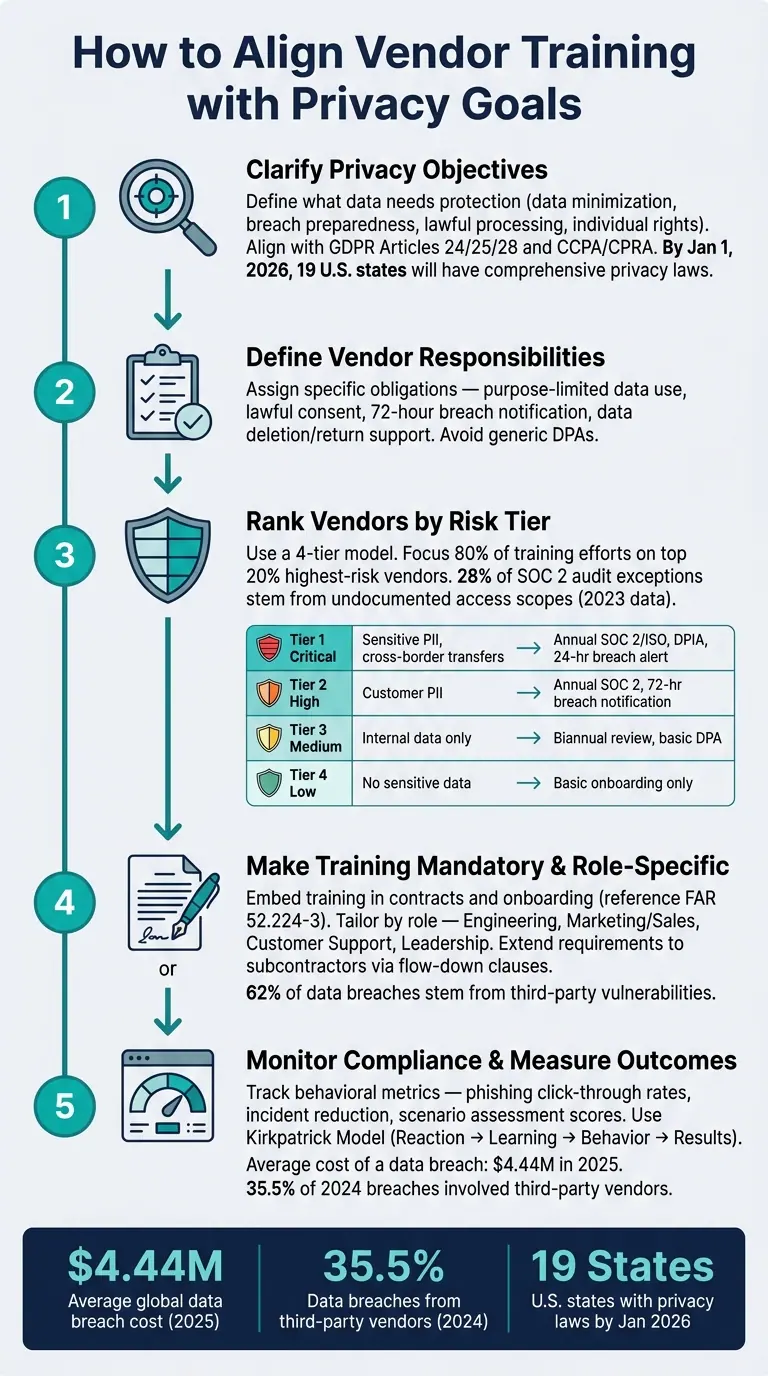
How to Align Vendor Training with Privacy Goals: 5-Step Framework
Mapping Privacy Objectives to Vendor Training
Clarify Your Organization's Privacy Goals
Start by pinpointing what your organization needs to protect and why. This involves breaking down your core privacy objectives, such as data minimization, lawful processing, breach preparedness, and fulfillment of individual rights. These goals shouldn't just sit in policy documents that no one reads - they need to directly align with the regulations your business operates under.
For example, if you're dealing with GDPR, Articles 24, 25, and 28 require you to implement risk-based controls and privacy-by-design approaches. On the other hand, if you're subject to CCPA/CPRA, you'll need to prepare for expanded obligations in 2026, like automated decision-making rules and cybersecurity audits. This is especially critical since, by January 1, 2026, nineteen U.S. states will have comprehensive consumer privacy laws in effect.
A good first step? Rewrite your internal privacy policies in plain, straightforward language. This makes them not only easier for internal teams to follow but also useful as training materials for vendors.
From there, you should translate these goals into clear, actionable obligations for each vendor.
Define What Vendors Are Responsible For
Once your privacy goals are clear, break them down into specific responsibilities for your vendors. A common pitfall is relying on generic Data Processing Agreements that don’t address the unique risks each vendor might pose.
Be precise about what each vendor is allowed to do with your data. Vague contract terms can lead to serious consequences, like a data transfer being misclassified as a "sale" or "share." This could trigger opt-out requirements, additional notices, or even liability down the line.
Specific obligations might include:
- Using personal data strictly for defined purposes.
- Securing lawful consent before processing data.
- Complying with a 72-hour breach notification window.
- Supporting data return or deletion requests.
When these obligations are clearly defined, vendor training can be tailored to ensure compliance.
Rank Vendors by Risk Level
After assigning responsibilities, sort your vendors by risk level to focus your training and oversight efforts where they’re most needed. For instance, a cloud provider managing your customer database poses a much higher risk than a tool used internally for tracking expenses.
A four-tier risk model is practical and effective:
| Vendor Tier | Typical Profile | Training & Review Depth |
|---|---|---|
| Critical (Tier 1) | Handles sensitive PII, has production system access, or performs cross-border data transfers | Annual SOC 2/ISO review, DPIA, 24-hour breach alert requirement, role-specific training |
| High (Tier 2) | Processes customer PII or supports key business functions | Annual SOC 2 review or detailed security questionnaire, 72-hour breach notification |
| Medium (Tier 3) | Accesses internal data only, with limited business impact | Biannual review, basic DPA, security verification every 2 years |
| Low (Tier 4) | No access to sensitive data, non-critical functions | Basic onboarding due diligence; reassessment only if scope changes |
Focus the majority of your training and assessment efforts - about 80% - on the top 20% of vendors that pose the highest risk. A 2023 review of over 50 SOC 2 reports revealed that 28% of audit exceptions stemmed from undocumented access scopes, which delayed remediation by 40–60 days. Addressing these high-risk areas early can save significant time and resources down the line.
How to Design Vendor Privacy Training
Identify High-Risk Scenarios First
Start by mapping out your data flows to pinpoint vulnerabilities. Look at where data enters your system - through APIs, signup forms, or lead enrichment tools - how it moves internally, and where it’s shared with third parties. Focus on areas with the highest risk, such as cross-border data transfers, unapproved sub-processors, handling sensitive data like biometric or financial information, and shadow IT - those unsanctioned tools departments sometimes adopt without proper oversight.
The statistics are clear: in 2024, 35.5% of all data breaches stemmed from third-party vendors, a 6.5% increase from the previous year. Each incident carried an average remediation cost of $4.8 million. Ignoring these high-risk entry points makes training efforts ineffective.
Once you’ve identified these scenarios, the next step is to define targeted, measurable learning objectives. This ensures training addresses specific vulnerabilities while reinforcing your broader privacy goals.
Set Clear, Privacy-Focused Learning Objectives
Vague objectives like “understand GDPR” don’t give vendors practical guidance. Instead, focus on actionable outcomes. For instance, a goal like “Marketing vendors can evaluate whether a new lead collection initiative requires explicit consent and implement the correct procedure” provides clear direction.
A structured, four-level approach can help:
| Training Level | Focus |
|---|---|
| Level 1: Awareness | Vendor grasps basic principles and their importance |
| Level 2: Recognition | Vendor identifies privacy risks in their workflows |
| Level 3: Application | Vendor applies privacy best practices in routine tasks |
| Level 4: Expertise | Vendor handles complex or high-risk scenarios independently |
Most vendors only need to reach Level 3. The aim isn’t to turn them into privacy lawyers but to make them effective at spotting potential issues.
"The goal of privacy training isn't necessarily to make everyone a privacy expert. The main goal is to raise awareness to a level where employees are better issue spotters." - Jodi Daniels, Founder and CEO, Red Clover Advisors
To gauge success, use the Kirkpatrick Model: measure knowledge retention, observe behavioral changes (like privacy considerations during vendor check-ins), and track results, such as fewer incidents or quicker breach responses.
Build Role-Specific Training Content
Once your objectives are set, tailor the training to each vendor role. Different roles interact with personal data in unique ways - a customer support agent and a software engineer don’t face the same challenges. Generic training risks diluting the message for both.
Create role-specific content by mapping each vendor's responsibilities to their privacy touchpoints:
| Vendor Role | Core Training Focus |
|---|---|
| Engineering/Dev | Data minimization, encryption, access controls, Privacy by Design principles |
| Marketing/Sales | Consent management, opt-out procedures, data collection limits, cross-border rules |
| Customer Support | Recognizing DSARs, meeting response deadlines, escalating breaches |
| Leadership | Risk governance, regulatory awareness, resource planning for compliance |
For example, sales and marketing vendors need training tailored to the tools they use. If your team relies on Reform to manage lead data, the training should cover which fields are appropriate to capture, how to document consent at collection, and the proper handling of that data afterward. Reference your internal policies and data processing records to connect theoretical principles with practical actions.
"Training isn't a one-time event to document - it's an ongoing capability development process that needs to be measured by outcomes, not completion statistics." - PrivacyForge.ai
Embedding Privacy Training into Vendor Operations
Include Training Requirements in Onboarding and Contracts
Even the best training programs fall flat without proper enforcement. The simplest way to ensure privacy training is followed? Make it a contractual obligation.
Start by including specific training clauses in your vendor contracts. For example, under federal procurement rules (FAR 52.224-3), vendors are required to ensure their employees complete both initial and annual privacy training before accessing systems that handle personally identifiable information (PII). Even if you're not working within federal guidelines, this sets a clear precedent: no training, no access. For vendors handling EU data or sensitive consumer information, a Data Processing Agreement (DPA) should also outline training requirements, breach notification timelines, and security protocols.
It's equally important to extend these requirements to subcontractors. Flow-down clauses ensure that subcontractors handling regulated data meet the same training standards as your prime vendors. This is critical because 62% of data breaches stem from third-party vulnerabilities.
To streamline onboarding, categorize vendors by risk tier:
| Vendor Risk Tier | Data Access | Onboarding Requirements |
|---|---|---|
| Tier 1 (Critical) | Full PII/PHI/Financial access | Complete security questionnaire; provide SOC 2 Type 2, DPA/BAA; grant audit rights |
| Tier 2 (Elevated) | Limited regulated data | Abbreviated questionnaire, SOC 2 summary, standard contract terms |
| Tier 3 (Standard) | No regulated data | Vendor attestation, standard terms, GDPR DPA if EU data involved |
Source: ComplianceStack
Additionally, consider requiring breach notifications within 24–48 hours. While HIPAA allows up to 60 days, a shorter window ensures your team has enough time to meet its own regulatory deadlines.
With these contractual safeguards in place, the focus shifts to maintaining training and monitoring compliance over time.
Run Ongoing Training and Monitor Compliance
A signed contract and completed onboarding are just the beginning. Vendors evolve - staff turnover, regulatory updates, and operational changes mean privacy training must be a continuous effort.
At a minimum, schedule annual refresher training for vendors with access to sensitive data. For Tier 1 vendors, go a step further with a full reassessment. If a vendor experiences a breach, changes sub-processors, is acquired, or undergoes significant changes, trigger an ad-hoc reassessment.
Monitoring compliance shouldn't be a passive process. Use automated tools like security rating platforms, breach alert services, and quarterly financial health checks to catch potential issues early. Maintain a vendor register to track training completion, including who was trained, what was covered, and when. Under CCPA/CPRA guidelines, retain this documentation for at least 24 months.
Use Governance to Enforce Accountability
Strong governance is essential for keeping privacy training efforts on track. Without clear accountability, gaps will form - and regulators are quick to notice.
A practical approach is the Three Lines Model. Here’s how it works:
- First line: Business units manage the day-to-day vendor relationship.
- Second line: Risk and compliance teams set training standards and monitor overall exposure.
- Third line: Internal audit provides independent assurance.
This structure ensures no one assumes "someone else" is responsible for vendor training.
"Your organization's security is only as strong as your weakest vendor." - Ivana Ludiga, Partner, Vision Compliance
Governance committees should also leverage Key Risk Indicator (KRI) dashboards to flag overdue training or drops in vendor security ratings. Don’t forget about shadow IT - tools adopted without central approval can process personal data outside your established training framework. Part of governance involves identifying and bringing these tools into compliance.
"Regulators treat training documentation as evidence of the compliance culture of an organization, and the absence of documented training is cited in enforcement actions as a contributing factor to violations." - Colton Hibbert
sbb-itb-5f36581
Measuring and Improving Training Outcomes
Define Clear Metrics for Training Success
Tracking training success often goes beyond the basic completion rates many organizations rely on. As PrivacyForge.ai aptly states:
"Completion rates mean nothing. Generic module completions do not build capability."
The true test of success lies in assessing whether vendors can make privacy-compliant decisions in real-world scenarios. This involves monitoring behavioral indicators in addition to standard compliance data. For instance, keep an eye on phishing simulation click-through rates, response times, and reductions in privacy-related incidents. Also, look for "near-misses", where vendors identify and address potential issues before they escalate. These indicators provide a clearer picture of training effectiveness than mere completion rates.
Here’s a helpful way to organize the metrics you should track:
| Metric Category | Specific Indicator | What It Tells You |
|---|---|---|
| Knowledge | Scenario-based assessment scores | Whether vendors can apply privacy principles rather than just recall them |
| Behavior | Phishing simulation click-through rates | Awareness and ability to recognize threats in real-world situations |
| Behavior | Reporting accuracy and response times | How quickly and accurately vendors escalate incidents |
| Risk | Human Risk Score | A combined metric of simulation performance, training progress, and credential exposure |
| Outcome | Incident reduction pre- vs. post-training | The tangible impact on organizational security |
These metrics provide a solid foundation for evaluating training outcomes, which the next section explores in more detail.
Apply Evaluation Frameworks to Assess Results
The Kirkpatrick Model offers a structured approach to evaluate training effectiveness, progressing from surface-level feedback to measurable business outcomes.
- Reaction: Start by collecting feedback after each training module. This helps gauge whether vendors found the content engaging and relevant.
- Learning: Use scenario-based assessments rather than simple quizzes. For example, present vendors with a data deletion request scenario and evaluate their response. Are they distinguishing genuine threats from benign messages?
- Behavior: Track changes in how vendors apply their training in real-life situations, such as reporting accuracy or phishing simulation responses.
- Results: Measure the broader impact, such as reductions in breach-related losses. Improved human risk scores can help quantify this impact.
"Auditors used to be satisfied with completion rates. Now they want to see measurable effectiveness. The bar has moved." - Dmytro Koziatynskyi, Founder & CEO, RansomLeak
With the average cost of a global data breach projected to hit $4.44 million in 2025, the case for rigorous training evaluation is clear.
Use Feedback to Refine Training Programs
Metrics and evaluation frameworks are only as good as the action they inspire. Use the insights you gather to fine-tune training modules and address gaps quickly.
Before rolling out major updates, test them with a small pilot group of 5–8 vendors from different roles and risk tiers. Ask targeted questions: Does this training feel relevant to your daily work? Are the scenarios realistic? Their feedback often highlights issues that internal teams might overlook.
When a privacy incident occurs, conduct a root cause analysis to identify whether it stems from a knowledge gap (indicating a need for training updates) or a process failure (pointing to a system issue). This prevents organizations from mistakenly overhauling training programs when the actual problem lies elsewhere - or vice versa.
For large-scale feedback collection, tools like Reform’s customizable multi-step forms make it easy to design surveys tailored to vendors' roles and risk levels. This streamlined approach ensures continuous improvement, keeping training aligned with privacy goals and reinforcing measurable risk reduction.
"Training isn't a one-time event to document - it's an ongoing capability development process that needs to be measured by outcomes, not completion statistics." - PrivacyForge.ai
Act on vendor feedback promptly. If vendors report that a module feels too long or disconnected from their work, adjust it. Outdated or irrelevant training disengages participants, and disengaged vendors pose compliance risks of their own.
Vendor Compliance: The Hidden Risk Most Organizations Miss
Conclusion: Connecting Privacy Goals to Vendor Training
For vendor training to truly make an impact, it needs to focus on clear privacy objectives. Vendors must understand exactly what data they’re expected to collect, retain, and manage. This clarity leads to fewer mistakes, stronger audits, and better overall performance.
Adjust the level of training based on the vendor’s risk profile. Vendors dealing with regulated, sensitive, or large volumes of personal data - like payment processors, cloud service providers, or marketing platforms - require more detailed and frequent training. This isn’t just a good practice; it’s a practical step to ensure compliance and mitigate risks.
Incorporating training into onboarding processes, contracts, and regular reviews helps hold vendors accountable and ensures ongoing compliance. It’s about weaving training into the fabric of your operations.
Strong governance practices can further enhance training efforts by aligning them with the right technological tools. For example, platforms like Reform allow organizations to create standardized, no-code intake forms with features like conditional routing, email validation, and spam prevention. These tools help enforce data minimization and maintain controlled data flows - key principles of privacy-by-design.
FAQs
How do I decide a vendor’s privacy risk tier?
Start by evaluating the type of data a vendor handles and their role within your systems. Vendors that process sensitive data, engage in cross-border data transfers, or support essential operations typically fall into the high-risk category. On the other hand, vendors managing minimal sensitive data and those that can be replaced without much effort are generally considered low-risk.
To streamline the evaluation process, group vendors into risk tiers such as Critical, High, Medium, or Low. This way, you can prioritize your due diligence efforts on the areas that pose the greatest potential risks to your organization.
What should vendor privacy training cover for each role?
Effective privacy training works best when tailored to specific roles. While all employees should understand the basics - like privacy principles, how to report incidents, and handling personal information - certain roles need more focused guidance:
- Engineering/Development: Emphasis on incorporating privacy by design, minimizing data use, and implementing security measures.
- Marketing/Sales: Training on managing consent, gathering data responsibly, and respecting communication preferences.
- Customer Support: Understanding data subject rights, following access protocols, and knowing when and how to escalate issues.
- Leadership: Prioritizing strategic governance and overseeing risk management efforts.
By addressing these unique needs, privacy training becomes more relevant and impactful for everyone involved.
How can I prove vendor training is actually reducing privacy risk?
To demonstrate how vendor training can help lower privacy risks, it's important to look past basic metrics like completion rates and quiz scores. Instead, establish a shared taxonomy that connects training topics to incident categories and control objectives. This approach allows you to track risk scores for specific team-topic combinations, offering a clearer picture of training impact.
To assess effectiveness, conduct a pre/post analysis over a 60- to 90-day period. Signs of success include fewer repeat incidents, fewer control failures, and quicker issue resolution within the teams involved. This method provides a more meaningful way to measure the real-world impact of training.
Related Blog Posts
Get new content delivered straight to your inbox

The Response
Updates on the Reform platform, insights on optimizing conversion rates, and tips to craft forms that convert.

Drive real results with form optimizations
Tested across hundreds of experiments, our strategies deliver a 215% lift in qualified leads for B2B and SaaS companies.
