
.webp)
Ultimate Guide to Vendor Risk Training by Role



Vendor risk training is critical for organizations to manage the risks introduced by third-party vendors. With 35.5% of data breaches in 2024 linked to vendors and remediation costs averaging $4.8 million per incident, tailored training for specific roles is essential. Generic compliance training often falls short, as different roles face unique risks. For example:
- Finance managers may encounter payment fraud.
- Developers are at risk of supply chain attacks.
- Executives could face impersonation scams.
Role-based training ensures employees are equipped to handle risks relevant to their responsibilities. It aligns with the vendor lifecycle, from onboarding to offboarding, and integrates governance frameworks like the Three Lines of Defense model. Specialized modules for high-risk roles, combined with regular updates and behavior-focused metrics, improve both compliance and risk management. By tailoring training to specific job functions, organizations can reduce human error and strengthen their overall security posture.
Mastering Vendor Management | Cybersecurity Vendor Risk Management Training | TPRM
sbb-itb-5f36581
Building a Governance Framework for Training
Without a solid governance structure, vendor risk training can easily lose its direction and accountability. This framework lays the groundwork for designing and delivering role-specific training effectively.
Creating Accountability Through Governance
One effective way to establish accountability is by using the Three Lines of Defense model. Here's how it works:
- First Line: Business units and procurement teams manage daily vendor interactions and flag potential risks early.
- Second Line: Risk and compliance teams define policies and oversee the training framework.
- Third Line: Internal and external auditors verify that the first two lines are functioning as intended.
To make this model actionable, implement a RACI matrix. This tool assigns roles - such as Procurement, Security, and Legal - as Responsible, Accountable, Consulted, or Informed for each training activity. By clearly defining responsibilities, you avoid situations where everyone assumes someone else is handling a risk.
"Role clarity is what determines whether your audit findings get closed or just get documented." - Nasir R, TPRM Expert
A cross-functional steering committee, with representatives from IT, Legal, and Procurement, can further ensure that training covers all vendor risk areas - not just technical ones. To avoid gaps during handoffs, designate a single TPRM Program Lead to oversee the entire program.
Role Mapping and Training Needs Analysis
Before developing a training curriculum, map each vendor-facing role to its unique risk exposure. For example, a finance team member approving payments faces different risks than a system administrator managing access credentials. Training should align with these specific governance objectives.
A tiered training approach works well:
- Baseline Training: All employees receive annual training on general vendor risk awareness.
- Specialized Modules: High-risk roles like developers, finance staff, system administrators, and executives get additional, focused training.
The table below outlines how training can be structured:
| Role | Specialized Training Topics | Frequency |
|---|---|---|
| Developers | Secure coding, OWASP Top 10, code review security | Annual + Onboarding |
| Finance | Wire fraud prevention, invoice scams, payment verification | Annual |
| System Admins | Privileged access management, hardening, incident detection | Annual + Role assignment |
| Executives | Business email compromise, whale phishing, board-level security | Annual |
| Customer Support | Social engineering defense, data verification, escalation | Annual + Onboarding |
This structure ensures that resources are allocated where they're needed most, giving employees with higher risk exposure the in-depth training they require. These mappings also guide the curriculum customization discussed in the next section.
Standardizing Training Policies and Documentation
A governance framework is only as strong as its documentation. To withstand audits, maintain a centralized repository that includes vendor inventories, assessment reports, training logs, and policy versions.
Track employee names, completed modules, training dates, and scores. For new hires, ensure training is completed within 30 days. Behavioral evidence, such as phishing simulation results, adds an extra layer beyond basic compliance.
"A policy with no revision log looks like a policy that is never reviewed. The log is evidence." - Visualping Editorial Team
Automate reminders at the 11-month mark to alert employees of upcoming deadlines, and escalate to managers if training isn't completed by month 12. Include triggers for policy reviews following major regulatory or organizational changes to keep the framework current.
Core Stakeholder Roles and Training Objectives
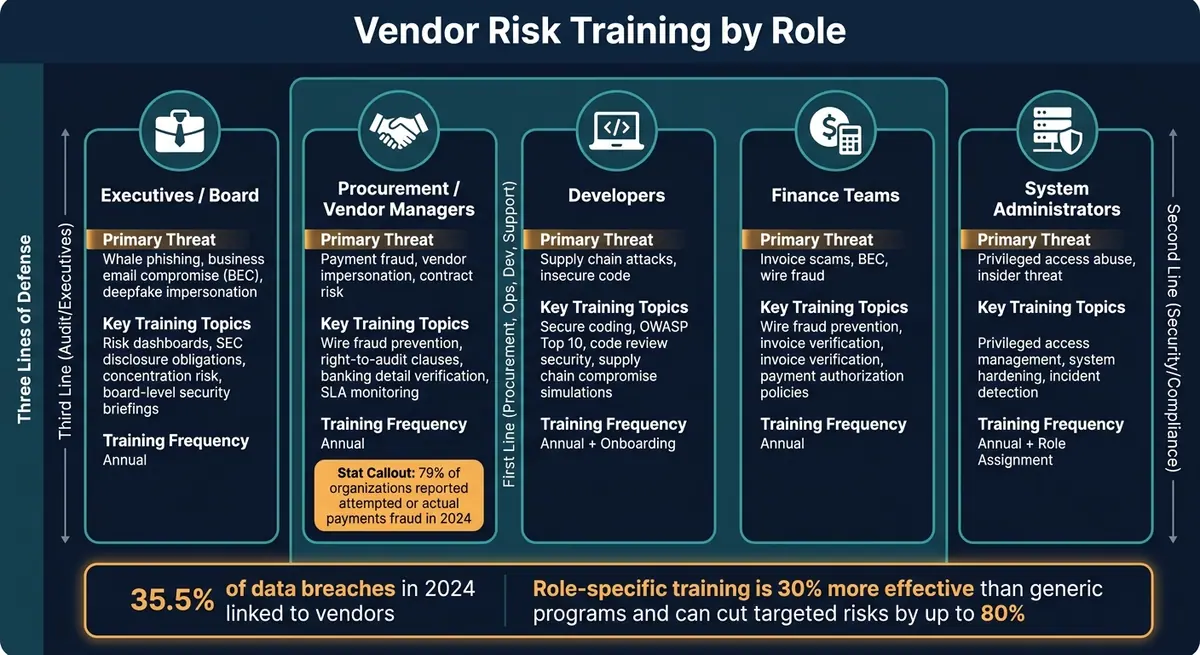
Vendor Risk Training by Role: Threats, Topics & Frequency
Once governance is in place, the next step is to tailor training for each stakeholder group based on their specific responsibilities. This ensures that every role actively contributes to a strong vendor risk management program.
Executive Leadership and Board
The board's primary responsibility isn't managing vendors directly - it’s about setting the strategic direction, asking insightful questions, and ensuring vendor risk is treated as a critical business issue, not just an IT problem. Training for this group should focus on interpreting risk dashboards, evaluating financial impacts, and overseeing vendor risk management, including compliance with SEC disclosure requirements.
For example, Delta Air Lines suffered significant financial losses due to an over-reliance on a single vendor, exposing the dangers of concentration risks. Board training should teach leaders to identify and challenge such risks while also addressing their obligation to report on third-party cyber risk governance under SEC rules.
"A board's oversight must now extend beyond the company's walls to its third- and fourth-party dependencies." - Kris Lovejoy, Partner Content Provided by Internet Security Alliance
Procurement and Vendor Relationship Managers
Procurement teams often act as the first line of defense, spotting early warning signs like missed SLA targets, leadership turnover, or overdue contract renewals. Training for this group should go beyond basic process compliance, focusing on sharpening their ability to identify risks.
Key skills include understanding contractual risks and embedding clauses like right-to-audit, incident notification windows (24–72 hours), and data return obligations. Fraud awareness is equally critical, as 79% of organizations reported attempted or actual payments fraud in 2024. Procurement teams must verify any changes to vendor banking details through pre-approved channels, avoiding reliance on contact information provided in change requests.
"A vendor that presented as low-risk at onboarding can become high-risk after a breach or leadership change." - Vendorfi Team
Information Security and Compliance Teams
Security and compliance teams serve as a secondary line of defense, requiring advanced technical training. These teams must be proficient in analyzing SOC 2 Type 2 reports, understanding frameworks like HIPAA, GDPR Article 28, and NIST SP 800-161r1, and using security rating platforms.
Training should also emphasize the importance of fourth-party visibility - knowing who your vendors’ subcontractors are. For instance, Providence Medical Institute paid $240,000 in 2024 to settle HIPAA violations after failing to establish a Business Associate Agreement with an IT vendor managing electronic Protected Health Information. Such cases highlight the need for training that addresses vendor contract accountability alongside technical controls.
| KRI (Key Risk Indicator) | Data Source | Red Threshold |
|---|---|---|
| Vendor Security Rating | BitSight / SecurityScorecard | Score < 650 |
| SLA Breach Frequency | Service Management Platform | > 3 per quarter |
| Financial Health | Credit Agencies (D&B) | Watch list / Downgrade |
| Concentration Ratio | Vendor Register | > 20% dependency |
| Fourth-Party Changes | Vendor Self-Report | Unapproved subcontracting |
Designing and Delivering Role-Based Training Programs
Once you've established stakeholder training objectives, the next step is to design role-specific curricula that align with your vendor risk management goals.
Defining Role-Specific Curricula
Start by conducting a human risk assessment. This involves reviewing simulation failure rates, breach history, and access maps to identify high-risk departments. Build your training around two key components: a foundational module covering phishing, password hygiene, and multi-factor authentication, and a role-specific module tailored to unique threats. For example, Finance teams might focus on business email compromise (BEC) scenarios, while Developers could tackle supply chain compromise simulations.
Choose formats that suit each audience. Use microlearning modules (5–10 minutes) for frontline employees, briefings for executives, and hands-on tabletop exercises for technical teams. Research highlights that role-specific training is 30% more effective than generic programs and can cut targeted risks by up to 80%.
To ensure accuracy, involve subject matter experts from departments like Finance, Legal, and IT. Their input helps tailor scenarios to your organization's real-world processes.
Streamlining these curricula is easier with the help of digital tools.
Using Digital Tools to Run Training Operations
Integrating your training platform with HR systems, such as Workday or BambooHR, ensures smooth enrollment updates when employees change roles or join the company. Tools like Reform simplify workflows for pre-training knowledge checks and post-training feedback by routing responses based on roles.
"Role-based training only works when it's grounded in your actual policies and procedures. Otherwise you're creating roles on paper while delivering generic content in practice." - Sarah Mitchell, Compliance Specialist, Securan
Leverage just-in-time training to deliver micro-modules immediately after events like simulated phishing failures. These timely lessons take advantage of moments when employees are most receptive to learning.
While these tools improve efficiency, it's equally important to ensure compliance with U.S. regulatory requirements.
U.S.-Specific Considerations for Training Programs
In the U.S., organizations must navigate a complex regulatory environment that dictates training content and audience. The table below outlines key frameworks, their target roles, and training requirements:
| Framework | Target Roles | Key Training Requirements |
|---|---|---|
| HIPAA §164.308(a)(5) | All personnel handling PHI | Privacy and security training tailored to function; records retained for 6 years |
| PCI DSS v4.0 | Personnel with cardholder data access | Phishing and acceptable-use training |
| CMMC Level 2 | Personnel handling CUI | Role-specific training and insider threat awareness |
| GLBA | Financial institution staff | Social engineering and BEC/invoice fraud awareness |
| Texas SB 2610 (effective Sept. 2025) | All employees (tiered by company size) | Basic awareness for small firms; full NIST/ISO frameworks for larger ones |
New hires should complete training before gaining access to sensitive data. Ignoring this sequencing can have serious consequences. For instance, in October 2018, Anthem faced a $16 million settlement with the HHS Office for Civil Rights after a spear-phishing breach exposed 78.8 million records. This led to a corrective action plan that included enhanced workforce training.
For remote or hybrid teams, training should also cover home network security and safe practices for using personal devices, as these environments introduce risks not present in traditional office settings.
Measuring and Improving Training Effectiveness
Understanding how to measure and refine training programs is key to ensuring they deliver real, measurable results.
Key Metrics for Measuring Training Success
If you're only tracking completion rates, you're missing the bigger picture. Just because someone finishes a training module doesn't mean they've learned or changed their behavior. Julie Haney, a Computer Scientist at NIST, puts it perfectly:
"Organizations measuring only training completion rates reveal little about whether training actually changes and sustains security behaviors."
The focus should shift from activity-based metrics (like completion rates) to behavior-based metrics. Instead of asking, "Did everyone complete the training?" ask, "Are employees making smarter security decisions?" This means tracking metrics like phishing simulation click rates, how accurately employees report threats, and how quickly they respond to suspicious emails. For example, a steady decline in click rates over a 90-day period provides far more insight than a 100% completion rate on a dashboard.
For role-specific programs, tailor metrics to match specific risks. These targeted measurements create a strong foundation for ongoing improvements.
| Metric | What It Measures | Benchmark |
|---|---|---|
| Phishing Click Rate | Percentage of employees clicking simulated malicious links | Look for a sustained decline over rolling 90-day periods |
| Reporting Accuracy | Ability to classify real threats versus benign messages | Higher accuracy reflects greater awareness |
| Time-to-Report | Time between receiving and reporting a suspicious email | Faster reporting minimizes attacker dwell time |
| Knowledge Assessment Scores | Quiz results after role-specific training | Indicates role-specific understanding |
Using Data to Improve Training Over Time
Metrics aren't just for tracking - they're tools for improvement. Behavioral data can reveal where training falls short. For instance, if a department repeatedly struggles with vendor impersonation emails, it's a clear signal to introduce targeted microlearning rather than rehashing generic training for everyone.
Annual training sessions don't cut it anymore. Research, like the Ebbinghaus forgetting curve, shows that people forget about 50% of new information within a day without reinforcement. Short, focused modules - under 10 minutes - delivered periodically can help combat this. Even better, trigger these micro-modules immediately after an employee fails a simulation. This "just-in-time training" approach ensures employees learn when they're most engaged.
Don’t forget to update training materials after policy changes. Scenario-based training, where employees see the real-world impact of their decisions, consistently outperforms static slide decks.
Using these insights, you can continuously refine your training program, ensuring it stays relevant and effective.
Tracking Compliance and Reporting Results
For audit readiness and regulatory compliance, maintain detailed training logs tied to specific policy versions. Include timestamps showing when employees reviewed and acknowledged updates. For example, HIPAA mandates retraining within 90 days of major rule changes, while CCPA/CPRA requires training for employees handling consumer rights requests. Keeping at least three years of records demonstrates program maturity to regulators.
When presenting results to leadership, focus on risk reduction rather than operational metrics. Nasir R. from Atlas Systems explains:
"A dashboard showing assessment completion rates tells leadership how busy the team is. A dashboard showing critical findings closed per cycle... tells leadership how much risk the program is actually reducing."
Tools like Reform make it easier to collect structured feedback and identify gaps by role. Quarterly governance reviews that include a 90-day risk trend summary help leadership see the training program as a dynamic, evolving strategy - not just a checkbox exercise.
Conclusion and Key Takeaways
Final Thoughts on Role-Specific Training
Generic training often misses the mark because it overlooks the specific risks tied to individual roles. Sarah Mitchell, Compliance Specialist at Securan, puts it perfectly:
"A generic module... can't reflect your internal payment authorization policy. It was built for everyone, which means it was built for no one in particular."
When training is tailored to actual job responsibilities, it can significantly impact behavior. Considering that 60% of data breaches involve a human element, organizations implementing role-based programs have seen a 40% reduction in their human risk score over two quarters. This not only lowers incident rates but also reduces the costs associated with remediation.
Taking these insights into account, it's time to take clear, actionable steps to structure your training program.
Next Steps for Building Your Training Program
The benefits of role-specific training provide a clear roadmap for action. Start with a human risk assessment by analyzing simulation data and breach history to pinpoint high-risk roles. From there, align specific threats to relevant departments: for example, Business Email Compromise training for Finance teams, secure coding modules for Developers, and deepfake impersonation exercises for Executives.
Once your role-specific training framework is mapped out, integrate it with your HRIS system. This ensures training assignments are automatically updated when employees change roles or join the company. This step is especially important during transitions, as new hires are most vulnerable in their first 90 days.
Tools like Reform can streamline this process by collecting structured role assessment data and identifying training gaps early. Set a clear timeline for implementation: complete governance and vendor inventories within 30 days, finish tiering and critical assessments by day 60, and launch KRI dashboards to monitor phishing reports and susceptibility trends by day 90. These steps make your program measurable and actionable from day one.
FAQs
How do I decide which roles need specialized vendor risk training?
To figure out which roles require specialized vendor risk training, assess job functions by looking at threat exposure, system access levels, and compliance needs. Pay close attention to high-risk roles such as finance teams handling payments, IT administrators with elevated access, and procurement staff dealing with third-party vendors. Leverage tools like incident history, simulations, and intelligence reports to pinpoint these roles and customize training based on their unique responsibilities and potential risks.
What should we track to prove training is reducing vendor-related risk?
To demonstrate that training helps lower vendor-related risks, focus on tracking behavioral changes and operational compliance:
- Keep an eye on phishing simulation outcomes, such as click rates, reporting rates, and response times. A decline in clicks and an increase in reports suggest improved awareness and reduced risk.
- Evaluate training metrics like completion rates, assessment scores, and how quickly new hires finish their training.
- Assess operational risks by reviewing vendor security documentation. Look for recurring issues that may highlight the need for additional or refresher training.
How can we keep role-based training current when vendors, roles, and regulations change?
To keep role-based training relevant, move away from rigid, static schedules and adopt dynamic, event-driven workflows. This approach ensures training adapts in real-time to changes in regulations or organizational needs.
Start by maintaining a controlled inventory that links roles to specific policies and risk levels. This way, when regulations change, the system can automatically update training requirements. Tools that directly map policy changes to training modules are invaluable here, as they enable immediate retraining without manual intervention.
Additionally, set up triggers for events like vendor scope changes, the introduction of new integrations, or incidents within the organization. These triggers help align training with the latest risks, ensuring employees are always equipped with the knowledge they need to handle evolving challenges.
Related Blog Posts
Get new content delivered straight to your inbox

The Response
Updates on the Reform platform, insights on optimizing conversion rates, and tips to craft forms that convert.




Drive real results with form optimizations
Tested across hundreds of experiments, our strategies deliver a 215% lift in qualified leads for B2B and SaaS companies.
