
.webp)
Ultimate Guide to Predictive Lead Scoring Tools



Predictive lead scoring uses machine learning to identify which prospects are most likely to convert into customers. By analyzing data like website visits, email interactions, and CRM history, it eliminates guesswork and ensures sales teams focus on high-priority leads. Companies using predictive lead scoring report up to a 2.9x ROI and a 30% pipeline growth.
Key Benefits:
- Improved lead quality: Focus on prospects with higher conversion potential.
- Aligned sales and marketing teams: Shared, data-driven definitions of qualified leads.
- Real-time scoring: Instant updates based on lead behavior for timely follow-ups.
- Increased efficiency: Automated processes reduce manual scoring errors.
How It Works:
- Data Collection: Pulls from CRM, multi-step form data, website analytics, and third-party sources.
- Model Training: Learns from historical outcomes (wins/losses).
- Scoring Updates: Adjusts lead scores dynamically as new data comes in.
- Retraining: Regular updates ensure accuracy as market conditions change.
Choosing the Right Tool:
- Look for CRM integration, real-time scoring, and explainable results.
- Ensure the tool supports customizable scoring models to reflect your business needs.
- Prioritize tools with automated retraining to keep up with evolving buyer behaviors.
Best Practices:
- Regularly clean and standardize your data. Use interactive multi-step forms to enrich leads with relevant questions during the collection process.
- Retrain models every 3–6 months to avoid accuracy loss.
- Collaborate with sales teams to fine-tune scoring thresholds.
- Use metrics like conversion rates and pipeline velocity to measure success.
Predictive lead scoring simplifies lead prioritization, boosts sales efficiency, and drives better results. With the right data and tools, you can turn insights into action, ensuring your team focuses on leads that matter most.
Setting Up Predictive Lead Scoring Using Machine Learning
sbb-itb-5f36581
How Predictive Lead Scoring Works
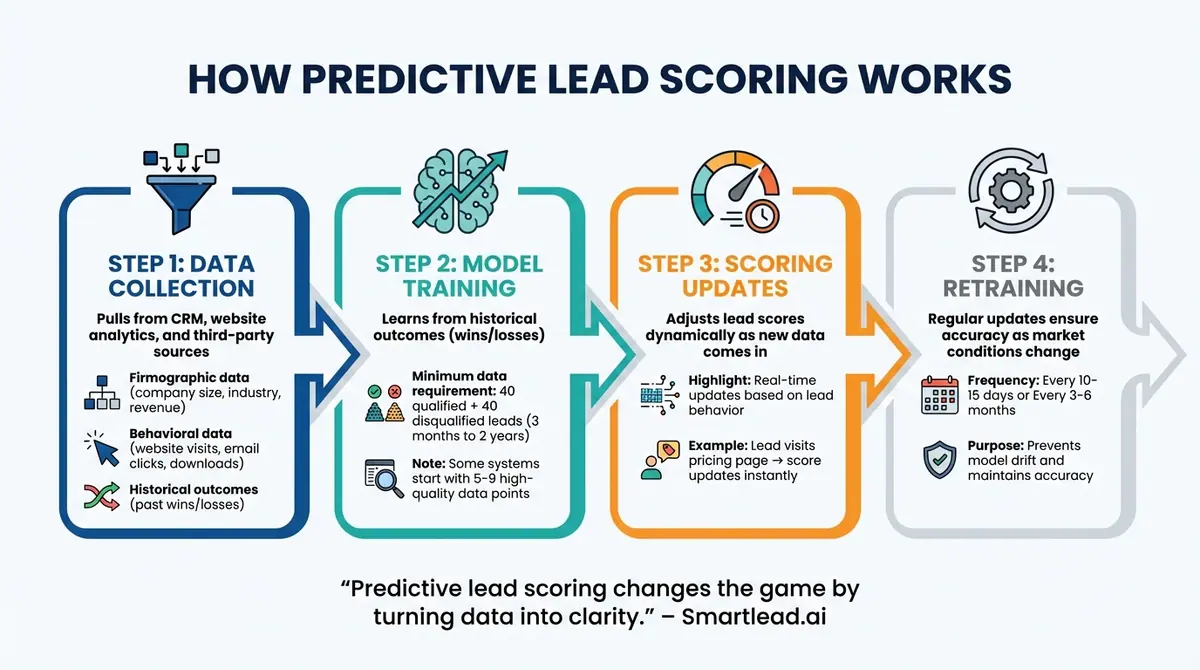
How Predictive Lead Scoring Works: 4-Step Process
Predictive lead scoring takes raw CRM and analytics data and refines it through five key steps: ingestion, cleansing, feature engineering, model training, and ongoing retraining. Each step plays a role in turning unstructured data into actionable insights.
"Predictive lead scoring changes the game by turning data into clarity." – Smartlead.ai
Here’s how it works in real time: when a new prospect enters your database, the algorithm evaluates their behavior against historical patterns. As they interact with your content - whether it’s clicking an email or visiting the pricing page - their lead score updates instantly.
The Role of Data in Predictive Lead Scoring
The effectiveness of predictive models depends on three main types of data:
- Firmographic data: Details like company size, industry, annual revenue, location, and technology stack help determine if a lead matches your ideal customer profile.
- Behavioral data: Tracks actions like website visits, email clicks, downloads, webinar attendance, or product trials to measure interest and urgency.
- Historical outcomes: Past wins and losses create the foundation for training the model, offering a clear understanding of what works.
Before diving into model training, it’s critical to clean your data. This means removing duplicates and standardizing entries to ensure the scoring system is reliable. For enterprise-level models, it’s recommended to have at least 40 qualified and 40 disqualified leads from the past three months to two years. While some systems can begin offering insights with as few as 5 to 9 high-quality data points, accuracy improves significantly with larger datasets.
"Lead scoring lives and dies by data quality." – Hawke Media
With clean, structured data, machine learning can take over to generate precise predictions.
Machine Learning and Algorithms in Lead Scoring
Machine learning excels at uncovering patterns that traditional rule-based systems might miss. For instance, it might identify that leads from a specific industry who visit a pricing page are three times more likely to convert. The algorithm assigns dynamic weights to these features based on their historical impact, continuously adjusting as new data flows in. Many tools use metrics like the Area Under the Curve (AUC) to measure predictive accuracy. This constant fine-tuning ensures sales teams focus on the leads with the highest potential.
"Machine learning enables systems to autonomously adapt based on evolving data." – Jamie Finch, B2B Writer, Salespanel
A real-world example highlights its power: In 2025, a startup sales rep closed 11 deals in just 60 days by focusing solely on leads flagged as "hot." The system had pinpointed that bootstrapped startups downloading specific whitepapers were three times more likely to convert - insights that manual processes had missed. This shows how advanced algorithms can transform data into actionable strategies, allowing even small teams to achieve big results.
Key Features of Predictive Lead Scoring Tools
When it comes to predictive lead scoring, not all tools are created equal. The best ones stand out by going beyond basic functionality, offering features that truly help sales teams identify and act on high-quality leads. At the heart of it all is data ingestion - top tools pull from a wide range of sources, including demographics, firmographics, behavioral signals, and CRM history. Without this depth, algorithms can miss critical patterns.
It’s also important to choose tools that don’t just spit out a score but explain why a lead received that score. This insight helps sales reps personalize their outreach, making their efforts more effective.
Another must-have feature? Automated retraining. Buyer behaviors and market dynamics are always shifting, so your scoring model needs to evolve too. The best tools retrain themselves automatically - whether every couple of weeks or quarterly - using fresh data from recent wins and losses to stay accurate.
Real-Time Scoring and Insights
Imagine this: a lead clicks on a demo link or visits your pricing page, and their score updates instantly. Tools with real-time scoring make this possible, giving your sales team the ability to act on opportunities right away. For instance, if a lead’s score jumps after they engage with a case study, a quick follow-up could seal the deal. In fact, teams using real-time scoring can grow their pipelines around 30% faster.
"AI ranks leads by conversion likelihood, then triggers targeted follow-up sequences to engage them." – Smartlead.ai
CRM and Marketing Tool Integrations
Integration is key for a smooth workflow. Tools that embed predictive scores directly into your CRM save time and effort. When scores appear right in contact records or list views, sales reps can prioritize leads without hopping between platforms. These integrations also enable automated lead handoffs. For example, you can set a threshold - say, 80 out of 100 - so high-scoring leads go straight to sales, while lower-scoring ones are directed into nurturing campaigns.
Customizable Scoring Models
One size doesn’t fit all, and that’s where customization comes in. Scoring models should reflect what matters most to your business. For instance, you might give more weight to a demo request than a blog visit, as it shows stronger buying intent. Many tools allow a hybrid approach, combining traditional rule-based scoring with AI-driven insights. Large companies can even create separate models for different regions or business units to match their unique sales strategies. Features like time decay, which reduces scores as engagement drops off, help keep your lead list fresh. To stay aligned with market trends, it’s a good idea to review and tweak your scoring models every three to six months.
| Feature | Why It Matters |
|---|---|
| Comprehensive Data | Combines insights from CRM, email, web analytics, and firmographics for a full lead profile. |
| Explainability | Helps sales reps understand why a lead scored high, making outreach more targeted. |
| Automated Retraining | Keeps models up-to-date with changing buyer behaviors and market conditions. |
| Real-Time Updates | Enables immediate action based on the latest signals of interest. |
| CRM Integration | Embeds scores directly into workflows, eliminating the need to switch platforms. |
| Customizable Weights | Aligns scoring criteria with your ideal customer profile and prioritizes high-intent actions. |
With these features in place, you’ll have the tools to implement a scoring strategy that drives better results and keeps your sales team focused on what matters most.
How to Implement Predictive Lead Scoring
Setting up predictive lead scoring takes clear objectives, reliable data, and the right technology. Here's how to create a system that works.
Step 1: Define Your Lead Scoring Goals
Start by figuring out what success looks like. Calculate your current lead-to-customer conversion rate to establish a baseline. Then, work with your sales and marketing teams to define your Ideal Customer Profile (ICP). This means identifying key traits, such as:
- Specific job titles (e.g., VP of Marketing or Director of Sales)
- Industries (e.g., SaaS or healthcare)
- Company size (e.g., 50–500 employees)
- High-intent actions (e.g., demo requests or webinar sign-ups)
Once you have clear goals, move on to gathering quality data.
Step 2: Collect and Prepare Quality Data
Your predictive model needs reliable data from three main categories:
- Demographics: Job titles, company size, and location
- Behavioral Signals: Website visits, email clicks, and similar actions
- CRM Actions: Deal stage progress and historical outcomes
Make sure your data is clean - remove duplicates and standardize entries. For most enterprise-level models, you'll need at least 40 qualified and 40 disqualified leads from a timeframe of 3 months to 2 years to train the system effectively.
LeadsBridge puts it bluntly:
"Using old or bad data is a no-go. Even the best scoring tools and AI are useless with stale data."
With clean and structured data in hand, you're ready to pick the right tool.
Step 3: Choose the Right Predictive Lead Scoring Tool
Now that your goals are set and your data is ready, focus on selecting a tool that integrates smoothly with your existing systems. Look for features like:
- CRM Integration: Ensure scores can be viewed directly in platforms like Salesforce, HubSpot, or Pipedrive.
- Explainability: Choose tools that clearly show why a lead scored high (e.g., "visited pricing page + fits ICP").
- Real-Time Scoring: This allows your team to act quickly on promising leads.
If your CRM already offers predictive scoring features, test those first - they often provide the easiest integration. For smaller businesses, some tools can use anonymous global data to improve accuracy, even if you don’t have a large historical dataset. Additionally, tools like Reform can enhance your lead forms by creating high-converting lead forms with custom screening questions, capturing intent data right from the start.
Once you've picked a tool, integrate it with your systems and set up automation so high-scoring leads trigger immediate follow-ups. Run a 90-day pilot to confirm that higher scores lead to better win rates. And don't forget to retrain your model regularly - every 10–15 days - to keep it aligned with market changes.
How to Optimize Predictive Lead Scoring
Keeping your predictive lead scoring model effective requires constant updates. As markets shift and buyer preferences change, staying on top of these trends is key.
Best Practices for Lead Scoring
Here are some key tips to keep your scoring model sharp and actionable:
Retrain your model regularly. Models can lose accuracy over time, a phenomenon known as model drift. To prevent this, review and update your scoring models every 3–6 months.
Collaborate with your sales team. Sales reps are on the front lines and can provide valuable feedback. Regularly ask them to identify "false positives", or high-scoring leads that don’t pan out. This will help you adjust variables that might be overemphasized or underweighted in your model.
"If sales teams find high-scoring leads unqualified, adjustments are needed".
Incorporate time decay rules. Leads that haven’t engaged in 60 or 90 days should have their scores adjusted downward. This ensures your team focuses on leads that are actively engaged.
Maintain clean data. Your model is only as reliable as the data it uses. Regularly audit your CRM system to standardize job titles, remove duplicates, and ensure data accuracy. Before retraining your model, clean your dataset to improve learning outcomes.
Experiment with scoring thresholds. Use A/B testing to find the ideal score for handing off leads to sales. For example, compare conversion rates for leads scored 80+ versus 70+. Also, set clear SLAs for high-scoring leads, such as requiring outreach within two hours to maximize conversion potential.
Key Metrics to Track Performance
Tracking performance metrics is a must to see how well your optimizations are working. Here’s what to focus on:
| Metric Category | What to Track | Why It Matters |
|---|---|---|
| Conversion Performance | Lead-to-opportunity ratio, MQL-to-SQL rate, SQL-to-opportunity rate | Links high scores to actual sales outcomes |
| Sales Efficiency | Pipeline velocity, sales cycle length, time-to-contact for high-score leads | Shows how quickly deals are closing |
| Financial Impact | Cost per acquisition (CAC), cost per lead (CPL), return on marketing investment (ROMI) | Measures cost efficiency |
| Revenue Metrics | Average deal value, customer lifetime value (CLV), marketing spend as % of revenue | Tracks bottom-line improvements |
Companies that adopt AI-driven lead scoring often see a 38% improvement in lead-to-opportunity conversion rates and cut sales cycles by 28%. Predictive analytics users report up to a 20% boost in pipeline conversion rates and a 15% increase in deal velocity. ROI from successful implementations typically ranges between 300% and 700%.
For technical insights, keep an eye on metrics like AUC (Area Under the Curve), precision/recall, and F1 scores to ensure your model is performing well. If accuracy dips below your set threshold, refine the model before rolling out updates. Additionally, monitor pipeline velocity - if your sales cycle isn’t getting shorter, your model might be favoring active leads over those truly ready to convert.
Conclusion
Predictive lead scoring changes the game for identifying high-value prospects. By removing guesswork and bias, these AI-powered tools allow teams to zero in on leads that are most likely to convert. As mentioned earlier, the impact on lead conversion rates and pipeline speed is hard to ignore.
To make the most of predictive lead scoring, focus on three key areas: maintaining clean data, keeping your models up to date, and ensuring smooth integration across your tech stack. High-quality data is essential. Tools like Reform can help by offering branded forms that capture accurate and complete lead information from the start. With features such as email validation, lead enrichment, and spam prevention, Reform ensures your system gets the reliable data it needs to perform at its best. Seamless CRM integrations and automated data enhancements - like those provided by Reform - are critical for effective lead scoring.
To succeed, define clear scoring goals, regularly audit your data for accuracy, and choose a tool that works seamlessly with your CRM and marketing automation systems. Retrain your predictive model every 3–6 months and monitor key metrics like lead-to-opportunity conversion rates and pipeline velocity to measure progress.
FAQs
How much data is needed to start predictive lead scoring?
You don’t need tons of data to get started with predictive lead scoring. What’s crucial is having accurate, relevant data - think demographic details, behavioral insights, and firmographic information. When it comes to building a solid scoring model, quality always trumps quantity.
How do I know if my lead scoring model is drifting?
To check if your lead scoring model is staying on track, keep an eye on metrics like precision, recall, and the F1 score to gauge its accuracy. Additionally, monitor lead-to-opportunity conversion rates and the length of your sales cycle to see if the model is effectively prioritizing high-value leads. It's also important to routinely evaluate and adjust the model to account for shifts in buyer behavior or data quality, ensuring it remains in sync with the current market landscape.
What should I automate when a lead score changes?
When a lead's score shifts, set up automated actions to ensure high-potential leads get the attention they deserve. For instance, you can trigger personalized follow-ups, such as sending targeted emails, updating the lead's status in your CRM, or kicking off nurturing workflows. This approach helps your sales and marketing teams stay aligned and concentrate on the most promising prospects, increasing the chances of turning leads into customers.
Related Blog Posts
Get new content delivered straight to your inbox

The Response
Updates on the Reform platform, insights on optimizing conversion rates, and tips to craft forms that convert.




Drive real results with form optimizations
Tested across hundreds of experiments, our strategies deliver a 215% lift in qualified leads for B2B and SaaS companies.
