
.webp)
Real-Time CRM Sync: Benefits for Lead Enrichment


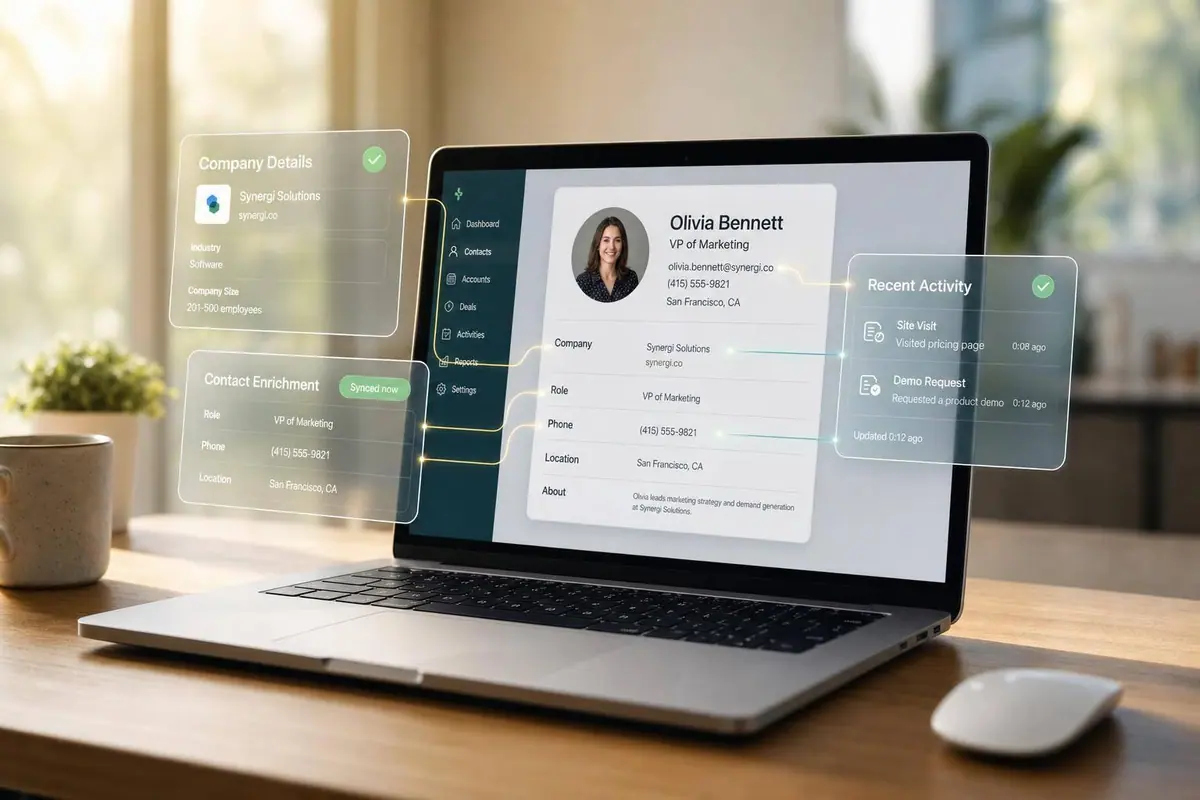
If lead data updates right away, teams can respond while intent is still high. I’d sum up the article like this: real-time CRM sync helps you keep records clean, score leads with more context, send them to the right rep faster, and improve the odds of conversion.
Here’s the core idea in plain English:
- Speed affects conversion. Leads contacted within 5 minutes are far more likely to qualify than leads reached 30 minutes later.
- Data gets old fast. B2B contact data changes by about 22.5% per year, so slow sync leaves teams working from stale records.
- Enrichment adds context. It fills in details like company size, industry, role, and behavior so sales can prioritize leads with less guesswork.
- Clean inputs matter. Validation, deduplication, and spam filtering help stop weak records before they hit your CRM.
- Forms shape results. Multi-step forms, progressive profiling, and email validation can improve data quality and completion rates.
- Workflow rules matter. One-way, two-way, and selective sync each come with tradeoffs around control, field updates, and data drift.
A few numbers stand out:
- 55% lift in conversion from real-time email validation in one cited example
- 21x higher odds of qualifying a lead when contact happens within 5 minutes
- $750,000 in pipeline from 50 extra qualified meetings per quarter at $15,000 per opportunity
If I had to boil it down to one sentence, it’s this: real-time sync turns a basic form fill into a usable lead record fast enough for sales to act on it.
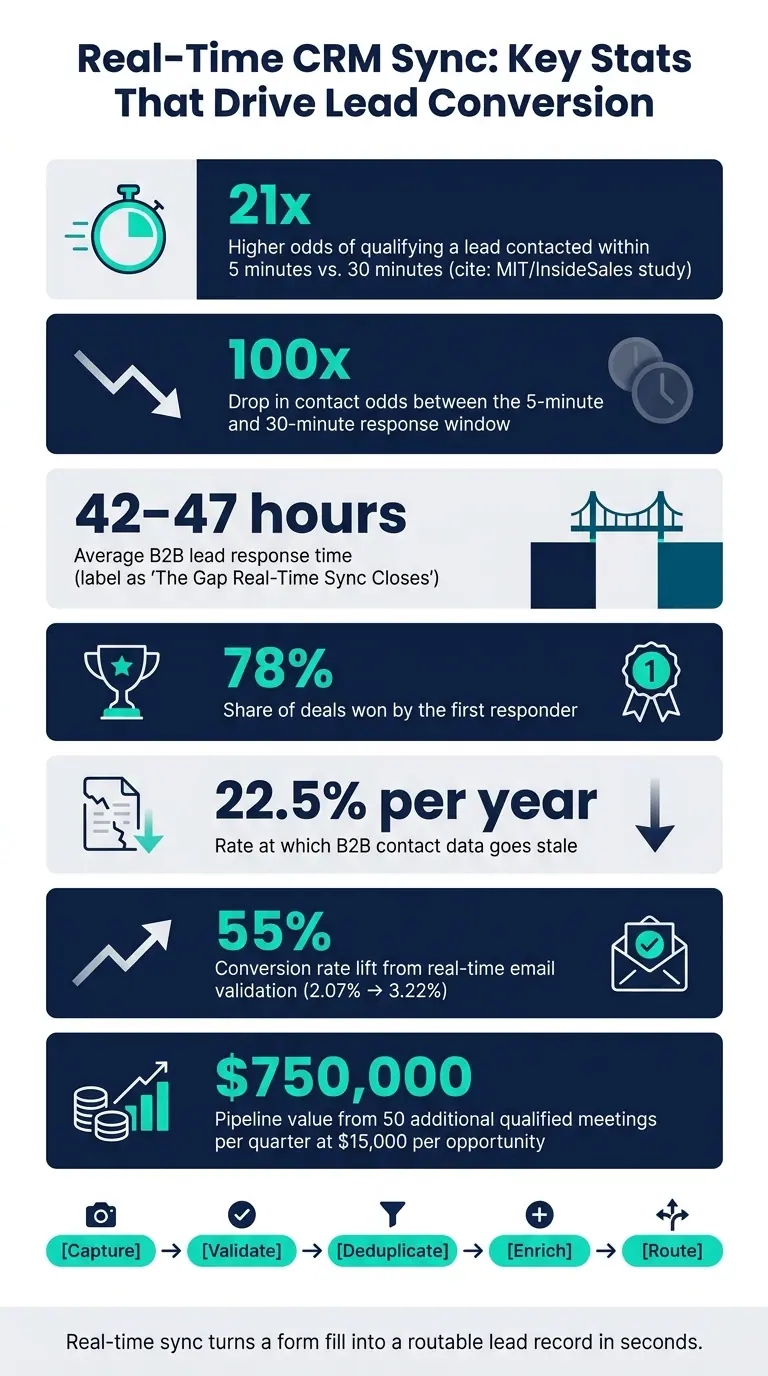
Real-Time CRM Sync: Key Stats That Drive Lead Conversion
The System That Fixes Your CRM Data in Real Time (Without Breaking It)
What Research Shows About Data Quality and Lead Qualification
B2B contact data goes stale fast - about 22.5% per year. In high-turnover fields like tech startups, it can change even faster. That’s the core problem with nightly or weekly batch updates: they’re often already behind. If a record changes this often, timing matters. Enrichment helps most when it happens right away.
How Instant Updates Improve Record Completeness and Accuracy
When a lead fills out a form, real-time sync can verify the email, add firmographic data, and update the CRM within seconds. And the impact shows up in the numbers. Real-time email validation can increase conversion rate by 55% and reduce bounce rates by a large margin.
It also cuts out the messy export-cleanup-reimport loop that tends to create duplicates and formatting mistakes. For U.S. teams, that means phone numbers, states, and ZIP Codes are formatted in a consistent way and ready for routing and segmentation. The result is a faster handoff and cleaner sales workflows.
Why Enriched Leads Are Easier to Score and Prioritize
Lead scoring only works if fit and intent data are complete. Real-time enrichment gives the CRM the firmographic, demographic, and behavioral data it needs as soon as the lead comes in. That means scoring can happen with fewer gaps and less guesswork.
There’s another win here too: teams spend less time digging through bad records or filling in missing details by hand. Instead, they can sort leads into hot, warm, and nurture tiers with more confidence. That tighter prioritization makes the next step - routing and follow-up - work better too.
How Real-Time Sync Affects Conversion Rates
Once enrichment improves record quality, speed decides whether that added detail turns into revenue. Better data helps shape the record. Fast action helps win the conversion. Study after study shows the same pattern: lead response speed is one of the strongest signals of qualification and conversion, especially for high-intent forms.
Faster Routing and Outreach While Buying Intent Is Fresh
A MIT/InsideSales study found that the odds of qualifying a lead contacted within 5 minutes are 21x higher than if contacted at 30 minutes, and contact odds drop by about 100x between 5 and 30 minutes. Yet average B2B response times are still 42–47 hours.
That gap usually comes from batch workflows. If form submissions sit around waiting for hourly or nightly syncs, routing and outreach start too late. By then, the moment has passed. Research also suggests that 78% of deals go to the first responder, so slow follow-up can cut into pipeline capture in a very direct way.
When a demo request form submission triggers an immediate CRM update, enrichment, and routing rule, the lead can land in the right rep’s queue within seconds. And that matters. It gives sales a shot at making contact while interest is still high, not hours later when the prospect is already comparing other options.
More Relevant First-Touch Messaging From Enriched CRM Data
Speed matters, but context is what makes the first message land. Real-time sync gives reps the details they need to send a relevant first touch instead of a generic note.
For example, a VP of Marketing at a 500-person SaaS company needs a different value story than a founder at a 10-person agency, even if both submitted the same demo request form. Enriched CRM data makes that difference visible right away. No manual research. No extra delay. No guessing.
Every added delay lowers the odds of qualification. Real-time sync helps keep first contact inside the window when intent is still active.
sbb-itb-5f36581
System and Workflow Patterns That Support Real-Time Enrichment
Once routing depends on enriched records, your sync setup stops being a back-office detail and starts driving the whole workflow. And when enrichment and routing happen in real time, field rules decide whether that data stays clean or turns messy fast.
One-Way, Two-Way, and Selective Sync Models
Each sync model fits a different kind of workflow. Pick the wrong one, and you can end up with data drift, bad handoffs, and enrichment issues.
One-way sync sends data from a source system into the CRM without sending updates back. It’s simpler, which makes it a solid starting point for high-volume lead capture. Two-way sync keeps multiple systems aligned in real time, but it needs strict conflict rules. Without them, updates from different systems can overwrite clean records. Selective sync is often the best match for enrichment workflows because it controls which fields move, and in which direction. That cuts noise and helps protect data quality.
| Sync Pattern | Primary Use Case | Enrichment Value | Drift Risk |
|---|---|---|---|
| One-Way Sync | Initial lead capture from form to CRM | High for new records; limited for existing data | Low - data flows in one direction only |
| Two-Way Sync | Keeping CRM and sales/marketing tools aligned | Strong; keeps both systems current | High - requires strict conflict resolution rules |
| Selective Sync | Syncing only high-intent leads or specific fields | Targeted; enriches only specific fields that matter most | Moderate - requires precise filtering and mapping |
One-way and selective sync help limit early drift. Two-way sync adds more conflict risk.
The sync model sets the lane, but field mapping and deduplication are what keep the workflow clean.
Field Mapping, Validation, and Deduplication Rules
Even if you choose the right sync model, enrichment can fall apart fast when fields aren’t mapped the same way across systems. Field names, data types, and picklist values need to match. That isn’t optional setup. It’s the baseline.
Bad data can hit scoring and assignment rules the moment it enters the system. So it helps to catch problems early. Validate email format, normalize phone numbers, and require core fields at capture. That keeps weak records from slipping into the pipeline.
Deduplication is the last backstop. In most cases, email address should be the main match key, with fallbacks like company domain or phone number. Then set clear rules for what happens next:
- Update an existing record
- Create a new record
- Send the submission to a review queue when match confidence is low
Use capture → validate → deduplicate → enrich → route.
Using Conversion-Focused Forms to Strengthen CRM Sync
Form quality shapes whether real-time sync creates records your team can actually use. In practice, the form is the first quality check in the entire sync flow.
How Better Form Inputs Improve Enrichment Results
Once sync happens in real time, input quality becomes the next choke point.
Multi-step forms lower friction by splitting the process into smaller parts. For example, the first step can ask for name, work email, and company. The next can ask for role, team size, and use case. You still collect the structured fields enrichment tools need to match records against firmographic datasets, but the experience feels lighter. Case studies from B2B SaaS teams show that replacing long, single-page forms with multi-step forms or progressive profiling can lift completion rates by double-digit percentages while increasing usable data points per lead.
Progressive profiling pushes this idea further. Instead of asking for everything at once, it asks for more fields on return visits or later interactions. That means richer profiles over time, without adding friction on the first touch.
The best form-level controls work together:
- Validation helps stop bad inputs before they enter the system.
- Spam prevention keeps fake submissions from draining enrichment spend and polluting CRM records.
- Drop-off tracking shows where people quit, so you can spot friction fast.
Real-time email validation improved conversion from 2.07% to 3.22% - a 55% increase - while also reducing deliverability problems downstream.
Where Reform Fits in a Real-Time Lead Capture Workflow
This is where the front-end form layer does a lot of heavy lifting.
Reform sits at the top of the funnel as the lead capture layer - on demo request pages, resource gates, landing pages, and in-app upgrade prompts. When a visitor submits a form, Reform’s validation and spam controls run right away. Clean, structured data then moves into connected CRMs and marketing tools through native integrations, which can trigger enrichment, scoring, and routing within seconds.
Because Reform is no-code, revenue operations and marketing teams can build, test, and update form structure without developer help.
The table below maps Reform’s core capabilities to their day-to-day effects on enrichment and CRM data quality:
| Form capability | Effect on lead enrichment | Impact on CRM data quality |
|---|---|---|
| Multi-step forms | Higher completion rates for detailed fields needed for enrichment matching and segmentation | Reduces partial records; increases completeness of key fields |
| Conditional routing | Sends high-intent submissions to the right owner instantly | Minimizes misassigned leads and manual re-routing in the CRM |
| Email validation | Provides deliverable identifiers for enrichment and third-party data matching | Decreases invalid contacts, bounces, and unusable records |
| Spam prevention | Keeps bots and fake entries out of enrichment pipelines | Protects dashboards, reports, and scoring from distorted data |
| Real-time analytics | Reveals which fields and steps produce the best enriched leads | Supports ongoing form and field optimization tied to CRM metrics |
Real-time analytics also show which form variants send the cleanest CRM data and support the fastest follow-up.
Conclusion: The Core Benefits of Real-Time CRM Sync for Revenue Teams
Put it all together, and three gains stand out: cleaner data, faster follow-up, and stronger conversion. Real-time CRM sync helps with lead capture, enrichment, routing, and follow-up. That means cleaner records and faster outreach while buyer intent is still active.
The money side is pretty direct: 50 additional qualified meetings per quarter at an average opportunity value of $15,000 adds up to $750,000 in pipeline.
That upside starts at the form level. Clean, validated inputs give enrichment tools solid data to match against firmographic datasets from the start. Conversion-focused forms such as Reform support this flow with structured inputs, validation, and real-time CRM sync.
When a demo request comes in, the CRM should already know the company size, industry, and role. The right rep should also get an alert within minutes. Real-time sync, enrichment, and better forms work together to cut response time and improve conversion.
FAQs
How does real-time CRM sync improve lead scoring?
Real-time CRM sync improves lead scoring by making checked, up-to-date data available right away. That gives scoring models more dependable inputs and helps teams move on new lead activity faster.
It also helps keep records clean through exact field mapping, duplicate prevention, and live updates. With tools like Reform, businesses can do a better job filtering out low-quality prospects before they affect the pipeline.
What data should be validated before syncing to a CRM?
Validate email addresses, contact details, duplicate records, subscription status, and consent tracking before syncing to a CRM. That cuts bounce rates, helps prevent sync errors, keeps records clean, and supports privacy compliance.
With Reform, you can verify this data in real time at the point of capture, so only accurate, enriched, and compliant information gets synced.
Which sync model is best for lead enrichment?
There’s no single best sync model: real-time and batch solve different problems.
Real-time sync through webhooks works best for time-sensitive leads. It lets teams respond right away, while the lead is still warm.
Batch enrichment usually makes more sense for high-volume, lower-sensitivity processing. It can cost less when you’re handling large sets of lead data that don’t need instant action.
Most organizations end up using both. That mix helps keep lead data reliable and ready to use. Reform supports these workflows with real-time analytics, instant data routing, and CRM integrations.
Related Blog Posts
Get new content delivered straight to your inbox

The Response
Updates on the Reform platform, insights on optimizing conversion rates, and tips to craft forms that convert.




Drive real results with form optimizations
Tested across hundreds of experiments, our strategies deliver a 215% lift in qualified leads for B2B and SaaS companies.
