
.webp)
Scaling Multilingual Content for Global Campaigns



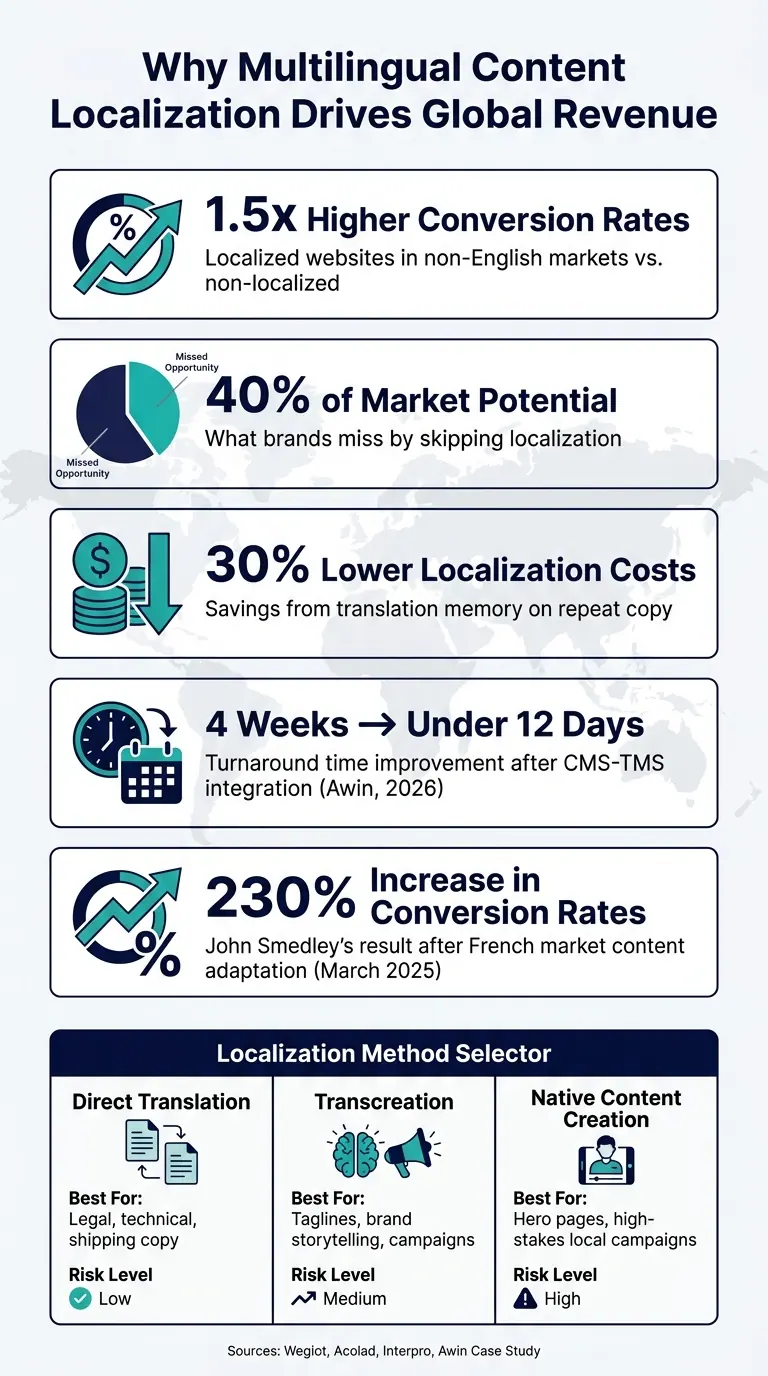
If you want global campaigns to work, I’d treat multilingual content like a system, not a pile of translation jobs. The article’s core point is simple: start with market focus, match each asset to the right localization method, set firm rules for voice and terms, connect your tools, and track results by market. That matters because localized sites can see 1.5x higher conversion rates in non-English markets, while brands that skip localization may miss up to 40% of market potential.
Here’s the short version:
- I’d use central planning with local market review
- I’d localize high-conversion pages first: landing pages, pricing, high-converting forms, and checkout
- I’d choose between translation, transcreation, and native content based on business risk
- I’d use modular content, CMS/TMS workflows, and translation memory to cut waste
- I’d measure conversion, bounce rate, revenue by market, and rework rate
- I’d turn test results and sales feedback into updates for glossaries, templates, and review rules
A few numbers stand out:
- 1.5x higher conversion rates on localized websites in non-English markets
- Up to 30% lower localization costs from translation memory on repeat copy
- One example cut turnaround from 4 weeks to under 12 days
- One France-focused update led to a 230% increase in conversion rates from French purchases by using multi-step forms to reduce friction
So the article isn’t just saying, “translate more.” It’s saying: pick the right markets, localize the pages that drive revenue, give teams clear ownership, and measure what each market does after launch. That’s how I’d scale multilingual campaigns without losing brand control or slowing launches.
Multilingual Content Localization: Key Stats & ROI at a Glance
Webinars: Phrase Platform | Making LLMs work for scalable, brand-consistent multilingual content
sbb-itb-5f36581
Set the multilingual content strategy before production starts
Before you create a single asset, decide which markets get attention, how much localization each one needs, and how your content model will support repeatable execution. If you skip this step, things get messy fast. Teams end up rewriting the same assets, spending too much on low-impact pages, or localizing content that was never likely to convert in the first place.
Prioritize markets using demand, revenue, and lifecycle data
Not every market should get the same level of spend. Start with the data you already have: organic visitors using non-English browser settings, search volume in the target language, and order data by country or region. Those signals can point you to markets that are already converting even without localization.
Then rank markets using factors like revenue potential, AOV, language complexity, localization effort, and launch friction.
Inside each priority market, begin with the funnel stages that tend to convert first: landing pages, pricing pages, lead generation forms, and checkout flows. Tackle those before moving into lower-risk content.
Once you’ve ranked your markets, pair each one with the lightest localization method that still protects conversion.
Choose between translation, transcreation, and native content creation
Don’t use one method for every asset. The content type should decide the approach.
- Direct translation fits technical specs, legal copy, shipping info, and other low-risk content.
- Transcreation makes sense when the message needs emotional pull, like taglines, campaign concepts, and brand storytelling.
- Native content creation works best in markets that need local trust, such as hero pages, high-stakes local campaigns, or region-specific blogs.
A simple way to think about it: translate low-risk copy, transcreate brand-led campaigns, and use native creation for hero pages and high-stakes local content.
The 80/20 rule helps here too. Put manual localization work into the 20% of assets that drive 80% of conversions, including pricing pages, landing pages, lead generation forms, and checkout flows. For archived blog posts and help docs, machine translation is often enough.
After you choose the method, set up the structure that makes reuse and localization faster.
Build a content model for each market
Use modular fields and components so teams can localize at the field level. That setup cuts rework, speeds launches, and keeps brand-controlled elements consistent across markets.
For each market, document the details that change execution: currency, date formats, payment methods, imagery standards, and any regulatory or compliance needs. Your English source content should stay clear, neutral, concise, and free of idioms or dense metaphors so it translates cleanly. Then local teams can adapt the content with the context they need instead of rebuilding it from zero.
Use the source model to set tone, terminology, and field-level rules before production starts. That gives teams a shared system for localization standards, workflows, and approvals.
Create localization standards that protect brand consistency
Turn your content model into a market-by-market playbook. This is where your style, terminology, and visual rules move from theory into day-to-day use. They apply straight to the modular fields and components you’ve already set up, so multilingual campaigns stay consistent at scale, not just technically correct.
As Acolad puts it: "Multilingual content quality is a production and governance problem, not just a translation problem."
Document language, tone, terminology, and visual rules
A localization playbook should include two core documents: a style guide and a glossary.
The style guide covers brand voice, tone, grammar, punctuation, formatting rules, and legal disclaimers. The glossary sets approved translations for product names, UI strings, industry terms, and SEO keywords. That way, teams don’t end up using different terms for the same idea.
"A Translation Style Guide delivers the guardrails, voice, tone, and formatting, while a Translation Glossary supplies the bricks, approved equivalents for your product names and industry jargon." - Interpro
Be explicit about format rules. For U.S.-led campaigns, spell out standards like MM/DD/YYYY for dates, $1,500 for dollar amounts, commas for thousands, and periods for decimals. For non-U.S. markets, list the local versions clearly. Don’t leave that choice to translators.
The same goes for measurements. The U.S. uses imperial units, while most other markets use metric. If content mentions distance, weight, or size, your playbook should define the conversion rule for each market.
Use the 80/20 rule for your glossary: focus on the 20% of terms that show up in 80% of your content - core product features, pricing language, and legal disclaimers. That’s usually where mixed wording causes the most trouble.
Your playbook should also cover:
- Region-appropriate imagery
- Color usage
- Native replacements for idioms and culture-specific phrasing
Split governance between central and local teams
A hybrid model tends to work best. HQ owns the source content and the standards. Local teams own market fit and final approval. Put simply: headquarters protects the brand, and local teams make sure the message lands in the market.
"Consistency is achieved through clearer infrastructure and unambiguous accountability at each stage, not by adding more approval layers." - Kevin Freedman, Founder, Freedman International
| Responsibility | Central Team (HQ) | Local Market Team |
|---|---|---|
| Source Messaging | Owner | Consultant |
| Brand Voice & Tone | Sets global standard | Adapts for local register |
| Terminology / Glossary | Owns global terms | Owns local equivalents |
| Legal / Compliance | Global templates | Final sign-off on local regs |
| SEO Targets | Strategy & infrastructure | Keyword research & intent |
| Visual Assets | Master templates | Cultural adaptation & selection |
Run approvals in parallel.
Once ownership is clear, define the review level for each asset type.
Set quality control and approval standards
Different assets need different review depth. A homepage headline doesn’t need the same process as a pricing page, and a metadata field shouldn’t get stuck in the same queue as campaign copy.
| Content Type | Primary Requirement | Recommended Review Level |
|---|---|---|
| Campaign Copy / Headlines | Creative impact, cultural fit | Senior transcreation specialist |
| Landing / Pricing Pages | Conversion, brand voice | Full linguistic and market review |
| Product Descriptions / FAQs | Accuracy, terminology | AI-assisted with human post-editing |
| Metadata / Alt Text | SEO keyword alignment | Automated check with spot review |
Use per-asset checklists that cover linguistic accuracy, brand voice, factual accuracy, accessibility, and functional QA. Also make sure feedback goes straight to the writers or teams responsible. If comments stay buried in one asset’s revision history, the same mistakes will keep showing up elsewhere.
"Quality failures caught late mean corrections, and corrections mean delays." - Kevin Freedman, CEO, Freedman International
Those standards should now feed directly into the workflow and tooling stack.
Build a scalable workflow and tooling stack
Standards on their own won't save a campaign. You need a workflow that puts those standards to work. Otherwise, the best playbook in the world falls apart the minute deadlines get tight.
Connect your CMS, translation workflows, and reusable content assets
Manual handoffs drag multilingual campaigns down. A CMS-TMS integration sends updated segments straight to translators, which cuts back-and-forth and helps stop version drift. It also helps to use structured, modular content models, so teams can localize individual fields instead of cloning an entire page just to change a few lines.
The TMS also stores approved translations and reuses them when the same wording shows up again. That matters more than it might seem. Translation memory can cut localization costs by up to 30% on repetitive content.
A simple tiered setup helps match QA effort to business impact:
| Content Tier | Impact/Risk | Translation Method | Quality Assurance |
|---|---|---|---|
| Tier 1 (Core) | High | Human-first / Professional | 100% review + linguistic QA |
| Tier 2 (Growth) | Medium | AI-assisted + human post-editing | High-visibility strings reviewed |
| Tier 3 (Low-risk) | Low | Pure machine translation | Automated checks only |
In 2026, the affiliate marketing platform Awin brought its localization workflow into one system by connecting its CMS with a TMS. The setup paired AI-assisted translation with expert human review and automated routing. The result: content turnaround dropped from four weeks to under 12 days. For lean teams, that's the kind of pace worth aiming for.
This same setup doesn't stop at page copy. It also applies to forms, routing, and CRM data.
Localize lead capture and routing without breaking conversion paths
A lot of teams translate campaign pages but leave forms in English. That's where leads start slipping through the cracks. Field labels, address formats, phone number structures, and CRM mapping all need to match the market so submissions route the right way.
Form localization should sit inside the same modular system as page localization. If someone submits a form from /fr/, it should go to the right sales rep, trigger the right follow-up flow, and land cleanly in your CRM, just like a submission from /en-us/.
For smaller teams, Reform offers branded, no-code forms with multi-step logic, conditional routing, validation, spam prevention, analytics, and CRM integrations. Submissions move into your stack, and custom thank-you pages help keep the post-submit experience intact.
Once the lead path is local, the next problem usually shows up fast: process bottlenecks.
Prevent bottlenecks with clear roles, SLAs, and launch calendars
Even good tools break down when no one owns the process. Every multilingual campaign needs a named content owner, one reviewer for each market, and a clear handoff path between translators, designers, and ops. Roles, SLAs, and calendars act as the control layer that keeps the workflow moving.
Set direct SLAs for each stage. A solid starting point is a 48-hour review window for Tier 1 assets. It also helps to run market reviews in parallel, with each language routed to its local reviewer at the same time.
Use one shared launch calendar across the team. Each campaign entry should show:
- target markets
- publish date by region
- current status
When a global launch gets delayed, the cause is often simple: one market's review is still sitting in someone's inbox while everyone else is ready to go live.
Those controls make the next step easier: measuring performance with less guesswork.
Measure performance by market and improve the system
Track performance by language, market, and funnel stage
Total traffic alone doesn't prove localization is working. When you're dealing with multiple markets, you need reporting that separates language impact from market impact.
That means tracking conversion rate by market, revenue by language, MQL quality, and opportunities generated per localized asset. Then layer in engagement signals like bounce rate and time on page for each localized version. Those numbers help you catch where people drop off before they even get to a form. Implementing expert form strategies can help minimize these drop-offs by optimizing the conversion path for each market.
"After launching, track conversion rate, checkout drop‑off, and payment success by country and by method. Watch for patterns and measure the customer journey: are potential customers navigating your site in the way you expected?" - Elizabeth Pokorny, Head of Brand and Content, Weglot
| KPI Category | Metric | Target |
|---|---|---|
| Conversion | Regional conversion rate | 2.5%–3.5% |
| Conversion | Revenue by language/market | Market-specific targets |
| Engagement | Bounce rate by market | <45% |
| Engagement | Average time on page | >3.5 minutes |
| SEO | Top 10 rankings for local keywords | 1,000+ terms |
If traffic is high but conversion is low, there's usually a message issue or a trust issue. If bounce rates are high on localized pages, the problem often sits in technical friction instead: broken hreflang tags, slow load times, or currency and payment options that don't match what people expect. Different signals point to different fixes.
Use that data to decide what to test next in each market.
Use testing and feedback loops to refine localization decisions
Once you know where performance drops, start testing the message, form templates, and CTA behind it.
What works in English won't always work somewhere else. In March 2025, heritage brand John Smedley adjusted its content for the French market and saw a 230% increase in conversion rates from French purchases. That didn't happen from translation by itself. It came from testing what clicked in that market.
Run A/B tests on headlines, CTAs, and page layouts within each region. Then feed the winners back into your glossaries, templates, and approval rules so the whole system gets better, not just one page.
Also track your rework rate: how often localized content needs revision after launch. If that number is high, your glossary or localization standards likely missed something.
Your local sales and customer success teams can spot issues that dashboards won't catch. Maybe a CTA sounds too aggressive in one market. Maybe a term carries the wrong meaning somewhere else. Those problems tend to show up on sales calls before they show up in reporting. Build a simple feedback loop between those teams and the people who own localization standards, and review it on a regular basis.
Conclusion: How to build a multilingual content operation that lasts
With the right metrics in place, each launch becomes input for the next one. The aim is a repeatable multilingual operating model where every localized asset ties back to a business outcome, and where the process for making it better is already set before the next campaign begins.
FAQs
Which pages should I localize first?
Start with the pages that have the biggest effect on revenue and user decisions: landing pages, product pages, pricing pages, and lead-gen or consent form pages. Then move to other campaign pages that play a big role in performance.
Next, focus on pages where accurate localization helps build trust and improve conversion. That usually includes major CTAs, metadata, and SEO-focused pages.
A simple way to handle this is the 80/20 rule: put human effort into the pages that convert the most, and automate lower-impact content when it makes sense.
When should I use translation vs. transcreation?
Use translation when staying close to the source matters most. That’s usually the right call for technical specs, product documentation, and legal copy, where precision comes first.
Use transcreation when the message needs to land with a new audience, not just match the original wording. It works best for taglines, headlines, and brand campaigns, where idiomatic phrasing and tone can make the copy feel natural and on-brand.
How do I measure multilingual campaign ROI?
Measure multilingual campaign ROI by dividing your net financial gain - revenue growth, cost savings, and operational efficiencies - by your total localization investment.
The main thing to watch is incremental performance. Don’t just look at raw traffic and call it a day. Compare localized pages against a control group and track what changes in conversions, session length, and retention.
In Google Analytics 4, segment your data by language. Then assign one primary conversion goal for each page type, and compare translated pages with the source content. That side-by-side view helps you spot which regions are bringing in the strongest returns.
Related Blog Posts
Get new content delivered straight to your inbox

The Response
Updates on the Reform platform, insights on optimizing conversion rates, and tips to craft forms that convert.




Drive real results with form optimizations
Tested across hundreds of experiments, our strategies deliver a 215% lift in qualified leads for B2B and SaaS companies.
