
.webp)
Repurposing Content for Multi-Channel Workflows



Creating fresh content for every platform is time-consuming and expensive - costing $500–$2,000 and 8–12 hours per piece. The solution? Repurposing. By transforming one core asset (like a blog or webinar) into multiple formats, you can cut costs to $50–$200 per piece and reduce production time to 4–6 hours. This approach increases engagement by 3.5x and reaches 5–10x more people.
Here’s how it works:
- A single blog post can become 10+ social media posts, an email series, and a video script.
- Tailor content for each platform’s style: short videos for TikTok, carousels for LinkedIn, or email sequences for nurturing leads.
- Focus on evergreen content and prioritize high-performing assets for repurposing.
Repurposing isn’t just about saving time - it’s about working smarter. With the right workflows and tools, you can maximize your content’s impact across email, social media, and high-converting landing pages while staying on budget.
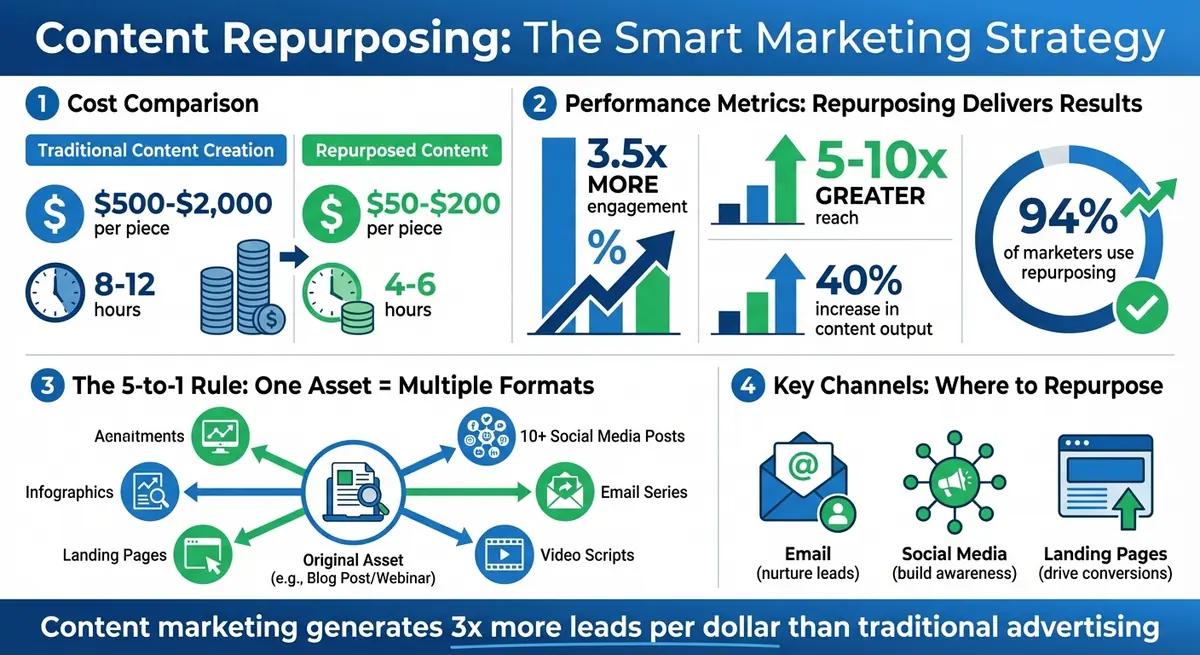
Content Repurposing ROI: Cost Savings and Engagement Benefits
What Is Multi-Channel Content Repurposing?
Defining Content Repurposing for Multi-Channel Workflows
Multi-channel content repurposing is all about transforming a single, central piece of content into various formats tailored for different platforms. Picture this: a blog post or webinar morphs into LinkedIn carousels, email campaigns, TikTok videos, and Instagram graphics. Each version is adjusted to meet the unique style and expectations of its platform.
The key distinction here is that repurposing isn’t just copying and pasting. It’s about reshaping the content - adjusting its length, tone, and format - while keeping the original message intact. For instance, a dense whitepaper can turn into a series of bite-sized social media posts, or a 45-minute webinar can be split into quick, engaging clips for YouTube Shorts.
| Method | Action | Primary Benefit |
|---|---|---|
| Crossposting | Sharing content as-is on another platform | Saves time |
| Reposting | Reusing the same content on the same platform | Builds on a previous success |
| Repurposing | Adapting the content into a new format | Expands reach and improves distribution |
This strategy creates multiple opportunities to connect with your audience, catering to different preferences - whether they prefer reading, watching, or listening. It’s about meeting people where they are, in the format they enjoy most.
Now, let’s dive into how repurposing content can save both time and resources.
How Content Repurposing Saves Time and Resources
Repurposing content isn’t just a clever strategy - it’s a huge time-saver. A whopping 94% of marketers repurpose their content to stay efficient without sacrificing quality. By doing this strategically, teams can boost their overall content output by 40% without needing to spend extra time creating new material from scratch.
The financial upside is just as compelling. Crafting original content can cost anywhere from $500 to $2,000 per piece. In contrast, repurposing that same content into fresh formats costs only $50 to $200. This makes it easier to produce high volumes of content while sticking to tight budgets.
Repurposing also breathes new life into evergreen content, like how-to guides or research reports. By reformatting these assets, you can extend their lifespan and value. In fact, 42% of marketers say updating and repurposing content has significantly boosted their results.
"Content repurposing is the difference between shouting a message once and building a surround-sound system that reinforces your narrative from every angle." - Webbb.ai Content Strategy Team
Consistency plays a big role too. 90% of consumers expect brands to deliver a unified experience across all platforms. Repurposing ensures your messaging stays aligned, whether your audience finds you on LinkedIn, in their email inbox, or while scrolling through Instagram.
With these advantages in mind, the next step is to identify the best channels for repurposed content.
Primary Channels for Repurposed Content
When it comes to multi-channel workflows, three platforms often take center stage: email, social media, and landing pages. Each one plays a unique role in guiding potential customers through the buyer journey.
Email is your go-to for nurturing leads. It works well for mid-funnel prospects, delivering valuable insights in a format they can digest on their own time. For example, you can break a whitepaper into a five-part email series, keeping each email concise - under 200 words - and easy to scan with bullet points.
Social media thrives on variety. Platforms like TikTok and YouTube Shorts are perfect for short, attention-grabbing videos that draw people in at the top of the funnel. Meanwhile, LinkedIn appeals to decision-makers with professional, data-driven content like carousels and case studies. Each platform has its own style: TikTok favors authentic, snappy clips (15–60 seconds), while LinkedIn leans toward structured, insightful posts.
Landing pages are where conversions happen. These pages are ideal for bottom-funnel prospects, featuring content like case studies, video testimonials, and research that builds trust. Unlike social media posts, landing pages allow for longer-form content - as long as it’s well-organized with clear headings and visuals.
To maximize your efforts, follow the 5-to-1 rule: aim to create at least five smaller pieces of content from every long-form asset. For instance, a 2,000-word blog post might yield 10 social media posts, an email series, and several video scripts. This ensures you’re getting the most out of your content without overloading your production team.
With these channel-specific strategies in place, you’re set to explore detailed workflows in the next section.
sbb-itb-5f36581
Aligning Content to Lead Nurturing Journeys
Auditing Your Content Library
Start by evaluating your existing content to determine what’s worth repurposing. Use metrics like organic traffic, engagement, and conversions to identify pieces with the most potential.
Pay special attention to your "pillar content" - those in-depth, high-value pieces like comprehensive guides, webinars, or research studies. These assets are goldmines because they can be broken down into smaller pieces, such as statistics, quotes, or processes, and repurposed into three to five different formats.
Focus on evergreen content - resources that remain relevant over time, like how-to articles or foundational industry insights. Make sure any statistics or references are up-to-date. To streamline your efforts, categorize your content into three groups: "Repurpose Now" (high-performing, evergreen content that’s ready for reuse), "Update & Repurpose" (good potential but needs updated data), and "Leave As Is" (low-performing or too time-sensitive).
| Content Type | Performance Indicator | Repurposing Potential |
|---|---|---|
| Blog Posts | High organic traffic, social shares | Excellent – great for social posts, emails, or videos |
| Case Studies | High conversion rates | Good – ideal for testimonials and social proof |
| Research Reports | Download volume, citations | Excellent – a rich source for infographics and stats |
Once your content is sorted, the next step is aligning it with the buyer journey.
Mapping Content to Funnel Stages
With your best content identified, it’s time to map it to the different stages of the buyer journey. For the awareness stage, focus on formats that maximize reach, like blog posts or social media content. In the consideration stage, shift to formats that deliver more detailed insights. Examples include LinkedIn video testimonials, nurture email sequences, or interactive tools like decision trees that help guide prospects. For the decision stage, prioritize conversion-oriented content, such as product comparison videos or myth-busting clips.
The key is to match the depth of your content to your audience’s readiness. Use short, introductory pieces for awareness and save the detailed, proof-heavy materials for decision-making. Structure your original content with clear sections and headings so it’s easier to repurpose later.
"Repurposing content isn't something that happens by accident, you need to plan for it to drive the most efficient content creation process possible." - Alice Rowan, Website Copywriter & SEO Consultant
Next, tailor your content formats to fit the unique demands of each channel.
Selecting Formats for Each Channel and Stage
Every channel has its own strengths, and the format you choose should match the platform’s style. For the awareness stage, focus on short-form videos, infographics, and carousels - formats that grab attention quickly and align with algorithms favoring frequent, engaging content.
In the consideration stage, repurpose long-form assets like whitepapers into condensed email sequences. Share case studies, expert interviews, and nurture series on platforms like LinkedIn, email, or niche forums.
Finally, for the decision stage, emphasize content that drives conversions. Use product comparisons, testimonials, ROI data, and free trial offers. Distribute these through email campaigns, landing pages, and LinkedIn to nudge leads toward taking action. By matching formats to the right stage and channel, you ensure your repurposed content keeps leads moving through the funnel efficiently.
TURNING 1 PIECE OF CONTENT INTO 10 | My content strategy for juggling multiple platforms
Step-by-Step Repurposing Workflows
Let's dive into step-by-step workflows for repurposing your content across different channels, building on strategies to keep your messaging aligned and impactful.
Repurposing Content for Email Campaigns
Start with your cornerstone content - think whitepapers, webinars, or detailed guides - and break them into smaller, digestible pieces, often called content atoms. Each piece should focus on one key takeaway, like a statistic, tip, or hook that stands strong on its own in an email [20,28]. Instead of sending a single promotional email, consider creating a nurture sequence that highlights individual subtopics [2,20].
For example, a 3,000-word guide could transform into a five-email sequence, with each email tackling a specific chapter. Keep emails concise - under 200 words - and use bullet points for easy readability. A conversational tone works best here. Add visuals, like graphics or data from your original content, as headers to catch attention and maintain brand consistency. Space out your emails over 6 to 8 weeks to prevent overwhelming your audience [6,26].
Here’s why this works: Companies that repurpose content see 3.5× more engagement compared to those sticking to single formats. Plus, repurposing can save 40–70% of the time spent on content creation. Including videos in email campaigns? That can boost open rates by 19% and click-through rates by 50%. The rule of thumb: break long-form content into at least five smaller assets.
Once your email strategy is in place, think about how to extend the reach of these assets on social media.
Repurposing Content for Social Media
Take your core content and adapt it into bite-sized, platform-specific posts. For example, a long-form blog or webinar can generate 7–10 short video clips for TikTok, Reels, or YouTube Shorts [1,32].
On platforms like LinkedIn and Instagram, turn step-by-step guides into engaging 10–12 slide carousels, with each slide focusing on a key takeaway. For X (formerly Twitter) or Threads, break down your content into 5–7 connected posts to spark discussions [1,5]. If you're repurposing videos, be sure to remove platform watermarks, as algorithms may deprioritize content with them. Experiment with different hooks - use bold opinions, eye-catching statistics, or compelling quotes to keep your posts fresh and engaging across channels.
Strategic repurposing can generate a 300% boost in engagement while saving 60% of the time spent creating new content. Distribute your posts over 1 to 2 weeks to maximize visibility and test what resonates with your audience [5,31].
But why stop there? Repurposed content can also fuel high-performing landing pages.
Building Landing Pages from Existing Content
Repurposing for landing pages ensures your key messages hit home across multiple touchpoints. Start with evergreen content - such as ebooks, whitepapers, or research reports - and use it as the backbone for your landing page [6,8]. Pull out key insights, like statistics or actionable tips, and use them as headers or bullet points to keep your message clear and focused [5,29]. Borrow headers directly from your original content to create thematic sections that reinforce your main value proposition.
If you're driving traffic from social media to your landing page, make sure the page copy aligns with the hook in your social post for a seamless experience. Structure the page to guide visitors toward a lead-capture form, and if you're using older content, update any statistics or examples to keep it relevant. Repurposing content for landing pages is also budget-friendly, costing between $50 and $200, compared to $500 to $2,000 for creating new content from scratch. Plus, turning webinars into downloadable guides or landing pages can improve lead quality by up to 32%. Tools like Reform can help you design high-converting lead forms that integrate smoothly with your landing page, ensuring a cohesive user experience while capturing high-quality leads.
Using Tools and Automation for Content Repurposing
Using the right tools can turn content repurposing into a smooth, scalable process. Automation helps tackle common hurdles like manual format changes, delays in approvals, and inconsistent tracking - issues that often slow down marketing teams. By streamlining these processes, tools not only enhance the effectiveness of content but also integrate seamlessly into multi-channel lead nurturing strategies. For example, Kraft Heinz has managed to cut campaign launch times from months to just weeks by adopting structured workflows and automation. Similarly, Costa Coffee has employed a modular content approach to create localized regional sites in as little as 15 minutes, drastically reducing the need for manual effort.
How Reform Improves Landing Page Performance
When repurposing content for landing pages, using powerful form templates plays a key role in boosting conversions. Multi-step forms often outperform single-page forms because they reduce cognitive overload, breaking the process into smaller, more manageable steps. This approach works particularly well for landing pages built from extensive content like webinars or in-depth guides. Reform’s multi-step forms, complete with progress bars and custom step labels, help guide visitors through the process, minimizing abandonment rates.
Reform also uses conditional routing to tailor the user journey. For instance, if someone downloads an enterprise-focused whitepaper, high-value leads - determined by factors like company size or revenue - can be sent directly to a sales scheduling link. Meanwhile, other users might receive follow-up resources like webinars or additional self-service content.
Automating Workflows with Form Data
Beyond better form design, automating how data is handled can refine your workflows even further. Reform includes tools like real-time email validation and automated lead enrichment, which ensure that contact details are accurate and CRM records are updated - without requiring extra fields on the form.
A standout feature is "Form Shortening", which dynamically hides fields when certain data is already available, leaving only the necessary fields visible for manual input. Hidden fields can collect backend data for scoring or routing purposes, keeping the user interface clean. Additionally, Reform’s abandoned submission capture feature retains partial form data, giving teams an opportunity to follow up with leads who didn’t complete the process.
Connecting Forms to Multi-Channel Workflows
Once form data is validated and enriched, seamless CRM integration ensures every lead is nurtured in a way that matches their specific journey. Reform integrates directly with platforms like HubSpot, Salesforce, Close, and Kit, while also capturing UTM parameters to provide accurate attribution across marketing channels. When a visitor completes a form on a repurposed landing page, Reform updates CRM records, applies relevant tags and lifecycle stages, and launches tailored nurture sequences. This ensures that beginners receive introductory content, while more experienced users get advanced resources.
| Feature | Impact on Multi-Channel Workflows |
|---|---|
| Multi-Step Forms | Reduces cognitive overload, increasing lead volume for nurturing |
| Conditional Logic | Automates lead segmentation, directing users to relevant content or sales paths |
| Lead Enrichment | Populates CRM with firmographic data while keeping forms short |
| Email Validation | Ensures accurate contact information and protects email campaign performance |
| UTM Capture | Links marketing spend to lead quality across various channels |
Tracking and Improving Repurposed Content Performance
Once you've set up smooth workflows for repurposing content, the next step is keeping tabs on performance across all channels. This tracking isn't just about seeing what works - it's about fine-tuning your strategy for even better results.
Metrics to Track Across Channels
B2B marketers often focus on five key metrics to measure content performance: conversions (73%), email engagement (71%), website traffic (71%), website engagement (69%), and social media analytics (65%). Each platform has its own benchmarks. For example, email campaigns should aim for open rates of 20–25% and click-through rates above 2%. On social media, it’s all about engagement - look at likes, shares, comments, and referral traffic. For video content, track views and retention rates, while podcasts benefit from monitoring average consumption and completion rates.
To get precise insights, use UTM parameters for all your links. These tags help you pinpoint which channels are driving conversions. Additionally, tools like Google Analytics allow you to set custom goals - such as tracking visits to a "Thank You" page after a form submission - so you can map out the exact path users take with your repurposed content. This data not only highlights what works but also reveals where and why it works.
Understanding Attribution in Multi-Channel Workflows
Attribution can get tricky when leads engage with multiple pieces of content before converting. Multi-touch attribution is especially useful for B2B sales cycles, as it gives credit to all touchpoints - whether it's a blog post, a social media ad, or an email sequence. For campaigns focused on conversions, time-decay attribution is a great option because it prioritizes recent interactions. On the other hand, first-touch attribution is ideal for measuring how well your content builds awareness.
Using UTM parameters consistently is crucial for understanding which formats and platforms drive the most valuable actions on your site. For example, if a lead interacts with a LinkedIn carousel, clicks an email link, and then fills out a form on your landing page, multi-touch attribution will show how each piece contributed to the final conversion. This kind of visibility allows you to invest more resources in what’s working and scale back on what isn’t.
With clear attribution models in place, you can keep your content strategy dynamic and effective.
Updating and Testing Content Over Time
Armed with insights from attribution tracking, it’s important to revisit and test your content regularly. In fact, 42% of marketers say that updating and repurposing existing content has been key to their most successful campaigns. Monthly content audits can help you identify evergreen pieces that still align with your current goals. When refreshing content, focus on updating stats, facts, and external references to keep everything accurate and trustworthy.
Experiment with different approaches for the same core message. For instance, you might start with a bold opinion on LinkedIn, highlight a compelling statistic on Twitter, or point out a common mistake on TikTok. Each platform has its own rhythm, so testing is key to finding what resonates.
A/B testing can also help you refine your formats. Compare carousels with short-form videos, or test static images against quote cards to see what works best on specific platforms. Instead of publishing everything at once, stagger your posts across platforms over a week or two. This gives you time to analyze early engagement and tweak your approach before scaling up.
Pay attention to deeper engagement metrics like saves, shares, and comments, rather than just views. Tools like Reform can provide real-time analytics for landing pages built from repurposed content, helping you identify which versions reduce abandonment and attract higher-quality leads.
Conclusion
Repurposing content is a smart way to stretch every dollar and hour spent on content creation. Studies show it costs 62% less while driving 3.5x more engagement. It’s no wonder that 94% of marketers have already embraced this approach.
The real magic lies in creating workflows that turn one core piece of content into 10–20+ assets tailored for email, social media, landing pages, and more. This strategy doesn’t just save time - it also creates multiple opportunities to connect with leads. In fact, content marketing generates three times more leads per dollar spent compared to traditional advertising. By aligning repurposed content with specific funnel stages and tracking performance across platforms, you ensure every asset works hard to deliver results.
"The content repurposing calculus is pretty simple: get the greatest reach from the fewest resources." - WordStream
Platforms like Reform make this process even smoother. With tools like real-time analytics, A/B testing, and CRM integrations, it’s easier to manage multi-channel workflows and convert higher-quality leads. Features like conditional routing and lead enrichment ensure every form submission directly supports your content strategy, helping you pinpoint which repurposed pieces perform best.
To maximize your ROI, start by auditing your top-performing content. Use the 5-to-1 rule to create multiple assets from each piece, map them to your funnel stages, and consistently track their impact. A well-executed repurposing strategy not only amplifies your content’s reach but also builds a reliable, multi-touch lead nurturing system.
FAQs
What content should I repurpose first?
Start with a blog post or a long-form report as your base. These formats give you a solid starting point and can easily be repurposed into various other formats - think social media posts, email campaigns, or even short videos. This method not only stretches the usefulness of your content but also helps it reach a broader audience over time.
How do I adapt one idea for email, social, and landing pages?
To make one idea work across email, social media, and landing pages, tailor the content for each platform's specific style and audience expectations. For social media, keep posts short and engaging, using platform-friendly formats like images, videos, or polls. In emails, focus on the main points, using a compelling subject line and concise body text to draw attention. For landing pages, combine eye-catching visuals with clear, persuasive calls to action that guide users toward your goal. Leverage automation tools to simplify the process and monitor performance metrics to fine-tune your approach as needed.
How do I measure ROI across channels?
To figure out the ROI of repurposing content across different channels, keep an eye on key performance indicators (KPIs) like engagement rates, reach, conversions, and SEO performance. Tools like analytics platforms can help you compare results from before and after repurposing. Look at how the repurposed content contributes to specific goals, such as generating leads, boosting brand awareness, or improving SEO. This method gives you a clear picture of how effective your efforts are and ensures they align with your broader marketing objectives.
Related Blog Posts
Get new content delivered straight to your inbox

The Response
Updates on the Reform platform, insights on optimizing conversion rates, and tips to craft forms that convert.




Drive real results with form optimizations
Tested across hundreds of experiments, our strategies deliver a 215% lift in qualified leads for B2B and SaaS companies.
