
.webp)
Trade Agreements and Data Flows: Guide



Trade deals can help lead data move across borders. They do not make that transfer legal on their own.
If I had to sum up the full guide in a few lines, it would be this:
- Trade agreements like USMCA and CPTPP can block rules that force data to stay in one country.
- Privacy laws like the GDPR still control whether personal data can move.
- For EU and UK lead data, I still need to check for adequacy, DPF status, or SCCs plus a TIA.
- Each tool in the stack matters: forms, enrichers, email platforms, webhooks, and CRM syncs can all create a cross-border transfer.
- The safest review flow is simple: map the route, classify the data, confirm the legal transfer tool, update notices and contracts, then recheck vendors on a set schedule.
Here’s the plain-English version: a trade rule may remove one barrier, but it does not replace privacy compliance. If my vendor stores EU lead data in the U.S., sends it to a subprocessor in another region, or allows remote access from abroad, I still need to review that path.
A few points stand out:
- Personal data is broader than many teams think. Names, work emails, IP addresses, and cookie-linked behavior can all count.
- DPF is not the same as USMCA or CPTPP. DPF is a privacy transfer tool. USMCA and CPTPP are trade frameworks.
- Canada is often lower-friction for EU commercial data because of EU adequacy, while China and Vietnam need extra care due to stricter local controls.
- U.S. vendor access risk still matters, including questions tied to the CLOUD Act.
- Medium-risk routes often need SCCs and a TIA. High-risk routes should go to legal before launch.
Data Rules in Modern Trade Agreements
sbb-itb-5f36581
Quick comparison
| Item | What it does | What I still need to check |
|---|---|---|
| USMCA | Limits data-localization rules between the U.S., Mexico, and Canada | Local privacy law and vendor terms |
| CPTPP | Supports business data transfers across member countries | Public-policy limits, local privacy rules, vendor routing |
| EU-U.S. DPF | Lets certified U.S. companies receive EU personal data under that framework | Whether the vendor is self-certified and whether the transfer fits the coverage |
| SCCs | Contract terms for transfers where adequacy does not apply | DPA language, subprocessor chain, and country risk |
| TIA | Written review of risk in the destination country | Government access risk, storage, remote access, and onward transfers |
Bottom line: if I want lead routing that keeps moving when legal or procurement asks questions, I need to review the full data path, not just the vendor homepage or hosting claim.
Key Terms and the Basic Legal Map
Cross-Border Data Flows, Personal Data, and Data Localization
A cross-border data flow happens when lead data is transferred, accessed, processed, or stored outside the country where it started. In a B2B lead stack, that might be a form submission or CRM sync handled on servers in another country. And yes, each stop along the way can count as a transfer under privacy law.
In B2B, personal data is often broader than teams expect. It includes names, work email addresses, IP addresses, and tracking cookies used in B2B forms. If the data can identify a person, either directly or indirectly, it will likely qualify.
Data-localization rules push in the other direction. Instead of allowing data to move across borders, they require companies to store or process data on local servers within a certain country or region as a condition of doing business there. Trade agreements like USMCA and CPTPP often limit data-localization requirements, but they do not override privacy laws.
This matters most when forms, enrichers, email tools, and CRM syncs send data from one country to another.
Adequacy, Standard Contractual Clauses, and Transfer Impact Assessments
These three tools are the basic gatekeepers for cross-border transfers. They help determine whether your form, enrichment, or CRM vendor can receive the data.
Adequacy is the easiest route. It means one jurisdiction has formally decided that another country's privacy protections are strong enough. When adequacy applies, data can move without extra legal steps.
Standard Contractual Clauses (SCCs) are preapproved contract terms used when there is no adequacy decision. If the vendor's location is not covered by adequacy, SCCs should appear in the vendor's Data Processing Agreement (DPA).
A Transfer Impact Assessment (TIA) is a written review of whether the laws in the destination country weaken those protections. It is mandatory and should stay on file as part of the compliance record.
| Tool | What It Does | When You Need It |
|---|---|---|
| Adequacy | Country-wide approval | When the destination has a formal adequacy decision |
| SCCs | Contract-level data protection commitment | When no adequacy decision covers the vendor's location |
| TIA | Documented risk review of destination laws | Required alongside SCCs for the destination country |
Trade Rules vs. Privacy Rules: Understanding the Overlap
Trade rules in agreements like USMCA and CPTPP support the free flow of business data and limit data-localization requirements. Privacy rules, like the GDPR, focus on protecting people and can still restrict a transfer if the destination lacks proper safeguards.
The EU treats privacy as a fundamental right. So even if trade rules make cross-border movement easier, that does not settle the privacy side of the issue.
For a U.S. marketing team, this is the plain-English version: trade rules may remove a localization barrier, but privacy law still demands a valid transfer basis. Trade rules can open the road, but vendor contracts and transfer tools still decide whether lead data can travel on it.
Next, map these rules to the main regions that affect U.S. lead generation.
The Main Frameworks and Regions That Affect U.S. Lead Generation
USMCA, CPTPP, and the EU-U.S. Data Privacy Framework Compared
These frameworks do different jobs. Some deal with trade. One deals with privacy transfers. For lead generation, that difference is the whole ballgame.
The core question isn't whether a treaty exists. It's which rule applies to each data route.
USMCA puts cross-border data flows first and blocks data localization requirements. CPTPP covers parts of Asia-Pacific and the Americas. It says member countries should allow cross-border data transfers for business, while still leaving room for public policy exceptions tied to privacy, as long as those exceptions aren't arbitrary or overly restrictive for trade.
The EU-U.S. Data Privacy Framework (DPF) works differently. It's a privacy transfer mechanism, not a trade rule. If a U.S. company self-certifies under the DPF, it can receive EU personal data for covered transfers without using SCCs.
| Framework | Primary Nature | Geographic Scope | Main Safeguard Required |
|---|---|---|---|
| USMCA | Trade Rule | U.S., Mexico, Canada | Prohibits data localization; supports free flow for business |
| CPTPP | Trade Rule | Asia-Pacific & Americas | Allows transfers for business; permits legitimate public policy exceptions |
| EU-U.S. DPF | Privacy Mechanism | EU to U.S. | U.S. organizations must self-certify to specific privacy principles |
For lead generation, the key issue is the rule that controls each destination and vendor path. That line matters when a form tool, data enricher, or CRM sync sends data to a given country.
Region-by-Region Transfer Rules: EU, UK, U.S., Canada, Mexico, and Asia-Pacific
EU and UK routes need the closest look. If a vendor is outside the DPF, use SCCs and a TIA for EU/UK lead data sent abroad. The U.S. CLOUD Act is one reason this comes up so often. It lets federal law enforcement require U.S.-based tech companies to produce data stored anywhere, which is why EU partners often ask for a TIA.
Canada is simpler. The EU has issued an adequacy decision for Canadian commercial organizations, so EU-to-Canada transfers to those organizations are pre-approved. On top of that, USMCA blocks data localization requirements between the U.S. and Canada.
Mexico also gets help from USMCA's ban on localization rules. But that doesn't wipe out local privacy law. Domestic rules still control how personal data must be handled inside Mexico.
In Asia-Pacific, things get patchy fast. China and Vietnam fall on the higher-risk side. Both have strict data localization rules that can create transfer issues. If your tech stack sends lead data through China or Vietnam, treat that route as high-risk and send it to legal for review.
Next, test the actual vendor route against these regional rules.
Legal Overlap and Transfer Risk Review for Lead Generation Systems
When Trade Agreement Support Is Not Enough
Use these rules to test every live transfer route, not just the destination country.
A trade agreement can lower friction. But it doesn't give you a free pass. Each form, enricher, email tool, and CRM sync still needs its own transfer check. Privacy law still governs the transfer, and trade support does not replace that review.
That means you should apply the same check to:
- Forms
- Enrichers
- Email tools
- CRM syncs
A Simple Transfer Risk Review Model
Before you connect a new form, enricher, email tool, or CRM sync, run each transfer through three questions:
- Where is the destination country?
- What is the vendor's certification status?
- Where is data stored, and where does it move next?
Those three questions line up with risk level. Here's how common lead generation setups usually land:
| Risk Level | Transfer Setup | Key Concern |
|---|---|---|
| Low | Intra-regional hosting; adequacy applies (e.g., EU to Canada) or the vendor has DPF certification; no onward transfers to non-adequate countries | Monitor adequacy status for changes |
| Medium | Trade agreement exists (e.g., USMCA or CPTPP) but no adequacy decision; vendor uses SCCs; data synced across regions | Vendor's ability to meet SCC obligations; CLOUD Act exposure |
| High | Recipient country has mandatory localization or broad government access; opaque subprocessor routing | Conflict between trade-law "free flow" and local security laws |
Use that risk level to decide what happens next. Some routes need legal review. Some need contract changes. Some need both.
Any route that lands in the high-risk column should go to legal before the integration goes live. Medium-risk setups need SCCs and a TIA.
What to Check in Vendor Terms and Data Flow Diagrams
Vendor terms are where this stops being abstract and gets real.
Start with the subprocessor list and subprocessor locations. That's often where onward transfers show up. A form tool might store data in one region, then sync enrichment data through a subprocessor in a non-adequate country. If that happens, it's a transfer you need to document in your privacy notices and in your risk review.
Next, check regional hosting options. Many cloud vendors offer region-locked storage. If your vendor supports EU hosting for EU lead data, turn it on.
Then review the incident notice language. You want clear incident-notice deadlines, not vague wording that leaves too much room for delay.
Last, audit the data flow diagram for caching and export behavior. Lead data doesn't just sit in one place. It can be synced, copied, cached, and exported across forms, enrichers, email tools, and CRM links. Map those hops before launch so you know where the data can travel.
Then map that same route again across forms, enrichers, email tools, and CRM links.
Checklist for Forms, Enrichment, Email Tools, and CRM Links
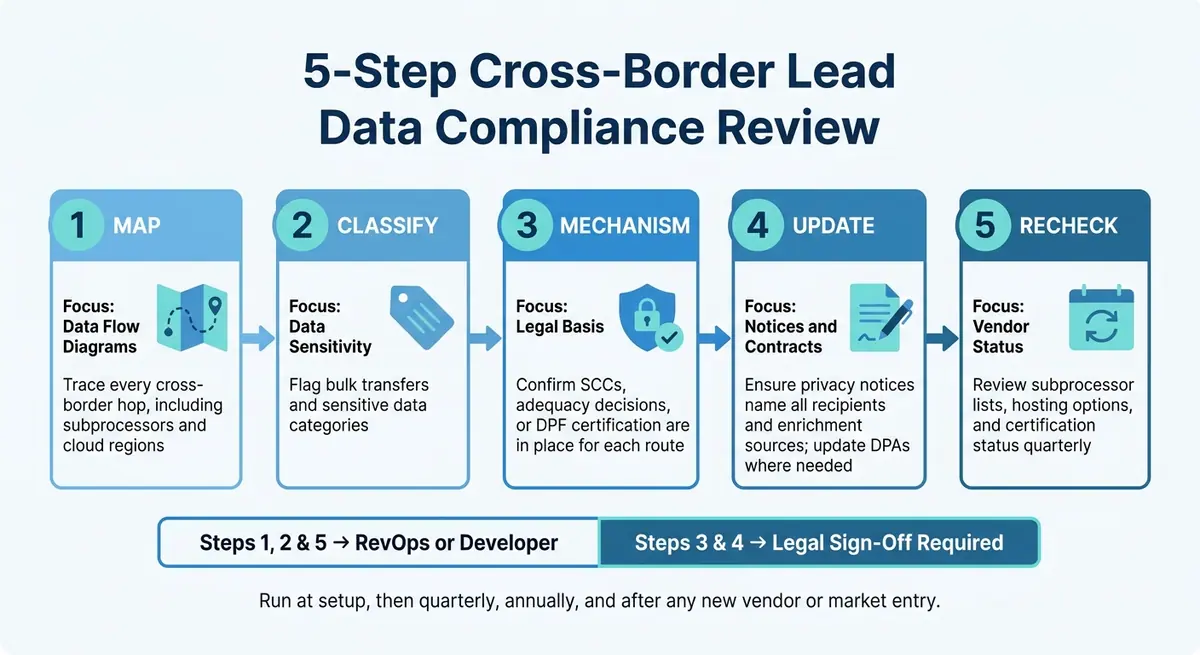
5-Step Cross-Border Lead Data Compliance Review
Forms and Enrichers: Collect Less, Disclose Clearly, and Track Data Sources
Start by optimizing your lead forms to collect less data. If a form field doesn't serve the lead workflow, cut it.
Your privacy notice and consent language should match the way data actually moves. If lead data is enriched, document each source and any subprocessor in a jurisdiction with localization or restricted-handling rules.
Reform supports several collection-layer controls without custom code. Its conditional routing shows or hides fields based on earlier answers. Built-in email validation and spam prevention also help filter out low-quality records before they sync downstream.
From there, follow the same lead into your email platform and CRM.
Email Tools and CRM Links: Check Routing, Storage, Sync Behavior, and Export Controls
Once data leaves the form and enrichment layer, review the next handoff points: where the data is stored, who can access it across borders, and whether syncs move data one way or both ways.
Sync behavior needs a close look. If a CRM sends updated contact records back to an email tool - or the email tool sends them back to the CRM - more than basic contact data can travel. Suppression lists, campaign lists, and field updates may move too. Webhooks deserve the same scrutiny because they can send event data to endpoints nobody has reviewed yet. Check CRM field mappings and tags so sensitive data doesn't end up flowing into higher-risk jurisdictions.
For EU and UK leads on U.S.-based platforms, include CLOUD Act exposure in the TIA.
Conclusion: A 5-Step Review Sequence for Safer Data Flows
Use this sequence to review the full lead stack before launch and on a recurring schedule. Run it at setup, then check again quarterly, annually, and after any new vendor or market entry.
| Step | Focus | What to Do |
|---|---|---|
| 1. Map | Data flow diagrams | Trace every cross-border hop, including subprocessors and cloud regions |
| 2. Classify | Data sensitivity | Flag bulk transfers and sensitive categories |
| 3. Mechanism | Legal basis | Confirm SCCs, adequacy decisions, or DPF certification are in place for each route |
| 4. Update | Notices and contracts | Ensure privacy notices name all recipients and enrichment sources; update DPAs where needed |
| 5. Recheck | Vendor status | Review subprocessor lists, hosting options, and certification status quarterly |
Not every review needs legal input.
- Steps 1, 2, and 5 can usually sit with RevOps or a developer working from a checklist.
- Steps 3 and 4 need legal sign-off, especially for any route your transfer risk review flagged.
FAQs
Do trade agreements make data transfers legal?
No. Trade agreements can support cross-border data flows and can limit forced data localization. But they do not automatically make every data transfer legal.
Companies still have to follow the data protection laws that apply to them. That includes regional rules like the GDPR, along with local laws in each jurisdiction, especially when privacy, cybersecurity, and consumer protection rules come into play.
When do I need SCCs or a TIA?
You need SCCs and a TIA when moving personal data from places like the EU to a country that doesn’t have an adequacy decision. The same goes when you use a provider that may fall under foreign government surveillance rules.
SCCs are the contract tool that covers the transfer itself. A TIA checks whether the laws in the destination country - especially laws tied to government access - undercut those contract protections.
If your vendor is a U.S. company, the TIA should deal with possible U.S. government-access exposure even if the data is hosted somewhere else.
What counts as a cross-border transfer?
A cross-border data transfer usually happens when information moves from one country to another as part of delivering a product or service.
In trade agreements, this can cover both personal and non-personal data. It also includes data that’s processed or stored on computing facilities outside a party’s territory. And in practice, one service may involve several data flows, not just a single transfer.
Related Blog Posts
Get new content delivered straight to your inbox

The Response
Updates on the Reform platform, insights on optimizing conversion rates, and tips to craft forms that convert.


Drive real results with form optimizations
Tested across hundreds of experiments, our strategies deliver a 215% lift in qualified leads for B2B and SaaS companies.
