
.webp)
GDPR and Data Transfers: Tech Solutions Explained



When handling personal data from EU residents, GDPR compliance is non-negotiable - even for cross-border data transfers. Non-compliance risks include fines up to €20 million or 4% of global annual revenue, and even operational disruptions. Here's what you need to know:
- What qualifies as a data transfer? Sharing data outside the EEA, using non-EEA cloud services, or internal transfers within multinational companies.
- Why safeguards matter: Data sent to countries with weaker privacy laws risks unauthorized access, loss of user rights, or surveillance.
- Key legal tools:
- Adequacy Decisions: Simplest method for "safe" countries like Japan or the UK.
- Standard Contractual Clauses (SCCs): Widely used but requires extra steps like Transfer Impact Assessments (TIAs).
- Binding Corporate Rules (BCRs): Best for large corporations but time-intensive to implement.
- Codes of Conduct/Certifications: Emerging options for industry-specific compliance.
Technology's role: Automating compliance through tools like real-time TIAs, encryption, and integrated platforms simplifies processes, reduces risks, and ensures data handling aligns with GDPR.
Staying compliant requires constant monitoring of regulatory changes and embedding privacy safeguards into every step of your data operations.
GDPR Requirements for International Data Transfers
What Counts as a Cross-Border Data Transfer
According to the EDPB, a cross-border data transfer involves three key elements: (1) the controller or processor must fall under GDPR jurisdiction, (2) a data exporter must share personal data with a data importer, and (3) the importer must be situated outside the EEA or be an international organization.
Some common examples include sharing customer information with vendors located outside the EEA, granting remote access to data stored in the EEA from offices abroad, using cloud services hosted on servers in third countries, or even internal data sharing within a multinational company from an EEA branch to one in the U.S. or Asia. However, not all scenarios qualify as a transfer. For instance, if an EU consumer voluntarily provides their data to a U.S. website, that counts as direct collection, not a transfer. Similarly, an employee traveling to a third country with a work laptop doesn’t trigger transfer rules.
Why Data Transfers Need Safeguards
The GDPR ensures that personal data maintains the same level of protection when it leaves the EEA. As the EDPB explains:
"The GDPR aims to guarantee an equivalent level of protection to personal data being transferred to the one they enjoy within the EEA".
Without proper safeguards, personal data may end up in countries with weak privacy protections, unchecked surveillance, or inadequate legal remedies.
These risks are more than theoretical. Foreign governments could access data without meeting EU legal standards, individuals might lose the ability to exercise their rights (like accessing or deleting their data), and information could be intercepted in transit or processed without oversight. For example, in January 2019, France's CNIL fined Google LLC €50 million for failing to meet transparency and consent requirements in its data processing practices. More recently, in 2022, the CNIL imposed fines ranging from €100,000 to €200,000 on organizations using Google Analytics due to unlawful data transfers to the U.S..
The Schrems II ruling has added another layer of complexity. Exporters are now required to perform Transfer Impact Assessments (TIAs) to determine whether the legal environment in the recipient country - particularly its surveillance laws - undermines the effectiveness of contractual protections. These assessments are vital for demonstrating compliance and avoiding penalties, which can reach up to €20 million or 4% of global revenue.
To address these challenges, robust legal frameworks are essential. In addition, organizations are increasingly relying on advanced compliance technologies, such as privacy-focused form templates, to integrate safeguards directly into their data handling processes. Such tools help ensure that data transfers align with GDPR requirements while minimizing risks.
sbb-itb-5f36581
Getting started with GDPR compliance: Data transfers
Legal Methods for GDPR-Compliant Data Transfers
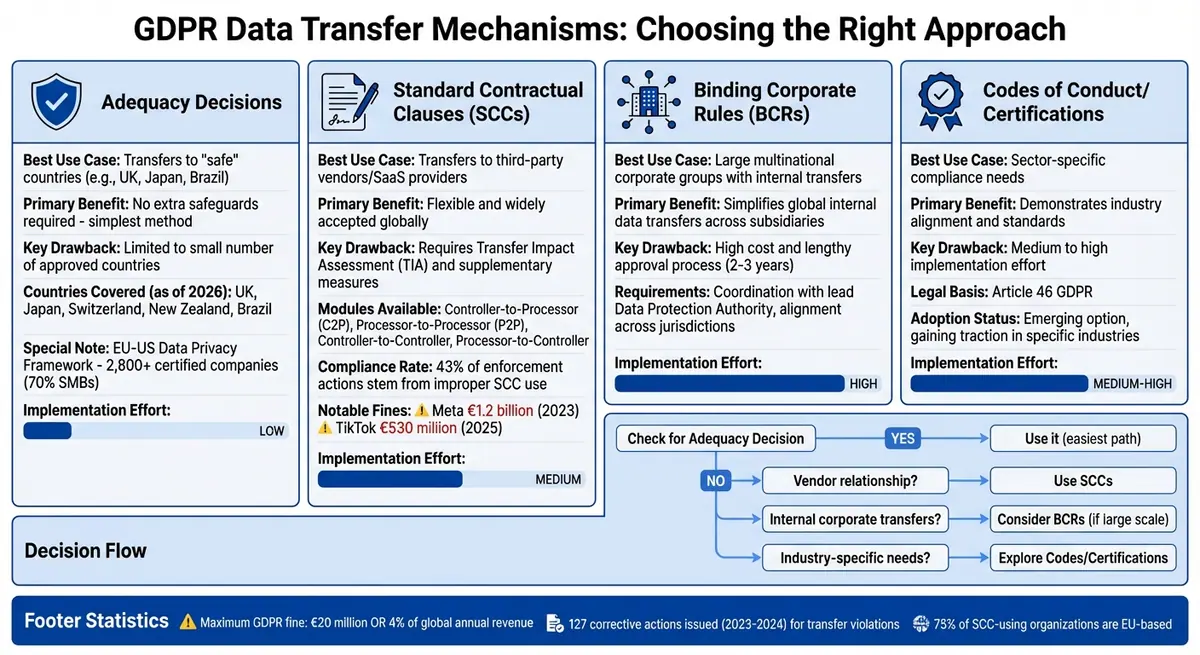
GDPR Data Transfer Mechanisms Comparison: Adequacy Decisions vs SCCs vs BCRs
Navigating cross-border data transfers under GDPR can seem complex, but there are four key legal mechanisms businesses can use to stay compliant. By combining these methods with modern technology, companies can simplify the process and reduce risks. Each approach is tailored to different transfer scenarios.
Adequacy Decisions
An adequacy decision is the most straightforward option for transferring data internationally. Essentially, the European Commission evaluates whether a country’s data protection laws align with GDPR standards. If they do, data can flow freely without needing extra safeguards or a Transfer Impact Assessment (TIA).
As of early 2026, countries like the UK, Japan, Switzerland, and New Zealand are covered by adequacy decisions. Brazil joined this list in December 2025. For transfers to the U.S., only companies certified under the EU‑US Data Privacy Framework qualify. By July 2024, over 2,800 U.S. companies had self-certified, with 70% of these being small or medium-sized businesses.
However, adequacy decisions aren’t permanent. They’re periodically reviewed and can be amended or revoked if circumstances change. This fragility has been highlighted by the collapse of previous frameworks like Safe Harbor and Privacy Shield.
Standard Contractual Clauses (SCCs)
Standard Contractual Clauses are pre-approved legal agreements provided by the European Commission. They’re used when transferring data to countries without an adequacy decision. The updated 2021 framework introduced modular templates tailored to different roles, such as Controller-to-Processor (C2P) or Processor-to-Processor (P2P).
Using SCCs requires a Transfer Impact Assessment, and if risks are identified, additional safeguards like encryption must be implemented.
The stakes are high for non-compliance. For example:
- In May 2023, Meta was fined €1.2 billion by the Irish Data Protection Commission for transferring EU data to the U.S. using SCCs without proper safeguards.
- TikTok faced a €530 million fine in May 2025 for transferring EEA user data to China without conducting a TIA.
A 2023 survey also revealed that 43% of enforcement actions stemmed from improper use of SCCs.
Binding Corporate Rules (BCRs)
Binding Corporate Rules are internal policies that allow multinational organizations to transfer data within their corporate group globally. These are ideal for large enterprises managing significant volumes of intra-group data.
Getting BCRs approved is no small feat. The process typically takes two to three years and requires coordination with a lead Data Protection Authority to align policies across multiple jurisdictions. While resource-intensive, BCRs provide a unified approach to global data handling and demonstrate a strong commitment to privacy.
Codes of Conduct and Certification Mechanisms
Under Article 46, businesses can also comply with GDPR by following approved industry-specific codes of conduct or obtaining certifications that validate their data protection measures. Though less common than SCCs or adequacy decisions, these approaches are gaining traction in certain industries, offering a balance between simplicity and regulatory obligations.
| Mechanism | Best Use Case | Primary Benefit | Key Drawback |
|---|---|---|---|
| Adequacy Decision | Transfers to "safe" countries (e.g., UK, Japan) | No extra safeguards required | Limited to a small number of countries |
| SCCs | Transfers to third-party vendors/SaaS | Flexible and widely accepted | Requires TIA and supplementary measures |
| BCRs | Large multinational corporate groups | Simplifies internal global transfers | High cost and lengthy approval process |
| Codes/Certifications | Sector-specific compliance | Demonstrates industry alignment | Medium to high implementation effort |
When deciding on a mechanism, start by checking for an adequacy decision. If unavailable, SCCs are often the most practical choice for vendor relationships. BCRs are better suited for large-scale internal transfers, while codes of conduct and certifications work well for meeting industry-specific needs.
These legal tools form the backbone of GDPR compliance, with technology playing a critical role in making cross-border data transfers more efficient and secure.
Technology Solutions for GDPR Compliance
Modern technology takes much of the heavy lifting out of GDPR compliance. As regulatory requirements grow more complex, automation tools simplify the process, ensuring businesses can meet their legal obligations without overburdening their teams. Between 2023 and 2024, EU Data Protection Authorities issued 127 corrective actions related to international data transfers, with most violations stemming from inadequate Transfer Impact Assessments (TIAs). The right technology not only helps organizations avoid these costly mistakes but also ensures smoother day-to-day operations by bridging the gap between legal mandates and practical implementation.
Running Transfer Impact Assessments (TIAs)
Automated platforms guide organizations through a six-step TIA process. This starts with data mapping, which identifies hidden transfer pathways, and incorporates legal databases and risk scoring tools to streamline compliance.
One key component of this process is customer-managed encryption (CME). By using EU-based CME with hardware security modules (HSMs), businesses can ensure their data remains unreadable to third-country recipients. Marc ten Eikelder from Kiteworks highlights its importance:
"When encryption makes data unintelligible to third-country importers and government authorities, assessment demonstrates adequacy through technical architecture rather than extensive legal justification".
Organizations that adopt a structured TIA process alongside customer-managed encryption often see a 60% drop in findings during audits by Data Protection Authorities. Platforms like OneTrust and Kiteworks help by automating documentation, which serves as proof of compliance. These tools also monitor for reassessment triggers, such as changes in transfer volumes, new data categories, or updates to destination country laws.
Building Privacy-First Infrastructure
Strong encryption - both at rest and in transit - plays a vital role in protecting data, regardless of the legal landscape in its destination country. Keeping encryption keys under EU-based control ensures third-country entities can never decrypt the data.
A privacy-first infrastructure also benefits from middleware that synchronizes and verifies data in real time before it crosses systems, such as web forms and CRMs. This prevents inaccurate or unnecessary data from being transferred. Additional technical measures, like access restrictions, pseudonymization, and detailed audit logs, further strengthen security. Supervisory authorities, including Germany's BfDI, emphasize that exporters who maintain exclusive control over technical safeguards provide some of the strongest evidence during audits. Beyond infrastructure, compliance tools integrated into these systems further simplify GDPR adherence.
Using Integrated Compliance Tools
Comprehensive compliance platforms automate the entire workflow, from tracking international data flows to managing legal requirements. These tools maintain centralized transfer inventories, documenting purposes, legal bases, and supplementary measures to meet GDPR Article 30 accountability requirements. They also streamline the selection of appropriate mechanisms, generate Standard Contractual Clauses (SCCs) for various scenarios, and manage Binding Corporate Rules.
Vendor management features are another critical component, enabling organizations to vet sub-processors and evaluate their data protection practices. Consent management tools ensure explicit and informed consent is captured for specific transfers, as required under Article 49 derogations. Additionally, real-time monitoring keeps companies updated on regulatory changes, such as shifts in adequacy status, ensuring they remain aligned with evolving compliance frameworks. Kevin Yun, Founder of ComplyDog, underscores this accountability:
"The principle of accountability extends to international transfers, requiring organizations to demonstrate adequate protection rather than simply claiming compliance".
| Feature | Function in Data Transfers | Compliance Benefit |
|---|---|---|
| Data Mapping | Visualizes cross-border flows and storage locations | Identifies hidden transfers to prevent gaps |
| TIA Automation | Evaluates recipient country legal risks | Provides systematic risk assessment |
| Customer-Managed Encryption | Ensures data is unintelligible to third parties | Demonstrates technical sovereignty |
| SCC Modules | Automates contract generation for various scenarios | Simplifies legal basis implementation |
| Vendor Portal | Monitors sub-processor compliance | Manages third-party risks |
Recent Changes in Data Transfer Compliance
The rules for international data transfers have undergone significant changes since July 2020, following the Schrems II ruling. This decision invalidated the EU‑U.S. Privacy Shield, leaving around 5,000 organizations scrambling to find other legal pathways for transatlantic data transfers. The ruling highlighted a key point: adequacy decisions are not set in stone and can be revoked if they fail to uphold fundamental rights.
In June 2021, the European Commission introduced updated Standard Contractual Clauses (SCCs). These modular templates address four distinct scenarios: Controller-to-Controller, Controller-to-Processor, Processor-to-Processor, and Processor-to-Controller. This update reflects the growing complexity of cloud services and outsourcing. A critical addition was the requirement for Transfer Impact Assessments (TIAs), compelling exporters to evaluate whether the destination country's laws - particularly those related to government surveillance - undermine the contractual protections.
Fast forward to July 2023, and the EU‑U.S. Data Privacy Framework (DPF) brought some stability back to the scene. This framework, based on U.S. Executive Order 14086, reinstated a legal basis for transferring data to DPF-certified U.S. organizations. It introduced enhanced safeguards for U.S. signals intelligence practices and a redress mechanism for individuals outside the U.S.. However, enforcement remains strict, with recent penalties highlighting the risks of non-compliance.
Brexit has added its own challenges. The UK now has separate mechanisms, including the International Data Transfer Agreement and the UK Addendum to the EU SCCs. The compliance deadline for these frameworks passed in March 2024. Organizations operating across both regions must now navigate two distinct regulatory systems, each with its own rules. These developments emphasize the need for adaptable, tech-driven compliance strategies.
Keeping Up with Regulatory Changes
Staying compliant means keeping pace with shifting regulations. Nicola McCrudden, Of Counsel at Ogletree Deakins, stresses the importance of staying proactive:
"The emphasis remains on 'know your transfers,' and where there are transfers of personal data, ensuring that there are appropriate technical and organisational measures in place".
Constant reassessment is crucial. Organizations must stay alert to changes in adequacy decisions and evaluate whether updates in destination country laws necessitate revised Transfer Impact Assessments. A recent example is the European Data Protection Supervisor's investigation into the European Commission for potential breaches related to Microsoft 365 cloud transfers, showing that even public entities are under scrutiny. While the Data Privacy Framework offers some stability now, businesses should still rely on SCCs as a backup for potential legal shifts.
Forward-thinking companies are moving beyond reactive compliance to a more proactive approach. Building systems that can adapt to regulatory changes is becoming essential. This includes maintaining thorough documentation of data transfer details - such as categories, purposes, countries, and legal bases. A survey revealed that 75% of organizations using SCCs are headquartered in Europe, with 13% based in the U.S., highlighting the global scope of these challenges. Modern compliance tools now provide real-time monitoring to help businesses adjust quickly to changes. Organizations that prioritize privacy as a core operational value - not just a legal requirement - are better equipped to handle the evolving regulatory landscape.
Conclusion
Navigating GDPR cross-border compliance becomes much more manageable with the right technology. Tools like automated mapping and privacy-focused technologies help uncover data flows and allow for cross-jurisdictional analysis without requiring the movement of personal data.
The cost of non-compliance is steep, with significant penalties on the line. Automated Transfer Impact Assessments (TIAs) and integrated compliance tools simplify evaluations and centralize documentation, ensuring consistent oversight.
These solutions don’t just reduce audit risks - they also align effortlessly with existing legal frameworks. By combining technical safeguards with legal measures, organizations can address residual risks effectively.
Paul Krasy, Data Protection Officer at Mentor Group, emphasizes the importance of this approach:
"Success depends on adopting a proactive mindset to anticipate changes, leverage technology and treat privacy not as a constraint, but as a cornerstone of trust and resilience".
Companies that prioritize building privacy-first systems - rather than treating compliance as an afterthought - are better equipped to handle the complexities of shifting regulations. The way forward is clear: map your data flows, implement layered security measures, and automate assessments to stay ahead of regulatory changes. With the right technology, GDPR compliance becomes not just achievable but a strategic advantage in today’s privacy-driven world.
FAQs
Do I need a TIA for every transfer?
Under GDPR, a Transfer Impact Assessment (TIA) isn't mandatory for every data transfer. However, organizations are required to carry out a Data Protection Impact Assessment (DPIA) when transferring data internationally. This process helps identify potential risks and establish measures to protect data, ensuring compliance and safeguarding information during cross-border transfers.
What’s the safest way to use U.S. cloud tools?
To use U.S. cloud tools safely while adhering to GDPR requirements, it's crucial to establish robust safeguards for cross-border data transfers. Start by encrypting your data - use AES-256 for storage and TLS 1.3 for data in transit. Additionally, implement pseudonymization to protect personal data and minimize the amount of data collected in the first place.
Strengthen access controls by enforcing multi-factor authentication (MFA) and role-based access control (RBAC) to restrict who can access sensitive information. Regular audits are essential to ensure compliance and identify potential vulnerabilities. For secure transfers, rely on protocols like TLS 1.3 or use VPNs for added protection.
Finally, continuous monitoring is key. By actively tracking activity and addressing risks as they arise, you can maintain compliance and safeguard data effectively.
How do I find “hidden” data transfers in my stack?
To identify "hidden" data transfers, it's important to establish consistent monitoring and conduct risk assessments. Keep a close eye on data flows, maintain thorough documentation of compliance efforts, and leverage tools designed to analyze how data moves across your systems. These steps are particularly useful in complex environments where unnoticed transfers can occur. Additionally, conducting audits and using encryption protocols like TLS 1.3 can protect data in transit while helping to detect unusual activity that might signal unauthorized transfers.
Related Blog Posts
Get new content delivered straight to your inbox

The Response
Updates on the Reform platform, insights on optimizing conversion rates, and tips to craft forms that convert.



Drive real results with form optimizations
Tested across hundreds of experiments, our strategies deliver a 215% lift in qualified leads for B2B and SaaS companies.
