
.webp)
When SCCs Conflict With Existing Transfer Terms



If your MSA, DPA, or addendum says one thing and the SCCs say another, the SCCs control the transfer point. And if a contract term weakens the SCCs, the transfer setup can fail.
Here’s the short version:
- I’d treat liability caps, audit limits, subprocessor notice, Annex II security detail, governing law, and third-party beneficiary clauses as the first items to check.
- I’d separate true conflicts from terms that can sit next to the SCCs without changing them.
- I’d fix clashes with a precedence clause, SCC carveouts, Annex updates, or a narrow side letter - not by editing the SCC text.
- I’d review the full contract stack together: MSA, DPA, SCCs, UK addendum, Swiss terms, and subprocessor terms.
A simple test helps: if you cannot follow both documents at once, or if one term cuts back an SCC duty, you likely have a conflict.
Quick comparison
| Issue | What to ask | Usual fix |
|---|---|---|
| Liability cap | Does the cap apply to SCC duties? | Carve SCC duties out of the cap |
| Audit limits | Do notice, timing, or fees block SCC audit rights? | Narrow the limit so SCC rights stay in place |
| Security terms | Does Annex II use vague wording? | Add specific measures in Annex II |
| Subprocessors | Is notice only posted on a website? | Add written notice and time to object |
| Third-party rights | Does the contract block all third-party claims? | Add an SCC exception |
| Governing law | Does the stack use non-EU law for EU SCCs? | Align with the SCC rule |
So my takeaway is simple: don’t review the SCCs alone. Review the seams between documents. That’s where most transfer problems show up.
Which terms control when SCCs and other documents do not match
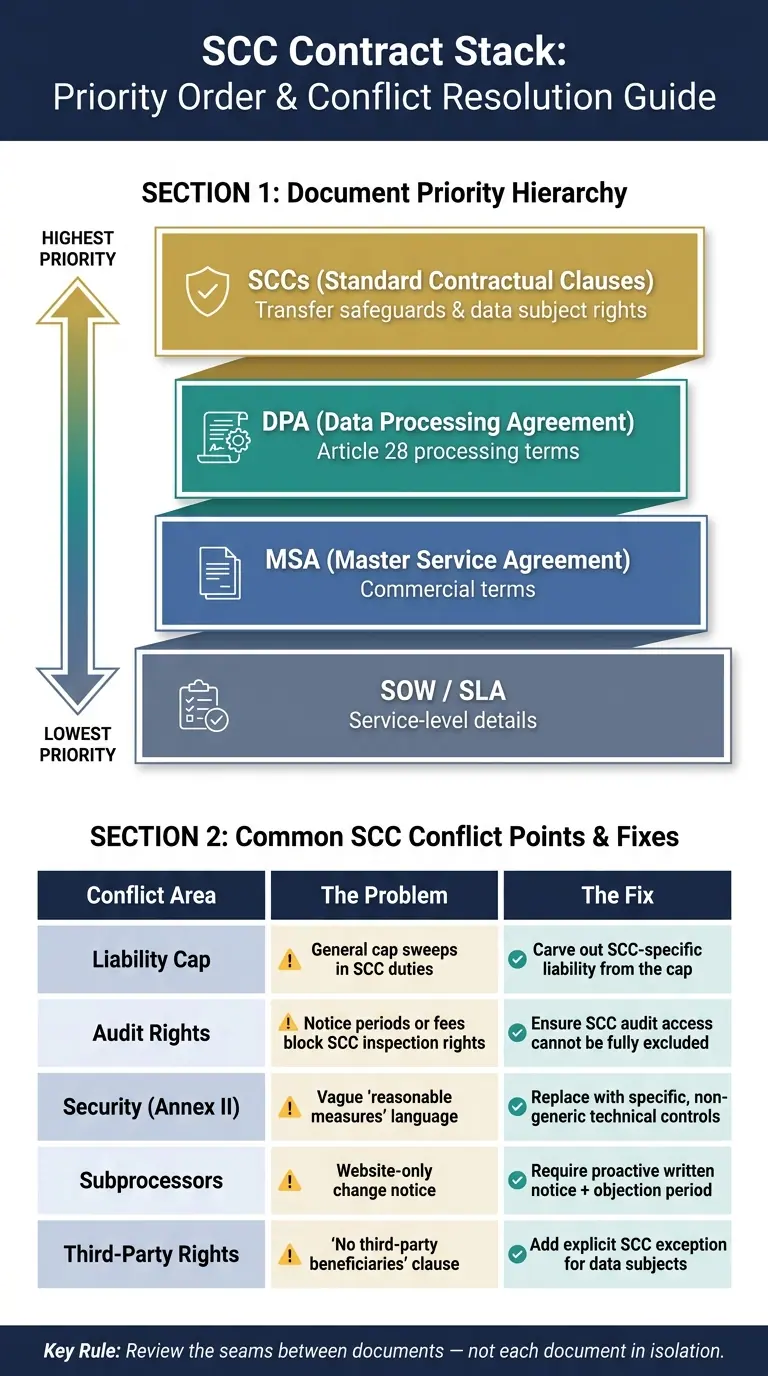
SCC Contract Stack: Priority Order & Conflict Resolution Guide
The SCCs control when transfer terms clash. The 2021 SCCs include a simple hierarchy rule: if another contract term covers the same issue and conflicts with the SCCs, the SCCs win. You can add extra terms, but only if those terms don't conflict with the SCCs.
This comes up most often when the SCCs run into a broader DPA, MSA, or regional addendum. In that setup, the SCCs override only the terms tied to personal-data transfers. The commercial deal itself still sits in the MSA.
How SCC precedence clauses work in practice
The easiest place to see this is liability. If your MSA has a broad liability cap, and that cap pulls in SCC duties, you've got a problem. A general cap in the MSA should carve out SCC obligations.
The European Commission has said this plainly: limiting liability tied to SCC obligations can invalidate the SCCs as a transfer tool.
"Any contractual provision in the underlying contract that seeks to cap, limit or otherwise exclude the parties' liability under the SCCs risks invalidating the SCCs as a valid tool for transferring personal data outside the EEA."
How to draft order-of-precedence clauses around SCCs
A written priority stack helps each document stay in its own lane.
| Document | Scope | Priority |
|---|---|---|
| SCCs | Transfer safeguards and data subject rights | Highest |
| DPA | Article 28 processing terms | Second |
| MSA | Commercial terms | Third |
| SOW/SLA | Service-level details | Lowest |
The clause should say that the SCCs prevail only to the extent of a conflict about personal-data transfer terms. That's the key point. It protects the SCCs where they matter, without rewriting the rest of the commercial deal.
One more thing: check the limitation-of-liability section with care. A broad cap can accidentally sweep SCC obligations into the MSA's general limit, which creates risk under the European Commission's view.
Where conflicts most often appear in SCCs, DPAs, and addenda
Once precedence is clear, the next step is to find the clauses that tend to break it. Most SCC conflicts don’t look dramatic at first. They usually sit inside standard terms that seem fine on their own, then start causing trouble when you read the full contract stack together. That’s where the rule that SCCs control in a conflict gets tested.
Liability, security, audits, and subprocessors
Liability caps are a common problem when they reach SCC duties. If a cap applies to SCC obligations, it can put the transfer mechanism at risk.
Security wording is another frequent trouble spot. DPAs often use broad phrases like "commercially reasonable" or "industry standard" controls. But SCC Annex II requires technical and organizational measures to be described in specific, non-generic terms, and it must be clear which measures apply to each transfer or set of transfers. In plain English: Annex II needs detail, not vague promises.
Audit rights can clash too. Commercial agreements often limit audits to once a year or layer on heavy notice periods and fee conditions. The SCCs, though, require audit access and do not allow a full bar on inspection rights.
Subprocessor terms are another regular mismatch. Many SaaS DPAs rely on website-only notice. The SCCs require proactive written notice of planned changes so the exporter has a chance to object.
Data subject rights and third-party beneficiary terms
Most MSAs include a "No Third-Party Beneficiaries" clause. That’s normal in commercial contracts. The issue is that SCCs give data subjects enforceable rights, so the contract needs an SCC carveout for that clause.
Comparison table: common SCC conflicts and how to resolve them
The table below shows the clauses most likely to conflict and the fastest fix for each.
| Topic | Typical MSA or DPA Term | SCC Requirement | Practical Resolution |
|---|---|---|---|
| Liability | General cap applies to all claims | SCC-specific liability cannot be capped | Carve out SCC-specific liability |
| Security | Generic "reasonable" or "industry standard" measures | Specific, non-generic technical and organizational measures in Annex II | Replace generic schedules with detailed Annex II language |
| Audits | Highly restricted, e.g., once per year | Audit access cannot be fully excluded | Ensure the audit clause does not override SCC-mandated access |
| Subprocessors | Website-only notice | Proactive written notice of planned changes | Commit to written notice and an objection period |
| Third-Party Rights | "No third-party beneficiaries" | Data subjects can enforce SCC clauses against both parties | Add an SCC exception to the no-third-party-beneficiaries clause |
Use these fixes before moving the deal into a DPA, side letter, or regional addendum.
sbb-itb-5f36581
How to fix overlaps using side letters, DPAs, and regional addenda
Once you know where the conflict sits, fix it in the DPA, a side letter, or a regional addendum.
Using the DPA and side letters to clarify scope
Use the DPA for day-to-day terms the SCCs don't cover, such as audit costs, insurance, and subprocessor notices. Put specific technical and organizational measures in Annex II.
Add a precedence clause that gives the SCCs priority on transfer terms.
Use a side letter only for narrow interpretive points or TIA notes. Do not amend the SCC text.
How to stack EU SCCs, UK addenda, and U.S. transfer tools
Append the UK Addendum to the EU SCCs for UK transfers. Use SCCs or DPF only where they apply to the specific transfer. In plain English, each document should handle its own local transfer rule without changing the SCC core text.
Comparison table: regional transfer documents and conflict points
| Instrument | Geographic Scope | Typical Overlap Area | Drafting Note |
|---|---|---|---|
| EU SCCs | EEA to third countries | Liability, security, audits, subprocessors | Core text is immutable; use Annexes I and II for specific transfer and security details. |
| UK Addendum | UK to third countries | Governing law, terminology | Appended to EU SCCs; adapts EU terms to UK GDPR requirements without a standalone contract. |
| DPA | General processing | Audit costs, liability allocation, subprocessor notice | Add SCC priority for transfer terms. |
| Side Letter | Specific parties | Interpretation of local laws, TIA documentation | Use for TIA notes only; do not change SCC text. |
| EU-U.S. Data Privacy Framework (DPF) | U.S. certified organizations | Onward transfers, redress mechanisms | Functions as an adequacy mechanism for certified U.S. organizations transferring data from the EU. |
With the stack aligned, the next step is negotiating the remaining business terms and applying the final drafting choices.
Negotiation and implementation steps for SaaS teams
What to negotiate before signing
Start with the contract stack itself. Add a short precedence clause so the SCCs control only when transfer terms conflict. That keeps the clause tight and avoids giving the SCCs control over unrelated parts of the deal. Also carve SCC breaches out of any general liability cap, since a broad cap can undercut the transfer terms.
Use side letters with care. They work best for narrow clarifications, not for rewriting the main transfer setup.
Then make sure the paperwork matches the way data actually moves. Match the SCC module to the real data flow, line up Annex III subprocessor authorization with the DPA, and package any UK or Swiss transfer add-ons with the same set of documents.
Annex II also needs close attention. Write it in specific, non-generic terms, and make sure it matches your current security exhibit. If Annex II says one thing and your security schedule says another, you're setting yourself up for trouble later.
Once the drafting is done, sync your internal records and workflows with the signed terms.
How to put the contract terms into practice after signing
After signature, the job shifts from legal drafting to day-to-day controls. Map the real data flows - including support access and cloud storage - back to your RoPA so Annex I and Annex II stay accurate over time.
Then push SCC protections into downstream subprocessor contracts. At the same time, update internal workflows for data subject rights and monitoring duties. If your team handles requests one way, but the contract promises something else, that gap can become a problem fast.
TIAs shouldn't sit on a shelf. Review them every year and also after any material change in destination-country law or in the scope of the transfer.
Conclusion: key rules to keep in mind
This contract stack works only when the signed documents match the data flows on the ground. SCCs control when transfer terms conflict, so the rest of the stack needs to line up with them.
It's also smart to review the full package together - MSA, DPA, SCCs, and any regional addenda - instead of checking each document in isolation. Most conflicts don't show up inside one document. They show up at the seams between them.
FAQs
How do I spot a true SCC conflict?
A true conflict comes up when an underlying agreement, like a DPA, clashes with the protections in the SCCs or waters them down. When that happens, the SCCs will usually control for that same subject matter.
That’s why it helps to look closely at any terms that:
- cap or exclude liability under the SCCs
- impose tougher notice requirements
- set breach timelines that don’t match the SCCs
You can add extra terms, but they can't conflict with the SCCs.
Can a side letter fix SCC issues?
Yes - parties can use a side letter or similar agreement to add to SCCs, as long as it does not conflict with the mandatory SCC terms or reduce protections for data subjects.
Since the SCC text itself can’t be changed, teams often put extra commercial or processing terms in a broader contract or an exhibit. That’s common, and often the cleanest way to handle it.
But there’s a clear line: if those added terms prejudice data subjects’ fundamental rights, the SCCs may lose their legal certainty.
Which document controls first?
The SCCs should take priority over any commercial contract terms that conflict with them. So before you sign, check that the rest of the agreement doesn’t say anything that clashes with the SCCs.
The SCCs also include terms that can meet GDPR Article 28 requirements. That means a separate DPA may not be needed. To help keep the SCCs binding and enforceable, attach the SCCs and the completed Annexes to the main contract.
Related Blog Posts
Get new content delivered straight to your inbox

The Response
Updates on the Reform platform, insights on optimizing conversion rates, and tips to craft forms that convert.




Drive real results with form optimizations
Tested across hundreds of experiments, our strategies deliver a 215% lift in qualified leads for B2B and SaaS companies.
