
.webp)
Spam Prevention with NLP in Lead Forms


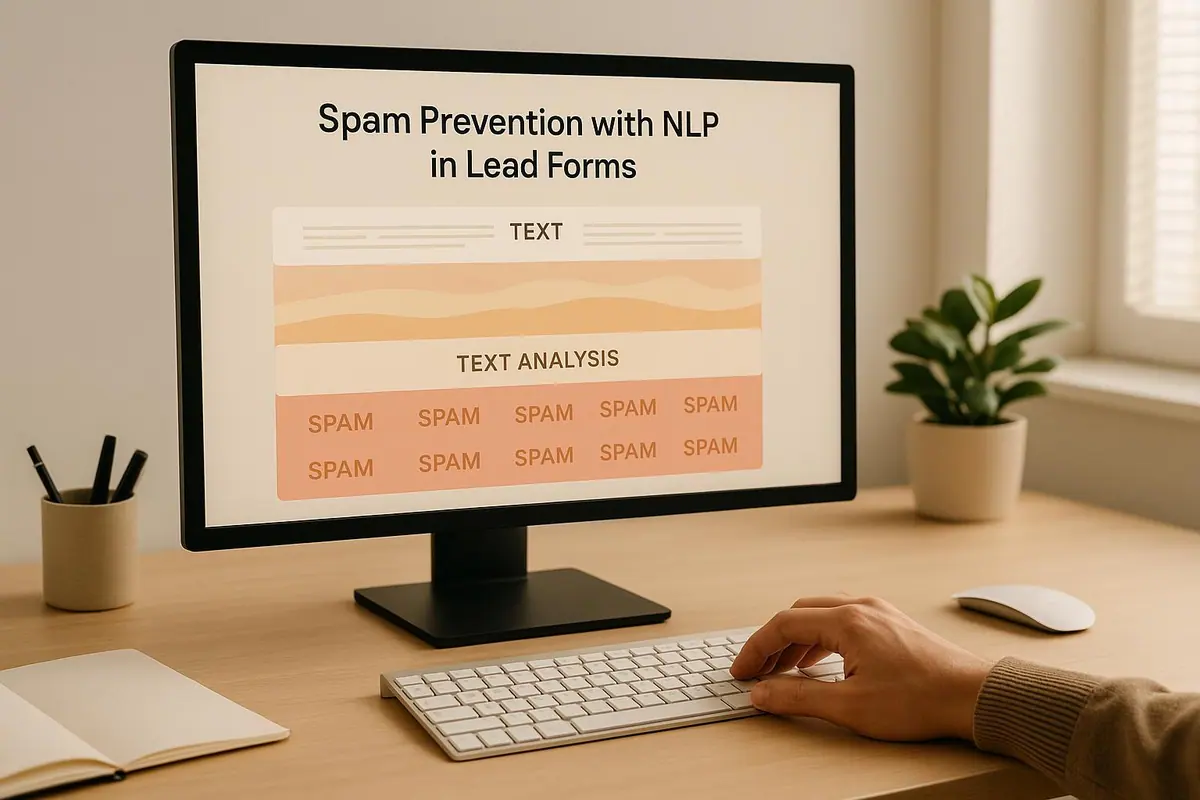
Spam in lead forms wastes time, money, and resources. Traditional tools like CAPTCHAs often fail against advanced AI-powered spam. Natural Language Processing (NLP) offers a smarter solution by analyzing form content for tone, intent, and patterns to filter out fake or malicious submissions.
Here’s the process to implement NLP-based spam prevention:
- Define Spam: Tailor your spam definition to your business. Examples include fake names, disposable emails, or mismatched geographic info.
- Analyze Patterns: Identify red flags like repeated IPs, gibberish text, or suspicious links.
- Prepare Data: Label historical submissions as spam or valid to train your models.
- Apply NLP: Use rule-based filters, machine learning classifiers, and transformer models for layered detection.
- Score Submissions: Assign spam scores in real-time to block, flag, or accept entries.
- Monitor Results: Track metrics like spam catch rate and false positives to refine your system.
Tools like Reform simplify this by combining spam detection, real-time scoring, and CRM integration in a no-code platform. With NLP, your business can reduce spam by up to 87%, improve lead quality, and save hours of manual review.
6.4.2: Using a natural language model: Comment spam detection - loading a pretrained NLP model
Define Spam and Prepare Your Data
To tackle spam effectively, start by defining what "spam" means for your business. Spam doesn't look the same for everyone - it depends on your industry and goals. For instance, a B2B SaaS company might label competitor research submissions as spam, while a local service provider might focus on bulk promotional messages from other vendors. This tailored definition becomes the backbone of your model training, filtering rules, and real-time scoring.
Your definition should cover a range of spam types, including bot traffic (automated scripts filling forms), fake leads (bogus details entered to access gated content), malicious submissions (phishing attempts or abusive messages), and unsolicited promotions from other businesses. According to industry reports, spam and bot-driven submissions can account for 20–40% of all form entries in B2B and B2C lead-generation campaigns.
A precise definition ensures that historical data is labeled consistently, NLP models are trained with the right features, and filters strike a balance between catching spam and letting high-quality leads through. In the U.S., where lead quality directly impacts media spend and acquisition costs, missteps here could mean wasted time for your sales team - or worse, missed revenue.
Identify Common Spam Patterns
Once you've nailed down your spam definition, analyze your existing submissions for recurring patterns. Common red flags in U.S.-based lead forms include:
- Fake names like "John Test" or gibberish such as "asdfgh asdfgh"
- Disposable email domains
- Geographic mismatches (e.g., U.S. ZIP code paired with a foreign phone number)
- Repeated submissions from the same IP address
- Nonsensical or copy-pasted text
- Links leading to suspicious or unrelated domains
Document these patterns with specific examples. For instance, if your contact forms are flooded with cryptocurrency pitches, note the exact phrases and URLs. Similarly, if quote requests feature automated keyword-stuffed text, capture those details. These examples will guide the creation of rule-based filters and training data labels.
Go beyond surface-level patterns by digging into textual and structural features that might not be immediately obvious. At the character level, watch for long strings of random characters, excessive special symbols, or unusual Unicode characters. At the word level, keep an eye out for overused commercial keywords, adult content terms, or language mismatched to your market. Even response length can be a clue - extremely short entries or walls of text might signal spam, depending on what's typical for your forms.
Structural features like email domain reputation, URL patterns (e.g., frequent use of shorteners), and metadata such as IP reputation or submission timing can also reveal spam. For instance, a sudden burst of 50 submissions in 10 minutes is a clear red flag. Use these insights to refine your data labeling process.
Collect and Label Historical Data
With a clear spam definition and identified patterns, the next step is to gather and label your historical data. Pull data from all lead sources - website forms, landing pages, partner portals, ad platform lead forms, and any tools you use. If you're using platforms like Reform, you can centralize this data easily since they often enrich submissions with metadata like IP addresses and geographic details.
Standardize this data into a single repository with consistent fields for contact details, message content, timestamps, and outcomes (e.g., whether the lead converted or was flagged as spam). Then, take a random sample and have two human reviewers label each submission as "spam", "valid", or "uncertain." When disagreements arise, resolve them using a detailed labeling guide. For example, you might decide that any entry with a disposable email domain is spam, even if the text seems legitimate.
Pay special attention to borderline cases. Flag ambiguous submissions for discussion with your sales or compliance team. You might even create intermediate labels like "low-quality but real" or "suspected affiliate fraud" to help your NLP models distinguish between outright spam and low-intent leads.
Protect personal data by limiting access to authorized staff and securing it with encryption. Stick to the privacy promises you've made to users, and minimize the data exported for training. For example, you could hash email addresses or truncate free-text content to detect patterns without exposing full details. Document how spam detection aligns with your broader risk and compliance policies, and ensure third-party tools involved in NLP processing meet your privacy standards.
Preprocess Text for NLP Models
Clean, well-prepared data is the foundation of effective NLP models. Raw form submissions need normalization and cleaning to ensure reliable pattern detection. Start by converting text to lowercase, trimming whitespace, and standardizing character encodings. This ensures that "SPAM" and "spam" are treated the same.
Handle punctuation and special characters carefully. Keep meaningful symbols like "@" and ".com" for email analysis. Tokenize text into words or smaller units, and separate URLs or email addresses into distinct tokens so the model can learn from their structure.
Don't discard stop words entirely - they can reveal stylistic differences. For example, a real lead might write, "I'm interested in learning more about your pricing", while spam might say, "click here now get best deal." Subtle differences like these are key. Test various preprocessing setups to find what works best for your data.
Preserve special characters, emojis, and non-English text instead of removing them. Spam often relies on unusual character sequences, emoji-heavy messages, or language mismatches. Use lightweight language detection to tag each submission with its primary language and confidence score. Treat unexpected languages as higher-risk, depending on your market.
Replace URLs, email addresses, and numbers with generic tokens like "[URL]" or "[EMAIL]" instead of deleting them. This approach helps the model recognize patterns (e.g., multiple URLs signaling spam) without memorizing specific domains that may change over time.
Finally, ensure your training data is balanced. If spam examples vastly outnumber legitimate ones, your model might overflag real leads. Use techniques like undersampling or class weighting during training to maintain balance. Continuously monitor false positives (real leads marked as spam) and false negatives (spam that slipped through) in production. Use these insights to refine your definitions, update patterns (like new disposable domains), and retrain models regularly with fresh data.
NLP Techniques for Spam Detection
Once you've outlined what constitutes spam and prepared your data, the next step is to apply layered NLP techniques to filter out unwanted submissions. The most effective strategy combines various methods, starting with basic filters and advancing to more complex models as needed. This approach strikes a balance between accuracy, speed, and cost while ensuring your lead forms remain efficient for genuine prospects.
Each technique brings its own strengths, helping you avoid overcomplicating your solution or leaving exploitable gaps. Let’s dive into the details.
Rule-Based Filters and Keyword Lists
Rule-based filters act as your first line of defense. These filters work by identifying submissions that match predefined patterns, specific keywords, or structural red flags. They’re quick, straightforward, and don’t require advanced machine learning expertise - making them a great way to block spam before more resource-intensive methods kick in.
Start by creating a blacklist of common spam phrases. For lead forms targeting U.S. audiences, examples might include phrases like "100% free", "work from home", "limited time offer", "click here now", or certain adult content terms. Analyze your historical spam data to identify recurring phrases that don’t convert. For instance, if your B2B SaaS forms are inundated with cryptocurrency pitches, add those specific terms to your blocklist.
You should also look at URL and domain patterns. Submissions with multiple external links, URL shorteners (e.g., bit.ly, tinyurl), or domains linked to disposable email services are often indicators of spam. Structural patterns - like excessive punctuation, all-caps text, repeated characters, or long strings of symbols - can also serve as flags. Instead of outright blocking, you can assign weights to these elements. For example, a single promotional keyword might raise a submission’s score moderately, while multiple suspicious signals combined could cross a threshold to classify it as spam. Regularly review and A/B test your rule sets to ensure you’re catching spam effectively without rejecting legitimate leads.
Machine Learning Classifiers
When rule-based filters start missing subtle spam or flagging too many valid submissions, machine learning classifiers can significantly improve your detection capabilities. These models analyze statistical patterns in your labeled data, identifying combinations of features that simpler rules might overlook. They’re particularly effective for managing high submission volumes.
One common approach is using TF-IDF to convert text into numerical features. For example, words like "budget", "implementation timeline", or "number of seats" often signal genuine B2B interest, while terms like "guaranteed", "act now", or "no obligation" are more typical of spam. By examining unigrams and bigrams, the model can identify language patterns that distinguish real inquiries from scripted pitches.
For real-time scoring, lightweight models like logistic regression or SVM work well. If you have more resources, ensemble methods can enhance accuracy. Beyond text, consider incorporating non-text signals like message length, URL count, or metadata from platforms like Reform. Features such as IP reputation, geographic mismatches, or form completion time can further boost the model’s performance. Evaluate your model using metrics like precision, recall, and ROC-AUC to ensure it performs well across various scenarios.
Deploy your trained model as an API or serverless function to score submissions in real time. Speed and accuracy are critical here - your forms need to stay responsive, even during high traffic.
Transformer Models for Spam Detection
Transformer models take spam detection to the next level by understanding semantic meaning and context. These models are particularly effective at spotting advanced or AI-generated spam that simpler methods might miss. For U.S.-based organizations dealing with high-value spam attacks or complex technical inquiries, transformers can provide a noticeable boost in precision.
Models like BERT, RoBERTa, or DistilBERT encode submissions into dense vectors that capture both meaning and context. This allows them to identify similar intents even when the wording differs. You can fine-tune a pre-trained transformer on your labeled spam and legitimate submissions. Starting with a compact model like DistilBERT offers a good trade-off between speed and accuracy. Alternatively, you can use off-the-shelf sentence embeddings and feed them into a downstream classifier.
Transformers shine in cases where simpler methods fall short, such as detecting AI-generated spam - a growing concern as spammers adopt advanced text generation tools. However, these models are computationally intensive, which can lead to latency issues. To address this, consider techniques like model distillation or caching embeddings to improve performance. It’s also a good idea to reserve transformer-based scoring for high-risk or ambiguous submissions that have already passed through initial filters.
Maintaining transformers in production requires strong MLOps practices. Monitor for changes in spam tactics (concept drift) and retrain your models with fresh labeled data as needed. Keep clear documentation and version control so updates are transparent to non-technical stakeholders. Often, a hybrid approach works best: use rule-based methods for straightforward cases, traditional ML classifiers for the majority of submissions, and transformers for the most challenging ones.
Reform simplifies this process by integrating these NLP pipelines into its no-code platform. Instead of building custom infrastructure, you can configure spam-score thresholds, routing rules, and model options directly in the form builder. This allows marketing and operations teams to leverage advanced spam detection without needing to manage servers or write code - keeping the focus on generating high-quality leads.
Implement NLP in Lead Forms
Using the NLP techniques discussed earlier, you can integrate real-time scoring and routing into your lead forms to streamline the handling process. The idea is simple: evaluate each submission as it comes in, decide instantly whether to accept, flag, or block it, and then direct legitimate leads into your CRM or marketing automation tools. Here's how to implement NLP-based spam detection while keeping your forms efficient and user-friendly.
Real-Time Scoring and Threshold Blocking
Real-time scoring means analyzing a submission right after the user clicks submit, before it moves to your database or any other tools. This typically involves a server-side API that processes the form data, applies the NLP model, and returns a spam score - all within 50 to 300 milliseconds. This ensures the process feels seamless for users on standard U.S. broadband or mobile networks.
The setup is straightforward: your form sends data to a REST endpoint over HTTPS. The server normalizes fields like name, email, company, and message, then runs them through your spam detection model. Based on the spam score, the system decides to either accept, flag, or block the submission. Keeping this process server-side ensures your filters and models remain secure from tampering.
A well-designed threshold strategy is key. Assign each submission a probability score (0 to 1) and divide it into three categories: allow (0 to 0.3), review (0.3 to 0.7), and block (0.7 to 1.0). These thresholds can be adjusted over time based on false-positive rates and feedback from your sales team.
Your form should send structured data - like names, email addresses, company details, and referral sources - along with metadata such as user agent, IP address (with privacy considerations), timestamp (MM/DD/YYYY HH:MM AM/PM format), and form ID. The scoring service should return a numeric spam score, a decision label (e.g., "allow", "review", or "block"), and optional indicators like "multiple suspicious links" or "disposable email domain." These details help your team refine the filters and understand why a lead was rejected.
For submissions that are blocked, provide an inline error message in plain language, such as "Something about this submission seems like spam - please revise and try again." Avoid revealing specifics that spammers could exploit. For borderline cases, accept the form but display a message like "Your submission is being reviewed and may take a little longer than usual." Behind the scenes, these submissions can be flagged for review rather than outright rejected, minimizing the risk of losing legitimate leads.
Next, let’s explore how flagged submissions can be routed effectively.
Flag and Route Submissions
Not every flagged submission requires the same treatment. Here's how you can handle them based on their risk level:
- High-risk submissions (score above 0.7): Quarantine these in a separate "Spam" table that doesn’t sync with your CRM. This keeps your sales team focused on genuine leads.
- Ambiguous submissions (score between 0.3 and 0.7): Send these to a review queue or shared inbox where team members can quickly tag them as valid or spam. Valid leads can then be added to the sales pipeline.
- Low-risk submissions (score below 0.3): Route these directly into your CRM or marketing tools like Salesforce, HubSpot, or Marketo for immediate follow-up.
Store all submissions, along with their spam scores and decision labels, in a centralized database. Use automation tools like webhooks, Zapier, or Make to execute routing logic. Many teams add custom CRM fields such as "Spam risk score" and "Spam status" to streamline the review process and allow overrides. These overrides also provide valuable feedback for improving your NLP model.
Tools like Reform simplify this process by offering pre-built spam scoring, conditional routing, and integrations with popular CRMs. For instance, you can configure Reform to skip CRM integration for scores above 0.8, send medium-risk leads to a review list for scores between 0.4 and 0.8, and route the rest to your main pipeline - all without coding.
Now, let’s address the tricky edge cases that even advanced models can stumble on.
Handle Edge Cases
Even the most advanced NLP models can produce false positives or negatives in certain situations. Short messages like "Call me" or "Need a quote", industry-specific jargon, and unusual phrasing from non-native English speakers can all be mistakenly flagged as spam despite being legitimate.
To mitigate this, add contextual features to your scoring logic. For example, if a visitor comes from a paid U.S. ad campaign, an authenticated portal, or a trusted partner referral, you can lower the spam threshold or bypass certain checks. Whitelisting patterns like known customer domains, partner email addresses, or referral codes can also prevent valid submissions from being blocked. For high-priority forms - like demo requests or quote inquiries - route ambiguous entries to human review instead of automatically rejecting them.
Handling submissions in other languages can also be tricky, especially for U.S.-based companies serving global audiences. Use language detection before applying your spam model, and adjust thresholds for languages where the model might be less accurate. This reduces the risk of rejecting legitimate international leads. For forms that collect sensitive information (e.g., healthcare or legal forms), rely more on flag-and-review processes and implement privacy-aware logging, such as hashed identifiers, to meet regulatory and confidentiality standards.
To avoid systemic biases or revenue loss, periodically review both blocked and allowed leads. Track metrics like false positives, lead conversion rates, and revenue per lead. Require a second review before permanently deleting quarantined submissions. Establish clear governance policies for adjusting thresholds, evaluating models, and feeding overrides back into the system for tuning. This ensures your filters improve lead quality without unintentionally excluding important user groups or regions.
Finally, combine NLP scoring with additional defenses like honeypots, behavioral CAPTCHAs, and rate limiting. These measures protect against automated spam while keeping the experience smooth for genuine users. With this layered approach, your lead forms remain resilient against evolving spam tactics while staying accessible to legitimate prospects.
sbb-itb-5f36581
Optimize and Monitor with Reform
Reform combines spam prevention, lead enrichment, and real-time analytics into one user-friendly, no-code platform. With Reform, you can quickly set up NLP workflows, monitor spam trends, and adjust thresholds through a simple interface. It simplifies these processes for marketers, making them more efficient and accessible.
Configure Spam Prevention in Reform
Reform helps block bots and fake leads using tools like real-time email validation, IP/domain blocking, and hidden honeypot fields - all adjustable without any coding. For high-value forms, you can enable one-time password verification. This feature sends users a unique code via email that they must enter to complete the submission, effectively reducing fake entries and bounce rates without frustrating legitimate users.
Conditional routing is another powerful feature. Reform uses NLP-derived spam risk scores to automatically route submissions. High-risk entries can be quarantined, while low-risk leads are sent directly to your CRM. You can customize routing rules based on factors like how quickly fields are completed, response patterns, or content analysis - all without writing code.
Reform also enhances lead quality with its lead enrichment capabilities. The platform gathers contextual data and prompts users for additional details, helping to qualify leads more effectively. This enriched data integrates with your spam scoring system, giving you more accurate insights to separate genuine leads from spam.
Use Analytics to Track and Adjust
Once your spam prevention setup is in place, Reform's analytics dashboard lets you monitor and refine your strategy. The real-time dashboard provides key metrics like spam detection rates, flagged submissions, and conversion patterns. This instant feedback helps you identify new spam trends and make timely adjustments to your NLP rules or thresholds.
Key metrics to watch include the spam detection rate, false positives (legitimate leads flagged incorrectly), false negatives (spam that slips through), and overall lead quality improvements. Submission volume trends, average response times, and the ratio of verified to unverified email addresses also offer valuable insights. Studies show that spam submissions can account for 20% to over 50% of total form fills in high-traffic environments. Real-time email verification and disposable-domain blocking can cut bounce rates by 30% or more. If you notice patterns, like repeated suspicious keywords or spikes from certain IP ranges, you can tweak your NLP model to catch similar spam in the future.
A/B testing within Reform allows you to fine-tune your approach. Experiment with different configurations - such as varying email verification steps, CAPTCHA settings, or conditional routing rules - to measure their impact on both spam rates and lead conversions. Comparing results before and after implementing NLP-driven spam prevention provides a clear picture of your ROI, ensuring ongoing improvements without inconveniencing real users.
Use Reform's No-Code Approach
Reform's visual workflows make it easy for marketers to adjust spam prevention settings, modify NLP thresholds, and connect with CRMs - all without needing technical support. This quick setup means you can respond immediately to new spam tactics. With visual workflows, you can enable or disable specific validation checks - like email verification, IP blocking, or honeypot fields - and fine-tune detection rules in real time.
When faced with new threats, such as bot attacks or disposable email campaigns, you can deploy countermeasures instantly. Any changes you make go live as soon as you save them, enabling rapid testing and optimization.
Reform also integrates seamlessly with major CRMs and marketing tools. When leads pass through Reform's filters, your CRM receives clean, verified data, along with metadata detailing how each lead was validated. Sales teams can provide feedback on flagged leads, which helps refine your NLP models over time.
Reform's multi-step forms take spam prevention a step further while improving conversion rates. By collecting qualification data across several steps, these forms deter bots and low-intent submissions. You can apply different validation requirements at each stage - such as email verification at the start and advanced checks like honeypot fields or behavioral analysis later - balancing security with a smooth user experience.
To maintain a strong spam prevention strategy, establish clear guidelines for managing your workflows. Document how long quarantined leads should be retained, decide who can adjust thresholds, and outline how to test changes. Regularly audit false positives to catch overly strict rules and review blocked submissions to ensure no key user groups are excluded. With Reform's no-code flexibility and a structured approach, your lead forms remain effective against evolving spam tactics while staying open to genuine prospects.
Monitor and Evaluate Spam Prevention
After deploying your NLP-based spam prevention system, the work doesn’t stop. Regular monitoring is essential to stay ahead of evolving spam tactics and ensure your system continues to deliver high-quality leads. Ongoing evaluation keeps potential issues in check, safeguards lead quality, and demonstrates the value of your investment. Plus, it provides the insights needed to fine-tune your system for maximum effectiveness.
Track Key Metrics
Start by setting clear performance metrics that tie directly to revenue. At a minimum, track these:
- Spam catch rate: The percentage of spam submissions successfully blocked.
- False positive rate: Legitimate leads mistakenly flagged as spam.
- False negative rate: Spam that slips through undetected.
- Overall form conversion rate: The percentage of form submissions that convert into leads.
- Qualified lead rate: The percentage of leads deemed qualified after a sales review.
These metrics should align with revenue-focused KPIs like cost per qualified lead, pipeline generated per 100 submissions, and time spent per lead review. This approach ensures you’re not just blocking spam but also driving measurable business outcomes.
To keep false positives and negatives in check, periodically review a sample of blocked and accepted submissions. Define clear guidelines for what counts as spam, low-intent, or a qualified lead, and create short review checklists in your CRM to streamline this process. Regular audits - scheduled monthly or quarterly - help recalibrate NLP thresholds and maintain accuracy.
Visualize these metrics using a dashboard that includes time-series charts for total submissions, blocked spam, suspected spam, and approved leads. Break down the data daily or weekly, and pair it with lead-quality metrics like opportunities created, win rates, and revenue by source or form variant. This combined view ensures your spam prevention efforts are improving lead quality, not just reducing noise.
Don’t forget qualitative feedback. Gather input from sales teams (e.g., "lead quality feels better or worse this month") and form respondents via short post-form surveys. This ensures any added friction - like extra verification steps - isn’t discouraging high-intent prospects in the U.S.
Establish Governance and Guidelines
To keep your spam prevention system running smoothly, establish clear policies. Define who owns model updates, how often updates occur, and the approval process. Maintain a lightweight change log documenting each update, its purpose, expected impact, and rollback plan. This ensures traceability and simplifies audits, while preventing accidental disruptions - like blocking key customers or U.S. partner domains.
Equally important is managing data retention and access control. Set clear retention periods for raw submissions (e.g., 12–24 months) and training datasets, ensuring compliance with privacy policies and contractual obligations. Minimize, mask, or anonymize sensitive data before training models. Limit access to spam-related logs, labeled datasets, and NLP configurations to essential roles - such as marketing operations, analytics, and security - using role-based permissions and audit logs to track changes.
Prepare for incidents with response procedures. Define triggers like spikes in spam volume, customer complaints, or sudden drops in conversion rates. Designate an on-call contact and outline steps such as tightening thresholds, enabling CAPTCHAs, or isolating affected campaigns. After the issue is contained, conduct a review to identify the root cause, make corrective updates, and communicate with stakeholders impacted by the incident.
Compare Pre-NLP and Post-NLP Results
To validate the impact of your NLP system, compare performance before and after implementation. Use a baseline period (e.g., the previous 30–90 days) and track metrics like total submissions, spam percentage, qualified lead rate, sales acceptance rate, and pipeline or revenue generated. Also, measure workload metrics like time spent per lead review and spam-related support tickets to highlight operational improvements.
For example, many organizations report significant reductions in manual spam triage - cutting it by 50–80% - while maintaining or increasing sales-qualified opportunities. A B2B SaaS company might see fewer total submissions due to spam being blocked, but a higher percentage of leads converting into meetings and closed deals. This also results in cleaner CRM data and more accurate campaign performance reporting.
Here’s an example of how this comparison might look:
| Metric | Pre-NLP (90 days) | Post-NLP (90 days) | Change |
|---|---|---|---|
| Total Submissions | 5,000 | 3,200 | -36% |
| Spam Submissions | 2,500 (50%) | 320 (10%) | -87% |
| Qualified Leads | 1,000 | 1,150 | +15% |
| Sales Acceptance Rate | 40% | 65% | +25 pts |
| Pipeline Generated | $250,000 | $345,000 | +38% |
| Avg. Minutes per Lead Review | 8 | 3 | -63% |
| Spam-Related Support Tickets | 45/week | 8/week | -82% |
This table clearly shows that spam reduction isn’t just about cutting noise - it’s about improving lead quality and reducing team workload. For instance, fewer submissions but more qualified leads and higher pipeline revenue demonstrate that your NLP system is doing its job effectively.
Tools like Reform simplify this ongoing monitoring process. With built-in spam prevention features - such as NLP scoring, email validation, and conditional routing - alongside analytics dashboards, non-technical teams in the U.S. can easily track spam trends, adjust settings, and monitor their impact on lead quality without needing to write code or manage infrastructure.
Conclusion
Spam in lead forms has evolved from being a minor annoyance to a serious threat, draining budgets and compromising data quality. With AI-generated spam becoming more advanced, traditional measures like basic CAPTCHAs and keyword filters just don’t cut it anymore. That’s where NLP-based spam prevention steps in, analyzing the content, structure, and intent of submissions to identify fake leads that other methods might miss. The result? A cleaner, more reliable CRM.
This guide walks you through the essentials: defining what spam means for your business, preparing labeled training data, choosing the right combination of rule-based filters and machine learning models, deploying real-time scoring, and keeping a close eye on performance. By integrating NLP analysis with tried-and-true methods like honeypots, email validation, and multi-step forms, you can build a defense system that adapts to evolving spam tactics - all while maintaining a smooth experience for genuine U.S. prospects.
The benefits are clear. Your sales team can focus on real leads instead of wasting time on junk. Metrics like attribution and funnel performance become more reliable. Plus, your cost per qualified lead drops, and your pipeline quality improves. By stopping spam before it enters your system, NLP transforms spam prevention from a reactive headache into a proactive, data-driven strategy that gets smarter over time.
Tools like Reform make this advanced approach accessible, even if you don’t have a data science team. With features like NLP scoring, email validation, conditional routing, and real-time analytics, Reform lets you set up robust defenses through an easy-to-use, no-code interface. You can tweak thresholds, flag questionable submissions for review, and measure the impact on lead quality - all without writing a single line of code or relying on engineering support. As Justin Jackson, Co-founder of Transistor.fm, shared:
Early user of Reform here! Loving the simplicity; I've already switched some things from Typeform to Reform.
The takeaway? NLP-powered spam prevention isn’t a one-and-done task - it’s an ongoing effort to protect your funnel, safeguard your budget, and keep your forms efficient and user-friendly as spam tactics continue to evolve. By using the right techniques, tracking key metrics, and leveraging tools built with marketers in mind, you can generate high-quality leads at scale, reduce manual work, and boost your conversion rates.
FAQs
How does NLP help prevent spam in lead forms more effectively than tools like CAPTCHAs?
NLP, or Natural Language Processing, plays a key role in stopping spam in lead forms by examining the content of submissions to detect patterns or behaviors that are typical of spam bots. Unlike old-school methods like CAPTCHAs - which can be frustrating for users - NLP works quietly in the background. It filters out automated or low-quality entries without interrupting the experience for legitimate users.
Platforms like Reform use NLP to help businesses get better-quality leads. This not only boosts conversion rates but also saves time by eliminating the need for manual spam checks. It’s an approach that balances precision with ease of use, ensuring lead lists stay clean without inconveniencing real users.
How can businesses define and label spam effectively to train an NLP model?
To train an NLP model to identify spam effectively, businesses need to start by setting clear rules for what counts as spam in their specific use case. Typical signs of spam include irrelevant or nonsensical text, an overabundance of links, or repetitive patterns in the content. Once these criteria are established, the next step is to compile a diverse dataset that contains both legitimate and spam entries.
Each entry in this dataset should then be manually reviewed and labeled as either "spam" or "not spam" based on the pre-defined criteria. To ensure accuracy and reduce bias, it's a good idea to involve multiple reviewers and provide them with detailed labeling guidelines. This approach helps the model learn from high-quality, consistent data, making it better equipped to identify and block spam in lead forms.
How does Reform simplify using NLP for spam prevention in lead forms?
Reform simplifies the process of adding NLP-based spam prevention to your lead forms with its straightforward, no-code tools. These tools feature advanced spam filters that automatically identify and block fake or low-quality submissions, ensuring that only legitimate leads come through.
Thanks to Reform, you can keep your lead list clean and reliable without requiring technical skills. Its easy-to-use platform allows you to concentrate on connecting with real prospects while cutting down on the hassle of dealing with spam.
Related Blog Posts
Get new content delivered straight to your inbox

The Response
Updates on the Reform platform, insights on optimizing conversion rates, and tips to craft forms that convert.



Drive real results with form optimizations
Tested across hundreds of experiments, our strategies deliver a 215% lift in qualified leads for B2B and SaaS companies.
