
.webp)
Why Data Clean Rooms Matter After Cookies



Third-party cookies are fading, and that broke two big things for marketers: measurement and targeting. If you can’t link ad exposure to pipeline, or control audience overlap across platforms, budget decisions get weaker. Data clean rooms help by letting companies compare first-party data without moving raw customer records.
Here’s the short version:
- Attribution got harder after browser limits, iOS opt-outs, and privacy laws
- Retargeting pools got smaller and frequency control got worse
- Clean rooms match hashed data and only return aggregated results
- B2B and SaaS teams use them for pipeline measurement, overlap analysis, lift tests, and partner reporting
- Input data still matters because bad CRM records and bot leads lower match rates
A few numbers stand out:
- 96% of U.S. iOS users chose to opt out of app tracking
- Many audience segments are only 20% to 30% accurate
- That can waste $0.70 to $0.80 per $1.00 in targeting spend
- Nearly 30% of enterprise CRM records contain errors
- More than 53% of web traffic is bot traffic as of August 28, 2026
What this means for me is simple: clean rooms do not fix bad data. They give me a privacy-safe way to connect media exposure to outcomes, but only if my first-party data is clean, consented, and formatted the right way.
The article below explains that shift in plain English and shows where clean rooms help most after cookies.
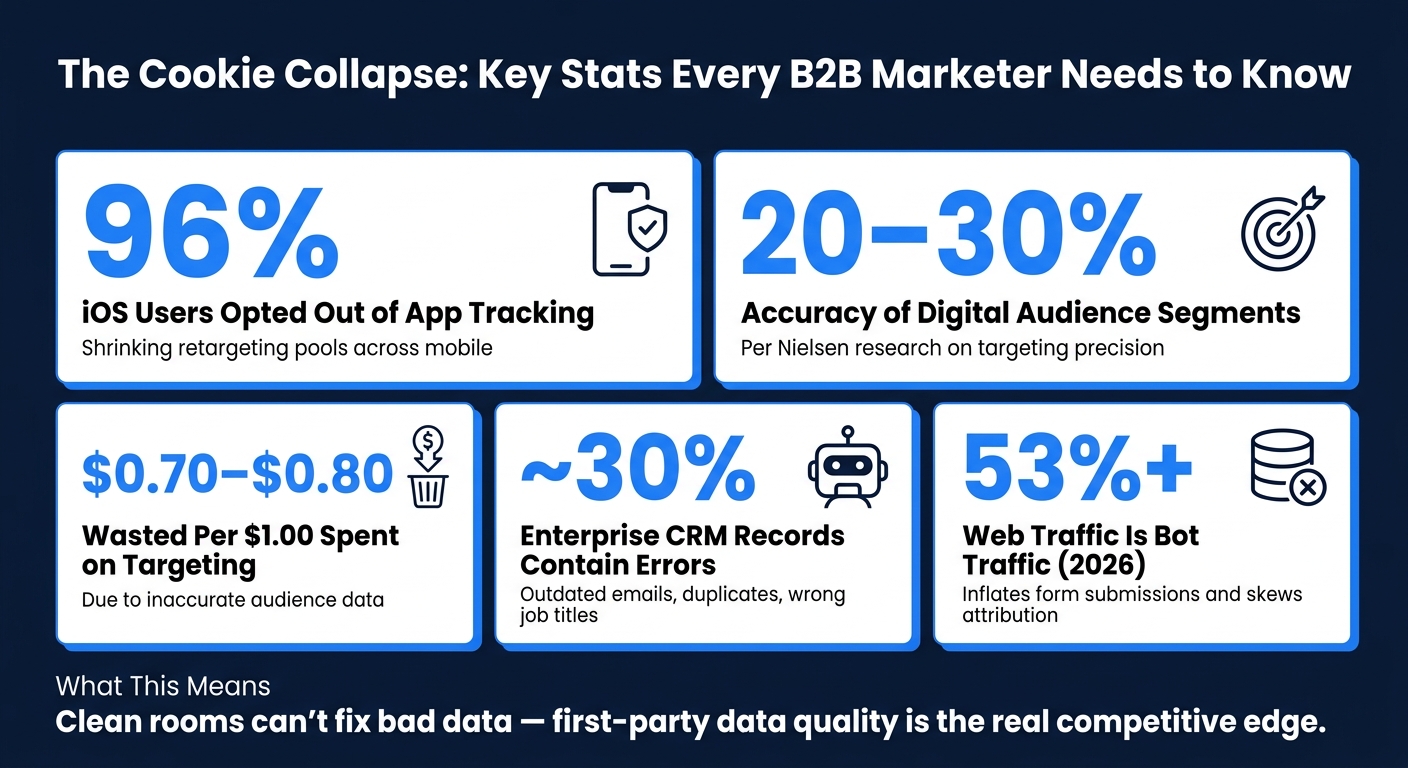
The Cookie Collapse: Key Stats Every B2B Marketer Needs to Know
Programmatic Advertising in a Privacy-First World: Solutions & Strategies
sbb-itb-5f36581
The post-cookie problems marketers need to solve
Teams can still collect leads, but they can’t reliably show which media source drove those leads or whether ad spend turned into pipeline. That’s the gap B2B and SaaS teams need to close. At a basic level, the problem comes down to two things: measurement and targeting.
Measurement breaks when conversion paths go dark
A common path looks like this: someone clicks an ad, comes back a few days later through organic search, then fills out a demo request form. In the cookie era, attribution tools could connect those touchpoints. Now, that path often disappears from view. The demo request still shows up in reporting, but the original ad may get no credit at all.
That hits B2B especially hard because the buying journey is long and rarely happens in one visit. Demo requests, webinar sign-ups, and sales-qualified lead (SQL) handoffs often stretch across many sessions, devices, and domains. So what happens? Attribution gets weaker. Pipeline reporting gets shakier. Budget calls get made with only part of the picture, and channels that drove the result can get ignored.
When attribution goes dark, marketers need a privacy-safe way to connect ad exposure to business outcomes.
Targeting and audience management lose precision
Cookie-based retargeting used to help marketers reconnect with specific visitors across the open web. That playbook doesn’t work the same way now. And when that fades, so does the ability to reach high-intent prospects at the right time.
There’s also a frequency issue. Without cross-publisher frequency capping, the same person may see the same ad again and again across different platforms, with no cross-platform control. Nielsen research found that many digital audience segments are only 20% to 30% accurate, which means $0.70 to $0.80 of every $1.00 spent on targeting is effectively wasted.
For B2B teams, that kind of waste means more spend lost and less efficient pipeline generation. That’s where clean rooms come in: they link exposure, audiences, and outcomes without sharing raw records.
How data clean rooms work
A data clean room is a controlled workspace where brands and partners can analyze data together without sharing raw records. The rule is simple: only aggregated results can leave the room.
Here’s the basic idea behind the matching process.
How data gets matched without exposing records
The main job of a clean room is secure matching without a raw-data swap. Instead of handing over customer lists, each side converts identifiers - usually email addresses, loyalty IDs, or transaction IDs - into hashed identifiers.
Those hashed values work like join keys. They let the clean room find records that show up in both datasets without revealing the original inputs.
After the match, the clean room returns aggregated outputs only. Most systems use minimum aggregation thresholds, and some add extra privacy controls to lower re-identification risk. Query limits and query logs also matter here. They record every request and help stop repeated inference attacks.
What clean rooms restore after cookies
Clean rooms bring back several things that got much harder after third-party cookies disappeared: privacy-safe attribution, reach and frequency analysis, audience overlap measurement, and incrementality testing.
That matters because these outputs deal with the two problems mentioned earlier - broken attribution and weaker targeting. Instead of tying ad exposure to one person, they connect exposure to outcomes at the cohort level.
For B2B and SaaS teams, the next move is to use these outputs to measure pipeline impact.
Where clean rooms help most for B2B and SaaS marketers
Once the matching process makes sense, the next step is simple: where does it turn into business value? For B2B and SaaS teams, clean rooms matter most when they tie media exposure to pipeline and account quality.
Connecting media exposure to qualified pipeline
The main headache for B2B lead teams is pretty simple. Ad exposure data sits inside media platforms, while lead and revenue data sit in the CRM. Without third-party cookies, there’s no dependable link between the two.
A clean room helps close that gap. When teams match hashed CRM records against platform exposure data inside the clean room, they can connect CRM data to media exposure without moving raw customer records around. The output stays aggregated, which means the clean room returns metrics like:
- Conversion rates by campaign
- Pipeline contribution
- Estimated revenue impact
That gives marketers a clearer view of which campaigns are driving qualified pipeline, not just clicks or form fills.
Audience overlap, incrementality, and partner analysis
Attribution is only part of the story. Clean rooms also help with audience overlap analysis, incrementality testing, and partner measurement.
For teams running campaigns across several platforms, overlap analysis shows where reach is duplicated. That makes it easier to control frequency across publishers and avoid wasting spend on the same audience again and again.
Incrementality testing is another strong use case. SaaS teams running always-on paid campaigns can split audiences into exposed and unexposed groups, then measure the lift between those groups. In plain English, that helps answer a hard question: did the ads drive extra results, or were those people likely to convert anyway?
The same setup works for partner measurement too. If you’re co-marketing with a technology partner or publisher, a clean room can look at audience overlap without either side handing over a raw contact list. In multi-party clean rooms, three or more partners can work together on omnichannel attribution across the full funnel.
That only works if the first-party data going into the clean room is in good shape.
Building a first-party data foundation that works with clean rooms
Once clean rooms handle collaboration, the next problem is the data going in. Clean rooms only do their job when the input data is accurate, standardized, and backed by consent. If first-party data is messy, incomplete, or poorly governed, match rates drop and reporting gets shaky.
Why lead capture quality matters before data enters a clean room
Nearly 30% of enterprise CRM records contain inaccuracies such as outdated emails, wrong job titles, and duplicate entries. On top of that, as of 2026, bot traffic makes up more than 53% of all web traffic. That can inflate fake submissions and throw off downstream analysis.
Both problems hurt clean-room matching and attribution. Bad records go in, weak analysis comes out. It's that simple.
Clean rooms still process personal data, so consent, lawful basis, and purpose limitation still apply. If a team skips that work up front, it carries compliance risk into every shared analysis it runs.
That makes lead capture the first control point, not some cleanup task after the fact.
How Reform supports cleaner first-party lead data
Clean-room performance starts at lead capture. Reform is a no-code form builder with built-in email validation, spam prevention, real-time analytics, and CRM integrations. The goal is simple: stop bad submissions before they hit the CRM.
That means fewer inaccurate records entering the data pipeline and better match rates downstream. In practice, cleaner form inputs can help teams avoid a lot of the mess that usually shows up later in reporting, attribution, and audience matching.
Conclusion: Privacy-safe measurement is now a competitive requirement
The loss of third-party cookies exposed how much measurement and targeting depended on infrastructure that was never built to last. Clean rooms help close part of that gap, but their output still depends on input quality.
Teams that invest in accurate lead capture, consistent schemas, and documented consent are more likely to get higher match rates and more dependable analysis. Teams that don't will carry the same data issues into every clean-room workflow they run.
FAQs
How is a data clean room different from a CDP or data warehouse?
A CDP or data warehouse brings your own first-party data into one place and keeps it organized for internal use, like building unified customer profiles.
A data clean room serves a different job. It’s built for privacy-safe analysis across two or more parties. Companies can match datasets without exposing raw records, then get back aggregated insights for secure measurement and targeting.
What first-party data do I need before using a clean room?
Before you use a data clean room, you need high-quality first-party data that comes straight from customers with clear consent. That usually means CRM records, email addresses, purchase history, loyalty program data, and on-site behavior.
Zero-party data can help too. This includes things like stated preferences or quiz responses.
The big thing is consistency. Your data collection methods should stay the same over time, and identifiers like email addresses and phone numbers need to be formatted correctly so matching works as expected.
How do I know if my clean room match rates are good enough?
Compare them with ground-truth conversion data. Recent industry pilots found clean room measurement can land within 4–8% of ground-truth data, versus the 25–35% underreporting that often shows up with pixel-only attribution.
That kind of result depends on clean data prep, though. Small issues can throw off matches during SHA-256 hashing, like missing country codes or extra whitespace.
Related Blog Posts
Get new content delivered straight to your inbox

The Response
Updates on the Reform platform, insights on optimizing conversion rates, and tips to craft forms that convert.

Drive real results with form optimizations
Tested across hundreds of experiments, our strategies deliver a 215% lift in qualified leads for B2B and SaaS companies.
