
.webp)
AI Lead Scoring: Sales-Marketing Alignment Guide



Most AI lead scoring problems are not model problems. They are agreement problems. If sales and marketing do not share the same rules for qualification, routing, and follow-up, the score becomes one more thing to argue about.
Here’s the short version: I’d make AI lead scoring work around four shared agreements - who fits the ICP, what each lifecycle stage means, where each score goes, and how the team reviews results. That matters because teams that are not aligned can lose 10% or more of annual revenue, while aligned teams see 24% faster revenue growth and 27% faster profit growth.
If I were setting this up, I’d focus on these points first:
- Use clean input data: CRM history, website activity, email engagement, firmographics, and form data (often improved via real-time enrichment)
- Train from enough history: about 12–24 months of data, with at least 200 closed-won and 200 closed-lost deals
- Define stages together: MQL, SAL, SQL, and Opportunity need one shared meaning
- Tie scores to action: for example, 90–100 goes to an AE in under 15 minutes
- Set SLA rules in plain terms: owner, deadline, and next step
- Track shared KPIs: conversion by score band, first-response time, follow-up compliance, win rate, deal size, and scored pipeline
- Log rep feedback: false positives, false negatives, and fixed reason codes in the CRM
- Fix intake before fixing the model: weak forms and bad data often cause weak scoring
A simple way to look at it is this:
| Area | What I’d lock down |
|---|---|
| Qualification | Shared ICP, fit rules, disqualifiers |
| Lifecycle | Clear definitions for MQL, SAL, SQL, Opportunity |
| Routing | Score bands tied to owner and deadline |
| Review | Weekly or biweekly KPI and score checks |
Bottom line: AI lead scoring helps when the score tells both teams exactly what it means, who owns it, and what happens next.
Set Shared Scoring Goals and Lifecycle Definitions
Define ICP and Qualification Criteria Together
Before anyone starts scoring leads, sales and marketing need to agree on what the ideal customer profile looks like based on closed-won deals, not gut feel.
That means standardizing fields like job titles, employee ranges, industry values, and country codes so they connect directly to qualification rules. If one team says "VP Marketing" and the other logs "Vice President of Marketing", things get messy fast.
Both teams also need to work from the same lifecycle model. If marketing calls someone an MQL but sales treats that lead like an early-stage contact, handoffs will break down.
A simple split works best:
- The CRM should own accounts, contacts, and stage progression
- Marketing automation should own engagement data and scoring
Map AI Scores to MQL, SAL, SQL, and Opportunity Stages
Once the ICP is locked in, connect AI scores to lifecycle stages so everyone uses the same language.
Each stage should have:
- a clear owner
- an entry rule
- required fields
- a plain definition of what "qualified" means at that point
| Lifecycle Stage | Primary Owner | Entry Criteria | Required Fields | Qualification Evidence |
|---|---|---|---|---|
| MQL | Marketing | Score threshold met | Industry, Role, Email | Intent signals like content downloads |
| SAL | Sales / SDR | Threshold met; assigned for review | Company Size, Revenue | Initial fit check against ICP |
| SQL | Sales | Accepted after discovery | Buying Authority, Budget | Confirmed pain point and timeline |
| Opportunity | Sales | High conversion probability | Product Fit | Formal proposal or demo scheduled |
This matters because a score on its own doesn't mean much. A lead score needs to trigger a shared next step, not just sit in a dashboard.
Use Historical Data to Validate Score Thresholds
A threshold is only useful if it lines up with deal outcomes.
Look at historical closed-won and closed-lost records. Then compare the AI score at handoff with the final result of the deal. That gives you a much better read on where the cutoff should be based on actual conversion rates, not guesswork.
A practical way to test this is to run a new inbound lead through the full process:
- MQL
- routing
- handoff
- opportunity creation
Then check that the data lands in the right place at each step.
After that, spell out exactly who gets each lead and how fast they need to respond.
sbb-itb-5f36581
HubSpot Lead Scoring Explained: Setup, Thresholds, and Sales Handoff
Build Handoff Rules, Routing Logic, and SLAs
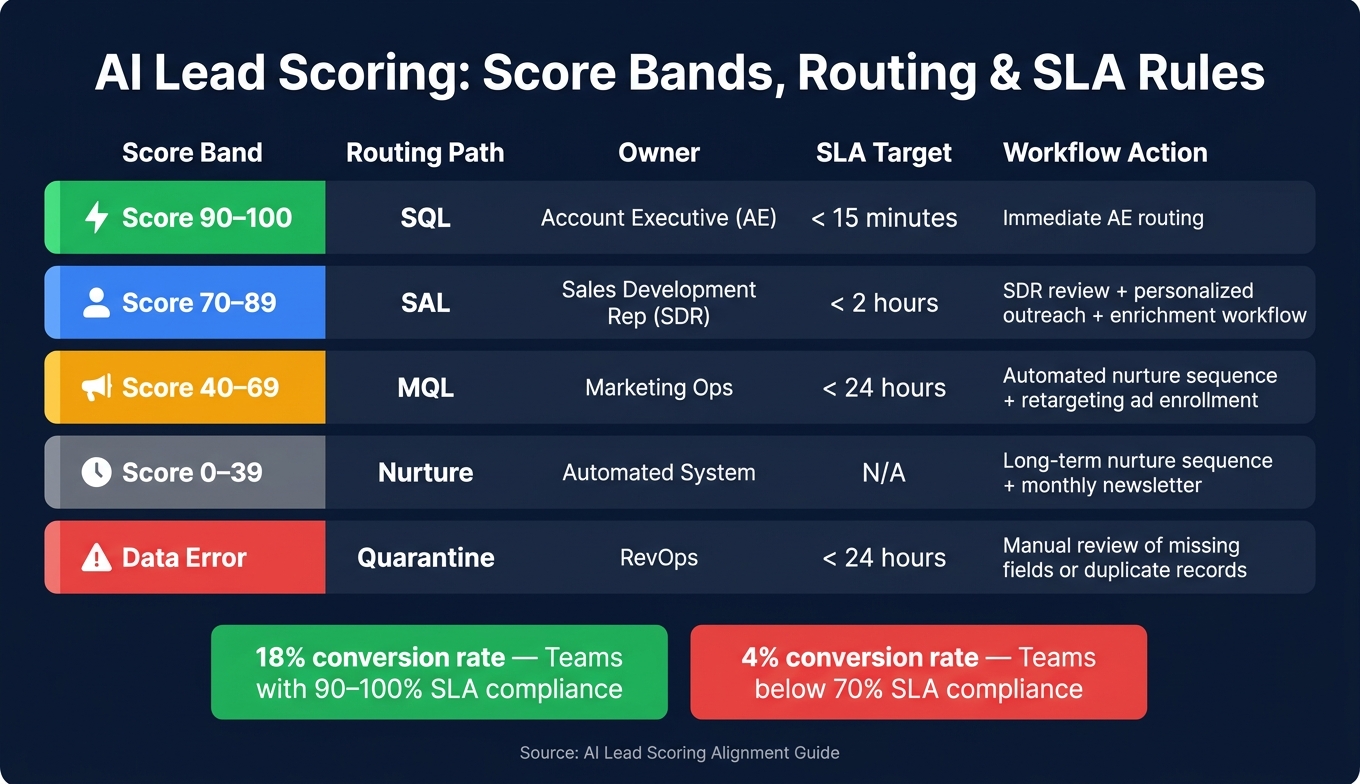
AI Lead Scoring: Score Bands, Routing Rules & SLA Targets
Tie Score Thresholds to Routing and Next Actions
Use the lifecycle definitions from the previous section to turn each threshold into a routing rule. Once score bands are validated, each one should trigger a clear next step. In plain English: a score should decide who owns the lead, how fast they need to act, and what happens next.
Different score bands should send leads down different paths. A lead scoring 90–100 should reach an Account Executive within 15 minutes. A 40–69 score should stay in nurture until new intent signals appear. The routing logic makes that call on its own, so nobody has to dig through a queue by hand.
That cuts down on lag and stops duplicate ownership. When routing rules are spelled out, high-priority leads don't sit unassigned, and the same lead doesn't get picked up by both an SDR and an AE at the same time. Each routing path should line up with the MQL, SAL, SQL, and Opportunity stages both teams agreed on.
| Score Band | Routing Path | Owner | SLA Target | Workflow Action |
|---|---|---|---|---|
| 90–100 | SQL | Account Executive (AE) | < 15 minutes | Immediate AE routing |
| 70–89 | SAL | Sales Development Rep (SDR) | < 2 hours | SDR review; personalized outreach; enrichment workflow |
| 40–69 | MQL | Marketing Ops | < 24 hours | Automated nurture sequence; retargeting ad enrollment |
| 0–39 | Nurture | Automated System | N/A | Long-term nurture sequence; monthly newsletter |
| Data Error | Quarantine | RevOps | < 24 hours | Manual review of missing fields or duplicate record |
Leads that fail key data checks - missing fields, invalid email addresses, or a duplicate record - should go to a quarantine queue for RevOps review instead of landing in a sales rep's inbox.
Set Sales Response SLAs in Measurable Terms
Once routing is in place, the next step is speed. How fast does each team need to move? An SLA should name the owner, the deadline, and the action. “First contact within 15 minutes for leads scoring 90–100” is an SLA. “Respond quickly” isn't.
Clear SLAs turn trust in the score into day-to-day action. RevOps sets the rules. Sales Ops handles exceptions and reassignment.
Use High-Converting Lead Forms and Integrations to Improve Handoff Quality
If a lead comes in with missing fields, an invalid email address, or a duplicate record, the score will be wrong and the routing will be wrong too. That's the domino effect you want to avoid.
Reform supports conditional routing, email validation, spam prevention, and CRM integrations, so cleaner data reaches your routing rules from the start. Enriched form data flows straight into the CRM fields your handoff rules rely on, giving sales the context they need to act without chasing extra details.
The goal is a clean handoff: clear ownership, clean data, and fast action. These routing rules then become the baseline for the weekly performance review.
Run a Review Cadence Around KPIs and Model Performance
Use a Weekly or Biweekly Alignment Meeting Format
Once routing and SLAs are live, check whether scores still line up with conversion behavior. The point here isn't to read dashboards out loud. It's to catch drift early and make sure score bands still reflect how buyers act in the field.
Set up a 30- to 60-minute weekly or biweekly meeting with sales, marketing, and ops. Review score changes, conversion by band, SLA misses, and rep feedback. Every meeting should end with one decision, one owner, and one metric to watch in the next cycle.
Track the KPIs Both Teams Are Accountable For
Shared metrics cut down on blame-shifting. When sales and marketing own the same numbers, the conversation changes. Instead of arguing about lead quality, the team can focus on what's dragging down a given score band.
| KPI | What It Tells You | Primary Accountability |
|---|---|---|
| MQL-to-SQL Conversion by Score Band | Whether higher scores actually produce better-qualified leads | Marketing & Sales |
| Speed to First Contact | Whether sales is acting on high-priority leads fast enough | Sales |
| Sales Follow-Up Compliance | Whether reps are following the agreed SLA and prioritization rules | Sales |
| Win Rate by Score Tier | Whether the model's predictions hold up through close | Joint |
| Average Deal Size (USD) | Whether AI is prioritizing high-value, ICP-aligned accounts | Joint |
| AI-Scored Pipeline and Revenue | The downstream pipeline value and revenue impact of the scoring system | Joint |
These KPIs help you diagnose different problems fast.
- If high-scored leads convert to SQL at a strong rate but average deal size stays flat, the model may be picking up intent without screening for account value.
- If conversion is weak even with fast follow-up, the threshold may be too loose.
Each KPI points to a different fix. When the numbers move in opposite directions, dig into whether the problem is fit, trust, or follow-up ownership.
Create a Feedback Loop for Score Tuning
Sales feedback is one of the most ignored inputs in scoring systems. Reps usually know within minutes whether a lead is a fit, but that call often never makes it back into the model. A structured feedback loop fixes that.
Sales should log false positives - high-scoring leads that were unqualified - and false negatives - low-scoring leads that converted - directly in the CRM. Use standardized reason codes such as wrong company size, wrong buying role, no budget, poor timing, or duplicate record. Notes like bad lead are too fuzzy to help. Clear reason codes are much more useful because they point to feature gaps or cutoff errors that marketing and operations can fix.
On the ops side, review feature quality first, then threshold calibration, and then data gaps. Drift often shows up first as a quiet drop in SAL acceptance rates before it turns into a clear pipeline problem. Catch it at that stage, and you may only need a threshold change instead of a full model rebuild.
Use KPI movement to decide whether to change thresholds, feature weights, routing, or ICP definitions.
When the model and reps still disagree after tuning, the issue is often team conflict rather than the model itself.
Resolve Common Sales-Marketing Conflicts and Build an Action Plan
Fix Disputes Over Lead Quality, Model Trust, and Follow-Up Responsibility
When score reviews keep turning tense, the root cause is usually the process, not the model itself. Most lead scoring fights come down to three things: poor lead quality, weak trust in the score, and slow follow-up.
Lead quality disputes show up when marketing and sales are aiming at different targets. Marketing may push for MQL volume, while sales cares about deal fit and buying intent. The fix is simple on paper, but it needs joint buy-in: create one shared qualification rubric before launch. That rubric should spell out firmographic fit, role, intent signals, and disqualifiers like students, vendors, and competitors.
If that rubric exists and reps still push back, the issue is usually visibility. Model trust falls apart when a rep sees a high score on an obvious mismatch and has no clue how the number was reached. Put the main score drivers inside the CRM so reps can see the top 3–5 factors behind each score. Then test the system with a 4- to 6-week pilot in one segment before rolling it out across the board. That kind of trust gap is common: only 30% of sales professionals say their teams are closely aligned.
Even when the score is trusted, poor follow-up can still sink results. Missed SLAs are the third trouble spot. Treat SLA misses like process breakdowns, not one-off mistakes. Auto-reassign leads when the response window passes, and escalate repeat misses to managers. The gap here is huge: teams with 90% to 100% SLA compliance convert at 18%, while teams under 70% compliance convert at just 4%.
Improve Form Capture to Reduce Low-Quality MQLs
If weak leads keep getting into the system, fix intake before you touch the model. A form that asks only for a name and email gives the AI very little to work with. At that point, the model leans too hard on shallow behavior signals, and scores get shaky. Sales then gets leads with no company size, no role, and no buying intent, which means reps have to stop and do manual research before they can even qualify them.
The better move is to redesign forms around the fields your scoring model needs. Multi-step forms help by starting with low-friction questions, then asking deeper qualifying questions like budget range, use case, and timeline once the user is already engaged. Conditional logic keeps the form relevant instead of dumping the same questions on everyone. An enterprise buyer might see questions about seat count and integrations. A small business lead might see a much simpler set of usage questions.
You should also use lead enrichment to append firmographic data from an email domain, which cuts down on manual entry. And email validation and spam prevention help keep fake submissions out of your training data.
Reform supports multi-step forms, conditional routing, lead enrichment, spam prevention, and email validation. That gives your model better data from the start. Better intake usually leads to better scoring, and that tends to quiet the low-quality MQL debate fast.
Conclusion: The 4 Agreements That Make AI Lead Scoring Work
These four agreements turn team alignment into day-to-day rules. Every conflict in this guide points back to one of them. Once both teams write them down and treat them as shared operating rules, repeat friction tends to drop.
| Agreement | Meaning | Missing | Fix |
|---|---|---|---|
| Shared qualification criteria | A documented ICP and rubric co-created by both teams; minimum thresholds for MQL status | High MQL volume, low MQL-to-SQL conversion; frequent bad-lead complaints | Run a rubric workshop, redesign intake forms, adjust AI features toward fit signals |
| Clear lifecycle stage definitions | Measurable definitions for MQL, SAL, SQL, and Opportunity with CRM fields enforcing each state | Reps create opportunities from raw leads; confusion over SAL vs. SQL | Document each stage, run training, add dashboard filters that expose stage misuse |
| Explicit handoff and SLA rules | Documented response times and ownership by score band for inbound, outbound, and recycled leads | Leads sit untouched for days; low contact rates on high-score leads | Enforce SLAs in routing logic, surface breaches in dashboards, adjust capacity or thresholds |
| Recurring KPI and model reviews | Scheduled alignment meetings with shared dashboards showing conversion by score band, campaign, and rep | Declining predictive power; rising conflict volume; reps building separate scoring systems | Recalibrate the model, refresh training data, adjust thresholds, refine intake forms |
The payoff is hard to ignore. Aligned teams are 2x more likely to report high-quality leads - 39% vs. 18% - than teams working from separate playbooks. Put these four agreements in writing, assign one owner to each, and review them every quarter as your ICP and market change.
FAQs
How do we start AI lead scoring if our data is messy?
Start by cleaning and standardizing the data the AI will learn from. Remove duplicates, fix errors, and standardize free-text fields like job titles and industries so records don’t get split across slightly different entries.
Next, verify the key fields and fill in incomplete records where you can. Then label historical leads as converted or not converted, review CRM outcomes and field mapping, and only after that set your scoring and routing rules.
Plan for 4–6 weeks of data cleanup before training.
How often should sales and marketing review lead score performance?
Review lead score performance on three cadences:
- Bi-weekly pipeline reviews to get sales feedback on lead quality
- Monthly reviews to spot score drift early
- Quarterly meetings to adjust scoring logic and thresholds
In fast-changing markets, switch to monthly audits and keep an eye on dashboards and alerts between meetings.
What should we do if sales does not trust the lead scores?
Start with transparency. Show the top factors behind each score - such as job title or recent web behavior - so sales can see the logic.
Then audit CRM data quality, track false positives, and require reps to log rejection reasons. Review those patterns in monthly or quarterly meetings to reset thresholds or retrain the model. Also make sure score bands line up with sales capacity and team agreements.
Related Blog Posts
Get new content delivered straight to your inbox

The Response
Updates on the Reform platform, insights on optimizing conversion rates, and tips to craft forms that convert.



Drive real results with form optimizations
Tested across hundreds of experiments, our strategies deliver a 215% lift in qualified leads for B2B and SaaS companies.
