
.webp)
How Behavioral Analytics Stops Spam Submissions



Behavioral analytics is transforming how multi-step forms tackle spam. Instead of relying on outdated methods like CAPTCHAs or IP blocking, this approach focuses on how users interact with forms - tracking mouse movements, typing patterns, and navigation behavior. Bots, no matter how advanced, struggle to mimic these subtle human actions. The result? Over 90% spam reduction for businesses using these tools.
Key takeaways:
- Traditional methods fail: Modern bots bypass CAPTCHAs, proxies, and keyword filters with ease.
- Behavioral signals matter: Bots often fill forms instantly or follow rigid patterns, unlike humans who show natural pauses, typos, and irregular mouse movements.
- AI-powered detection: Risk scores analyze user behavior invisibly, ensuring security without frustrating real users.
- Business impact: Cleaner data, fewer fake leads, and better productivity for sales teams.
Behavioral analytics offers a smarter, invisible way to secure forms and protect your pipeline without disrupting genuine users.
Why Traditional Spam Prevention Falls Short
For years, tools like CAPTCHAs, IP blacklists, and keyword filters were enough to fend off spam bots submitting generic entries. But things have changed. Modern bots are no longer basic scripts - they’re advanced systems designed to behave like humans. This evolution has rendered many traditional defenses almost useless.
Take this for example: AI models can now solve reCAPTCHA v2 with a staggering 99.8% accuracy, and bots can fill out ten-field forms in just 3 seconds. On top of that, bots now make up over 25% of all web traffic on high-traffic commercial sites. CAPTCHA farms, which solve these puzzles using human labor, charge as little as $0.50 for 1,000 solves. It’s clear that older methods just can’t keep up.
How Spam Bots Have Evolved
Today’s bots don’t just submit data - they mimic human behavior. They replicate typing patterns, pauses, scrolling, and even mouse movements like hovering or curved motions. Some even make intentional typos to appear more authentic. Using tools like Playwright or Puppeteer, bots can simulate legitimate browser fingerprints.
IP blocking? It’s becoming almost useless. Attackers now rotate through thousands of residential proxies, making it hard to pinpoint their origin. Geographic restrictions don’t help much either since bots can switch locations in seconds.
Advanced bots also employ "low-and-slow" strategies. Instead of flooding forms with submissions, they submit just a few entries per hour, staying under the radar of volume-based alerts. And with AI-generated text, they craft responses that sound contextually appropriate, easily bypassing keyword filters.
Interestingly, even the measures designed to stop bots can end up frustrating genuine users.
Problems with Basic Security Measures
The irony of traditional spam prevention is that it often inconveniences real users while failing to stop advanced bots. For instance, CAPTCHAs can reduce conversion rates by up to 12% and add an extra 10 seconds to each form submission. That’s a potential loss of leads for businesses.
Honeypot fields, once effective against simple bots, are now easily identified by advanced scripts that analyze CSS and visual rendering to spot hidden traps. Email validation, while helpful in catching fake addresses, struggles against bots that use temporary email services with valid MX records - or worse, hijacked legitimate accounts.
"Ignoring hidden bots is like leaving your form open to fraud. The damage is silent but severe." – Clearout
The core issue is that traditional methods focus on what data is submitted rather than how it’s submitted. Modern bots can flawlessly fill out forms, solve puzzles, and rotate through clean IP addresses. But their interaction patterns - mechanical and unnatural - still set them apart from real users. This gap is why behavioral analytics is emerging as a critical tool in the fight against spam.
sbb-itb-5f36581
How Behavioral Analytics Detects Spam
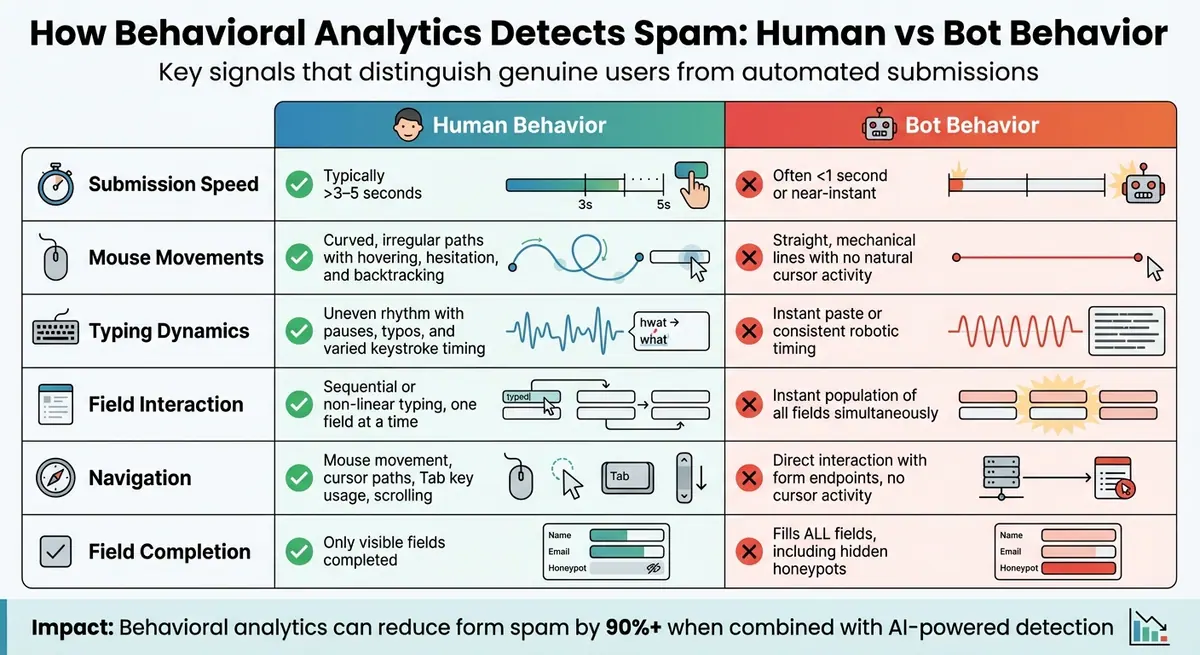
Human vs Bot Form Behavior: Key Detection Signals
Behavioral analytics focuses on how users interact with optimized conversion paths, instead of just analyzing the data they input. Here's the key distinction: bots process the raw HTML, while humans engage with the visual layout.
Human users exhibit natural behaviors - moving their mouse, reading labels, navigating between fields, and typing at an uneven pace. Bots, on the other hand, tend to populate fields instantly or follow a rigid, top-to-bottom pattern through the DOM structure. Submissions completed in under 200 milliseconds are a clear sign of automation.
Behind the scenes, systems assign a risk score ranging from 0.0 (likely a bot) to 1.0 (likely a human). This scoring happens invisibly, analyzing dozens of behavioral signals without interrupting the user experience.
Key Behavioral Signals to Track
Behavioral analytics evaluates specific interaction patterns to distinguish humans from bots. For example:
- Mouse movements: Human cursor paths are curved and irregular, while bots often move in straight, mechanical lines. Humans hover, hesitate, and backtrack - behaviors bots typically lack.
- Typing dynamics: According to Clearout.io, "A real person's typing rhythm is never perfectly uniform". Humans pause, make typos, and vary their keystroke timing. Bots either paste values instantly or type with consistent, robotic timing. Systems also detect whether values are entered through natural typing, browser autofill, or instant population, as each method leaves a unique trace.
- Navigation sequences: Humans might click fields out of order, use the Tab key to move between them, or trigger natural browser events like scrolling or focusing. Bots, in contrast, often skip these interactions, completing forms while remaining static on the page. They may also fill every field simultaneously, including hidden honeypots designed to catch automated submissions.
- Dwell time: The time a user spends on a page before submitting is another critical signal. For short forms, human completion typically takes 3–5 seconds. Faster submissions are suspicious. However, advanced bots have adapted by delaying submissions to mimic human reading time, which makes timing just one piece of the puzzle.
| Signal Category | Human Behavior | Bot Behavior |
|---|---|---|
| Submission Speed | Typically >3–5 seconds | Often <1 second or near-instant |
| Field Interaction | Sequential or non-linear typing | Instant population of all fields |
| Navigation | Mouse movement and cursor paths | Direct interaction with form endpoints |
| Field Completion | Only visible fields completed | Fills all fields, including honeypots |
These signals, when combined, create a detailed behavioral profile that helps systems identify spam submissions.
AI-Powered Anomaly Detection
Behavioral signals are just the starting point. AI takes things further by synthesizing these behaviors to determine if a submission is genuine. Unlike rule-based systems that rely on fixed criteria (e.g., rejecting submissions under 2 seconds), AI uses probabilistic modeling to evaluate the overall likelihood of legitimacy.
Context is everything. For instance, a 4-second form submission might be legitimate if the user’s mouse movements and autofill usage align with human behavior. But the same 4-second submission with no cursor activity and uniform field population? That’s likely a bot. AI examines the intent and coherence of submissions instead of just flagging isolated anomalies.
Risk scores play a big role here. Businesses often adopt a tiered system:
- Automatically accept submissions with scores above 0.7
- Reject those scoring below 0.3
- Send mid-range scores for manual review
This approach balances security with user convenience.
What sets AI apart is its ability to learn over time. These systems improve as they process more data, adapting to the specific patterns of your forms and industry. With consistent training on confirmed spam and legitimate submissions, AI becomes increasingly accurate. Combined with other defenses, behavioral analytics can cut form spam by 90% or more.
"The only effective strategy in 2026 is behavior-based detection, watching how users interact, not just what they submit." – Clearout.io
How to Use Behavioral Analytics for Form Security
Protect your forms by monitoring user actions discreetly, ensuring security without interfering with the user experience. These methods work seamlessly with previously discussed analytics to strengthen form defenses.
Mouse Movement and Click Pattern Analysis
Track how users move their mouse from the moment the page loads. Human users naturally create curved, uneven cursor paths, hover over form labels, and sometimes backtrack. By observing events like scrolling, focusing on fields, and moving between them, you can calculate a "humanity score." Submissions that lack these natural interactions or cursor activity can be flagged as suspicious. This method boosts form security while keeping the process user-friendly.
Timestamp Validation for Submission Speed
Take submission timing into account by setting a minimum threshold - around 5 seconds for simple forms. Use JavaScript to record the form's start time and calculate the total completion time when the form is submitted. This data, stored in a hidden field, can be validated server-side. To differentiate between bots and real users, monitor interactions like scrolling or mouse movements during the completion period. Be aware that some advanced bots mimic human behavior by delaying submissions. Always validate timestamps on the server to prevent tampering. This technique strengthens security without disrupting the user experience.
Combining Behavioral Analytics with Other Security Tools
To create a stronger defense, combine behavioral analytics with other security measures. Use tools like honeypot fields to trap bots and email validation systems to verify contact information. In high-risk situations, invisible challenges such as Cloudflare Turnstile analyze browser behavior and network activity without affecting the user's journey. Platforms like Reform integrate these layers, offering features like behavioral tracking, email validation, and spam prevention. This layered approach is crucial, as bots can account for 30% to 60% of fake "leads" captured by forms. By applying these strategies, you can move toward behavior-based detection, reinforcing form security while keeping the process smooth for real users.
Business Benefits of Behavioral Analytics
Behavioral analytics transforms form security into a tool for growth. By automatically filtering out spam, it protects your sales pipeline and keeps your CRM data clean. This allows your team to focus on real leads, boosting productivity, improving data accuracy, and driving revenue. Beyond securing forms, this smarter detection method delivers measurable business benefits.
Less Manual Review Work
Automated behavioral detection takes the grunt work out of spam management. Your sales team no longer wastes time chasing fake leads - like dialing numbers that don’t work or emailing addresses that bounce back. This saves time and ramps up productivity. For businesses handling high submission volumes, relying on manual reviews just isn’t practical. AI-powered detection scales effortlessly to meet these demands.
"Every spam submission that hits your forms isn't just annoying - it's actively sabotaging your lead generation efforts." - Orbit
Clean data also ensures accurate marketing attribution. Instead of cluttering your CRM with fake entries, behavioral analytics focuses on weeding out even the more advanced bots that slip past basic filters. By blocking invalid email addresses in real time, it also protects your sender reputation, ensuring your legitimate emails land where they should.
Better User Experience
Unlike CAPTCHAs, which can frustrate users, behavioral analytics operates quietly in the background. It evaluates natural user interactions and assigns risk scores without disrupting the experience. This seamless approach not only enhances security but also keeps the user journey smooth, helping maintain conversion rates.
"Spam prevention should be about detecting bots, not proving that the user is human." - Dónal Boyle
Behavioral data can also point out problem areas, like form fields with high abandonment rates. Fixing these issues can streamline the user experience and improve lead generation. By combining frictionless security with actionable insights, behavioral analytics becomes a key tool for businesses focused on boosting conversions and revenue.
Conclusion
Behavioral analytics has become a game-changer for modern form security. By analyzing mouse movements, click patterns, and typing rhythms, it can distinguish between genuine users and bots without interfering with the user experience. This means your forms stay protected while maintaining strong conversion rates.
A multi-layered defense system - combining behavioral signals, honeypot fields, and real-time validation - adds an extra shield against both simple and complex bot attacks. Risk scoring systems further refine this process by evaluating user legitimacy, allowing businesses to set thresholds tailored to the importance of each form. This directly addresses the weaknesses of older, less sophisticated defenses.
But the benefits go beyond just security. Cleaner data leads to more accurate attribution and helps teams work more efficiently. Together, these advantages not only secure your forms but also enhance your overall lead generation strategy.
For those ready to implement these strategies, tools like Reform make it easy. Reform offers built-in spam prevention and email validation, all within a form builder designed to boost conversions. With a free version that includes unlimited forms and AI-driven insights, it’s a practical way to improve lead quality while keeping spam under control.
Start with your most critical forms - like demo requests or consultation bookings - and expand from there. This step-by-step approach aligns perfectly with the layered defense model, ensuring your forms stay secure and your pipeline remains clean.
FAQs
What behavior signals are most reliable for spotting form bots?
Detecting bots on forms often comes down to spotting unusual behavior. For instance, bots might show unnatural typing patterns, such as typing too quickly or inconsistently. Their scrolling behavior can also stand out, as it may not mimic how a real user would browse a page. Another clue? The timing of pauses before submission - bots often skip or rush through this step unnaturally.
Even though advanced bots aim to imitate human actions, behavioral analytics can pick up on subtle inconsistencies. These tools analyze user actions in detail, making it easier to separate bots from genuine users. By leveraging these insights, you can improve form security and cut down on spam submissions.
Will behavioral tracking block real users who use autofill or accessibility tools?
Behavioral tracking, when implemented with care, doesn't inherently block real users who depend on autofill features or accessibility tools. By focusing on clear communication and giving users control over their experience, these systems can work seamlessly without negatively affecting genuine users.
How do I set risk-score thresholds for accept, review, or reject?
To fine-tune your form security, behavior analysis tools can assign risk scores to incoming submissions. These scores allow you to set thresholds and define specific actions based on the level of risk:
- Low-risk submissions: Automatically accept these to ensure a smooth user experience.
- Moderate-risk submissions: Mark these for manual review to verify their legitimacy.
- High-risk submissions: Reject or flag these to prevent potential spam or abuse.
By implementing this approach, you can maintain a balance between strong security measures and a seamless experience for legitimate users.
Related Blog Posts
Get new content delivered straight to your inbox

The Response
Updates on the Reform platform, insights on optimizing conversion rates, and tips to craft forms that convert.



Drive real results with form optimizations
Tested across hundreds of experiments, our strategies deliver a 215% lift in qualified leads for B2B and SaaS companies.
